
Compact digital piano keyboards range from toy-like 32-key practice boards to fully weighted 88-note instruments that fold in half — and the biggest mistake buyers make is confusing the two. For a genuine piano experience in a small footprint, the Yamaha P145BT stands out as my best overall pick, combining a real weighted action, Bluetooth, and onboard speakers in a slim cabinet. If budget leads your decision, the Yamaha P71 delivers the same 88 weighted keys for less, while the Ktaxon Foldable wins on pure portability thanks to its folding frame. The main tradeoffs in this category come down to key count versus portability, and weighted action versus price. Read on for the full breakdown of all 15 models.

Get audio and creator gear delivered free with Prime
- Fast, free delivery on millions of items
- Prime Video, Amazon Music and more included
- Member-only deals all year
Complete the kit

Key Takeaways
- Only five of the fifteen models (Yamaha P145BT, P71, Roland FP-10, and the two NikoMaku SWAN-S variants) offer 88 keys — everything else in the lineup trades key count for a smaller, cheaper form factor.
- The Roland FP-10 and Yamaha P145BT were the only models whose key actions approach an acoustic piano feel; semi-weighted boards like the Vediya and NikoMaku SWAN-S feel noticeably springier under the fingers.
- Bundle kits (RockJam RJ5061, Alesis Melody 61 MK4) include stands, benches, and headphones that buyers would otherwise purchase separately — but the keyboards inside them are unweighted and best seen as starter instruments, not long-term instruments.
- Foldable designs (Ktaxon, Rhymo FP61A) solve the storage-and-transport problem better than any rigid board, but both sacrifice key feel and speaker quality to get there.
- Sub-49-key boards like the Casio SA-51 and SA-81 are genuinely useful only for young children or travel sketching — they cannot teach proper two-hand technique because there aren’t enough keys.
| MIZAYI 61-Key Portable Electronic Keyboard with Microphone |  | Best Budget Pick for Kids | Keys: 61 | Tones / Rhythms: 100 tones, 100 rhythms | Demo songs: 10 | VIEW LATEST PRICE | See Our Full Breakdown |
| Ktaxon Foldable 88-Key Electronic Keyboard Piano, Black |  | Best for Travel and Storage | Keys: 88 semi-weighted | Foldable: Yes, folds 180° | Weight (folded): 5.1 lb | VIEW LATEST PRICE | See Our Full Breakdown |
| Roland FP-10 Compact 88-Note Digital Piano |  | Best Overall Sound and Feel | Keys: 88 weighted | Sound engine: Roland SuperNATURAL Piano | Connectivity: MIDI / USB MIDI | VIEW LATEST PRICE | See Our Full Breakdown |
| Alesis Melody 61 MK4 61-Key Keyboard |  | Best Value Beginner Bundle | Keys: 61 | Sounds / Rhythms: 300 sounds, 300 accompaniment rhythms | Demo songs: 30 | VIEW LATEST PRICE | See Our Full Breakdown |
| NikoMaku SWAN-S 88-Key Semi-Weighted Portable Digital Piano Set, White |  | Best Complete Starter Kit | Keys: 88 semi-weighted, touch-sensitive | Weight: 10.8 lbs | Dimensions: 48.2 × 2.5 × 8.26 in | VIEW LATEST PRICE | See Our Full Breakdown |
| Yamaha PSR-E283 61-Key Portable Keyboard for Beginners |  | Best Learning Tools for Beginners | Number of keys: 61 full-sized | Skill level: Beginner | Learning tools: Ear-training games, Smart Chord, built-in songs | VIEW LATEST PRICE | See Our Full Breakdown |
| Yamaha P145BT 88-Key Digital Piano with Weighted Keys, Bluetooth, and Built-in Speakers |  | Best Overall | Keys: 88 weighted, touch-sensitive | Key action: Graded Hammer Compact | Connectivity: Bluetooth audio, USB | VIEW LATEST PRICE | See Our Full Breakdown |
| Casio Casiotone SA-81 44-Key Portable Keyboard |  | Best Ultra-Portable Pick | Number of keys: 44 mini keys | Tones: 100 | Rhythms: 50 | VIEW LATEST PRICE | See Our Full Breakdown |
| RockJam RJ5061 61-Key Keyboard Piano Kit with Stand, Bench, and Headphones |  | Best Complete Starter Bundle | Keys: 61 | Tones: 200 | Rhythms: 200 | VIEW LATEST PRICE | See Our Full Breakdown |
| RockJam RJ361 Compact 61-Key Keyboard Piano for Beginners |  | Best Budget Compact Choice | Number of keys: 61 | Sounds: 200 | Rhythms: 200 | VIEW LATEST PRICE | See Our Full Breakdown |
| NikoMaku SWAN-S 88-Key Semi-Weighted Portable Digital Piano Set, Black |  | Best Complete Starter Bundle | Number of keys: 88 | Key type: Semi-weighted, touch-sensitive | Weight: 10.8 pounds | VIEW LATEST PRICE | See Our Full Breakdown |
| Yamaha P71 88-Key Weighted-Action Digital Piano |  | Best Piano Feel Under a Compact Footprint | Number of keys: 88 | Key action: Weighted hammer action | Voices: 10 | VIEW LATEST PRICE | See Our Full Breakdown |
| Vediya 88-Key Semi-Weighted Digital Piano with MIDI, Pedal, 800 Tones and 600 Rhythms | 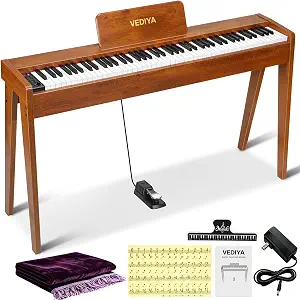 | Best Feature-Rich Flexibility | Number of keys: 88 | Key type: Touch-sensitive semi-weighted | Tones: 800 | VIEW LATEST PRICE | See Our Full Breakdown |
| Casio Casiotone SA-51 32-Key Compact Digital Keyboard |  | Best Ultra-Portable First Keyboard | Number of keys: 32 mini keys | Tones: 100 | Rhythm patterns: 50 | VIEW LATEST PRICE | See Our Full Breakdown |
| Rhymo FP61A Folding 61-Key Portable Piano Keyboard |  | Best for Travel and Commuting Musicians | Number of keys: 61 | Polyphony: 128 notes | Built-in timbres: 128 | VIEW LATEST PRICE | See Our Full Breakdown |
| compact digital piano keyboard | Connectivity | Weight | Number of keys |
|---|---|---|---|
| MIZAYI 61-Key Portable Electro | — | — | — |
| Ktaxon Foldable 88-Key Electro | Bluetooth MIDI, USB, MIDI, 3.5 mm jack | — | — |
| Roland FP-10 Compact 88-Note D | MIDI / USB MIDI | — | — |
| Alesis Melody 61 MK4 61-Key Ke | USB-MIDI, sustain pedal input, aux input, headphone output | 6.6 lbs (3 kg) | — |
| NikoMaku SWAN-S 88-Key Semi-We | USB, MIDI, 3.5 mm headphone jack | 10.8 lbs | — |
| Yamaha PSR-E283 61-Key Portabl | — | 8.8 pounds | 61 full-sized |
| Yamaha P145BT 88-Key Digital P | Bluetooth audio, USB | — | — |
| Casio Casiotone SA-81 44-Key P | — | 3.7 pounds | 44 mini keys |
| RockJam RJ5061 61-Key Keyboard | — | — | — |
| RockJam RJ361 Compact 61-Key K | — | 2.84 kg | 61 |
| NikoMaku SWAN-S 88-Key Semi-We | USB MIDI, 3.5 mm jack | 10.8 pounds | 88 |
| Yamaha P71 88-Key Weighted-Act | USB, auxiliary, sustain pedal jack, 3.5 mm headphone jack | 25 pounds | 88 |
| Vediya 88-Key Semi-Weighted Di | Bluetooth, USB-MIDI | — | 88 |
| Casio Casiotone SA-51 32-Key C | — | 2.2 pounds | 32 mini keys |
| Rhymo FP61A Folding 61-Key Por | Bluetooth MIDI, USB-C | Approximately 3.63 kg | 61 |
More Details on Our Top Picks
MIZAYI 61-Key Portable Electronic Keyboard with Microphone
The MIZAYI 61-key keyboard earns its spot as the cheapest way to give a child a first taste of playing and singing at the same time. The bundled microphone is the standout here — compared with the Alesis Melody 61 MK4, which offers far more sounds but no mic, this model leans into the sing-along, performer-in-the-living-room experience. Battery power and a slim 2.16-inch profile make it genuinely grab-and-go, more so than anything else in this lineup.
The tradeoffs are real, though. No power adapter or batteries ship in the box, so factor that in before gifting. The listed Bluetooth function is unexplained in the product details, so I wouldn’t buy it expecting wireless audio. Unweighted mini-style keys also mean this is a toy-adjacent starter, not a path to serious technique.
Pros:- Bundled microphone encourages singing while playing
- Runs on AA batteries for true portability
- Lightweight, slim body is easy for kids to carry
- Enough tones, rhythms, and demo songs to keep beginners exploring
Cons:- Power adapter and batteries are not included
- Bluetooth is listed but its function is never explained
- Unweighted keys limit long-term skill development
Best for: Parents buying an inexpensive first keyboard for young children who want to sing and play
Not ideal for: Students building real piano technique — the unweighted 61 keys won’t prepare fingers for an acoustic instrument
- Keys:61
- Tones / Rhythms:100 tones, 100 rhythms
- Demo songs:10
- Speakers:Built-in
- Extras:Microphone, LCD screen, recording and playback
- Power:DC 5V adapter or 4 AA batteries (not included)
- Dimensions:22.83 × 7.08 × 2.16 in
Our verdict“A fun, low-commitment first keyboard for kids who want to sing along, not a serious practice instrument.”
Ktaxon Foldable 88-Key Electronic Keyboard Piano, Black
Folding in half is the entire pitch of the Ktaxon 88-key, and it delivers: at 5.1 pounds folded with a padded bag included, it’s the easiest full-size keyboard here to stash under a bed or sling over a shoulder. The NikoMaku SWAN-S is also portable but doesn’t collapse and weighs twice as much with its accessories.
Semi-weighted keys put it a step above unweighted budget boards like the MIZAYI, though still short of the fully weighted feel of the Roland FP-10. Bluetooth MIDI is a genuine plus for pairing with learning apps on a phone or tablet, and the 1,000-tone library dwarfs most competitors. The main gap is unspecified battery life and power capacity — if you plan to play away from outlets regularly, that uncertainty matters.
Pros:- Folds in half and includes a padded carrying bag
- Semi-weighted 88 keys feel closer to a piano than budget boards
- Bluetooth MIDI connects to phones, tablets, and computers
- Large library of tones, rhythms, and demo songs
Cons:- 5.1 lb folded weight may still feel heavy for some users
- No stated battery life or power capacity
Best for: Apartment dwellers, travelers, and gig-curious beginners who need a full 88 keys that disappears when not in use
Not ideal for: Players who want authentic acoustic-piano key weight — semi-weighted action won’t satisfy serious students
- Keys:88 semi-weighted
- Foldable:Yes, folds 180°
- Weight (folded):5.1 lb
- Tones / Rhythms:1,000 tones, 1,000 rhythms
- Connectivity:Bluetooth MIDI, USB, MIDI, 3.5 mm jack
- Power:Plug-in or adapter charging
- Included:Padded portable bag
Our verdict“The most storage- and travel-friendly 88-key option here, as long as semi-weighted feel and vague battery specs don’t bother you.”
Roland FP-10 Compact 88-Note Digital Piano
This is the pick where playing experience beats feature count. Roland’s SuperNATURAL sound engine gives the FP-10 a depth and responsiveness that budget boards like the Ktaxon and NikoMaku SWAN-S simply can’t match — notes bloom and decay like an acoustic instrument rather than a sample playback demo. The ivory-feel weighted action is the closest thing in this roundup to a real piano under the fingers.
What you give up is breadth. No 300-sound libraries or rhythm accompaniments here; this model focuses on piano and does it properly. The compact body keeps it apartment-friendly, and Twin Piano mode splits the keyboard for student-teacher lessons — a thoughtful touch for families. Just know that the matching stand is sold separately, and the included foot switch is basic compared with a proper three-pedal unit.
Pros:- SuperNATURAL sound engine delivers expressive, acoustic-style tone
- 88 weighted keys with ivory feel for proper technique
- MIDI/USB connectivity for computers and music software
- Twin Piano mode supports side-by-side lessons
Cons:- Matching stand sold separately
- Minimal onboard sounds and no accompaniment rhythms
- Basic single foot switch instead of a full pedal set
Best for: Beginners and returning players who prioritize authentic piano touch and tone over gadget features
Not ideal for: Casual hobbyists who want rhythms, hundreds of tones, and accompaniments — this is a focused instrument, not an entertainment keyboard
- Keys:88 weighted
- Sound engine:Roland SuperNATURAL Piano
- Connectivity:MIDI / USB MIDI
- Practice features:Headphone output, Twin Piano mode
- Included:DP-2 foot switch, sheet music rest
- Stand:KSCFP10 matching stand sold separately
Our verdict“The best-sounding, best-feeling compact piano in this lineup for anyone serious about learning to play properly.”
Alesis Melody 61 MK4 61-Key Keyboard
The Alesis Melody 61 MK4 strikes the strongest value balance in this roundup: unlike the MIZAYI, it ships with a power adapter and a tablet-ready music stand, and it triples the sound library to 300 tones with 300 accompaniment rhythms. Online lesson access gives beginners a structured starting path that most sub-$100-style boards skip entirely.
Compared with the Roland FP-10, the compromise is obvious — 61 unweighted keys instead of 88 weighted ones — but for a first year of casual learning, that’s a fair exchange for the price. USB-MIDI means it can grow with a student as a controller for music software, and the 1/4-inch sustain pedal input is a nice touch at this level. The 6.6-pound body plus optional AA battery power makes it as portable as anything here.
Pros:- 300 sounds and 300 accompaniment rhythms for creative exploration
- Power adapter and music/tablet stand included in the box
- USB-MIDI and sustain pedal input support growth
- Battery power and light weight make it highly portable
Cons:- Only 61 keys limits advanced repertoire
- AA batteries not included
- Non-weighted keys won’t build acoustic-piano finger strength
Best for: Teens and adult beginners who want a well-equipped first keyboard with lessons included
Not ideal for: Players who know they’ll stick with piano long-term — the 61-key limit will eventually force an upgrade
- Keys:61
- Sounds / Rhythms:300 sounds, 300 accompaniment rhythms
- Demo songs:30
- Weight:6.6 lbs (3 kg)
- Power:Adapter (included) or 6 AA batteries (not included)
- Connectivity:USB-MIDI, sustain pedal input, aux input, headphone output
- Included:Music/tablet stand, power adapter, online lessons
Our verdict“The smartest starter package for a committed beginner who wants lessons, sounds, and accessories without paying for weighted keys.”
NikoMaku SWAN-S 88-Key Semi-Weighted Portable Digital Piano Set, White
If you want to unbox a full home setup in one purchase, the NikoMaku SWAN-S is the most complete package here: stand, sustain pedal, headphones, carrying case, music rest, and note stickers all ship together. The RockJam RJ5061 bundles similar accessories but only offers 61 unweighted keys; the SWAN-S gives you the full 88 with touch-sensitive semi-weighted action for dynamic playing.
Against the Roland FP-10, the gap is sound quality and key realism — the DREAM sound source is serviceable but not expressive at Roland’s level. Still, for a first-year student, having everything included removes friction, and battery power plus the carrying case make it viable for moving between rooms or homes. The white finish is a stylistic choice that not every buyer will want, and battery management adds a chore the Roland avoids.
Pros:- Complete kit: stand, pedal, headphones, case, and note stickers included
- Full 88 touch-sensitive semi-weighted keys
- Battery power and carrying case enable easy relocation
- MIDI and USB connectivity plus 128 tones and rhythms
Cons:- Semi-weighted keys feel unlike a fully weighted acoustic piano
- Battery-powered design requires charging management
- Divided white colorway may not suit every decor
Best for: First-time piano students who want a complete, ready-to-play home setup out of one box
Not ideal for: Players focused on authentic touch — the semi-weighted keys fall well short of the Roland FP-10’s graded action
- Keys:88 semi-weighted, touch-sensitive
- Weight:10.8 lbs
- Dimensions:48.2 × 2.5 × 8.26 in
- Tones / Rhythms:128 tones, 128 rhythms
- Connectivity:USB, MIDI, 3.5 mm headphone jack
- Power:Battery powered
- Included:Double-X stand, carrying case, music rest, sustain pedal, headphones, note stickers
- Color:White
Our verdict“The easiest one-box entry into 88-key playing for a new student, trading sound realism for sheer completeness.”
Yamaha PSR-E283 61-Key Portable Keyboard for Beginners
This option stands out for its structured learning features rather than raw sound quality. The ear-training games and Smart Chord function give new players a guided path that most budget keyboards in this roundup, like the RockJam RJ361, simply don’t offer — RJ361 bundles third-party lessons, but the PSR-E283 builds the training into the instrument itself. Full-sized keys matter here too: compared with the Casio Casiotone SA-81’s mini keys, developing proper finger technique on this Yamaha feels far more natural. The Portable Grand button is a thoughtful shortcut for beginners who want a decent piano tone without menu-diving.
The tradeoff is that this is an unweighted keyboard — anyone serious about classical technique should look at the Yamaha P145BT instead, whose Graded Hammer Compact action is in a different league.
Pros:- Full-sized keys support proper finger technique from day one
- Built-in ear-training games and Smart Chord teach musicality, not just notes
- Portable Grand button gives one-touch access to a respectable piano voice
- Battery power makes it genuinely portable for travel and outdoor use
Cons:- Unweighted, non-graded key action limits long-term technique development
- 61 keys won’t accommodate repertoire written for the full 88-key range
- Built-in speakers are modest and lack depth for piano tones
Best for: First-time players and children who want guided, game-based learning on a portable instrument
Not ideal for: Students aiming to transition to acoustic piano — the unweighted keys won’t build proper touch strength
- Number of keys:61 full-sized
- Skill level:Beginner
- Learning tools:Ear-training games, Smart Chord, built-in songs
- Headphone jack:6.35 mm
- Power source:AC adapter or batteries
- Weight:8.8 pounds
- Dimensions:12.5 x 37 x 4.1 inches
- Compatible software:Flowkey
Our verdict“This pick makes the most sense for absolute beginners who want a keyboard that actively teaches, rather than one they’ll outgrow skills-wise but keep for fun.”
Yamaha P145BT 88-Key Digital Piano with Weighted Keys, Bluetooth, and Built-in Speakers
Of everything in this roundup, this model best fulfills the compact-digital-piano promise: 88 fully weighted keys with Graded Hammer Compact action in a slim chassis you can actually move. Compared with the Roland FP-10, another compact weighted option, the P145BT adds Bluetooth audio streaming, letting players practice along with tracks wirelessly — a real workflow advantage for modern learners. Its premium grand piano sampling with natural resonance sounds more convincing than any 61-key arranger here, including the Yamaha PSR-E283, which shares the brand name but not the sound engine.
The compromises are predictable for the footprint: the included sustain foot switch is a plastic box pedal rather than a proper triple-pedal unit, and the onboard speakers, while serviceable, don’t rival the resonance the same sound engine produces through headphones or external amplification.
Pros:- Graded Hammer Compact weighted keys replicate acoustic piano feel in a slim body
- Bluetooth audio streaming makes play-along practice genuinely convenient
- Premium grand piano tone with natural resonance outclasses arranger keyboards here
- Works with Smart Pianist and Rec’n’Share apps for deeper practice control
Cons:- Included sustain foot switch is basic compared with a proper pedal unit
- Built-in speakers fall short of the sound quality the instrument is capable of through headphones
- Fewer onboard voices and rhythms than budget 61-key alternatives
Best for: Developing and returning pianists who want authentic weighted action and quality piano tone in a small, apartment-friendly footprint
Not ideal for: Casual hobbyists wanting bells and whistles — hundreds of rhythms and voices aren’t this piano’s focus
- Keys:88 weighted, touch-sensitive
- Key action:Graded Hammer Compact
- Connectivity:Bluetooth audio, USB
- Compatible apps:Smart Pianist, Rec’n’Share
- Speakers:Built-in
- Included accessories:Music rest, sustain foot switch, AC adapter
Our verdict“If the goal is a real piano experience that fits a small space, this is the strongest all-around choice in the lineup.”
Casio Casiotone SA-81 44-Key Portable Keyboard
At 3.7 pounds and under two feet wide, nothing else in this roundup travels like the SA-81. Compared with the slightly larger Casio SA-51’s 32 keys, the SA-81’s 44 keys give enough range to play simple melodies and chords without a constant octave shift — though the octave shift function is there when needed. Against fuller options like the Yamaha PSR-E283, the appeal is purely logistical: it fits in a backpack, runs on batteries, and costs a fraction of the space. Layering, sustain, and reverb effects are genuinely useful for a keyboard this size.
The obvious limitation is the mini key action. Players with adult-sized hands will feel cramped, and anyone building serious technique should treat this as a travel or toy-adjacent instrument rather than a practice piano. Factor in that the AC adapter isn’t confirmed as included, and budget buyers should verify what’s in the box.
Pros:- Extremely light at 3.7 pounds with a backpack-friendly footprint
- 100 tones and 50 rhythms offer surprising variety for the size
- Layer, sustain, octave shift, and reverb effects add creative flexibility
- Battery power enables truly cordless playing anywhere
Cons:- 44 mini keys are cramped for adult hands and limit two-hand playing
- AC adapter not clearly included, adding potential extra cost
- Sound quality and key feel are toy-adjacent compared with weighted options
Best for: Kids, travelers, and casual tinkerers who want a keyboard that literally fits anywhere
Not ideal for: Adult beginners with larger hands or technique goals — mini keys actively work against proper playing
- Number of keys:44 mini keys
- Tones:100
- Rhythms:50
- Built-in songs:10
- Power source:Battery or AC adapter
- Headphone jack:3.5 mm
- Weight:3.7 pounds
- Dimensions:23.78 x 8.31 x 2.24 inches
Our verdict“This model is better suited to portability-first buyers than to anyone practicing toward real piano skills.”
RockJam RJ5061 61-Key Keyboard Piano Kit with Stand, Bench, and Headphones
The RJ5061’s pitch isn’t the keyboard itself — it’s that everything arrives in one box: stand, bench, headphones, and note stickers. For a household gifting a first keyboard, that removes the usual follow-up purchases that the RockJam RJ361 (which includes a power supply and stickers but no furniture) or the bare Yamaha PSR-E283 would require. The 200 tones and 200 rhythms keep exploration fun, the pitch bend wheel adds a creative outlet most beginner boards omit, and headphone support means quiet practice is possible from day one.
Realism matters here: bundled stands and benches at this tier are lightweight, and the keys are unweighted. Compared with the Yamaha P145BT, this is an entry-level instrument through and through — a stepping stone, not a destination.
Pros:- Stand, bench, headphones, and note stickers included — nothing else to buy
- 200 tones and 200 rhythms provide lots of sonic exploration
- Simply Piano lessons and demo songs give beginners a starting structure
- Pitch bend wheel is a fun creative feature rarely found in beginner kits
Cons:- Unweighted keys and basic sound engine cap how far a student can progress
- Included stand and bench are lightweight and may wobble with enthusiastic playing
- Bundle pricing means the keyboard itself is a budget-tier instrument
Best for: Parents or gift-givers setting up a complete first keyboard station for a child without buying pieces separately
Not ideal for: Teen or adult students with long-term piano ambitions — unweighted keys and basic build won’t sustain progress
- Keys:61
- Tones:200
- Rhythms:200
- Features:Pitch bend wheel, LED panel
- Learning support:Simply Piano lessons, note stickers
- Included accessories:Stand, bench, headphones, note stickers
Our verdict“This pick makes the most sense for a zero-effort first keyboard setup, as long as buyers accept it’s a starter instrument rather than a keeper.”
RockJam RJ361 Compact 61-Key Keyboard Piano for Beginners
Where the RockJam RJ5061 bundles furniture, the RJ361 focuses on the essentials at a lower commitment level: a compact 61-key board with 200 sounds and 200 rhythms, a power supply, sheet music stand, and keynote stickers in the box. The recording and playback function is a genuine practice asset at this price — players can hear their progress, something the Casio SA-81 can’t offer. Sustain and vibrato effects, a headphone jack, and Simply Piano access round out a sensible starter package for tight budgets and tight spaces.
The tradeoffs are real. It’s corded only, so unlike battery-powered boards here, placement is tied to an outlet. And like most boards in this tier, the keys are unweighted and the built-in speaker is serviceable rather than inspiring — anyone drawn to piano specifically should weigh the step up to the Yamaha P145BT’s weighted action.
Pros:- Recording and playback lets beginners review and track their practice
- 200 sounds and 200 rhythms rival feature counts of pricier boards
- Power supply, sheet music stand, and keynote stickers all included
- Compact footprint suits desks, dorms, and small bedrooms
Cons:- Corded-only power restricts where it can be played
- Unweighted keys and modest speaker quality limit long-term satisfaction
- Build quality is budget-tier compared with Yamaha and Casio equivalents
Best for: Budget-conscious beginners in small apartments or dorms who want a complete low-cost starter with practice features
Not ideal for: Players who need portability without outlets, or anyone wanting authentic piano touch — corded power and unweighted keys rule it out
- Number of keys:61
- Sounds:200
- Rhythms:200
- Effects:Sustain, vibrato
- Power source:Corded electric
- Headphone jack:3.5 mm
- Weight:2.84 kg
- Dimensions:31.5 x 11.02 x 3.07 inches
- Included accessories:Power supply, sheet music stand, keynote stickers
Our verdict“For a low-cost first keyboard that includes the essentials and a few practice-friendly extras, this option earns its spot — just don’t expect piano-grade feel.”
NikoMaku SWAN-S 88-Key Semi-Weighted Portable Digital Piano Set, Black
This option stands out for value-through-inclusion: every accessory a first-year student needs arrives in the box, from the stand and sustain pedal to headphones, a carrying case, and even key stickers. Compared with the Vediya 88-key model, which offers far more tones and rhythms but skips headphones and a case, the SWAN-S trades sound variety for day-one playability. At 10.8 pounds, it is dramatically lighter than the Yamaha P71’s 25 pounds, making it a realistic choice for dorm rooms or moving between rooms. The compromise is the semi-weighted action, which builds finger strength less effectively than a fully weighted board, and battery power means planning ahead for practice sessions.
Pros:- Complete accessory bundle including stand, headphones, pedal, and case
- 88 full-size touch-sensitive keys at just 10.8 pounds
- USB MIDI support for connecting to learning apps
- Battery power enables truly portable practice
Cons:- Semi-weighted keys fall short of an acoustic piano feel
- Battery operation adds ongoing cost and planning
Best for: Beginners or casual players who want a full 88-key setup with zero extra purchases
Not ideal for: Students serious about classical technique who need true weighted hammer action
- Number of keys:88
- Key type:Semi-weighted, touch-sensitive
- Weight:10.8 pounds
- Tones:128
- Connectivity:USB MIDI, 3.5 mm jack
- Power source:Battery powered
- Included accessories:Stand, music rest, headphones, sustain pedal, carrying case, piano stickers
Our verdict“Buy this if you want the most complete 88-key starter package at a portable weight; skip it if authentic key action is your priority.”
Yamaha P71 88-Key Weighted-Action Digital Piano
The P71 earns its place through one thing the budget boards in this roundup cannot match: genuine weighted hammer action across all 88 keys. Where the NikoMaku SWAN-S and Vediya use semi-weighted keys, this model responds like an acoustic instrument, which matters for dynamics, finger strength, and long-term technique. Compared with the Roland FP-10, another weighted compact option, the P71 counters with a simpler one-button interface and Yamaha’s well-regarded grand piano voices. The tradeoff is connectivity — no MIDI support means no hooking it up to a laptop for recording or app-based lessons, and at 25 pounds it is the heaviest pick here, so portability suffers.
Pros:- 88 fully weighted, touch-sensitive keys for an acoustic-style feel
- Yamaha grand piano voices among the best in this price class
- Dual Mode layers two voices for richer sounds
- Sustain pedal and power supply included
Cons:- No MIDI support limits software and app integration
- 25-pound weight makes it the least portable full-size option here
Best for: Learners and hobbyists who prioritize an authentic weighted key feel over tech features
Not ideal for: Producers or app-based learners who need MIDI connectivity for recording and software
- Number of keys:88
- Key action:Weighted hammer action
- Voices:10
- Connectivity:USB, auxiliary, sustain pedal jack, 3.5 mm headphone jack
- Weight:25 pounds
- Power source:Corded electric
- Included accessories:Sustain pedal and power supply
Our verdict“This is the pick for players who want real piano feel in a compact frame and can live without MIDI.”
Vediya 88-Key Semi-Weighted Digital Piano with MIDI, Pedal, 800 Tones and 600 Rhythms
This model makes the most sense for players who want arranger-style creative options on a full-size board. With 800 tones, 600 rhythms, recording, transposition, and split/dual modes, it outguns the NikoMaku SWAN-S on sheer versatility while adding Bluetooth connectivity the Yamaha P71 lacks entirely — useful for wireless sheet-music apps and MIDI workflows. The wood-grain brown finish also looks less like a travel keyboard and more like furniture. The catch is size: at over 51 inches wide with a 30-inch depth including its stand, it is bulkier than the SWAN-S despite similar portability claims, and the semi-weighted action again falls short of the P71’s hammer-response feel for serious technique work.
Pros:- 800 tones and 600 rhythms for extensive creative experimentation
- Bluetooth plus USB-MIDI covers both wireless and wired workflows
- Recording, metronome, split, and dual modes support practice and songwriting
- Sustain pedal and music stand included
Cons:- Large stand-inclusive footprint limits placement options
- Semi-weighted keys lag behind true hammer action for technique
Best for: Hobbyists and songwriters who want deep tone, rhythm, and recording options on a full 88-key board
Not ideal for: Players with limited floor space — its stand-inclusive footprint demands a dedicated spot
- Number of keys:88
- Key type:Touch-sensitive semi-weighted
- Tones:800
- Rhythms:600
- Connectivity:Bluetooth, USB-MIDI
- Speakers:Dual 6W, 4Ω
- Features:Recording and playback, metronome, chord modes, transposition, split and dual modes
- Included accessories:Sustain pedal, music stand, key stickers
Our verdict“Choose this for maximum built-in variety and wireless connectivity on 88 keys, provided you have the room for it.”
Casio Casiotone SA-51 32-Key Compact Digital Keyboard
At 2.2 pounds and under 18 inches wide, the SA-51 is the smallest and cheapest entry point in this entire roundup — a category where even the compact Rhymo FP61A weighs eight pounds more. This pick makes the most sense for young children or absolute beginners testing whether piano sticks before committing to an 88-key investment like the Yamaha P71. The mini keys suit small hands, and 100 tones plus a metronome give a new player plenty to explore. The honest tradeoff: 32 keys cannot play most real repertoire, the AC adapter costs extra, and buying six AA batteries repeatedly adds up. It is a taster instrument, not a long-term one.
Pros:- Featherweight 2.2-pound body fits in a backpack
- 100 tones and 50 rhythms keep early exploration fun
- Built-in songs and metronome support first lessons
- Runs on batteries for truly anywhere play
Cons:- AC adapter sold separately adds hidden cost
- Mini keys and 32-note range quickly become a ceiling
- Six AA batteries drain with regular use
Best for: Parents buying a first keyboard for young children or testing interest cheaply
Not ideal for: Anyone learning actual piano repertoire — 32 mini keys can’t accommodate most songs
- Number of keys:32 mini keys
- Tones:100
- Rhythm patterns:50
- Built-in songs:10
- Weight:2.2 pounds
- Headphone jack:3.5 mm
- Power source:Six AA batteries or AC adapter (sold separately)
- Warranty:1 year manufacturer
Our verdict“A low-risk first instrument for kids — buy it to spark interest, not to build skills beyond beginner level.”
Rhymo FP61A Folding 61-Key Portable Piano Keyboard
The FP61A solves a problem no other pick here addresses: it folds in half, shrinking to 45 cm wide so it fits in the included padded gig bag like a piece of carry-on luggage. Compared with the NikoMaku SWAN-S, which is lighter per key but rigid and 48 inches long, the Rhymo is the one you can realistically take on a train or stash under a bed. Ten hours of battery life and Bluetooth MIDI make it genuinely gig- or travel-ready. The compromises are real, though: 61 keys leave out the top and bottom octaves of standard repertoire, the slightly-weighted action is no substitute for the Yamaha P71’s hammer feel, and the listed shipping weight varies between sources, so expect a heavier instrument than the description suggests.
Pros:- Foldable design with included padded gig bag for genuine portability
- Up to 10 hours of battery life per 1.5-hour charge
- Bluetooth MIDI and USB-C for modern device workflows
- 128-note polyphony handles complex sustained passages
Cons:- 61 keys omit the outer octaves needed for much repertoire
- Slightly weighted action falls well short of an acoustic feel
- Inconsistent listed weight suggests heavier real-world portability
Best for: Traveling songwriters and students who need a real keyboard that fits in a bag
Not ideal for: Classical or advanced players who need all 88 keys and graded hammer action
- Number of keys:61
- Polyphony:128 notes
- Built-in timbres:128
- Connectivity:Bluetooth MIDI, USB-C
- Battery life:Up to 10 hours
- Folded dimensions:45 × 11 × 19 cm
- Weight:Approximately 3.63 kg
- Included components:Padded gig bag
Our verdict“The clear choice if portability defines your purchase — accept the shorter keyboard and lighter action as the price of a piano that folds into a bag.”

How We Picked
My ranking logic starts with a simple question: what does the keyboard ask you to give up to gain its compactness? I grouped the fifteen models into three tiers — genuine compact digital pianos (weighted or semi-weighted, 88 keys), portable arranger-style keyboards (61 keys, unweighted), and mini boards (under 49 keys) — then judged each against what a buyer in that tier actually needs. Key action carried the most weight: a graded hammer action like the Roland FP-10’s serves a developing pianist for years, while an unweighted 61-key board is outgrown within months of serious practice.
From there I weighed portability versus stability (folding frames versus rigid cabinets), speaker quality (a compact piano you can’t hear clearly gets played less), connectivity (MIDI and Bluetooth determine whether the instrument grows with software and apps), and value completeness — whether bundles include accessories worth having or cheap filler. Models are ordered so the most complete instruments sit at the top, the best starter kits fill the middle, and the niche mini boards sit at the end with clear warnings about who should skip them.
Factors to Consider When Choosing Compact Digital Piano Keyboards
Before picking a specific model, it helps to understand what actually separates a compact piano from a compact keyboard — the words get used interchangeably, but the instruments are built for different people.Key Count: Why 88 Isn’t Always the Right Answer
Marketing makes 88 keys sound like an automatic win, but a full-size keybed only matters if the music you play reaches into the outer octaves. Beginners in their first year rarely leave the middle third of the keyboard, which is why a quality 61-key weighted-feel board often serves a new player better than a cheap 88-key one with a hollow action. The real cutoff is around 61 keys: anything smaller (like the 44- and 32-key Casios) prevents two-hand playing of most written music and forces awkward transposition. My advice is to buy 88 keys only if you can also afford a decent weighted or semi-weighted action to put under them — a great 61-key instrument beats a mediocre 88-key one every time.
Key Action: The Feature You Can’t See on a Spec Sheet
Three action types dominate this category, and they define the instrument more than any tone count. Unweighted keys (MIZAYI, RockJam, Alesis) feel like a computer keyboard — fine for melodies, terrible for building finger strength. Semi-weighted actions (NikoMaku, Vediya, Ktaxon) add resistance but spring back unnaturally, which advanced players notice immediately. Graded hammer actions (Roland FP-10, Yamaha P145BT, P71) replicate the heavier-bass/lighter-trelescope feel of an acoustic piano and are the only choice for anyone serious about technique. A common mistake is buying unweighted keys for a child learning piano — they’ll need to retrain their touch within a year, so the savings end up costing you a second purchase.
Speakers and Sound: The Hidden Quality Gap
Compact cabinets leave little room for speakers, and this is where cheap models cut corners hardest. A keyboard with 800 tones and tiny 5-watt drivers will sound thin and boxy no matter how many sounds it advertises — tone counts are marketing numbers, speaker wattage is the reality. Yamaha and Roland both put real amplifier design into their compact pianos, which is a large part of why they cost more. If you plan to practice mostly through headphones, speaker quality matters less and you can safely prioritize key feel instead — a genuinely useful way to save money. Just confirm the headphone jack placement and whether the included stand (if any) blocks it.
Folding Versus Rigid: The New Portability Tradeoff
Folding keyboards like the Ktaxon and Rhymo FP61A are the newest wrinkle in this category, and they solve a problem rigid pianos never could: fitting a keyboard into a backpack or a shelf. The tradeoff is real, though — folding hinges add flex to the chassis, keys sit on a less stable bed, and the actions are almost always semi-weighted at best. A rigid 61- or 88-key board still wins for regular home practice because nothing moves under your fingers. Choose folding only if you genuinely transport the instrument weekly — to lessons, gigs, or between homes. If it sits in one spot on a stand, the folding feature is paying for itself never.
Bundles: What’s Actually Worth Having
Starter kits tempt with boxes full of accessories, but the contents vary wildly in usefulness. A sturdy stand and bench are genuinely valuable — bought separately they add real cost — while bundled headphones and microphones are usually the cheapest available versions. The better question is whether the keyboard inside the bundle is one you’d buy on its own; if not, you’re paying for accessories attached to an instrument you’ll outgrow. I’d rather see a buyer purchase a better bare keyboard plus a simple X-stand than a full kit around a weak one. The RockJam RJ5061 is the rare bundle where the kit logic holds up reasonably well for absolute beginners, but it’s still a short-term instrument.
Connectivity and Growth: MIDI, Bluetooth, and Apps
A compact keyboard with MIDI over USB becomes a controller for recording software, lesson apps, and virtual instruments — effectively future-proofing a budget purchase. The Yamaha P145BT adds Bluetooth audio, letting you play along with lessons or songs from a phone without cables, a small feature that quietly improves daily practice. Cheaper boards often skip MIDI entirely or implement it poorly, capping their usefulness the moment you want to record or take app-based lessons. If a learner in the house might stick with piano beyond a year, connectivity is worth more than an extra hundred tones. Think of it as buying the instrument’s second life along with its first.
Frequently Asked Questions
Can a beginner genuinely learn piano on a 61-key keyboard, or do they need 88 keys?
For the first one to two years of study, a 61-key keyboard covers nearly all beginner repertoire, and a good 61-key instrument like the Yamaha PSR-E283 will serve better than a cheap 88-key board with a poor action. The catch is key feel: unweighted keys don’t build the finger strength and dynamics that piano method books assume, so a beginner on a 61-key unweighted board should plan to upgrade once they reach intermediate music. If the budget stretches to an 88-key weighted model from the start — the Yamaha P71 being the affordable example — that single purchase can last through advanced playing. The pragmatic middle path is a 61-key semi-weighted board for year one, then a full weighted piano once commitment is proven.
Are folding 88-key keyboards a real alternative to traditional digital pianos?
Folding models like the Ktaxon and the Rhymo FP61A are legitimate instruments, but they make a specific trade: maximum portability in exchange for a semi-weighted feel and a less rigid chassis. For someone who moves a keyboard between locations every week — a student commuting to lessons, a musician in a small apartment with no fixed practice spot — that trade makes sense. For someone who will set the piano on a stand and leave it there, the folding hinge adds nothing and the compromised action becomes a daily frustration. Compared with a rigid semi-weighted board like the NikoMaku SWAN-S, the folding models win on transport but lose on stability and touch. Treat them as travel pianos first and home instruments second.
Is it worth paying more for a Roland FP-10 or Yamaha P145BT over the budget 88-key options?
The difference shows up in the keys and the sound engine, and it’s the kind of difference you notice every single practice session. Roland’s hammer action and Yamaha’s graded weighted feel respond to touch the way an acoustic piano does, so dynamics and expression actually develop — the budget semi-weighted boards respond more like switches than hammers. The premium models also hold their usefulness far longer; a player who progresses to intermediate repertoire won’t outgrow a P145BT for many years, while a Vediya or Ktaxon becomes a ceiling within twelve to eighteen months of serious study. If piano is a passing interest, save the money. If there’s any real commitment, the extra spend buys years rather than features.
What’s the minimum keyboard size for a young child, and are 32-key boards okay?
A 32-key board like the Casio SA-51 works as a toy and an early-exposure tool for children under about six, where the goal is exploration rather than lessons. The moment structured learning begins, it fails fast: most method books require at least 61 keys, and even simple two-hand pieces don’t fit on 32. The Casio SA-81’s 44 keys are a marginal step up but still run out of room quickly. A smarter move for a child who shows sustained interest is a 61-key keyboard — the Alesis Melody 61 MK4 or Yamaha PSR-E283 — which costs little more and covers the first years of lessons. Buy the mini board only if the child is very young or the keyboard needs to fit in a travel bag.
Do I need to buy a stand, bench, and pedals separately?
It depends on which keyboard you buy, because this lineup splits evenly between bundles and bare instruments. The RockJam RJ5061 and Alesis Melody 61 MK4 include stands and benches of acceptable starter quality, while the NikoMaku SWAN-S sets ship with a pedal and accessories in the box. The bare instruments — Yamaha P145BT, P71, Roland FP-10 — assume you already have furniture or will buy it, and a proper stand plus bench plus sustain pedal adds meaningful cost that first-time buyers often forget to budget. One warning from comparing these kits: bundled benches and stands are sized for children and light adults, so taller players should plan on upgrading the bench eventually regardless of what comes in the box.
Conclusion
The right pick here depends less on specs and more on how long you plan to keep playing. For best overall, the Yamaha P145BT combines a genuine weighted action, Bluetooth, and speakers in a cabinet that still fits small spaces — it’s the one instrument in this lineup a player won’t outgrow. The Yamaha P71 takes best value by delivering the same 88 weighted keys with fewer frills, while the Roland FP-10 earns best premium for players who care most about authentic key touch.
For beginners on a budget, the Yamaha PSR-E283 offers the most sensible learning platform among the 61-key boards, with the Alesis Melody 61 MK4 as the kit-based alternative if accessories matter. The NikoMaku SWAN-S suits anyone who wants a full 88-key layout with portability and bundle value in one package. For specific needs: the Ktaxon Foldable for weekly travelers, the Casio SA-51 for very young children, and the RockJam RJ5061 for a complete low-cost starter station. Skip the sub-49-key boards entirely if real lessons are the goal — everything else on this list can earn its place in the right home.
Fall Picks
fall essentials
As an affiliate, we earn on qualifying purchases.