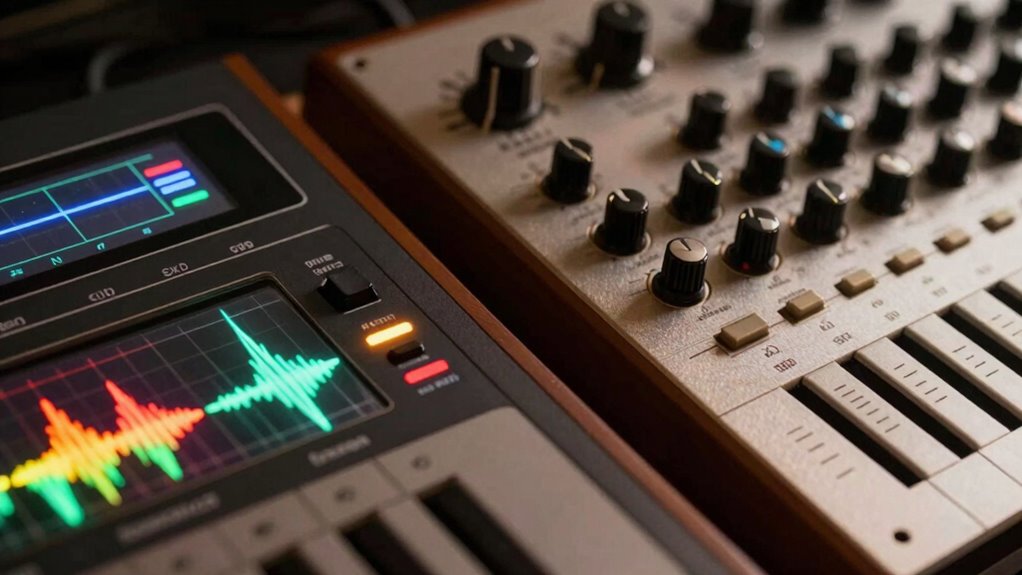

The key difference between wavetable and subtractive synthesis is how they shape sounds. Subtractive synthesis starts with a complex waveform and uses filters to remove unwanted frequencies, giving you straightforward control over classic tones. Wavetable synthesis uses multiple waveforms stored in a table; you can morph between them for evolving textures and complex sounds. Understanding these approaches opens new creative possibilities—if you want to explore more, you’ll find plenty of nuanced techniques to contemplate.

Get audio and creator gear delivered free with Prime
- Fast, free delivery on millions of items
- Prime Video, Amazon Music and more included
- Member-only deals all year
Key Takeaways
- Subtractive synthesis starts with a dense waveform and shapes it through filtering, while wavetable synthesis morphs between multiple waveforms for dynamic textures.
- Wavetable synthesis allows seamless transitions between different harmonic contents, whereas subtractive focuses on filtering a static waveform.
- Subtractive synthesis emphasizes filter modulation (cutoff, resonance) to sculpt sounds, while wavetable emphasizes waveform position changes for sound evolution.
- Subtractive synthesis is ideal for warm, traditional sounds; wavetable excels at complex, evolving textures and experimental tones.
- Both techniques manipulate oscillator waveforms but differ fundamentally in their approach to sound shaping and modulation.
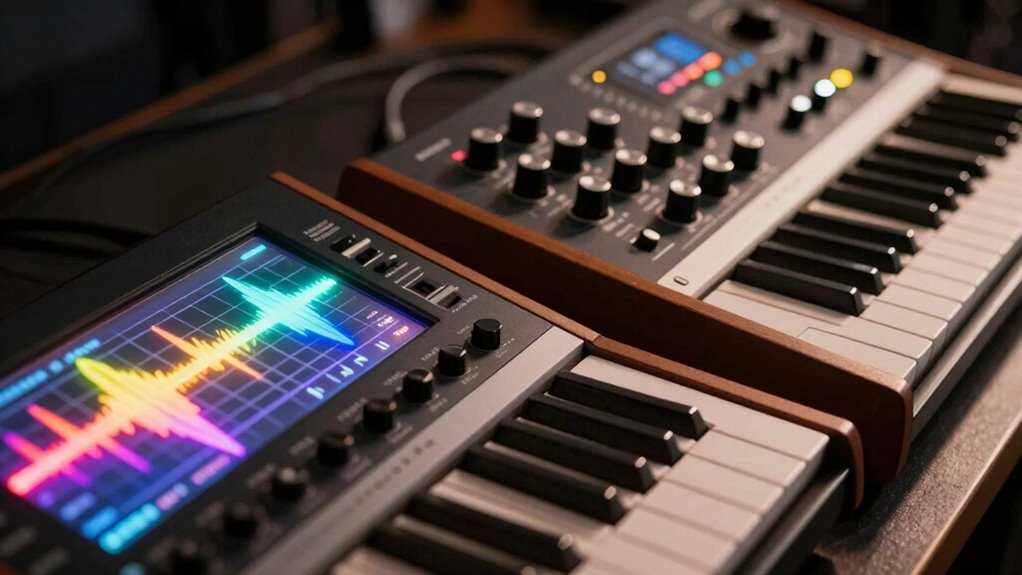
Understanding the difference between wavetable and subtractive synthesis is key to mastering sound design, as each method shapes sounds in unique ways. In subtractive synthesis, you start with a rich, harmonically dense waveform—like a sawtooth or square—that acts as your oscillator waveform. You then use filters to carve out parts of the sound, removing unwanted frequencies to sculpt your tone. Filter modulation plays an essential role here; by varying the filter cutoff or resonance over time, you can create movement and expressiveness. This approach relies heavily on shaping simple waveforms into complex tones, which makes it versatile for crafting everything from warm basses to bright leads. Wavetable synthesis, on the other hand, takes a different route. Instead of starting with a static oscillator waveform, you work with a table of multiple waveforms stored in memory. You can morph between these waveforms in real-time, creating evolving textures that change dynamically. This process allows you to generate sounds with more complexity and variability than traditional subtractive methods. The key here is that each waveform in the table can have different harmonic content, giving you a palette of timbres that can seamlessly shift. Rather than relying solely on filter modulation, wavetable synthesis often involves manipulating the waveform position within the table, which produces a natural, fluid evolution of sound. Additionally, understanding oscillator waveforms and their harmonic structures is fundamental to both synthesis methods. While subtractive synthesis depends heavily on filter modulation to shape the tone, wavetable synthesis emphasizes the movement between different oscillator waveforms. In subtractive synthesis, you might use a low-pass filter with modulation to create a sweeping sound, while in wavetable synthesis, you could morph through various waveforms to achieve a constantly evolving soundscape. Both techniques involve oscillator waveforms, but they harness this element in different ways—one by starting with a fixed waveform and filtering it, the other by changing waveforms themselves. Ultimately, understanding these distinctions helps you decide which approach suits your creative goals. Subtractive synthesis gives you straightforward control and is great for traditional sounds, while wavetable synthesis offers a broader spectrum of textures and motion. By mastering both, you’ll expand your sound design toolkit, enabling you to craft sounds that are both familiar and innovative.
As an affiliate, we earn on qualifying purchases.
Frequently Asked Questions
Can Wavetable Synthesis Emulate Analog Warmth Effectively?
Yes, wavetable synthesis can emulate analog warmth effectively. You can manipulate the wavetable to create rich, evolving sonic textures that mimic the organic feel of analog gear. By adjusting the modulation and filter parameters, you add warmth and subtle imperfections, giving your sounds a more authentic, vintage vibe. Wavetable synthesis offers flexibility that allows you to craft complex, warm tones that rival traditional analog synthesis.
Which Synthesis Method Is More Suitable for Live Performance?
For live performances, subtractive synthesis often works best because it offers straightforward live performance techniques and real-time control. Its simplicity allows you to quickly tweak sounds on the fly, making it easier to adapt to the moment. Wavetable synthesis can be more complex, but if you’re comfortable with its features, it can produce unique textures. Overall, subtractive synthesis is more user-friendly for live settings, especially when quick adjustments are essential.
How Do Computational Requirements Differ Between the Two Methods?
You’ll find wavetable synthesis generally demands more from your system’s processing efficiency due to its higher computational complexity, as it constantly manipulates complex waveforms. Subtractive synthesis, on the other hand, tends to be more forgiving on your hardware, offering smoother real-time performance with less strain. This means if you’re aiming for intricate sound design, wavetable might challenge your setup, whereas subtractive synthesis provides a more resource-friendly approach.
Are There Hybrid Synths Combining Wavetable and Subtractive Synthesis?
Yes, hybrid synths combining wavetable and subtractive synthesis exist, offering versatile sound design options. These synths integrate both synthesis methods, allowing you to blend complex wavetable textures with traditional subtractive filtering. This synthesis integration provides expanded sound-shaping possibilities, giving you the flexibility to craft unique tones. You’ll find hybrid synths popular among producers seeking a broad palette, as they seamlessly combine the strengths of both approaches for richer, more dynamic sounds.
What Are the Best Tools for Beginners to Learn Each Synthesis Type?
Imagine stepping into a vibrant music studio—your toolkit is your paint palette. For wavetable synthesis, try Serum or Ableton Wavetable; they teach oscillator modulation and complex wave shapes easily. For subtractive synthesis, start with TAL-Noisemaker or Synth1, which focus on filter design and straightforward controls. Both offer intuitive interfaces, making it easier for beginners to explore sound design while mastering fundamental synthesis concepts.
As an affiliate, we earn on qualifying purchases.
Conclusion
Understanding the difference between wavetable and subtractive synthesis is like choosing the right brush for your painting—each offers unique textures and colors. Wavetable synthesis acts as a vivid palette, morphing waveforms for dynamic sounds, while subtractive synthesis is your trusty charcoal, carving out timbres from rich harmonics. Mastering both allows you to craft soundscapes as diverse as a painter’s canvas, opening endless creative horizons. The choice ultimately colors your musical journey with depth and nuance.
Music Synthesizer with Waveform Morphing
As an affiliate, we earn on qualifying purchases.
As an affiliate, we earn on qualifying purchases.
Analog Synthesizer with Filter Modulation
As an affiliate, we earn on qualifying purchases.
As an affiliate, we earn on qualifying purchases.
Halloween Picks
halloween
As an affiliate, we earn on qualifying purchases.