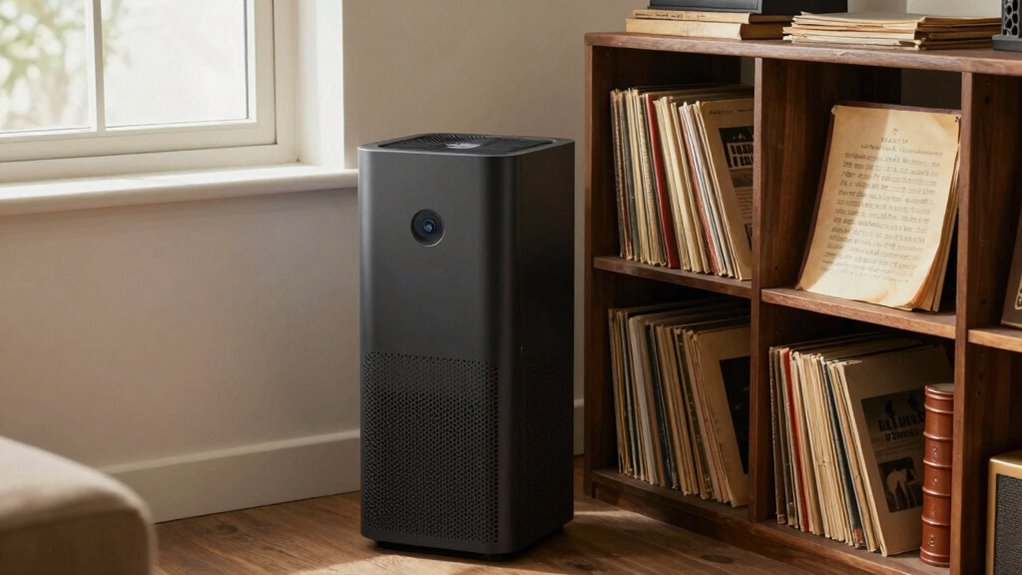

Air purifiers quietly help music archives age better by removing dust, mold spores, and airborne pollutants that can accelerate deterioration of delicate recordings. They operate silently, ensuring a stable environment without disturbing the space. By maintaining cleaner air and preventing chemical build-up, they help extend the lifespan of tapes, records, and other media. If you keep exploring, you’ll discover how advanced systems and sensors work together to protect your collection even further.

Get audio and creator gear delivered free with Prime
- Fast, free delivery on millions of items
- Prime Video, Amazon Music and more included
- Member-only deals all year
Key Takeaways
- Air purifiers reduce airborne pollutants that accelerate the chemical degradation of historic recordings.
- They operate silently, maintaining a stable, noise-free environment essential for sensitive materials.
- Purifiers minimize dust and mold spores, preventing physical and microbial damage to archival media.
- Continuous air quality monitoring allows proactive adjustments, ensuring optimal preservation conditions.
- Integrated purification systems help sustain consistent temperature and humidity levels, prolonging collection lifespan.

Music archives are delicate spaces where preserving recordings depends heavily on controlling environmental factors. One of the most critical aspects is maintaining stable temperature and humidity levels, but equally important is reducing airborne pollutants that can damage tapes, records, and other sensitive materials. That’s where air purifiers come into play, silently working behind the scenes to create a safer environment. They act as a line of defense by filtering out dust, mold spores, and other airborne contaminants that can accelerate deterioration. When combined with proper acoustic insulation, air purifiers help maintain a consistent environment, minimizing fluctuations that could harm historic recordings. Additionally, air quality sensors provide real-time data, enabling precise adjustments to filtration levels and ensuring optimal preservation conditions. Acoustic insulation plays a crucial role in these spaces because it prevents external noise from infiltrating and disrupting the archive. It also helps stabilize internal sound levels, which can influence temperature and humidity stability. But insulation alone isn’t enough; you need a system to monitor and improve air quality actively. Effective environmental control systems are essential tools in this regard. They continuously track pollutants, volatile organic compounds (VOCs), and humidity, providing real-time data. This information allows you to adjust air purifier settings or intervene before conditions become harmful. Sensors help you maintain ideal conditions consistently, reducing the risk of mold growth or chemical degradation that can threaten your collection. Moreover, the integration of air quality management systems enhances overall environmental control. Incorporating air purification technologies can further optimize the preservation environment by targeting specific contaminants more effectively.
A well-maintained environment with air filtration can dramatically extend the lifespan of delicate media and improve the longevity of your collection.
HEPA air purifier for music archive preservation
As an affiliate, we earn on qualifying purchases.
As an affiliate, we earn on qualifying purchases.
Frequently Asked Questions
How Do Air Purifiers Remove Airborne Pollutants From Archive Environments?
You can remove airborne pollutants with air purifiers by using effective filtration systems like HEPA filters. Proper air quality monitoring helps you identify pollutant levels, ensuring your purifier operates at its best. Placement is key; position the purifier where airflow circulates well, avoiding obstructions. This setup captures dust, mold spores, and pollutants, creating a cleaner environment that helps preserve sensitive materials in your archive and maintain better air quality overall.
What Types of Air Filters Are Most Effective for Music Archives?
You should choose HEPA filters for your music archive, as they remove 99.97% of airborne particles as small as 0.3 microns. Filter materials like dense fibers trap dust, mold spores, and pollutants effectively. Proper purifier placement—away from walls and in central locations—maximizes airflow. This setup helps protect delicate recordings and aging materials, ensuring they stay preserved in a cleaner, healthier environment.
Can Air Purifiers Prevent Mold Growth on Stored Music Materials?
Yes, air purifiers can help prevent mold growth on stored music materials by controlling humidity and reducing mold spores in the air. By maintaining proper humidity levels and filtering out mold spores, they create an environment less conducive to mold development. Regular use of an air purifier with humidity control features guarantees your music archives stay dry and mold-free, preserving your valuable materials for the long term.
Are Noise Levels From Air Purifiers Suitable for Sensitive Archive Spaces?
You’ll be pleased to know that most air purifiers designed for sensitive spaces operate at noise levels below 30 decibels, comparable to a whisper. This makes their background noise unobtrusive, ensuring ambient comfort isn’t compromised. Such quiet operation allows you to preserve the integrity of sensitive archive spaces, where even slight disturbances matter. So, air purifiers can effectively maintain air quality without disrupting the quiet environment essential for preserving valuable music materials.
How Often Should Air Purifiers Be Maintained in Archival Storage Areas?
You should perform regular air purifier maintenance every three to six months to guarantee peak performance. In archival environments, maintaining cleanliness is essential to prevent dust and pollutants from settling on sensitive materials. Check and replace filters as needed, and clean the unit regularly. Proper air purifier maintenance keeps the air clean, protecting the integrity of your archive collection, and helps maintain a stable, high-quality environment for long-term preservation.
silent air purifier with air quality sensors
As an affiliate, we earn on qualifying purchases.
As an affiliate, we earn on qualifying purchases.
Conclusion
By choosing to use air purifiers, you’re planting a silent guardian within your archives—like a gentle breeze that shields delicate melodies from decay. These devices quietly sweep away the invisible threats, preserving your collection’s essence as if nurturing a delicate bloom in a protected greenhouse. In this way, you become the custodian of both sound and memory, ensuring your treasured recordings continue to whisper their stories for generations to come.
air purifier for mold spores and dust removal
As an affiliate, we earn on qualifying purchases.
As an affiliate, we earn on qualifying purchases.
air quality monitor with air purifier integration
As an affiliate, we earn on qualifying purchases.
As an affiliate, we earn on qualifying purchases.
Fall Picks
fall essentials
As an affiliate, we earn on qualifying purchases.