TL;DR
A manifesto published November 16 by European game union groups urges workers to avoid generative AI where possible, employers to avoid it entirely, and players to support games made without it. The unions also call for consent and fair compensation before creative work is used to train AI models. The manifesto’s effect on studio policies is not yet known.
European game union groups published a generative AI manifesto on November 16, urging workers to avoid the tools where possible, employers to avoid using them entirely, and players to support games made without them. The document also calls on regulators to require consent and fair compensation before anyone’s work is used in AI training data.

Get audio and creator gear delivered free with Prime
- Fast, free delivery on millions of items
- Prime Video, Amazon Music and more included
- Member-only deals all year
The document, titled On Generative AI Usage in the Games Industry, appeared on the IWGB Game Workers website. It names members of the IWGB Game Workers’ Branch as authors, working with members of Game Workers Unite Ireland, CSVI in Spain and the FIOM-CGIL Milan Work Council. Rock Paper Shotgun and Kotaku also identify France’s STJV and Germany’s GDRT among the groups supporting it. The materials do not state how many workers these unions represent.
The recommendations address four groups. Workers are asked to avoid generative AI services when possible, organize and negotiate company agreements. Employers are told not to use the tools, not to require workers to use them, and to label any use precisely if it cannot be avoided. The text says AI should not be imposed on workers: “Workers should be the ones who decide when, where, and how to use it.”
The proposed limits cover both content that appears in a game, such as art, sound, code and dialogue, and behind-the-scenes work such as concept art, reference materials and pre-translations. The unions also ask players to voice support for games made without generative AI, and regulators to require consent and fair compensation for training data, with a right for workers to withdraw their work.
How the Demands Reach Studios
The manifesto sets out a labor-focused position that would reach beyond whether AI-generated material appears in a finished game. Its proposed employer rules also cover prototyping and early development, stages where studios may use AI internally without including its output in a release. If adopted by companies, these demands could shape workplace agreements, tool policies and disclosure practices.
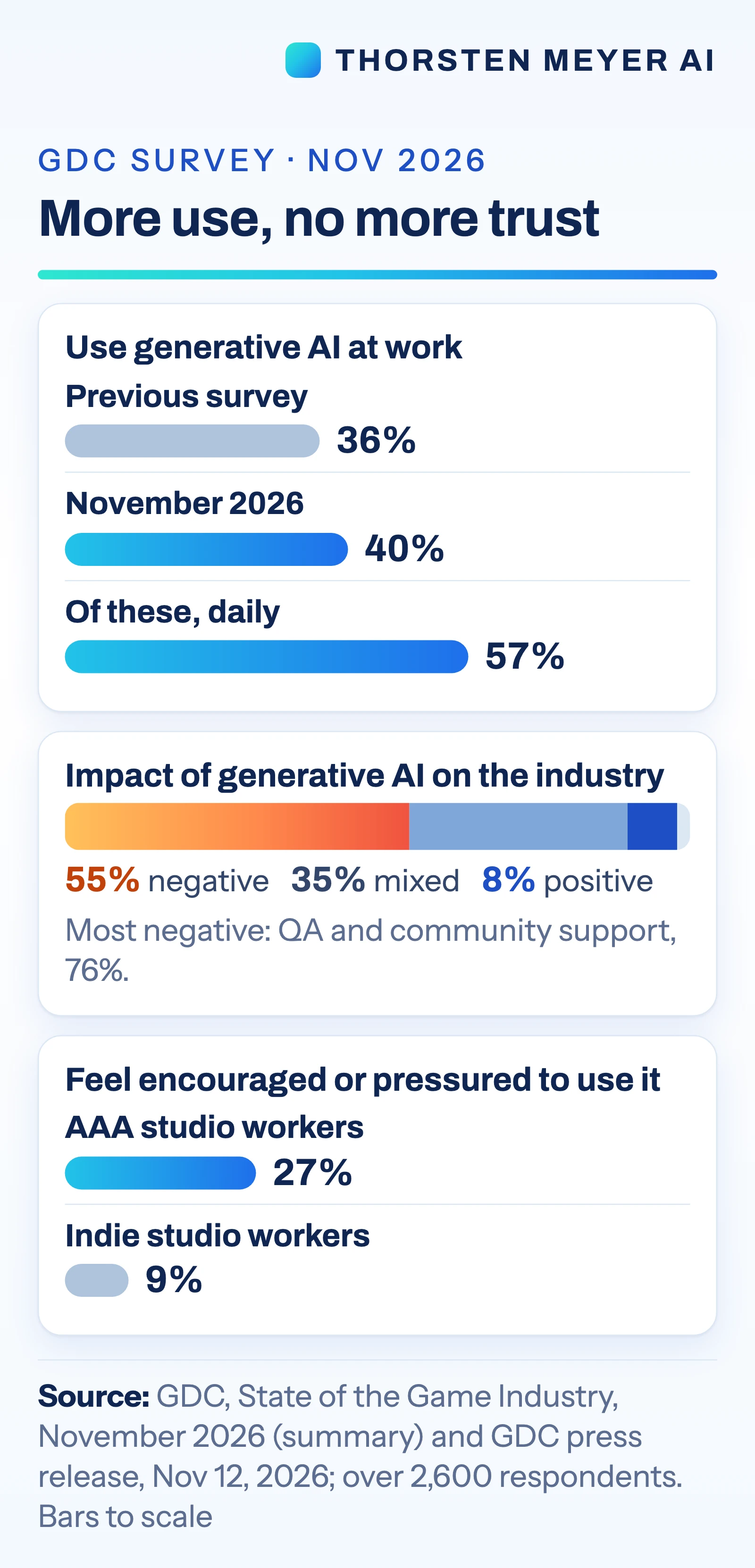
The timing puts the union position alongside signs of a broader industry debate. The Game Developers Conference’s annual survey, published November 12, reported that 40% of respondents use generative AI at work, up from 36% in the prior survey, while 55% said the technology is having a negative effect on the industry. Those figures describe survey respondents; they do not establish how all game workers or studios view AI.
Popular right now

Dyson Airwrap i.d. Multi-Styler with Bluetooth Connectivity

TCL 55-Inch F7D Series QLED 4K UHD Smart Fire TV (2026)

Bose QuietComfort Ultra Wireless Noise Cancelling Earbuds, 2nd Gen, with 20W 2-Port Wall Charger
As an affiliate, we earn on qualifying purchases.
A Debate Over Game Development
The union text argues that generative AI is harming workers and games, citing concerns about job displacement, pressure to use tools, fewer junior roles, workplace accountability, training data and cultural bias. These are the manifesto authors’ claims, not findings established by the publication of the document. The legality of using third-party work to train AI systems remains contested.
Industry representatives have voiced a different view. Video Games Europe, the sector’s European trade body, wrote in 2024 that generative AI was widely expected to advance video game development and argued against requiring AI labels on games. On November 12, Xbox CEO Asha Sharma said, without specifically naming AI, that “A small team will be able to build worlds that today demand hundreds of developers.” The statement does not establish that Xbox is adopting the unions’ proposals or that AI was involved.
Other developments around the same time show the debate taking different forms. A group of Independent Games Festival jurors said they would not vote for games using generative AI “in any capacity.” The studio behind Big Walk disclosed that large language models touched “well under 0.1%” of its code. That is the studio’s stated figure; it does not represent a broader industry measure.
““Games are best made by people.””
— European game union manifesto
Unclear Uptake and Workforce Effects
It is not clear how many workers the groups behind the manifesto represent, whether any studios will change their policies, or whether employers will negotiate agreements of the kind the unions propose. No public response from a studio or trade body to this manifesto was identified in the supplied reporting.
The manifesto argues that generative AI is replacing workers and contributing to fewer junior roles. The available information does not establish how much AI has contributed to job losses, including the 34% of GDC survey respondents who said they had been laid off in the past two years. The survey figure does not identify the cause of those layoffs.
Studio Responses and Policy Talks
The next developments to watch are whether studios respond publicly, revise internal AI rules or negotiate agreements with workers. Regulators may also face calls to address consent, compensation and withdrawal rights for creative work used in training data. The manifesto does not set a deadline or identify a formal process for tracking whether its demands are adopted.
Key Questions
What are the European game unions asking studios to do?
The manifesto tells employers to avoid generative AI entirely, not require workers to use it, and precisely label any use that cannot be avoided.
Does the manifesto cover AI used behind the scenes?
Yes. It addresses tools used for early development work, including concept art, reference materials and pre-translations, as well as assets in finished games.
Which groups are named as supporting the manifesto?
The IWGB Game Workers page names contributors from its own branch, Game Workers Unite Ireland, CSVI in Spain and the FIOM-CGIL Milan Work Council. Rock Paper Shotgun and Kotaku also list France’s STJV and Germany’s GDRT.
Have studios agreed to the unions’ demands?
The supplied reporting identifies no public studio response to the manifesto and does not say whether any company has changed its policy.
Does the GDC survey show that AI caused layoffs?
No. It reported that 34% of respondents had been laid off in the past two years, but the figure does not identify the cause of those layoffs.
Source: Thorsten Meyer AI