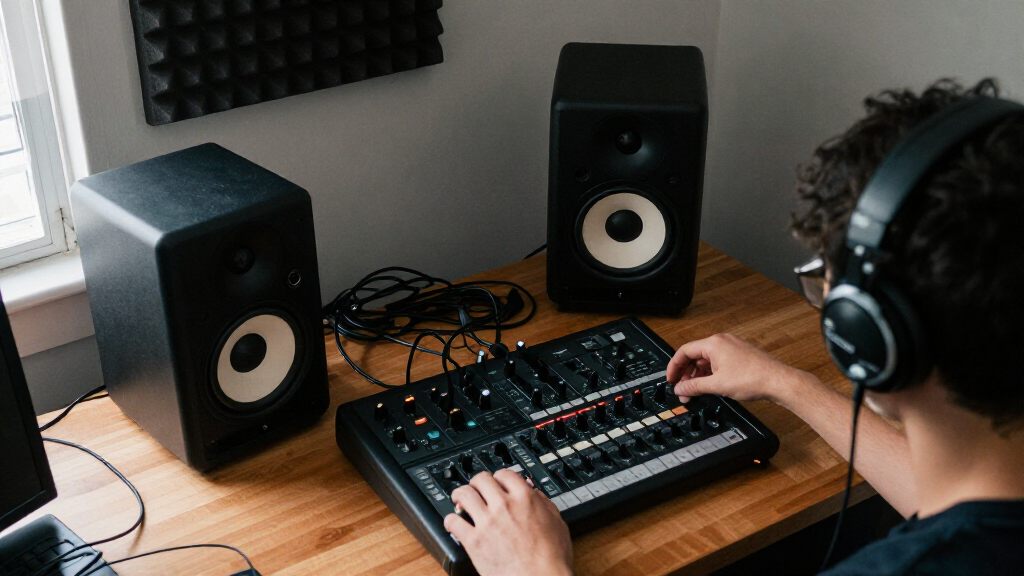
For most desktop setups, I’d start with the ADAM Audio D3V, which stands out as the premium-focused pick, while the PreSonus Eris 3.5 and Edifier MR3 offer approachable alternatives for smaller workspaces and mixed-use listening. The main tradeoff is between compact size and fuller low-end, with connectivity, placement flexibility, and listening priorities adding further differences. Some models are geared more toward checking mixes, while others make it easier to switch between production and casual playback. I compare all 10 options by their desktop fit, features, and likely use cases. Continue reading for the full breakdown and a guide to choosing the right pair for your setup.

Get audio and creator gear delivered free with Prime
- Fast, free delivery on millions of items
- Prime Video, Amazon Music and more included
- Member-only deals all year
Complete the kit



Key Takeaways
- ADAM Audio D3V is the premium-focused pick: it has a clearer role for buyers prioritizing desktop production, while more general-purpose models may suit casual listening better.
- The two PreSonus Eris 3.5 listings are near-duplicates: the black and white versions call for a color and listing check, not an assumption that one has a different sound.
- Edifier MR3 appears in several configurations: the standard, Bluetooth 5.4 white, and MR5 options differ in model and connectivity, so verify the exact product rather than shopping by color alone.
- Ortizan C7 gives buyers a color choice across separate listings: compare the white and black versions for included connections and package details before deciding they are interchangeable.
- Compact monitors involve a space-versus-bass tradeoff: the 3.5-inch and other small-format options are easier to place on a desk, but buyers seeking strong low bass may need a larger system or a subwoofer.
| Mackie CR3.5 Powered Studio Monitors, Pair, 3.5-Inch Woofers, Black | 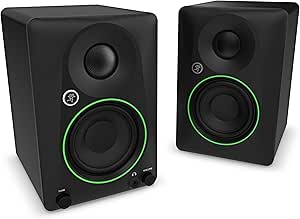 | Best for Flexible Desk Listening | Configuration: Powered stereo pair | Woofer: 3.5 inches | Tweeter: 1 inch | VIEW LATEST PRICE | See Our Full Breakdown |
| Yamaha HS4 Powered Studio Monitors, Black, Pair |  | Best for Compact Production Workstations | Configuration: 2-way powered stereo pair | Woofer: 4.5 inches | Tweeter: 1-inch dome | VIEW LATEST PRICE | See Our Full Breakdown |
| Edifier MR5 2.0 Studio Monitor Bookshelf Speakers, 110W RMS, Black |  | Best for Full-Range Desktop Setups | Configuration: 2.0 active stereo pair, three-way | Amplifier power: 110W RMS | Drivers: 5-inch woofer, 3.75-inch midrange driver, 1-inch silk dome tweeter | VIEW LATEST PRICE | See Our Full Breakdown |
| Ortizan C7 Powered Studio Monitors, White |  | Best Connectivity for a Small Desk | Driver: 3.5-inch carbon fiber mid-bass driver | Tweeter: 0.75-inch silk dome | Inputs: USB, Bluetooth 5.3, RCA, 3.5 mm AUX, and 6.35 mm balanced TRS | VIEW LATEST PRICE | See Our Full Breakdown |
| ADAM Audio D3V Active Desktop Studio Monitors, Black |  | Best Premium Desktop Placement Options | Configuration: Active stereo desktop monitor pair | Woofer: 3.5-inch aluminum | Tweeter: 1.5-inch D-ART | VIEW LATEST PRICE | See Our Full Breakdown |
| PreSonus Eris 3.5 Powered Studio Monitors, Stereo Pair |  | Best Value for Flexible Desktop Setups | Speaker type: Active near-field monitors | Quantity: Stereo pair (2) | Amplification: 50 watts, Class AB | VIEW LATEST PRICE | See Our Full Breakdown |
| PreSonus Eris 3.5 Powered Desktop Studio Monitors, Pair, White |  | Best for Beginners | Amplifier power: 50 W total (25 W per side) | Frequency response: 80 Hz–20 kHz | Drivers: 3.5-inch woven-composite woofer; 1-inch silk-dome tweeter | VIEW LATEST PRICE | See Our Full Breakdown |
| Edifier MR3 Powered Studio Monitor Speakers |  | Best for Bluetooth and App-Based Tuning | Audio output: 18 W × 2 RMS; 36 W maximum | Frequency response: 52 Hz–40 kHz | Drivers: 3.5-inch mid-low drivers; 1-inch tweeters | VIEW LATEST PRICE | See Our Full Breakdown |
| Ortizan C7 Powered Studio Monitor Speakers, Pair, Black |  | Best for Digital and Analog Connectivity | Quantity: Pair | Woofer: 3.5-inch carbon-fiber mid-bass driver | Tweeter: 0.75-inch silk-dome | VIEW LATEST PRICE | See Our Full Breakdown |
| Edifier MR3 Powered Studio Monitor Speakers with Bluetooth 5.4, White |  | Best White-Finish Mixed-Use Monitor | Power output: 18 W × 2 RMS; 36 W maximum | Frequency response: 52 Hz–40 kHz | Drivers: 3.5-inch mid-low drivers; 1-inch tweeters | VIEW LATEST PRICE | See Our Full Breakdown |
| desktop studio monitor speaker | Dimensions | Frequency response | Inputs | Tweeter |
|---|---|---|---|---|
| Mackie CR3.5 Powered Studio Mo | 7.1 × 5.5 × 8.1 inches | — | — | 1 inch |
| Yamaha HS4 Powered Studio Moni | — | 60 Hz–22 kHz (-10 dB) | XLR/TRS combo, RCA, and stereo mini | 1-inch dome |
| Edifier MR5 2.0 Studio Monitor | — | 46 Hz–40 kHz | — | — |
| Ortizan C7 Powered Studio Moni | 5.11 × 5.9 × 7.67 inches | — | USB, Bluetooth 5.3, RCA, 3.5 mm AUX, and 6.35 mm balanced TRS | 0.75-inch silk dome |
| ADAM Audio D3V Active Desktop | — | — | USB-C and balanced 1/4-inch TRS | 1.5-inch D-ART |
| PreSonus Eris 3.5 Powered Stud | 5.5 × 6 × 8.3 inches (D × W × H) | 80 Hz–20 kHz | Balanced TRS, RCA, front-panel aux | — |
| PreSonus Eris 3.5 Powered Desk | 6 × 5.5 × 8.3 inches (D × W × H) | 80 Hz–20 kHz | Balanced 1/4-inch TRS, RCA, front-panel auxiliary | — |
| Edifier MR3 Powered Studio Mon | — | 52 Hz–40 kHz | Balanced TRS, RCA, AUX, Bluetooth | — |
| Ortizan C7 Powered Studio Moni | 5.11 × 5.9 × 7.67 inches | — | — | 0.75-inch silk-dome |
| Edifier MR3 Powered Studio Mon | 6.9 × 12.1 × 16.2 inches (D × W × H) | 52 Hz–40 kHz | — | — |
More Details on Our Top Picks
Mackie CR3.5 Powered Studio Monitors, Pair, 3.5-Inch Woofers, Black
The Mackie CR3.5 suits a desktop setup that has to serve both editing and everyday listening. Its standout distinction is the tone control, which lets me shift away from a more reference-oriented sound when the speakers are used for music or video. A placement switch adjusts bass response for desktop or bookshelf positioning, giving it more setup flexibility than a simple small monitor. The included isolation pads and cables also make initial desk placement easier. Compared with the Yamaha HS4, the Mackie offers a more direct way to change the sound for different uses, while the Yamaha provides dedicated room and high-trim controls. The tradeoff is its smaller 3.5-inch woofer, which is less suited to judging deep bass, and the supplied specifications do not state a frequency range.
Pros:- Tone control can adapt the sound for monitoring or casual playback.
- Placement switch adjusts bass response for desktop or bookshelf use.
- Includes isolation pads and the cables needed for setup.
- Compact pair is intended for desks and small studios.
Cons:- The 3.5-inch woofers limit its usefulness for judging deep bass.
- The supplied specifications do not list a frequency-response range.
Best for: Desktop users who switch between basic music or video work and casual listening, and want tone and placement controls without a complicated setup.
Not ideal for: Producers who need to make confident decisions about deep bass or want published frequency-response data; the 3.5-inch woofers are better suited to compact near-field use.
- Configuration:Powered stereo pair
- Woofer:3.5 inches
- Tweeter:1 inch
- Maximum output power:50 watts
- Connectivity:RCA and TRS
- Dimensions:7.1 × 5.5 × 8.1 inches
- Included accessories:Isolation pads, speaker wire, 1/8-inch-to-1/8-inch cable, and 1/8-inch-to-RCA cable
Our verdict“Choose the CR3.5 if you want compact desktop monitors with useful sound and placement adjustments for both work and everyday listening.”
Yamaha HS4 Powered Studio Monitors, Black, Pair
The Yamaha HS4 is the more work-focused pick for a tight desktop where music production or video editing matters more than extra listening features. Its room control and high trim settings offer two ways to adapt the sound to a difficult workstation, while XLR/TRS combo, RCA, and stereo mini inputs make it straightforward to connect both studio gear and everyday devices. The 4.5-inch woofer is larger than the Mackie CR3.5’s 3.5-inch driver, and Yamaha specifies response down to 60 Hz, though neither figure makes this a substitute for a subwoofer when checking the lowest bass. Its 26-watt maximum output is modest beside the Edifier MR5’s 110W RMS rating, so the HS4 is a better fit for close listening than filling a large room. It favors focused adjustment over the MR5’s wireless and app features.
Pros:- Room control and high trim settings help adapt response to workstation placement.
- XLR/TRS combo, RCA, and stereo mini inputs cover studio and consumer sources.
- 4.5-inch woofers are larger than those in the Mackie CR3.5 and Ortizan C7.
- Includes anti-slip pads and connection cables.
Cons:- 26 watts maximum output power is modest for loud playback or larger rooms.
- The listed 60 Hz low-frequency limit leaves the deepest bass unchecked.
- Bluetooth connectivity is not listed.
Best for: Music makers and video editors working close to their monitors at a compact desk who want room-response controls and connections for studio equipment.
Not ideal for: Buyers needing high playback levels, deep bass extension, or a broad wireless feature set; the stated output is modest and Bluetooth is not listed.
- Configuration:2-way powered stereo pair
- Woofer:4.5 inches
- Tweeter:1-inch dome
- Frequency response:60 Hz–22 kHz (-10 dB)
- Maximum output power:26 watts
- Inputs:XLR/TRS combo, RCA, and stereo mini
- Controls:Room control and high trim
- Included accessories:Anti-slip pads, 2.5 m speaker cable, and 1.5 m stereo mini-to-RCA cable
Our verdict“Pick the HS4 for close-range editing and production when room controls and studio-friendly inputs matter more than loud output or wireless playback.”
Edifier MR5 2.0 Studio Monitor Bookshelf Speakers, 110W RMS, Black
The Edifier MR5 is the most expansive option here for buyers who want a desktop pair to handle production, streaming, and general playback. Its three-way driver layout separates woofer, midrange, and tweeter duties, while the stated 46 Hz–40 kHz response reaches lower than the Yamaha HS4’s 60 Hz limit. That gives the MR5 more headroom on paper for low-end and upper-frequency material, though it still does not replace a subwoofer for very deep bass. XLR, TRS, RCA, AUX, Bluetooth with LDAC, and app-based room tuning make it more adaptable than the wired-focused HS4. The tradeoff is complexity: buyers who only need a simple computer connection may not benefit from its extra options. Its larger, 5-inch woofer also calls for more desk space than the Mackie CR3.5.
Pros:- Three-way drivers separate woofer, midrange, and tweeter duties.
- 46 Hz–40 kHz stated response extends beyond the Yamaha HS4’s listed range.
- XLR, TRS, RCA, AUX, and Bluetooth with LDAC offer varied source options.
- Rear controls and the EDIFIER ConneX app provide room tuning.
Cons:- The larger 5-inch woofer and three-way cabinet take more desk space than compact options.
- The feature set may be excessive for users who only need straightforward computer audio.
- Corded power limits placement to locations near an outlet.
Best for: Home producers and multimedia creators who want one desktop pair for wired studio sources, Bluetooth playback, and room-adjustable listening.
Not ideal for: People with very shallow desks or a simple computer-only setup who prefer compact speakers and minimal controls; its larger three-way design and broad feature set may be unnecessary.
- Configuration:2.0 active stereo pair, three-way
- Amplifier power:110W RMS
- Drivers:5-inch woofer, 3.75-inch midrange driver, 1-inch silk dome tweeter
- Frequency response:46 Hz–40 kHz
- Wired inputs:XLR, TRS, RCA, and AUX
- Wireless connectivity:Bluetooth 6.0 with LDAC and multipoint
- Audio resolution:24-bit/96 kHz
- Headphone output:3.5 mm
Our verdict“Choose the MR5 if your desk can accommodate a larger pair and you want broad connectivity, room tuning, and a three-way design in one system.”
Ortizan C7 Powered Studio Monitors, White
The Ortizan C7 puts connection flexibility ahead of larger drivers or extensive room adjustment. Its small cabinet combines USB with a built-in 24-bit DAC for direct digital audio, balanced TRS for studio equipment, and Bluetooth 5.3, RCA, and AUX for other sources. A front headphone output is handy when I need to monitor privately without reaching behind the speakers. Compared with the Mackie CR3.5, the C7 offers USB and Bluetooth in addition to analog inputs; compared with the Yamaha HS4, it has no listed room or high-trim controls. Its 3.5-inch carbon fiber drivers keep the footprint compact, but they also make it a less convincing choice for bass-heavy production than the larger Edifier MR5. Choose it for a crowded desk and varied sources, not for low-frequency authority.
Pros:- USB input with a built-in 24-bit DAC supports direct digital playback.
- Balanced TRS, RCA, AUX, and Bluetooth 5.3 serve varied sources.
- Front headphone output makes private monitoring easy to access.
- Compact dimensions suit space-limited desktop setups.
Cons:- The 3.5-inch drivers may not provide enough low-frequency output for bass-critical work.
- Room-control or high-trim adjustments are not listed.
- The supplied specifications do not state output power or frequency response.
Best for: Computer-based creators with a small desk who need USB audio, balanced TRS, Bluetooth, and a front headphone jack in one compact pair.
Not ideal for: Bass-focused producers or buyers seeking detailed room-response controls; the small drivers limit low-frequency output, and no room-tuning controls are listed.
- Driver:3.5-inch carbon fiber mid-bass driver
- Tweeter:0.75-inch silk dome
- Inputs:USB, Bluetooth 5.3, RCA, 3.5 mm AUX, and 6.35 mm balanced TRS
- USB audio:Built-in 24-bit DAC
- Headphone output:Front-panel
- Dimensions:5.11 × 5.9 × 7.67 inches
- Enclosure materials:ABS, metal, and wood
Our verdict“Pick the C7 if a compact footprint and flexible USB, wireless, and studio connections matter more than strong bass or detailed room tuning.”
ADAM Audio D3V Active Desktop Studio Monitors, Black
The ADAM Audio D3V is the specialist choice for a desktop where speaker positioning is as important as source connections. It pairs USB-C and balanced TRS with placement controls, detachable angled stands, and 3/8-inch microphone-stand mounting holes, making it easier to aim the speakers around a monitor or reclaim desk space. Its 80-watt amplifier rating and 45 Hz low-frequency extension give it a more capable stated range than the Mackie CR3.5, though the 3.5-inch woofers still cannot match the Edifier MR5’s larger 5-inch driver for low-end scale. A 1.5-inch D-ART tweeter and passive radiators round out the design, while the headphone output adds a useful desktop convenience. The tradeoff is its focused feature set: buyers wanting Bluetooth or multiple consumer analog inputs should look at the MR5 or Ortizan C7.
Pros:- USB-C and balanced TRS support computer and analog studio sources.
- Placement controls and angled detachable stands help aim speakers for a desktop.
- 3/8-inch mounting threads allow microphone-stand placement.
- 80-watt amplifier power and stated extension to 45 Hz are strong figures for this compact format.
Cons:- The 3.5-inch woofers limit deep-bass scale compared with the Edifier MR5’s 5-inch woofer.
- Bluetooth and RCA or AUX inputs are not listed.
- Corded electric power restricts placement near an outlet.
Best for: Desktop producers who need USB-C and balanced analog input, plus flexible speaker aiming or microphone-stand mounting around a crowded workstation.
Not ideal for: Listeners who want Bluetooth, several consumer analog inputs, or deep bass for low-end mixing; those features are not listed, and the 3.5-inch woofers set a physical limit.
- Configuration:Active stereo desktop monitor pair
- Woofer:3.5-inch aluminum
- Tweeter:1.5-inch D-ART
- Amplifier power:80 W
- Low-frequency extension:45 Hz
- Inputs:USB-C and balanced 1/4-inch TRS
- Stand and mounting:Detachable 15° stands; 3/8-inch microphone-stand threads
- Headphone output:Included
Our verdict“Choose the D3V if precise placement, USB-C, and balanced studio input suit your desktop workflow better than Bluetooth or larger-woofer bass.”
PreSonus Eris 3.5 Powered Studio Monitors, Stereo Pair
The PreSonus Eris 3.5 is a practical fit for a small desk where one pair needs to serve music work, gaming, and general listening. Its 50 watts of Class AB power, stereo configuration, and TRS, RCA, and front-panel aux inputs make it easier to connect both studio gear and everyday devices than a setup with fewer input choices. High- and low-frequency controls offer a way to adjust the sound when the speakers sit close to a wall or desk surface. Compared with the Edifier MR3, this model gives you more stated total amplification, while the MR3 reaches a lower stated frequency and adds Bluetooth. The Eris tradeoff is its 3.5-inch woofer: it suits near-field listening, but buyers wanting fuller bass should look at larger monitors. A front headphone jack also makes private listening straightforward.
Pros:- 50 watts of built-in Class AB amplification across a matched stereo pair
- TRS, RCA, and front-panel aux inputs accommodate studio and consumer sources
- High- and low-frequency controls allow basic adjustment for desk placement
- Front headphone output supports private monitoring
Cons:- 3.5-inch woofers may not provide enough bass for low-end-critical production
- No Bluetooth connection is listed
Best for: Desktop producers and computer users who want a compact stereo pair with multiple wired inputs and basic room tuning.
Not ideal for: Bass-focused listeners or producers who need strong low-frequency output without a subwoofer.
- Speaker type:Active near-field monitors
- Quantity:Stereo pair (2)
- Amplification:50 watts, Class AB
- Drivers:3.5-inch woven-composite woofer; 1-inch silk-dome tweeter
- Frequency response:80 Hz–20 kHz
- Inputs:Balanced TRS, RCA, front-panel aux
- Acoustic controls:Adjustable high- and low-frequency tuning
- Dimensions:5.5 × 6 × 8.3 inches (D × W × H)
Our verdict“Choose the Eris 3.5 for a flexible, wired desktop setup; pick the Edifier MR3 instead if Bluetooth and a lower stated bass limit matter more.”
PreSonus Eris 3.5 Powered Desktop Studio Monitors, Pair, White
For a first desktop monitor pair, the white PreSonus Eris 3.5 keeps the setup simple: connect a computer or interface through TRS, RCA, or aux, then use the front-panel volume and headphone output for quick adjustments. Its 50-watt total amplification and high- and low-frequency tuning controls give a new user practical room to learn how placement affects sound without requiring a large speaker footprint. Compared with the black Eris 3.5 in this roundup, the listed core format and connections are closely matched, so the main distinction is the white finish rather than a different class of monitor. The Edifier MR3 is a better fit for someone who wants Bluetooth and app-based EQ; this Eris instead favors straightforward wired use. Its small woofers limit bass depth, so it is less suitable as the only reference for bass-heavy production.
Pros:- 50 watts total power in a powered stereo pair
- Balanced TRS, RCA, and front auxiliary inputs cover common desktop sources
- Front headphone jack and volume control are easy to reach
- High- and low-frequency tuning controls help adapt placement
Cons:- 3.5-inch woofers may leave low bass underrepresented
- No Bluetooth connectivity is listed
Best for: New home-studio owners who want simple wired connections, front-access controls, and a compact stereo pair.
Not ideal for: Producers who need extended bass response, Bluetooth playback, or detailed app-based EQ options.
- Amplifier power:50 W total (25 W per side)
- Frequency response:80 Hz–20 kHz
- Drivers:3.5-inch woven-composite woofer; 1-inch silk-dome tweeter
- Inputs:Balanced 1/4-inch TRS, RCA, front-panel auxiliary
- Headphone output:Front-panel 1/8-inch
- Audio output mode:Stereo or mono
- Mounting:Shelf mount
- Dimensions:6 × 5.5 × 8.3 inches (D × W × H)
Our verdict“Pick this white Eris pair if you are starting a wired desktop studio and value accessible controls over Bluetooth or deeper bass.”
Edifier MR3 Powered Studio Monitor Speakers
The Edifier MR3 stands out for a desktop where studio sources and casual wireless listening share the same speakers. Along with balanced TRS, RCA, and AUX, it offers Bluetooth 5.4 multipoint, so switching between compatible devices is part of the setup rather than an extra adapter problem. Its stated 52 Hz–40 kHz response extends lower than the PreSonus Eris 3.5’s listed 80 Hz floor, though neither model’s 3.5-inch drivers replace a subwoofer when deep bass needs close scrutiny. Music, Monitor, and Custom modes plus app-based EQ also provide more sound-shaping options than the Eris’s physical high- and low-frequency controls. That flexibility suits mixed-use desks, but buyers should note the MR3’s stated 18 watts per channel and its larger listed cabinet dimensions. It is a more feature-rich choice, not necessarily the best fit for a tight desktop.
Pros:- Bluetooth 5.4 multipoint complements balanced TRS, RCA, and AUX inputs
- Monitor, Music, and Custom modes with app-based EQ offer flexible voicing
- Stated 52 Hz lower frequency limit is below the Eris 3.5’s listed 80 Hz
- MDF cabinets are designed to reduce distortion
Cons:- 18 watts RMS per channel is less total stated RMS power than the 50-watt Eris 3.5
- 3.5-inch drivers still limit deep-bass monitoring
- Listed cabinet dimensions may take more desk space than compact alternatives
Best for: Desktop creators who alternate between wired studio equipment and wireless listening, and want selectable sound modes.
Not ideal for: Buyers with very limited desk space or those seeking a high-output monitor for bass-heavy mixing.
- Audio output:18 W × 2 RMS; 36 W maximum
- Frequency response:52 Hz–40 kHz
- Drivers:3.5-inch mid-low drivers; 1-inch tweeters
- Inputs:Balanced TRS, RCA, AUX, Bluetooth
- Bluetooth:Version 5.4; multipoint connection
- Sound modes:Music, Monitor, Custom
- Cabinet material:MDF
- Peak sound pressure level:92.5 dB
Our verdict“Choose the MR3 if Bluetooth and app-based sound modes matter more to your desktop workflow than higher stated total power or a smaller footprint.”
Ortizan C7 Powered Studio Monitor Speakers, Pair, Black
The Ortizan C7 makes a strong case for a computer-centered desktop by combining USB with Bluetooth 5.3, RCA, AUX, and balanced TRS. That range can simplify a desk shared by a computer, phone, and music equipment, while the listed USB 24-bit DAC gives the digital connection a more direct role than on the PreSonus Eris 3.5, which offers several analog inputs but no listed Bluetooth or USB. Its carbon-fiber mid-bass drivers and tuned two-way crossover are intended to deliver balanced sound in a compact pair, and a headphone output supports private monitoring. The tradeoff is that the product data gives no frequency-response or power figure, making specification-based comparisons harder than with the Edifier MR3. Like the other small-woofer options here, the C7 is not the pick for strong sub-bass; its appeal is connection flexibility in a small desktop format.
Pros:- USB connection includes a stated 24-bit DAC
- Bluetooth 5.3 joins USB, RCA, AUX, and balanced TRS connectivity
- Front headphone output supports private monitoring
- Compact cabinet dimensions suit desktop placement
Cons:- 3.5-inch woofers may not reproduce deep bass with authority
- Power output and frequency response are not specified in the supplied product data
- Requires corded power
Best for: Computer-based creators who want USB audio plus Bluetooth and analog inputs in one compact powered pair.
Not ideal for: Buyers who need published power and frequency-response specifications to judge monitoring performance, or who need deep bass.
- Quantity:Pair
- Woofer:3.5-inch carbon-fiber mid-bass driver
- Tweeter:0.75-inch silk-dome
- Connectivity:Bluetooth 5.3, USB, RCA, 3.5 mm AUX, 6.35 mm TRS
- USB DAC:24-bit
- Bluetooth range:18 meters
- Dimensions:5.11 × 5.9 × 7.67 inches
- Enclosure materials:ABS, metal, and wood
Our verdict“Choose the C7 if USB and Bluetooth connections are central to your desk; choose the Eris 3.5 if you prefer clearer published power and response specifications.”
Edifier MR3 Powered Studio Monitor Speakers with Bluetooth 5.4, White
This white Edifier MR3 brings the same mixed-use strengths as the black MR3: Bluetooth multipoint, TRS/RCA/AUX inputs, headphone output, and Music, Monitor, and Custom modes with app-based EQ. Its white finish gives buyers a color-matched alternative to the black model without changing the main stated performance profile. Compared with the white PreSonus Eris 3.5, the MR3 adds Bluetooth and lists a lower 52 Hz response limit, while the Eris offers 50 watts total amplification versus the MR3’s 18 W × 2 RMS. That makes the MR3 more versatile for wireless and everyday playback, but not automatically the better choice for every production desk. Its 3.5-inch drivers still constrain deep-bass judgment, and the larger listed dimensions call for more shelf or desktop room. The corded power requirement also limits placement to spots near an outlet.
Pros:- Bluetooth 5.4 multipoint and multiple wired inputs support mixed-use setups
- Music, Monitor, and Custom modes offer more voicing flexibility than the Eris 3.5
- Stated 52 Hz–40 kHz frequency response
- MDF cabinets are designed to reduce distortion
Cons:- 18 W × 2 RMS is lower stated total RMS power than the 50-watt white Eris 3.5
- 3.5-inch drivers may not provide sufficient deep bass for critical low-end work
- Listed dimensions require more space than the compact C7
Best for: Creators with a white desktop setup who want both wireless playback and wired studio connections, plus app-based EQ.
Not ideal for: Buyers seeking compact cabinets, higher stated total amplification, or dependable deep-bass monitoring from the speakers alone.
- Power output:18 W × 2 RMS; 36 W maximum
- Frequency response:52 Hz–40 kHz
- Drivers:3.5-inch mid-low drivers; 1-inch tweeters
- Connectivity:Bluetooth 5.4, balanced TRS, RCA, AUX, headphone output
- Sound modes:Music, Monitor, Custom
- Signal-to-noise ratio:85 dB
- Cabinet material:MDF wood
- Dimensions:6.9 × 12.1 × 16.2 inches (D × W × H)
Our verdict“Pick the white MR3 for a coordinated desktop that needs Bluetooth and sound-mode flexibility, but favor the white Eris 3.5 for higher stated total power in a wired setup.”
How We Picked
I ranked these desktop studio monitor speakers around practical desktop needs: footprint, connection options, setup convenience, and whether each model’s stated features suit production, editing, or mixed everyday use. I also considered how much flexibility a buyer gets from features such as Bluetooth, controls, and available finish options, while treating exact specifications as something to verify on the specific listing.
The ranking favors products with a distinct fit for a desktop buyer and a clear reason to choose them over alternatives in this lineup. The ADAM Audio D3V leads for buyers prioritizing a dedicated production setup; the PreSonus Eris 3.5 and Edifier MR3 offer straightforward compact alternatives. The Edifier MR5 and Ortizan C7 add different options for buyers weighing output, convenience, or finish. Duplicate color listings are not treated as distinct performance upgrades, and every pick has tradeoffs in size, connectivity, or intended use.
| desktop studio monitor speaker | Inputs |
|---|---|
| Mackie CR3.5 Powered Studio Mo | — |
| Yamaha HS4 Powered Studio Moni | XLR/TRS combo, RCA, and stereo mini |
| Edifier MR5 2.0 Studio Monitor | — |
| Ortizan C7 Powered Studio Moni | USB, Bluetooth 5.3, RCA, 3.5 mm AUX, and 6.35 mm balanced TRS |
| ADAM Audio D3V Active Desktop | USB-C and balanced 1/4-inch TRS |
| PreSonus Eris 3.5 Powered Stud | Balanced TRS, RCA, front-panel aux |
| PreSonus Eris 3.5 Powered Desk | Balanced 1/4-inch TRS, RCA, front-panel auxiliary |
| Edifier MR3 Powered Studio Mon | Balanced TRS, RCA, AUX, Bluetooth |
| Ortizan C7 Powered Studio Moni | — |
| Edifier MR3 Powered Studio Mon | — |
Factors to Consider When Choosing Desktop Studio Monitor Speakers
Choosing desktop monitors is less about picking the most impressive spec and more about matching the speakers to your room, listening distance, and audio work. I’d settle the following points before choosing between compact nearfield models and more flexible listening options.
Match Speaker Size to Your Desk and Listening Distance
Measure the space where the speakers will sit, including room for stands or isolation pads and access to rear connections. A compact cabinet can be easier to position close to a screen, but placing speakers too close to walls may change the perceived bass and balance. Nearfield listening means the speakers are relatively close to you, so left-right spacing and an unobstructed path to your ears matter. Avoid choosing a larger model simply because you expect it to sound fuller; a cramped setup can make placement harder. If your desk is small, prioritize a pair you can position symmetrically rather than the biggest cabinet that fits.
Decide Whether You Need Mix Reference or Everyday Playback
Studio monitors are often chosen to reveal mix details, while some desktop speakers are also intended to make games, video, and music enjoyable. Those goals can overlap, but they are not identical: a presentation that is pleasing for casual listening may not be the one you want for judging tonal balance. Before buying, decide whether you will mainly edit and produce, or switch frequently between work and entertainment. A monitor’s connection options and controls can make switching sources simpler, but they do not guarantee that it will suit your preferred sound. If mix decisions need to translate to other systems, plan to check them on headphones or familiar speakers as well.
Check Inputs Against Your Actual Audio Sources
Make a short list of what you plan to connect: an audio interface, computer, phone, turntable, or game console. Then confirm that the exact model supports those sources without an awkward chain of adapters. Bluetooth can be convenient for casual playback, but it may not be the best route for critical production listening, where a wired connection is easier to keep consistent. Also check whether the pair has the input switching or volume control you need within reach. A speaker with more connections is only useful if those ports match your gear.
Budget for Stands, Isolation, and Room Setup
The speakers are only one part of a desktop monitoring setup. A hard desk can transmit vibration, and placing cabinets directly on the surface can point the tweeters below or above ear level. Isolation pads or short stands can improve positioning and reduce desk coupling, though they also take up room. In a small or untreated space, reflections from a nearby wall or monitor can affect what you hear more than a minor specification difference. Reserve space and budget for positioning aids instead of spending everything on the speakers.
Be Realistic About Low-Frequency Needs
Small desktop speakers can make sense for voice editing, video work, and general production, but compact size limits how much low bass they can reproduce. If you work on bass-heavy music, do not judge a monitor only by how loud or punchy it sounds in a quick demonstration. Consider whether a larger pair fits your desk, whether a compatible subwoofer is an option, and whether you can cross-check bass on headphones. Adding a subwoofer can extend low-frequency monitoring, but it also brings extra placement and calibration work. Buyers who do not need deep bass may be better served by a compact pair that is easier to position.
Compare Exact Model Variants Before Ordering
Product listings can repeat a model name across different colors, bundles, or feature sets. This roundup includes separate black and white listings for the PreSonus Eris 3.5, Ortizan C7, and Edifier MR3 family, so verify the precise model name and included features before choosing. Do not infer that a Bluetooth version has the same connections or package contents as a standard version, or that a color option changes performance. Check the listing for pair quantity, included cables, and the manufacturer’s specifications. This quick check can prevent a mismatch between the speakers you expect and the version you receive.
Frequently Asked Questions
Can I use desktop studio monitors without an audio interface?
That depends on the monitor’s inputs and the source you plan to connect. Some desktop models accept a direct connection from a computer or other source, while others are easier to use with an audio interface or mixer. Check the exact model’s input types and whether your computer has a compatible output before buying. You may need an adapter, but an adapter cannot add features such as separate output control. If you plan to connect several sources, an interface or compact switcher can make the setup easier to manage.
Are these compact speakers enough for producing bass-heavy music?
They can be part of a production setup, but compact desktop monitors may not reveal the deepest bass with confidence. That makes it easier to under- or over-correct low frequencies if you rely on them alone. Check bass decisions on headphones or another familiar playback system, and use reference tracks you know well. A compatible subwoofer can extend the range, though it needs careful placement and level matching. If deep low-frequency work is your main priority, consider whether a larger monitoring setup better fits your room and desk.
Should I choose Bluetooth for studio monitoring?
Bluetooth is useful when you want to play audio from a phone or switch to casual listening without changing cables. For critical editing or mix checks, a wired connection is usually the more straightforward choice because it avoids relying on a wireless playback path. Bluetooth support also varies by model, so confirm that the specific version includes it rather than assuming the feature carries across a product family. A mixed-use desktop may benefit from both wired and wireless options. If you already have an interface, check whether its outputs cover your everyday sources before paying extra attention to Bluetooth.
Do the black and white versions of the same speaker perform differently?
A color difference by itself does not indicate a performance upgrade. In this lineup, several models appear as separate listings in different finishes, and the Edifier MR3 listings also distinguish a Bluetooth 5.4 white version. Compare the complete model name, connection options, included accessories, and manufacturer specifications instead of relying on the finish. If those details match, choose based on appearance and availability. If they do not, treat the listings as different configurations rather than color-only alternatives.
When should I choose a premium desktop monitor over a simpler compact pair?
Pay more when the additional features or design better fit work you do regularly, such as frequent mix decisions or a demanding desktop setup. The ADAM Audio D3V is the lineup’s premium-focused option, while models such as the PreSonus Eris 3.5 and Edifier MR3 make more sense for buyers who want a compact, practical starting point. A higher tier will not fix poor speaker placement, distracting room reflections, or a connection mismatch. Write down what you need the premium option to improve before paying for it. If you cannot name a specific benefit, a simpler pair may be the more sensible choice.
Conclusion
For a premium desktop production setup, I’d choose the ADAM Audio D3V; it is the clearest fit for buyers who put monitoring work first. For a more approachable compact option, the PreSonus Eris 3.5 is my pick for beginners, while the Edifier MR3 is the value-minded choice for buyers who want a straightforward desktop pair. The Edifier MR5 is worth a closer look if its larger-format feature set fits your space and needs, and the Ortizan C7 suits buyers comparing its available finishes and configuration. Before ordering any version, check the exact inputs, included accessories, and pair quantity. Match your choice to your listening work and desk rather than treating a more expensive or larger speaker as an automatic upgrade.