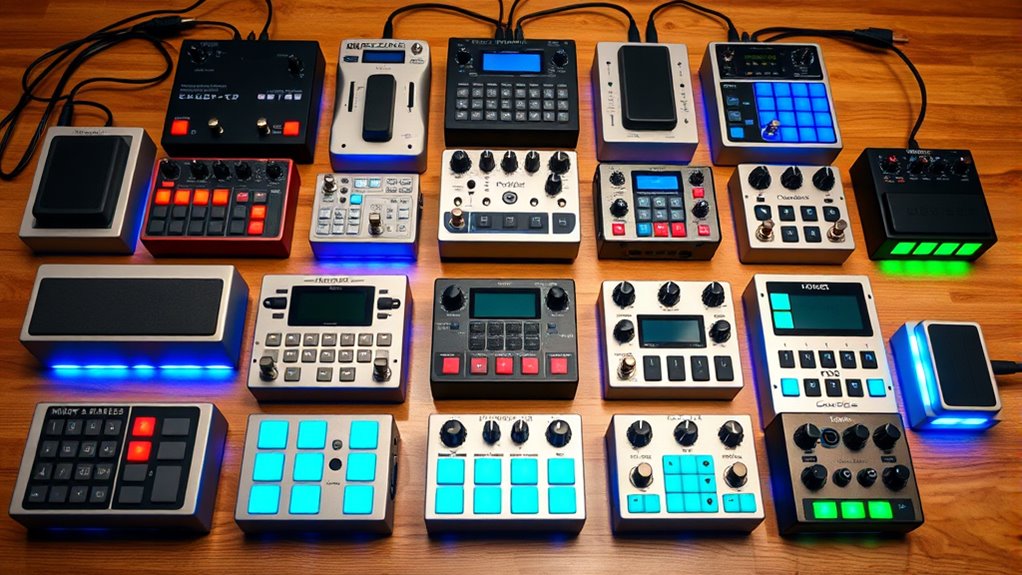
For musicians seeking versatile control over their MIDI gear, programmable MIDI foot controllers offer unmatched flexibility. The JG3 Tech 24 Note MIDI Bass Pedalboard stands out for its extensive note capacity and dedicated pedalboard layout, ideal for organ players and performers needing complex control. Meanwhile, the GOKKO GAM-10 AirMini Wireless MIDI Foot Controller shines with wireless convenience and app customization, perfect for on-the-fly adjustments during live shows. Most options balance between wired reliability and wireless freedom, but tradeoffs often include complexity, size, or price. Continue reading for a detailed breakdown of each product and which suits your specific needs best.
Complete the kit


Key Takeaways
- The top picks balance between wired stability and wireless flexibility, catering to different performance styles.
- Ease of use and app customization features are key differentiators among the best programmable options.
- Build quality and durability vary widely; premium picks often offer more robust construction for stage use.
- Pricing reflects complexity and feature set; more advanced controllers tend to cost more but deliver greater versatility.
- Size and portability are important considerations—compact models excel for gigging musicians with limited space.
| JG3 Tech 24 Note MIDI Bass Pedalboard – Organ Foot Controller for Hammond, Nord, Mojo & MIDI Keyboards |  | Best Overall for Authentic Organ Feel | Weight: 15 lbs | Dimensions: 33 in x 19 in x 5 in | Compatibility: Hammond, Nord, Mojo, MIDI Keyboards | VIEW ON AMAZON | See Our Full Breakdown |
| GOKKO GAM-10 AirMini Wireless MIDI Foot Controller with App Editing |  | Best for Versatile Wireless Control | Wireless: Yes | MIDI Control: Supported | Modes: Program Change, Custom MIDI, Advanced Custom, Touchscreen, Video, Keyboard, Multimedia, Custom Keyboard, Mixed Key | VIEW ON AMAZON | See Our Full Breakdown |
| M-VAVE Chocolate Plus MIDI Footswitch Controller Pedal, 4 Buttons, USB Compatible, APP Control, Portable |  | Best for Portable, USB MIDI Control | Number of Buttons: 4 | Connectivity: USB Type-C, BLE | Battery Life: 12 hours | VIEW ON AMAZON | See Our Full Breakdown |
| M-VAVE Chocolate Plus Wireless MIDI Foot Controller with 4 Buttons, Bluetooth Rechargeable, APP Control |  | Best Compact Wireless Bluetooth Control | Connectivity: Bluetooth | Platform Compatibility: Windows, Mac, iOS, Android | Buttons: 4 | VIEW ON AMAZON | See Our Full Breakdown |
| M-VAVE Chocolate Plus Wireless MIDI Foot Controller with 4 Buttons |  | Best Basic Wireless MIDI Control | Connectivity: Bluetooth | Platform Compatibility: Windows, Mac, iOS, Android | Buttons: 4 | VIEW ON AMAZON | See Our Full Breakdown |
| Behringer FCB1010 MIDI Foot Controller with Expression Pedals |  | Best Overall for Customization and Flexibility | Banks: 10 | Presets per bank: 10 | Expression pedals: 2 | VIEW ON AMAZON | See Our Full Breakdown |
| M-VAVE Chocolate Wireless MIDI Controller, Bluetooth Pedal Footswitch with Topper & Audio Cable |  | Best Wireless for Convenience and Portability | Connectivity: Bluetooth MIDI | Battery Life: 12 hours | Programmable footswitches: 4 | VIEW ON AMAZON | See Our Full Breakdown |
| Nektar Pacer – USB MIDI Footswitch Controller with DAW Integration |  | Best for DAW Integration and Studio Control | Number of foot switches: 10 | Connectable foot switch pedals: up to 4 | Relay outputs: 4 | VIEW ON AMAZON | See Our Full Breakdown |
| midi foot controllers programmable | Connectivity |
|---|---|
| JG3 Tech 24 Note MIDI Bass Ped | — |
| GOKKO GAM-10 AirMini Wireless | — |
| M-VAVE Chocolate Plus MIDI Foo | USB Type-C, BLE |
| M-VAVE Chocolate Plus Wireless | Bluetooth |
| M-VAVE Chocolate Plus Wireless | Bluetooth |
| Behringer FCB1010 MIDI Foot Co | — |
| M-VAVE Chocolate Wireless MIDI | Bluetooth MIDI |
| Nektar Pacer | — |
More Details on Our Top Picks
JG3 Tech 24 Note MIDI Bass Pedalboard – Organ Foot Controller for Hammond, Nord, Mojo & MIDI Keyboards
The JG3 Tech 24 Note MIDI Bass Pedalboard stands out for its authentic Hammond-style radial curve, making it ideal for players seeking a genuine organ pedal experience. Compared with the M-VAVE Chocolate Plus, which offers portability and modern connectivity, the JG3 excels in replicating the traditional pedalboard feel, but it comes at a weight of 15 lbs, making it less portable. Its LCD menu simplifies control over MIDI channels, volume, and transpose functions, providing intuitive operation for seasoned players. However, the hinged design requires careful handling to avoid damage, especially during setup or transport. This pedalboard makes the most sense for organists or keyboardists wanting a tactile, realistic pedal experience without sacrificing MIDI compatibility, but it might be overkill for casual or stage performers requiring lightweight gear.
Pros:- Authentic Hammond pedalboard radial curve
- Compatible with multiple keyboard brands
- Includes an LCD menu for easy adjustments
Cons:- Heavy at 15 lbs, less portable
- Hinged design may require careful handling
Best for: Organ players or keyboardists who prioritize authentic pedalboard feel and detailed MIDI control
Not ideal for: Musicians seeking ultra-lightweight, portable solutions or quick setup for casual gigs
- Weight:15 lbs
- Dimensions:33 in x 19 in x 5 in
- Compatibility:Hammond, Nord, Mojo, MIDI Keyboards
- Features:LCD menu, MIDI channel change, volume pedal on/off, transpose
Our verdict“This is the best choice for players who want a realistic, tactile pedalboard with comprehensive MIDI features, despite its weight and fragile hinges.”
GOKKO GAM-10 AirMini Wireless MIDI Foot Controller with App Editing
The GOKKO GAM-10 AirMini offers a flexible, wireless MIDI control experience, supporting a broad array of modes such as Program Change, Custom MIDI, and Video Control, making it ideal for performers who need hands-free, multi-function control. Compared with the M-VAVE Chocolate Plus Bluetooth, the GOKKO’s support for multiple modes and app customization provides a broader scope for complex setups, though it requires initial software configuration which may be daunting for beginners. Its wireless operation means no cables clutter the stage, but limited detail on battery range and life suggests potential connectivity issues during longer performances. This pick suits tech-savvy musicians or producers wanting extensive control options, yet those preferring plug-and-play simplicity should consider other options.
Pros:- Supports a wide range of MIDI modes for diverse control
- Wireless design eliminates cable clutter
- Supports app-based customization for workflows
Cons:- Requires software setup, which can be complex
- Learning curve for new users
- Limited info on battery life and range
Best for: Performers or producers needing customizable, multi-mode wireless MIDI control
Not ideal for: Users who prefer simple, plug-and-play devices without software setup or extensive customization
- Wireless:Yes
- MIDI Control:Supported
- Modes:Program Change, Custom MIDI, Advanced Custom, Touchscreen, Video, Keyboard, Multimedia, Custom Keyboard, Mixed Key
- Compatibility:Windows, Mac OS
Our verdict“Ideal for advanced users needing flexible, multi-mode wireless control, but not suited for those seeking quick, straightforward setup.”
M-VAVE Chocolate Plus MIDI Footswitch Controller Pedal, 4 Buttons, USB Compatible, APP Control, Portable
The M-VAVE Chocolate Plus provides a compact, portable solution with 4 programmable buttons, ideal for musicians who need reliable USB connectivity and app control on the go. When compared to the GOKKO GAM-10, which offers wireless versatility, the M-VAVE excels in straightforward USB connection and durability, making it better suited for studio use or quick setups. Its sturdy metal construction and rechargeable battery support demanding live performances, but the limited number of buttons might constrain complex setups. Users will appreciate its plug-and-play nature, yet beginners may need time to familiarize themselves with the app’s functionalities. This controller is perfect for mobile musicians and studio operators who value simplicity and durability over extensive control options.
Pros:- Sturdy metal construction for durability
- Rechargeable long-lasting battery
- USB connectivity for easy setup
Cons:- Limited to 4 programmable buttons
- Requires initial setup and learning curve
Best for: Musicians needing a durable, portable USB MIDI footswitch for studio or stage use
Not ideal for: Performers requiring more than 4 control buttons or wireless features for complex performance setups
- Number of Buttons:4
- Connectivity:USB Type-C, BLE
- Battery Life:12 hours
- Material:Sturdy metal
Our verdict“Best suited for mobile or studio users seeking a rugged, USB-based MIDI footswitch with straightforward control, at the expense of button count.”
M-VAVE Chocolate Plus Wireless MIDI Foot Controller with 4 Buttons, Bluetooth Rechargeable, APP Control
The M-VAVE Chocolate Plus Wireless offers a sleek, Bluetooth-based foot controller with 4 assignable buttons, suitable for performers needing mobility and platform versatility. Unlike the GOKKO, which supports multiple modes, this model emphasizes simplicity with Bluetooth connectivity and app control, making it ideal for mobile musicians. Its 12-hour battery life and portable size make it great for performances or practice, but reliance on the app for full functionality could complicate setup, especially for less tech-savvy users. Compared to the USB version, this device prioritizes convenience but limits control complexity by only offering 4 buttons. It’s a solid choice for users wanting wireless mobility within a familiar app environment, yet not for those who need extensive MIDI controls.
Pros:- Wireless Bluetooth connectivity
- Long-lasting 12-hour battery
- Compatible with multiple platforms including mobile devices
Cons:- Requires app setup for full functionality
- Limited to 4 buttons, restricting complex commands
- Potential connectivity issues in crowded environments
Best for: Mobile performers and home studio users who prioritize wireless convenience and app integration
Not ideal for: Musicians who require large control setups or prefer wired reliability over Bluetooth
- Connectivity:Bluetooth
- Platform Compatibility:Windows, Mac, iOS, Android
- Buttons:4
- Battery:300mAh rechargeable
Our verdict“This controller is ideal for mobile and stage performers seeking wireless flexibility and app-controlled operation, with some limitations on control complexity.”
M-VAVE Chocolate Plus Wireless MIDI Foot Controller with 4 Buttons
The M-VAVE Chocolate Plus wireless model offers a simple, rechargeable Bluetooth foot controller with 4 buttons, designed for basic MIDI control across multiple platforms. Compared with the Bluetooth-enabled version with app control, this model emphasizes straightforward wireless connectivity without the need for complex app setups, appealing to users who prefer minimal configuration. Its 12-hour battery life and portable size suit live performances or practice sessions. However, the limited number of buttons may restrict complex control schemes, and the reliance on Bluetooth can introduce stability issues in certain environments. This option fits users who want quick, reliable wireless MIDI control without the extras but may fall short for advanced control needs.
Pros:- Wireless Bluetooth connection
- Long battery life of 12 hours
- Portable, compact design
Cons:- Limited to 4 buttons for control
- Dependent on Bluetooth stability
- No app customization for advanced users
Best for: Performers or hobbyists seeking a simple, portable wireless MIDI foot controller with minimal setup
Not ideal for: Users requiring extensive control options or wired reliability for critical performances
- Connectivity:Bluetooth
- Platform Compatibility:Windows, Mac, iOS, Android
- Buttons:4
- Battery:Rechargeable 300mAh
Our verdict“This controller is perfect for users who want a straightforward, portable wireless MIDI solution without complex configuration or multiple controls.”
Behringer FCB1010 MIDI Foot Controller with Expression Pedals
The Behringer FCB1010 stands out for its extensive customization options, offering 10 banks with 10 presets each, along with two assignable expression pedals. Compared to more streamlined options like the Nektar Pacer, it provides a broader range of MIDI commands and relay controls, making it ideal for complex setups. However, its setup process can be daunting for newcomers, and its bulky design reduces portability. It’s perfect for musicians who need deep control over multiple devices but may be overkill for simpler needs. The absence of audio output means it remains purely a control device, not an all-in-one solution.Pros:- Highly customizable with 10 banks and 10 presets each
- Includes two assignable expression pedals for dynamic control
- Supports a wide variety of MIDI commands, including program changes and note triggers
Cons:- Complex setup process can be intimidating for new users
- Bulky and less portable due to its size and multiple components
Best for: Advanced live performers and studio musicians who require extensive preset management and MIDI control customization.
Not ideal for: Beginners or those seeking a lightweight, straightforward foot controller for simple tasks, as the setup complexity could be a barrier.
- Banks:10
- Presets per bank:10
- Expression pedals:2
- MIDI program change commands:5 per preset
- MIDI controller commands:2 per preset
- Relay-controlled switch jacks:2
Our verdict“This pick suits experienced performers who need detailed control and are comfortable with a steeper setup process.”
M-VAVE Chocolate Wireless MIDI Controller, Bluetooth Pedal Footswitch with Topper & Audio Cable
The M-VAVE Chocolate Plus offers the freedom of wireless control thanks to Bluetooth connectivity, making it ideal for performers who dislike cable clutter. Its rechargeable battery provides up to 12 hours of use, surpassing many wired options like the Behringer FCB1010 in convenience, especially on stage. The four programmable footswitches with an LED display allow quick customization, but reliance on Bluetooth apps can complicate initial setup, and device compatibility narrows its use. Compared with the Nektar Pacer’s wired stability, it prioritizes mobility, which is a significant advantage for mobile performers but might be limiting in studio environments with complex setups.Pros:- Wireless Bluetooth connectivity reduces cable clutter
- Long-lasting rechargeable battery with 12 hours of use
- Customizable footswitches with visual LED feedback
- Compact, durable metal housing for portability
Cons:- Dependent on Bluetooth-enabled devices and compatible apps
- Setup can be complex for users unfamiliar with Bluetooth MIDI
Best for: Musicians who value wireless operation, portability, and quick setup for live performances or studio use with compatible devices.
Not ideal for: Users working primarily in studio environments or with non-Bluetooth devices, as setup complexity and compatibility issues could hinder usability.
- Connectivity:Bluetooth MIDI
- Battery Life:12 hours
- Programmable footswitches:4
- Display:LED screen
- Compatibility:Windows, Mac, iOS, Android
- Build Material:Metal
Our verdict“Ideal for performers seeking wireless freedom and portability without sacrificing basic programmability.”
Nektar Pacer – USB MIDI Footswitch Controller with DAW Integration
The Nektar Pacer excels in controlling digital audio workstations, thanks to its 10 programmable switches and extensive MIDI features. It offers seamless USB and MIDI connectivity, making it a natural choice for studio users who want hands-free control over recording workflows, unlike the Behringer FCB1010’s focus on hardware presets. Its relay outputs and expression pedal inputs add versatility, but the configuration complexity can be a hurdle for beginners. This device is best suited for musicians with a home studio or live setup that relies heavily on DAW automation, rather than standalone instrument control. Its focus on software integration makes it less ideal for purely hardware-based setups.Pros:- Supports both MIDI and USB for flexible connectivity
- Includes relay outputs and expression pedal inputs for expanded control
- Designed specifically for DAW and software integration
Cons:- May be too complex for beginners unfamiliar with MIDI setup
- Limited to MIDI and DAW control, not suitable as a standalone instrument controller
Best for: Studio musicians and producers who need reliable DAW control and extensive MIDI capabilities within their digital workflows.
Not ideal for: Performers seeking a simple, standalone foot controller without the need for DAW integration, as its configuration complexity can be daunting.
- Number of foot switches:10
- Connectable foot switch pedals:up to 4
- Relay outputs:4
- Expression pedal inputs:2
- Outputs:MIDI and USB
- Included software:Bigwig Studio 8-track DAW + sound content
Our verdict“This device best suits studio users and producers who require deep integration with digital audio workstations.”

How We Picked
To determine the best programmable MIDI foot controllers, I evaluated each option based on performance, ease of use, build quality, customization capabilities, and value for money. I prioritized controllers that offer reliable connectivity, intuitive interfaces, and flexibility in programming, ensuring they suit both live performance and studio use. Products were ranked by how well they balance advanced features with user-friendly operation, considering the typical needs of musicians at different skill levels. This approach ensures that the top picks are not only feature-rich but also accessible and durable for real-world use.| midi foot controllers programmable | Connectivity |
|---|---|
| JG3 Tech 24 Note MIDI Bass Ped | — |
| GOKKO GAM-10 AirMini Wireless | — |
| M-VAVE Chocolate Plus MIDI Foo | USB Type-C, BLE |
| M-VAVE Chocolate Plus Wireless | Bluetooth |
| M-VAVE Chocolate Plus Wireless | Bluetooth |
| Behringer FCB1010 MIDI Foot Co | — |
| M-VAVE Chocolate Wireless MIDI | Bluetooth MIDI |
| Nektar Pacer | — |
Factors to Consider When Choosing Midi Foot Controllers Programmable
Selecting the right programmable MIDI foot controller involves understanding your specific performance needs and how the device integrates into your setup. Factors such as connectivity options, programmability, size, and durability play crucial roles. Beyond individual features, consider how intuitive the device is to program and operate, especially under live conditions. Making the right choice can streamline your workflow, but choosing a model that’s overly complex or underpowered can hinder your performance. Keep these factors in mind to find a controller that enhances your musical expression without adding unnecessary complexity.Connectivity and Compatibility
Ensure the controller supports your preferred connection type—USB, Bluetooth, or MIDI DIN—and is compatible with your existing gear and DAWs. Wireless options like Bluetooth offer convenience but can introduce latency issues, so verify that latency remains acceptable for your performance style. Some controllers include multiple connection options, providing flexibility for various setups. Compatibility with popular DAWs and MIDI devices also affects how seamlessly the controller integrates into your workflow, making this a key consideration.
Ease of Programming and Customization
Look for controllers that offer straightforward programming interfaces, whether via dedicated software or mobile apps. Devices with intuitive interfaces reduce setup time and minimize errors during live use. Advanced users may appreciate extensive customization options, like assigning multiple commands or macros to a single footswitch. However, overly complex programming environments can be intimidating for beginners, so balance your skill level with the device’s learning curve when choosing.
Size, Portability, and Build Quality
Size and weight matter depending on how and where you perform. Compact controllers are easier to transport but may sacrifice some functionality or number of switches. Conversely, larger pedalboards or controllers with numerous buttons suit studio setups or stage use but may be less convenient to carry. Durable construction and quality materials ensure longevity, especially if you perform regularly outdoors or in demanding environments. Consider your typical performance context to find a balance between portability and durability.
Price and Value
Prices range from budget-friendly models to premium controllers with extensive features. Cheaper options might lack advanced customization or wireless capabilities but still provide essential programmability. Conversely, investing in a higher-end model can offer more robust build quality, better connectivity, and richer feature sets, which often justify the higher cost for serious performers. Assess your budget against your performance needs to avoid overpaying for features you won’t use or underinvesting in a device that might limit your growth.
Additional Features and Future-Proofing
Some controllers include extra features such as expression pedal inputs, multiple banks of presets, or integration with specific DAWs. Consider whether these extras align with your current or future needs to maximize your investment. Firmware updates and manufacturer support can extend the lifespan of your device, making future-proofing an important aspect. Choosing a model with ongoing support and expandability can save money and hassle over time.
Frequently Asked Questions
Can I use a programmable MIDI foot controller with any MIDI-compatible device?
Most programmable MIDI foot controllers are designed to be compatible with a wide range of MIDI devices, including synthesizers, DAWs, and effects processors. However, it’s important to verify the specific compatibility details from the manufacturer, especially if you rely on particular features or protocols. Some controllers support only standard MIDI messages, while others may include proprietary features or require specific software. Ensuring compatibility beforehand helps avoid issues during setup or live performance.
Is wireless connectivity reliable enough for live performance?
Wireless MIDI controllers, such as those using Bluetooth, have improved significantly but may still experience latency or interference issues in crowded environments. For high-stakes live situations, wired connections generally offer more stability and zero latency. However, if you prioritize freedom of movement, choosing a well-reviewed wireless model with low latency and reliable pairing can work well, especially for less timing-critical applications. Testing your setup thoroughly before performing live is recommended.
How many preset banks can I typically program into a MIDI foot controller?
The number of preset banks varies widely among models, from a handful to dozens. More advanced controllers often include multiple banks, allowing you to organize different sounds or effects for various songs or sections. Consider how many presets you’ll need for your typical performances and choose a model that offers enough banks to avoid constant reprogramming. Keep in mind that larger banks may require more complex programming or software management.
Do I need special software to program these controllers?
Most programmable MIDI controllers come with dedicated software or mobile apps designed for easy programming and customization. Some models also support firmware updates and macro programming through these interfaces. The ease of use varies; user-friendly software reduces setup time, while more complex environments may offer deeper customization at the cost of a steeper learning curve. Check whether the software is compatible with your operating system and whether it’s intuitive enough for your skill level.
Are higher-priced models worth the extra investment?
Higher-priced MIDI foot controllers often feature more extensive customization options, better build quality, and wireless capabilities, which can justify the investment for serious performers. If you perform regularly, rely heavily on preset switching, or need robust durability, investing in a premium model can improve your workflow and reduce technical issues. However, for casual or beginner use, a mid-range or budget model might suffice, offering good functionality without the higher cost.
Conclusion
For those seeking the best overall experience with extensive programmability and reliable performance, the GOKKO GAM-10 AirMini Wireless MIDI Foot Controller makes a compelling choice thanks to its wireless flexibility and app customization. Beginners or casual performers might find the M-VAVE Chocolate Plus Wireless MIDI Foot Controller more accessible due to its simplicity and affordability. For stage-ready durability and complex setups, the Behringer FCB1010 MIDI Foot Controller offers a wired, robust option. Meanwhile, users with specific DAW integration needs should consider the Nektar Pacer for seamless studio workflow. Your ideal pick depends on your performance frequency, technical comfort, and budget.