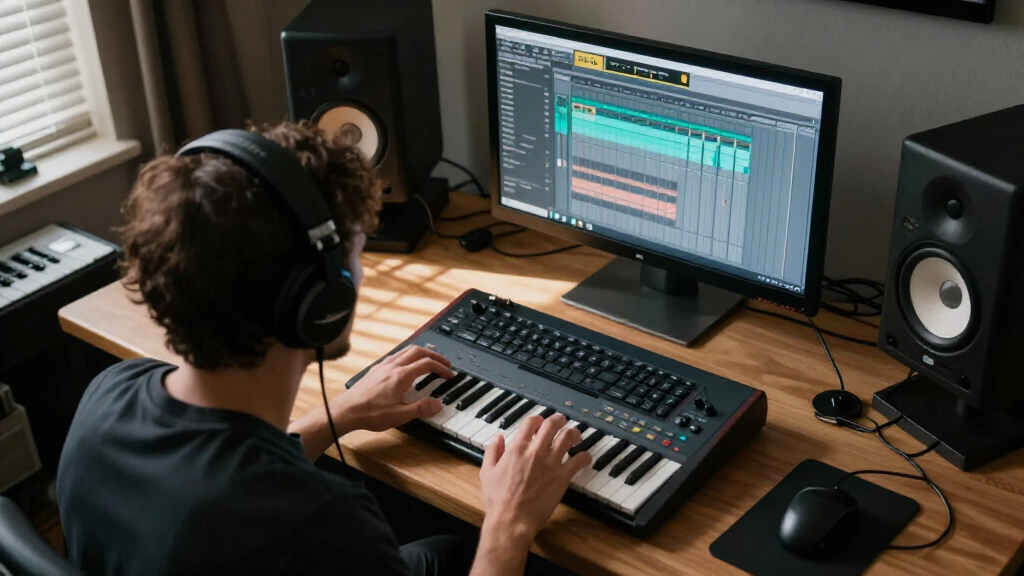

Choosing studio headphones for music production often means balancing an honest, revealing sound against comfort and isolation you can live with through a long session. The Sony MDR-7506 and Beyerdynamic DT 770 Pro are both closed-back headphones used for recording and editing, but they suit different priorities. The Sony is lighter, folds compactly and tends to make upper-mid and treble details stand out; the Beyerdynamic costs more but has plush replaceable ear pads and a more spacious presentation for a closed-back design. Choose the MDR-7506 for portability, familiar utility and tighter spending. Choose the DT 770 Pro if comfort and keeping sound from leaking into a microphone matter more.

Get audio and creator gear delivered free with Prime
- Fast, free delivery on millions of items
- Prime Video, Amazon Music and more included
- Member-only deals all year

Audio-Technica ATH-M50x Professional Studio Monitor Headphones, Black
- ✔ Driver size: 45 mm
- ✔ Driver type: Dynamic
- ✔ Frequency response: 20 Hz–28,000 Hz

Audio-Technica ATH-M20x Professional Studio Monitor Headphones
- ✔ Driver size: 40 mm
- ✔ Driver type: Dynamic
- ✔ Frequency response: 15–20,000 Hz

Sony MDR-7506 Professional Studio Headphones
- ✔ Driver size: 40 mm
- ✔ Frequency response: 10 Hz–20 kHz
- ✔ Connectivity: Wired
At a Glance
| Criteria | Sony MDR-7506 | Beyerdynamic DT 770 Pro | Winner |
|---|---|---|---|
| Sound character for production | Detailed, lively presentation; upper frequencies can sound prominent | More spacious image, with bass and treble emphasis that still needs reference checks | Depends |
| Comfort over long sessions | Lightweight, but compact ear cups and pleather pads may feel warm or cramped | Generally more comfortable for extended wear; soft, replaceable velour pads | B |
| Isolation and sound leakage | Useful closed-back isolation for tracking; moderate leakage at high volume | Strong isolation for tracking and reduced spill, though not silent | B |
| Portability and durability | Folds for storage; included pouch and coiled cable, with a less serviceable build | Does not fold; sturdy construction and replaceable parts, with a long cable | A |
| Amplifier compatibility | Low 63-ohm impedance is generally easy to drive from common interfaces | Available in 32, 80 and 250-ohm versions; higher-impedance versions may need more output | A |
| Price and value | Usually less expensive; replaceable pads and cable support long-term use | Costs more; higher price buys comfort, isolation and serviceable parts | Depends |
Audio-Technica ATH-M50x Professional Studio Monitor Headphones, Black
The ATH-M50x is the strongest fit for producers who move between recording, monitoring, and checking a mix. Its 90-degree swiveling earcups make one-ear monitoring a stated use case, which can be handy when we need to hear a performer or a room without removing the headphones entirely. The detachable cable also gives this model a practical advantage over the fixed-cord MDR-7506 and the ATH-M20x, whose description specifies a single-sided cable but does not say it detaches.Audio-Technica lists 45 mm dynamic drivers and describes the sound as clear across an extended range, with deep, accurate bass. That makes the M50x the most feature-rich monitoring option in this group, but the supplied specifications alone cannot establish how neutral it will sound in a particular room or whether it suits every mix decision. As with the other two closed-back models, its design favors isolation and tracking utility over an open presentation.We would choose it over the ATH-M20x when monitoring flexibility matters, and over the Sony when a detachable cable is more useful than foldable storage and a bundled case. The tradeoff is that it remains a wired, non-water-resistant headphone, so it is intended for controlled studio use rather than wet or highly mobile settings. For producers seeking one model in this lineup to cover the broadest range of studio tasks, the extra handling features make the M50x the clearest overall choice.
Pros:
- 90-degree swiveling earcups support one-ear monitoring.
- Detachable cable offers easier cable replacement or setup changes.
- 45 mm dynamic drivers are described as delivering clear sound and deep, accurate bass.
- Circumaural earcups are designed to isolate sound in louder environments.
Cons:
- Wired connectivity restricts movement away from the audio source.
- The supplied specifications state that it is not water resistant.
- The listed frequency range does not by itself establish mix neutrality.
Best for: Producers who record and monitor regularly and want one-ear monitoring plus a detachable cable.
Not ideal for: Anyone who needs wireless listening, water resistance, or an explicitly described compact folding design.
Bottom line: The ATH-M50x is our most versatile production pick because its swiveling cups and detachable cable support more studio workflows than the other two models.
“The ATH-M50x is our most versatile production pick because its swiveling cups and detachable cable support more studio workflows than the other two models.”
Audio-Technica ATH-M20x Professional Studio Monitor Headphones
For a producer who mainly needs closed-back headphones for recording and routine monitoring, the ATH-M20x keeps the feature set direct. Its circumaural earcups are described as providing sound isolation and helping minimize audio bleed, a useful priority when a microphone is open nearby. The single-sided cable exit can also keep the cord routed from one side of the setup rather than both.Audio-Technica lists 40 mm dynamic drivers tuned for enhanced low-frequency performance. That emphasis may appeal when monitoring bass-heavy material, though it is a different stated approach from the M50x’s description of deep, accurate bass across an extended range. We would not infer that the M20x is automatically less suitable for mixing; instead, its simpler stated feature set makes it a more focused pick for tracking and monitoring rather than the most flexible choice for varied studio routines.Compared with the ATH-M50x, the M20x does not list swiveling earcups or a detachable cable, so producers who rely on one-ear monitoring or want to change cables should step up to the M50x. Compared with the Sony MDR-7506, it emphasizes a suspension headband and durable materials for extended use, while the Sony offers folding storage and a case. The 9.8-foot wired cable provides reach at a desk or tracking setup, but it still tethers us to the source. This is a sensible pick when the job is clear and the added handling options of the M50x are not essential.
Pros:
- Circumaural earcups are designed to isolate sound and reduce audio bleed.
- 40 mm drivers are tuned for enhanced low-frequency performance.
- Single-sided cable exit can simplify cord routing.
- Suspension headband and durable materials are intended for extended sessions.
Cons:
- Wired connection limits movement around the studio.
- The description does not specify swiveling earcups or a detachable cable.
- Its listed role centers on monitoring, tracking, and mixing rather than broader portable use.
Best for: Home producers and recording setups that need closed-ear tracking and monitoring with a single-sided cable.
Not ideal for: Producers who need a detachable cable, one-ear monitoring, or wireless movement around the studio.
Bottom line: The ATH-M20x suits focused tracking and monitoring, while producers wanting more flexible handling should choose the ATH-M50x.
“The ATH-M20x suits focused tracking and monitoring, while producers wanting more flexible handling should choose the ATH-M50x.”
Sony MDR-7506 Professional Studio Headphones
The Sony MDR-7506 stands out for practical storage: its over-ear design folds, and the package includes a soft case and a 1/4-inch adapter. That combination can suit producers who carry headphones between a home setup, rehearsal space, or studio. The closed-ear construction is also described as reducing external noise, so the model remains relevant to recording and monitoring rather than serving only as a travel pair.Its 40 mm drivers have a listed frequency response of 10 Hz–20 kHz. That range differs from the ATH-M20x’s 15–20,000 Hz and the M50x’s 20 Hz–28,000 Hz, but we should not rank these headphones by frequency numbers alone: the specs do not tell us how evenly each model reproduces that range. The Sony’s strongest differentiators are the foldable build and included accessories, not a stated advantage in mixing accuracy.The main compromise is its non-detachable 9.8-foot cord. The ATH-M50x is the more adaptable choice if cable replacement and one-ear monitoring matter, while the ATH-M20x offers a single-sided cable design and a headband described for extended use. The MDR-7506 also has no wireless connectivity, so folding it for transport does not make it untethered in a session. Choose it when compact storage and the included 1/4-inch adapter fit the workflow; skip it if a fixed cord would be frustrating in a busy studio.
Pros:
- Foldable design is convenient for storage and transport.
- Soft case and 1/4-inch adapter are included.
- Closed-ear design is described as reducing external noise.
- Long cord supports connection to studio equipment at a desk.
Cons:
- The 9.8-foot cord is not detachable.
- No wireless connectivity is specified.
- Unlike the ATH-M50x, the supplied description does not mention swiveling earcups.
Best for: Producers who move headphones between workspaces and value foldable storage, a case, and a 1/4-inch adapter.
Not ideal for: Anyone who wants a detachable or wireless cable, or who prioritizes one-ear monitoring.
Bottom line: The MDR-7506 is the practical compact pick for moving between setups, provided its fixed cord fits your studio routine.
“The MDR-7506 is the practical compact pick for moving between setups, provided its fixed cord fits your studio routine.”
As an Amazon Associate we earn from qualifying purchases.
Key Differences
The clearest practical split is wearability versus portability. DT 770 Pro’s velour pads and roomy fit tend to suit long editing, mixing and tracking sessions better, while the MDR-7506 is lighter and folds into a smaller package. If headphones are worn for hours, the Beyerdynamic’s comfort can justify the premium. If they are carried between rooms or used as a reliable second pair, the Sony’s compactness is more useful.
Neither headphone is a neutral reference that makes room monitors unnecessary. MDR-7506’s forward upper detail can expose clicks, hiss and vocal consonants, but can also make bright material seem more pronounced. DT 770 Pro often feels wider and has a fuller, more extended bass presentation, yet its tonal balance also calls for reference tracks. Both work well for recording; the DT 770 Pro’s stronger isolation gives it the advantage near sensitive microphones. For final tonal decisions, check mixes on speakers or another familiar reference.
Detailed Comparison
Sound character for production (moderate difference)
MDR-7506 presents detail in a direct, sometimes bright way, which helps locate edits, noise and sharp vocal sounds. DT 770 Pro sounds more spacious and can make bass feel fuller, but neither is perfectly flat. This is a moderate, preference-dependent difference: Sony suits fault-finding, while Beyerdynamic can feel less confined for extended listening. Use reference material with either before committing to tonal balance.
Comfort over long sessions (Beyerdynamic DT 770 Pro wins — major)
DT 770 Pro wins for most extended sessions. Its velour pads are replaceable and usually feel softer and roomier than the Sony’s smaller pleather pads, which can become warm. The difference is moderate to major for producers who wear headphones for several hours; for short edits, the MDR-7506’s low weight may be enough.
Isolation and sound leakage (Beyerdynamic DT 770 Pro wins — moderate)
DT 770 Pro generally blocks outside sound and limits leakage better, making it the stronger choice for recording vocals or instruments near an open microphone. MDR-7506 still provides useful closed-back isolation, but it is less convincing in noisy rooms or when spill must be controlled. This is a moderate advantage in ordinary editing and a major one for close-mic tracking.
Portability and durability (Sony MDR-7506 wins — moderate)
MDR-7506 folds and is easier to pack, while DT 770 Pro has a bulkier fixed shape and long cable. The Beyerdynamic counters with sturdy construction and replaceable pads and components, which helps with repair over time. Sony wins for transport; Beyerdynamic is attractive for a mostly stationary studio where serviceability matters more. The gap is moderate.
Amplifier compatibility (Sony MDR-7506 wins — minor)
The 63-ohm MDR-7506 is an uncomplicated match for many audio interfaces, laptops and portable recorders. DT 770 Pro comes in 32-, 80- and 250-ohm versions; the higher-impedance models may need more output to reach the same listening level. Sony is the easier general-purpose pick, while the Beyerdynamic requires choosing the version to fit the source. This is a minor gap if the correct model is selected.
Price and value (moderate difference)
MDR-7506 usually costs less and gives a working producer a proven closed-back headphone without requiring a dedicated amplifier. DT 770 Pro costs more, and the extra spend makes sense mainly when its comfort, isolation or replaceable parts solve a real need. Sony is the stronger budget value; Beyerdynamic can be better value for people who wear headphones all day. The winner depends on use.
Sony MDR-7506: Pros and Cons
Pros:
- Folds compactly for storage and travel
- Lightweight and easy to drive from many interfaces
- Prominent detail can help identify edits, hiss and harsh consonants
- Typically lower cost than DT 770 Pro
Cons:
- Pleather pads may feel warm during long sessions
- Smaller ear cups may feel cramped for some listeners
- Bright presentation can make tonal balance harder to judge without references
- Less isolation than DT 770 Pro
Beyerdynamic DT 770 Pro: Pros and Cons
Pros:
- Comfortable velour pads suit longer sessions and can be replaced
- Stronger isolation for recording near open microphones
- Spacious presentation for a closed-back headphone
- Sturdy, serviceable design with multiple impedance versions
Cons:
- Higher cost requires a clear comfort or isolation benefit to justify
- Bulkier and does not fold for packing
- 250-ohm version may need a stronger headphone output
- Bass and treble character still requires mix checks on references
Who Should Choose What
Choose Sony MDR-7506 if:
- You need a dependable, lower-cost pair for editing, tracking and everyday studio use.
- You travel with headphones or want a pair that folds into a smaller space.
- Your interface or recorder has limited headphone output and easy drive matters.
- You prefer a direct, revealing presentation for spotting noise and edit problems.
Choose Beyerdynamic DT 770 Pro if:
- You wear headphones for long sessions and value softer pads and a roomier fit.
- You record vocals or instruments near an open microphone and need stronger isolation.
- You want replaceable comfort parts and a sturdy pair for a stationary studio.
- You have the budget and source output for the DT 770 Pro impedance version you choose.
Skip both if: You need a single, neutral reference for final mix translation; compare either with monitors or a flatter, familiar reference headphone before making tonal decisions.
Value for Money
The MDR-7506 is the better value for most budget-conscious producers: it costs less, is easy to drive and handles common editing and tracking work. Pay more for DT 770 Pro if you spend long hours wearing headphones, need reduced spill while recording, or expect to replace worn pads over years of use. Its 250-ohm version may also call for a more capable headphone output, so check your interface before buying. The premium is harder to justify for occasional use or a portable backup.
Final Verdict
For most producers seeking one affordable closed-back studio pair, choose the Sony MDR-7506. It is light, packable, easy to power and capable for everyday tracking and editing. Choose the Beyerdynamic DT 770 Pro if long-session comfort or stronger isolation will improve your daily work; those are meaningful benefits that can justify its higher price. The deciding factor is use: portability and cost favor Sony, while comfort and microphone isolation favor Beyerdynamic. Neither should be your only judge of final mix balance.
Frequently Asked Questions
Which is better for recording vocals, MDR-7506 or DT 770 Pro?
DT 770 Pro is usually the better choice when microphone spill is a concern because it isolates more effectively. MDR-7506 can still work for vocal tracking, especially at moderate headphone levels.
Are either of these headphones suitable for mixing?
Both can support editing and mix work, but neither should be treated as a perfectly neutral reference. Check tonal decisions against familiar reference tracks and, where possible, speakers.
Which DT 770 Pro impedance should I buy?
The 32- and 80-ohm versions are easier matches for many portable sources and interfaces. The 250-ohm version may need a stronger headphone output; confirm your equipment can drive it adequately.
Is the DT 770 Pro worth paying more for?
Yes if comfort during long sessions, stronger isolation or replaceable parts matter in your studio. If you need an affordable, portable pair for general production, MDR-7506 is the better value.