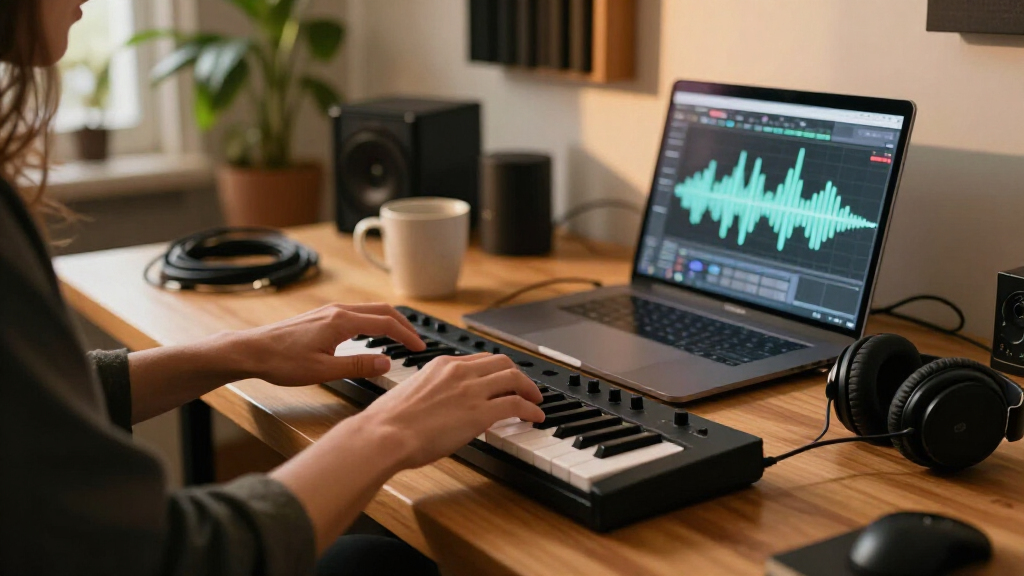
For most producers, I’d start with the Akai Professional MPK Mini IV: it combines compact keys, pads, and controls in a focused setup for producing with software instruments. The M-Audio Oxygen 49 MKV suits players who want more keyboard range, while the Akai MIDImix is a stronger fit for hands-on mixing than note entry. The main tradeoff is between key range, portability, and dedicated controls; a compact unit can save desk space but may feel limiting for two-handed playing or detailed editing. Read on for all 15 options, their tradeoffs, and the kinds of music-production setups each one suits.

Get audio and creator gear delivered free — and shop member deals
- Fast, free delivery on millions of items
- Access to Prime Big Deal Days deals on October 6–7
- Prime Video, Amazon Music and more included
Complete the kit


Key Takeaways
- The MPK Mini IV is the most balanced compact pick here because it combines keyboard input, pads, and hands-on controls without requiring a full-size setup.
- The Oxygen 49 MKV and Keystation 49 MK3 serve different full-size needs: Oxygen adds production controls, while Keystation keeps the focus on playing keys.
- Pad and mixer controllers solve different workflow problems. The LPD8 and APC Mini MK2 focus on triggering, while MIDImix and nanoKONTROL2 put mixing and parameter control first.
- Compact keyboards vary more than their key counts suggest. The MPK Mini Plus adds room to play and connect hardware, while the LPK25 favors a lighter, simpler footprint.
- Bluetooth and extra features are not automatic upgrades. The DaierTek and M-VAVE models offer wireless flexibility, but buyers should check their exact software, connection, and key-action needs before choosing them over established wired options.
| M-Audio Oxygen 49 MKV USB MIDI Keyboard Controller |  | Best Overall for Hands-On Production | Keys: 49 velocity-sensitive full-size keys | Pads: 8 backlit velocity-sensitive drum pads | Knobs: 8 assignable knobs | VIEW LATEST PRICE | See Our Full Breakdown |
| Akai Professional MIDImix USB MIDI Mixer Controller |  | Best for DAW Mixing | Connectivity: USB | Channel faders: 8 | Master fader: 1 | VIEW LATEST PRICE | See Our Full Breakdown |
| Akai Professional LPD8 USB MIDI Pad Controller |  | Best Compact Pad Controller | Pads: 8 velocity-sensitive, RGB-backlit pads | Knobs: 8 assignable Q-Link knobs | Presets: 4 programmable slots | VIEW LATEST PRICE | See Our Full Breakdown |
| Akai Professional MPK Mini MK3 25-Key USB MIDI Keyboard Controller |  | Best All-in-One Compact Controller | Keys: 25 velocity-sensitive mini keys | Connectivity: USB; USB 2.0 Type B | Pads: 8 velocity-sensitive MPC-style pads | VIEW LATEST PRICE | See Our Full Breakdown |
| Akai Professional LPK25 25-Key USB MIDI Keyboard Controller |  | Best Minimal Keyboard for Travel | Key count: 25 | Connection: USB | Power: USB-powered | VIEW LATEST PRICE | See Our Full Breakdown |
| DaierTek 25-Key Portable Bluetooth and USB MIDI Keyboard Controller |  | Best for Wireless Portability | Keys: 25 velocity-sensitive keys | Pads: 8 RGB backlit, velocity-sensitive pads with aftertouch | Knobs: 8 assignable encoders | VIEW LATEST PRICE | See Our Full Breakdown |
| Korg nanoKONTROL2 Slim-Line USB MIDI Controller, White |  | Best Compact DAW Mixer Surface | Model: NANOKON2WH | Connectivity: USB | Mixer channels: 8 | VIEW LATEST PRICE | See Our Full Breakdown |
| M-VAVE 25-Key Bluetooth MIDI Keyboard Controller with 8 Drum Pads |  | Best Value Feature Set for Mobile Beatmaking | Keys: 25 velocity-sensitive mini keys | Drum pads: 8 RGB backlit, velocity-sensitive pads | Knobs: 8 assignable rotary encoders | VIEW LATEST PRICE | See Our Full Breakdown |
| Akai Professional APC Mini MK2 USB MIDI Pad Controller |  | Best for Ableton Live Clip Launching | Pad matrix: 8×8 RGB backlit pads | Faders: 9 assignable track faders, including master | Dedicated modes: Drum and note modes | VIEW LATEST PRICE | See Our Full Breakdown |
| Akai Professional MPK Mini IV 25-Key USB-C MIDI Keyboard Controller |  | Best Premium Compact Keyboard Controller | Keys: 25 velocity-sensitive mini keys | Pads: 8 velocity- and pressure-sensitive RGB MPC pads | Knobs: 8 assignable 360° encoders | VIEW LATEST PRICE | See Our Full Breakdown |
| M-Audio Oxygen Pro Mini 32-Key USB MIDI Keyboard Controller |  | Best for DAW-Centered Beatmaking | Keys: 32 velocity-sensitive, semi-weighted mini keys | Connectivity: USB; 1/8-inch MIDI Out | Drum pads: 8 RGB backlit, velocity-sensitive pads with Note Repeat | VIEW LATEST PRICE | See Our Full Breakdown |
| M-VAVE 25-Key USB MIDI Keyboard Controller with 8 Backlit Drum Pads, Bluetooth, Semi-Weighted Keys, 8 Knobs, Software Included – Red |  | Best Wireless Pick | Keys: 25 semi-weighted, velocity-sensitive keys | Connectivity: Bluetooth and USB | Pads and controls: 8 RGB backlit drum pads, 8 assignable knobs, and 2 capacitive touch strips | VIEW LATEST PRICE | See Our Full Breakdown |
| Akai Professional MPK Mini Plus 37-Key USB MIDI Keyboard Controller |  | Best for External Gear and Sequencing | Keys: 37 velocity-sensitive mini keys | Connectivity: USB, MIDI I/O, and CV/Gate | Pads: 8 RGB MPC pads | VIEW LATEST PRICE | See Our Full Breakdown |
| M-Audio Keystation 49 MK3 USB MIDI Controller |  | Best Full-Size Keys for a Simple Setup | Keys: 49 full-size, velocity-sensitive keys | Connectivity and power: USB-MIDI; USB-powered | Controls: Volume fader, transport and directional buttons, pitch and modulation wheels, and octave buttons | VIEW LATEST PRICE | See Our Full Breakdown |
| M-Audio Keystation Mini 32 MK3 USB MIDI Controller |  | Best Lightweight Starter Keyboard | Keys: 32 velocity-sensitive mini keys | Connectivity: USB | Controls: Octave, pitch bend, modulation, volume, and sustain controls | VIEW LATEST PRICE | See Our Full Breakdown |
| USB MIDI controllers for music production | Connectivity | Keys | Compatibility |
|---|---|---|---|
| M-Audio Oxygen 49 MKV USB MIDI | USB MIDI | 49 velocity-sensitive full-size keys | — |
| Akai Professional MIDImix USB | USB | — | — |
| Akai Professional LPD8 USB MID | USB | — | Mac and Windows |
| Akai Professional MPK Mini MK3 | USB; USB 2.0 Type B | 25 velocity-sensitive mini keys | Mac and Windows |
| Akai Professional LPK25 25-Key | — | — | Mac and PC; popular DAWs and music applications |
| DaierTek 25-Key Portable Bluet | Bluetooth and USB MIDI | 25 velocity-sensitive keys | Windows, Mac OS, Android, and iOS |
| Korg nanoKONTROL2 Slim-Line US | USB | — | Mac, PC, and some iOS devices with a USB port |
| M-VAVE 25-Key Bluetooth MIDI K | USB and Bluetooth | 25 velocity-sensitive mini keys | Windows, Mac OS, Android, and iOS |
| Akai Professional APC Mini MK2 | USB 2.0 Type B | — | — |
| Akai Professional MPK Mini IV | USB-C and full-size MIDI Out | 25 velocity-sensitive mini keys | Mac, Windows, and mobile setups |
| M-Audio Oxygen Pro Mini 32-Key | USB; 1/8-inch MIDI Out | 32 velocity-sensitive, semi-weighted mini keys | Mac and Windows |
| M-VAVE 25-Key USB MIDI Keyboar | Bluetooth and USB | 25 semi-weighted, velocity-sensitive keys | — |
| Akai Professional MPK Mini Plu | USB, MIDI I/O, and CV/Gate | 37 velocity-sensitive mini keys | Mac and Windows |
| M-Audio Keystation 49 MK3 USB | — | 49 full-size, velocity-sensitive keys | Mac and PC; iOS with a separately sold Apple USB Camera Adapter |
| M-Audio Keystation Mini 32 MK3 | USB | 32 velocity-sensitive mini keys | — |
More Details on Our Top Picks
M-Audio Oxygen 49 MKV USB MIDI Keyboard Controller
The Oxygen 49 MKV is the most complete all-rounder here for producers who want to play parts and shape a session from the same controller. Its 49 full-size keys give more room for two-handed playing than the MPK Mini MK3 or LPK25, while eight pads, eight knobs, and nine faders cover beat triggering, parameter changes, and mixer control. DAW auto-mapping and NKS integration can reduce setup work when the software matches your workflow; Smart Chord, Smart Scale, and the arpeggiator also offer practical ways to develop ideas. The tradeoff is a larger, more computer-centered setup than the compact keyboards here, and the product information gives no dimensions or weight. I’d choose it over the MIDImix when playing keys matters, but the MIDImix is the more direct fit for fader-heavy mixing.
Pros:- 49 velocity-sensitive full-size keys support more comfortable, expressive playing than the mini-key options.
- Eight pads, eight knobs, and nine faders provide varied hands-on control for beats, instruments, and mixing.
- DAW auto-mapping and NKS integration can simplify control setup with supported software.
- Smart Chord, Smart Scale, an arpeggiator, and bundled production software give new sessions several useful starting points.
Cons:- The 49-key format takes more space than the MPK Mini MK3, LPK25, and LPD8.
- It depends on a computer and music software rather than operating as a standalone instrument.
- Dimensions and weight are not specified in the supplied product data.
Best for: Producers who want full-size keys alongside pads, mixer faders, and mapped DAW or NKS controls in one USB controller.
Not ideal for: Travel-focused producers or buyers seeking a compact controller; its 49-key format is less portable than the MPK Mini MK3, and it requires a computer and music software.
- Keys:49 velocity-sensitive full-size keys
- Pads:8 backlit velocity-sensitive drum pads
- Knobs:8 assignable knobs
- Faders:9 assignable faders
- Connectivity:USB MIDI
- Control and performance features:DAW auto-mapping, NKS integration, Note Repeat, Smart Chord, Smart Scale, arpeggiator, pitch and mod wheels, sustain pedal input
- Included software:MPC Beats, Ableton Live Lite, AIR Music Tech Hybrid 3 and Mini Grand, 5 MPC Expansion packs
Our verdict“Choose the Oxygen 49 MKV if you want a broad, playable keyboard and a full set of production controls in one computer-based setup.”
Akai Professional MIDImix USB MIDI Mixer Controller
The Akai MIDImix is built around a different job from the keyboard controllers in this roundup: it puts mixer-style control within reach rather than providing keys for playing notes. Eight channel faders, a master fader, 24 knobs, and 16 buttons give producers a tactile way to adjust multiple tracks and parameters, with one-to-one Ableton Live mapping as its clearest software advantage. That makes it a more focused choice for session control than the Oxygen 49 MKV, whose keys, pads, and faders split attention across several tasks. The tradeoff is that the stated DAW mapping centers on Ableton Live, and the MIDImix cannot serve as a keyboard or drum-pad controller. Its compact metal construction suits a small desk or portable rig, but buyers should pick it for mixing controls, not all-in-one production.
Pros:- Eight channel faders plus a master fader make track-level mixing more tactile than using a mouse alone.
- Twenty-four knobs and 16 buttons offer extensive access to mapped DAW parameters.
- One-to-one Ableton Live mapping and included Ableton Live Lite provide a clear starting workflow.
- Compact metal construction suits a portable or space-conscious production desk.
Cons:- It has no keys or drum pads, unlike the Oxygen 49 MKV and MPK Mini MK3.
- Ableton Live is the only DAW with specific mapping called out in the supplied product information.
- The listed controls focus on DAW operation rather than noise-control features.
Best for: Ableton Live producers who want physical channel faders and multiple knobs for controlling a DAW mix without adding another keyboard.
Not ideal for: Players who need keys or drum pads, or producers relying on a DAW other than Ableton Live who want confirmed dedicated mapping.
- Connectivity:USB
- Channel faders:8
- Master fader:1
- Control knobs:24
- Buttons:16
- Included software:Ableton Live Lite
- Compatible platforms:Mac OS and Windows
- Material:Metal
Our verdict“Pick the MIDImix if hands-on Ableton mixing matters more to you than playing notes or triggering pads.”
Akai Professional LPD8 USB MIDI Pad Controller
The Akai LPD8 is the most space-efficient way in this group to add dedicated drum triggering and a small bank of parameter controls without carrying a keyboard. Its eight velocity-sensitive RGB pads provide visual feedback as you trigger sounds, while eight assignable knobs can handle DAW or instrument parameters. At 0.4 kg and USB-powered, it is easier to tuck into a portable setup than the MPK Mini MK3, though that keyboard adds playable keys and an arpeggiator for a broader range of tasks. The LPD8’s four programmable presets are useful for saving mappings, but its eight-pad layout limits larger performance banks. I’d favor it over the MIDImix for pad-based beat work, while producers seeking a primary note-entry controller should choose a keyboard instead.
Pros:- Eight velocity-sensitive RGB pads combine expressive triggering with clear visual feedback.
- Eight assignable knobs add parameter control in a compact footprint.
- USB-powered setup works without an AC adapter or driver installation, according to the product description.
- Low weight and four programmable presets suit a portable rig with multiple saved mappings.
Cons:- Eight pads provide less room for large sample or performance banks than controllers with more pads.
- Four programmable preset slots may restrict users who need many saved layouts.
- It has no keyboard, so it cannot replace a MIDI keyboard for melodic note entry.
Best for: Beatmakers and mobile producers who already have a keyboard and want a lightweight USB pad-and-knob controller for triggering sounds and shaping DAW parameters.
Not ideal for: Producers seeking a primary keyboard or a large pad bank; it has only eight pads and no keys.
- Pads:8 velocity-sensitive, RGB-backlit pads
- Knobs:8 assignable Q-Link knobs
- Presets:4 programmable slots
- Connectivity:USB
- Compatibility:Mac and Windows
- Dimensions:12.12 × 3.24 × 1.32 in
- Weight:0.4 kg
- Materials:Metal and plastic
Our verdict“Choose the LPD8 as a lightweight companion for pad triggering and knob control, not as your main keyboard controller.”
Akai Professional MPK Mini MK3 25-Key USB MIDI Keyboard Controller
The MPK Mini MK3 packs more production roles into a small keyboard than the LPK25: alongside 25 velocity-sensitive mini keys, it has eight MPC-style pads, eight assignable knobs, and a four-way pitch and modulation joystick. Its built-in arpeggiator, Note Repeat, and Full Level add useful performance options for sketching parts and building beats. Compared with the LPK25, the extra pads and knobs make it a more versatile central controller; compared with the full-size-key Oxygen 49 MKV, it saves space but offers a much narrower playing range and smaller keys. That compactness brings a real compromise: mini keys may feel cramped for players used to full-size layouts, and it still relies on a computer and compatible music software. I’d pick it when portability and varied controls outweigh keyboard comfort.
Pros:- Combines 25 velocity-sensitive keys, eight pads, and eight knobs in a compact controller.
- The four-way joystick provides pitch and modulation control without taking up space for separate wheels.
- Arpeggiator, Note Repeat, and Full Level support quick performance and beat-making workflows.
- USB-powered design and included production software and sound content suit computer-based portable setups.
Cons:- Mini keys may feel cramped and offer less playing room than the Oxygen 49 MKV’s full-size keys.
- The 25-key range limits parts that require a wider span.
- Requires a computer and compatible music production software.
Best for: Bedroom producers, students, and traveling musicians who want keys, drum pads, sound controls, and basic performance tools in one compact USB controller.
Not ideal for: Pianists who need full-size keys or a wider playing range, or anyone wanting a controller that works without a computer and compatible software.
- Keys:25 velocity-sensitive mini keys
- Connectivity:USB; USB 2.0 Type B
- Pads:8 velocity-sensitive MPC-style pads
- Knobs:8 assignable 360-degree knobs
- Additional controls:4-way pitch and modulation joystick
- Built-in features:Arpeggiator, Note Repeat, Full Level
- Compatibility:Mac and Windows
- Material:Plastic
Our verdict“Choose the MPK Mini MK3 if you want the broadest mix of playing and beat-making controls in a compact keyboard.”
Akai Professional LPK25 25-Key USB MIDI Keyboard Controller
The Akai LPK25 is the straightforward pick for producers who want a small MIDI keyboard and little else to manage. Its 25 mini keys, octave buttons, sustain button, and built-in arpeggiator cover basic melodic entry and idea sketching, while USB power keeps the setup simple with a Mac or PC. Eight programmable presets give it more saved mapping flexibility than the LPD8’s four slots, but the LPD8 offers pads and knobs that the LPK25 lacks. The MPK Mini MK3 is the stronger choice if you also want drum pads and sound-shaping controls; the LPK25 makes more sense when keeping the controller focused and compact matters more. Its short range and mini keys are limiting for extended parts, so I wouldn’t make it my main keyboard for broad, two-handed playing.
Pros:- Compact 25-key layout fits easily into a small computer-based production setup.
- USB-powered plug-and-play connection avoids the need for a separate power supply.
- Eight programmable presets allow recall of custom mappings.
- Built-in arpeggiator, octave buttons, and sustain button add useful performance control for a minimal keyboard.
Cons:- Mini keys may feel cramped compared with the Oxygen 49 MKV’s full-size keys.
- The 25-key range can limit wider melodic or two-handed parts.
- It lacks the pads and assignable knobs found on the MPK Mini MK3.
Best for: Traveling producers and computer-based musicians who need a simple, compact keyboard for entering short melodic parts and recalling a few custom mappings.
Not ideal for: Players who need full-size keys, a wider playing range, or integrated pads and knobs for beat making and sound control.
- Key count:25
- Connection:USB
- Power:USB-powered
- Controls:Octave up/down buttons, sustain button, built-in arpeggiator and clock
- Programmable presets:8
- Compatibility:Mac and PC; popular DAWs and music applications
Our verdict“Choose the LPK25 if portability and simple note entry matter more than pads, knobs, or a full-size keyboard.”
DaierTek 25-Key Portable Bluetooth and USB MIDI Keyboard Controller
The DaierTek suits producers who want keys, pads, and knobs in a battery-powered controller they can use away from a desk. Its Bluetooth and USB MIDI connections offer more setup flexibility than the USB-only Akai MPK Mini IV, while the eight velocity-sensitive pads with aftertouch add expression for drum parts and triggered sounds. Smart chord, smart scale, and arpeggio functions can help sketch ideas without a larger keyboard. The tradeoff is its 25-key mini layout, which is less comfortable for extended two-handed playing, and wireless MIDI setup can depend on the operating system and app. It also makes no sound on its own: a compatible DAW or music app is required.
Pros:- Bluetooth and USB MIDI support for flexible connection options
- Velocity-sensitive keys and pads with aftertouch for expressive parts
- Eight assignable knobs provide hands-on software control
- Arpeggio, smart chord, and smart scale functions support quick idea generation
Cons:- Mini keys may feel cramped for players accustomed to larger keyboards
- Bluetooth setup and compatibility can vary by device and music app
- Requires a DAW or compatible music software to produce sound
Best for: Mobile producers who want a battery-powered keyboard-and-pad controller for working with a compatible phone, tablet, or laptop.
Not ideal for: Players who need full-size keys, a standalone instrument, or a predictable wired-only setup for every session.
- Keys:25 velocity-sensitive keys
- Pads:8 RGB backlit, velocity-sensitive pads with aftertouch
- Knobs:8 assignable encoders
- Controls:Mini-display and 2 capacitive touch-stripes for pitch bend and modulation
- Connectivity:Bluetooth and USB MIDI
- Battery:2,000 mAh; about 16 hours of operation
- Compatibility:Windows, Mac OS, Android, and iOS
- Sound:No sound by itself; requires music software or a DAW
Our verdict“Choose the DaierTek if wireless, battery-powered portability matters more than full-size keys or a simple wired-only workflow.”
Korg nanoKONTROL2 Slim-Line USB MIDI Controller, White
The nanoKONTROL2 is the specialist pick here: it controls a DAW’s mixer and transport-style tasks rather than providing keys or drum pads. Its eight mixer channels and track-selection and marker-advance functions give producers a slim surface for adjusting software sessions without reaching for a mouse. That makes it a different kind of tool from the Akai Professional APC Mini MK2, whose grid is built around Ableton clip launching and performance. The Korg’s compact footprint is useful when desk space is tight, but it offers no keyboard or pads for entering notes. It is also USB-only, so it needs a compatible computer or iOS device with a USB port. Choose it to manage an existing DAW workflow, not as a complete MIDI performance controller.
Pros:- Eight mixer channels provide direct control over a software session
- Track selection and marker advancement support DAW navigation
- Slim, lightweight format takes up little desk space
- Compatible with major DAW software and some iOS devices with USB
Cons:- Has no keys or drum pads for playing and triggering sounds
- USB connection requires a compatible device with a USB port
- Its focused mixer controls make it less versatile as a standalone MIDI performance surface
Best for: Producers with a keyboard or pad controller already who want a compact surface for controlling eight DAW mixer channels and navigating tracks.
Not ideal for: Beginners seeking one controller for playing notes, triggering drums, and mixing, or anyone who needs Bluetooth connectivity.
- Model:NANOKON2WH
- Connectivity:USB
- Mixer channels:8
- Supported tasks:Track selection and marker advancement
- Compatibility:Mac, PC, and some iOS devices with a USB port
- Included component:USB cable
- Weight:15.52 ounces
- Color:White
Our verdict“Pick the nanoKONTROL2 when you already have a way to play notes and want a small, dedicated DAW mixer controller.”
M-VAVE 25-Key Bluetooth MIDI Keyboard Controller with 8 Drum Pads
The M-VAVE packs a useful mix of 25 mini keys, eight RGB pads, and eight knobs into a portable controller for producers who want to sketch beats and melodies without a full-sized setup. Bluetooth and its built-in battery make it more mobile than the USB-powered Akai MPK Mini IV, while smart chord and smart sound functions add quick-start tools for building parts. That broad feature set suits informal sessions across supported computers and mobile devices. The main compromise is familiar for this size: mini keys limit playing comfort, especially for wider reaches or extended keyboard work. Its stated battery life is about 16 hours, so longer sessions may require planning around recharging. Compared with the DaierTek, the listed features do not specify pad aftertouch, making the DaierTek the clearer choice for that expressive control.
Pros:- Bluetooth and USB MIDI offer wireless and wired connection options
- Combines 25 velocity-sensitive mini keys, eight RGB pads, and eight knobs
- Smart chord and smart sound functions can help develop ideas
- Works with Windows, Mac, Android, and iOS
Cons:- Mini keys may feel too small for players who do extended keyboard parts
- Battery operation is stated at about 16 hours and requires recharging
- Pad aftertouch is not listed among the provided features
Best for: Mobile beatmakers and songwriters who want keys, pads, knobs, and wireless MIDI in one compact controller.
Not ideal for: Keyboard players who need larger keys, or performers who specifically want confirmed pad aftertouch.
- Keys:25 velocity-sensitive mini keys
- Drum pads:8 RGB backlit, velocity-sensitive pads
- Knobs:8 assignable rotary encoders
- Controls:2 capacitive pitch-bend touch strips
- Connectivity:USB and Bluetooth
- Battery:2,000 mAh; about 16 hours of use
- Compatibility:Windows, Mac OS, Android, and iOS
- Features:Smart chord and smart sound functions
Our verdict“Choose the M-VAVE for a portable, all-in-one beatmaking layout, but favor a larger-key controller if keyboard feel comes first.”
Akai Professional APC Mini MK2 USB MIDI Pad Controller
The APC Mini MK2 is the most focused performance controller in this group. Its 8×8 RGB pad matrix gives Ableton Live users a visual grid for launching clips, while nine assignable faders bring track and master-level adjustments within reach. Dedicated drum and note modes extend it beyond clip launching, but this remains a pad controller rather than a keyboard; the MPK Mini IV is a better fit for players who need keys and pressure-sensitive pads in one unit. The APC’s USB-powered, plug-and-play setup keeps the rig simple, though its support is centered on Ableton Live and its small controls may feel less substantial than larger gear. It is a strong choice for arranging and performing Live sets, not the most flexible option for DAW-agnostic production.
Pros:- 64 RGB pads provide visual feedback across an 8×8 clip-launching grid
- Nine assignable faders, including a master fader, support hands-on mixing
- Dedicated drum and note modes add options beyond clip launching
- USB-powered design needs no separate battery or adapter
Cons:- Optimized primarily for Ableton Live, with more limited out-of-the-box support elsewhere
- No keyboard for direct melodic playing
- Compact controls may feel less tactile than those on larger controllers
Best for: Ableton Live producers and performers who want a compact grid for launching clips and controlling mixer levels.
Not ideal for: Players who need a keyboard, broad out-of-the-box control across different DAWs, or larger hands-on controls.
- Pad matrix:8×8 RGB backlit pads
- Faders:9 assignable track faders, including master
- Dedicated modes:Drum and note modes
- Connectivity:USB 2.0 Type B
- Power:USB-powered
- Supported software:Ableton Live
- Platform:Mac and Windows
- Control functions:Track faders and clip launching
Our verdict“Choose the APC Mini MK2 if Ableton Live clip launching and compact fader control matter more than having keys.”
Akai Professional MPK Mini IV 25-Key USB-C MIDI Keyboard Controller
The MPK Mini IV is the most complete compact keyboard option in this batch for producers who want physical playing controls rather than wireless portability. It combines 25 velocity-sensitive mini keys with eight pressure-sensitive RGB MPC pads, eight encoders, pitch and modulation wheels, and a full-color screen. Compared with the Bluetooth-equipped DaierTek and M-VAVE, the MPK Mini IV is USB-powered rather than battery-powered, but its full-size MIDI Out gives it a connection option those portable wireless-focused models do not list. Chord and scale modes, an arpeggiator, DAW templates, and more than 1,000 included sounds add useful starting points for production. Its central compromise is the compact keyboard: players who need roomier keys or standalone wireless use should look elsewhere.
Pros:- Velocity-sensitive mini keys and pressure-sensitive RGB pads support expressive input
- Eight assignable 360-degree encoders and pitch and modulation wheels provide hands-on control
- USB-C and full-size MIDI Out support computer-based and MIDI hardware workflows
- Includes chord and scale modes, an arpeggiator, DAW templates, and more than 1,000 sounds
Cons:- Mini keys may feel cramped for players used to larger keyboards
- USB-powered operation requires a connected device
- Does not list Bluetooth connectivity or a built-in battery
Best for: Home and mobile producers who want an expressive compact keyboard, hands-on software controls, and a full-size MIDI Out connection.
Not ideal for: Players who need full-size keys, Bluetooth operation, or a controller that works without a connected power source.
- Keys:25 velocity-sensitive mini keys
- Pads:8 velocity- and pressure-sensitive RGB MPC pads
- Knobs:8 assignable 360° encoders
- Connectivity:USB-C and full-size MIDI Out
- Arpeggiator:Pattern, Freeze, and Mutate functions
- Additional modes:Chord and Scale
- Display:Full-color screen
- Compatibility:Mac, Windows, and mobile setups
- Included sounds:More than 1,000 sounds
Our verdict“Choose the MPK Mini IV if you want the richest compact wired keyboard-and-pad setup here, and can work comfortably on mini keys.”
M-Audio Oxygen Pro Mini 32-Key USB MIDI Keyboard Controller
The Oxygen Pro Mini is a strong fit for producers who want keys, pads, and hands-on DAW control in one compact controller. Its 32 semi-weighted mini keys give more room for phrases than the 25-key M-VAVE K5, while automatic DAW mapping can reduce setup work when controlling compatible software. Eight velocity-sensitive RGB pads with Note Repeat, plus assignable knobs, buttons, and faders, make it more beat-oriented than the simpler Keystation Mini 32 MK3. Smart Chord, Smart Scale, and the arpeggiator can help generate parts without changing the controller’s compact footprint. The tradeoff is that its mini keys may feel cramped for players accustomed to a full-size keyboard, and it needs a USB connection for power. I’d pick it over the Keystation Mini when pad and DAW control matter as much as portability.
Pros:- 32 velocity-sensitive, semi-weighted mini keys offer more playing range than a 25-key controller.
- Eight RGB pads with Note Repeat support beat programming and performance.
- Automatic mapping and assignable controls provide direct DAW operation.
- Includes MPC Beats, Ableton Live Lite, and virtual instruments for getting started.
Cons:- Mini keys can feel cramped for players with larger hands or established piano technique.
- USB power requires a connected computer or compatible USB power source.
Best for: Home producers who want a compact keyboard with drum pads, DAW controls, and guided tools for building chords and melodies.
Not ideal for: Pianists who need full-size keys or players seeking a wireless controller that can run without a USB power connection.
- Keys:32 velocity-sensitive, semi-weighted mini keys
- Connectivity:USB; 1/8-inch MIDI Out
- Drum pads:8 RGB backlit, velocity-sensitive pads with Note Repeat
- Assignable controls:4 knobs, buttons, and faders
- Display and performance features:OLED screen, arpeggiator, Smart Chord, Smart Scale, pitch and modulation wheels
- Compatibility:Mac and Windows
- Included software:MPC Beats, Ableton Live Lite, AIR Music Tech virtual instruments, and Akai Professional MPC expansion packs
- Construction and color:Plastic with rubberized outer material; black
Our verdict“Choose the Oxygen Pro Mini if you want a portable, feature-dense controller for DAW-based beatmaking and can work comfortably on mini keys.”
M-VAVE 25-Key USB MIDI Keyboard Controller with 8 Backlit Drum Pads, Bluetooth, Semi-Weighted Keys, 8 Knobs, Software Included – Red
The M-VAVE K5 stands apart from the USB-only controllers here by offering Bluetooth connectivity and a built-in battery rated for up to 16 hours. That makes it the more flexible choice for mobile setups using a phone or tablet, while the M-Audio Oxygen Pro Mini offers more keys and DAW-oriented controls for a desk-based workflow. The K5 still brings a useful performance set: 25 velocity-sensitive semi-weighted keys, eight RGB pads, eight assignable knobs, and two capacitive touch strips. Its broad listed compatibility includes Windows, macOS, iOS, and Android, so it can serve as a compact controller across several devices. The main compromise is the short key range; the Akai MPK Mini Plus has 37 keys for more room to play. There are no built-in speakers, so sound must come from an external device or audio setup.
Pros:- Bluetooth and USB connectivity support both mobile and computer-based setups.
- Built-in 2000 mAh battery is rated for up to 16 hours of use.
- Eight RGB pads, eight assignable knobs, and two touch strips provide multiple control options.
- Listed compatibility spans Windows, macOS, iOS, and Android.
Cons:- The 25-key range can restrict two-handed playing and larger arrangements.
- No built-in speakers; an external audio output is needed to hear instruments.
Best for: Mobile producers who want wireless MIDI control for a tablet or laptop and need keys, pads, and knobs in a single compact unit.
Not ideal for: Pianists who need more than two octaves, or anyone expecting the controller itself to produce audible sound through built-in speakers.
- Keys:25 semi-weighted, velocity-sensitive keys
- Connectivity:Bluetooth and USB
- Pads and controls:8 RGB backlit drum pads, 8 assignable knobs, and 2 capacitive touch strips
- Battery:2000 mAh; up to approximately 16 hours
- Compatible platforms:Android, macOS, Windows, and iOS
- Supported software:Ableton Live, FL Studio, Cubase, Logic Pro X, Bitwig, Reason, Studio One, and GarageBand for iOS
- Connectors:Bluetooth, TRS, and USB
- Color and warranty:Red; 1 year
Our verdict“Pick the K5 if wireless, cross-device portability matters more than a longer keyboard or a larger key range.”
Akai Professional MPK Mini Plus 37-Key USB MIDI Keyboard Controller
The MPK Mini Plus is the most expandable option in this group for producers who want a compact keyboard to control more than software. Its USB, MIDI I/O, and CV/Gate connections let it work with compatible external synthesizers and modular gear, a broader hardware path than the USB-only Keystation 49 MK3. A 64-step sequencer also supports composing patterns without relying entirely on a computer, while 37 mini keys give more melodic room than the 32-key Oxygen Pro Mini. Eight RGB MPC pads and eight assignable knobs keep beat and parameter control close at hand. The cost of that versatility is a more involved feature set and mini keys that may not suit players who prioritize piano feel. Some included software and sample access require registration or redemption, so setup is not limited to plugging in.
Pros:- 37 keys provide more room for chords and melodic parts than 25- or 32-key options.
- USB, MIDI I/O, and CV/Gate connect it to a range of compatible hardware.
- Built-in 64-step sequencer supports pattern creation without depending entirely on a computer.
- Eight RGB pads and eight assignable knobs add beat and parameter control.
Cons:- Mini keys may be uncomfortable for players who prefer full-size keybeds.
- Some included software and sample access require registration or redemption.
Best for: Producers building a hybrid setup with a computer, external MIDI instruments, or compatible modular gear who also want onboard pattern sequencing.
Not ideal for: Players who need full-size piano keys, or buyers looking for a simple keyboard with minimal setup and controls.
- Keys:37 velocity-sensitive mini keys
- Connectivity:USB, MIDI I/O, and CV/Gate
- Pads:8 RGB MPC pads
- Assignable controls:8 knobs
- Sequencer:64-step
- Compatibility:Mac and Windows
- Included software:MPC Beats
- Color:Black
Our verdict“Choose the MPK Mini Plus if sequencing and connections to external music gear matter more than full-size keys or a stripped-back workflow.”
M-Audio Keystation 49 MK3 USB MIDI Controller
For producers who play parts at a keyboard rather than tapping them in, the Keystation 49 MK3 offers a more natural playing surface than the mini-key controllers in this group. Its 49 full-size, velocity-sensitive keys make two-handed parts and wider melodic runs more practical than on the Akai MPK Mini Plus, though it gives up that model’s pads, assignable knobs, and onboard sequencer. The Keystation instead focuses on straightforward input, with pitch and modulation wheels, octave buttons, transport controls, and a sustain-pedal input. USB-powered, plug-and-play operation keeps the setup simple for Mac and PC production. The tradeoffs are its limited hands-on sound-shaping controls and the extra purchases needed for a sustain pedal or iOS connection. I’d favor it over the Keystation Mini 32 MK3 when key size and playing range matter more than compactness.
Pros:- 49 full-size, velocity-sensitive keys support more natural playing and a broader range than mini-key models.
- USB-powered plug-and-play connection avoids a separate power supply.
- Pitch and modulation wheels, octave buttons, and transport controls cover core performance tasks.
- Included software provides instruments and production tools to start making music.
Cons:- No drum pads or bank of assignable knobs for hands-on beat and mix control.
- Sustain pedal and the adapter needed for iOS devices are sold separately.
Best for: Producers who play virtual instruments with both hands and want full-size keys with basic DAW transport controls.
Not ideal for: Beatmakers seeking built-in drum pads, numerous assignable knobs, or a small controller for a cramped desk or travel bag.
- Keys:49 full-size, velocity-sensitive keys
- Connectivity and power:USB-MIDI; USB-powered
- Controls:Volume fader, transport and directional buttons, pitch and modulation wheels, and octave buttons
- Pedal input:1/4-inch (6.3 mm) sustain pedal input
- Compatibility:Mac and PC; iOS with a separately sold Apple USB Camera Adapter
- Included software:MPC Beats, Ableton Live Lite, Velvet, XPand2, Mini Grand, and Touch Loops
Our verdict“Pick the Keystation 49 MK3 if full-size keys and simple computer-based instrument control matter more than compactness or pad-driven production.”
M-Audio Keystation Mini 32 MK3 USB MIDI Controller
The Keystation Mini 32 MK3 is the simplest choice here for a beginner or mobile producer who mainly needs keys to enter notes into a computer. Its 32 velocity-sensitive mini keys offer more range than the 25-key Akai LPK25, while its light, slim design is easier to pack than the fuller Oxygen Pro Mini with pads and assignable controls. USB connection and driver-free setup keep the starting process straightforward, and pitch bend, modulation, volume, sustain, and octave controls cover basic performance adjustments. MPC Beats is included, with access to Melodics lessons also listed. The tradeoff is focus: unlike the Oxygen Pro Mini or M-VAVE K5, it has no drum pads or bank of knobs for beat programming and DAW parameter control. Its mini keys also limit comfort for extended or two-handed parts.
Pros:- Compact, lightweight design suits portable music-making setups.
- 32 velocity-sensitive mini keys offer more range than a 25-key mini controller.
- USB connection works without extra drivers or an external power supply.
- Includes MPC Beats and access to Melodics lessons.
Cons:- Mini keys can feel small for players used to standard keyboard spacing.
- No drum pads or assignable knob bank for hands-on beat and DAW control.
- Requires a computer or another compatible device with a USB port.
Best for: New producers and traveling musicians who want a lightweight keyboard for note entry and virtual instruments on a Mac or Windows computer.
Not ideal for: Beatmakers who need drum pads and assignable knobs, or players who prefer full-size keys for longer sessions.
- Keys:32 velocity-sensitive mini keys
- Connectivity:USB
- Controls:Octave, pitch bend, modulation, volume, and sustain controls
- Compatible platforms:Mac and Windows
- Dimensions:4.2 x 16.44 x 0.72 inches
- Weight:454 g
- Included software:MPC Beats
Our verdict“Choose the Keystation Mini 32 MK3 if you need a light, straightforward keyboard for computer-based note entry rather than a pad-and-knob production surface.”
How We Picked
I ranked these USB MIDI controllers for music production by how well they support common studio tasks: entering notes, playing parts, triggering samples, and shaping a mix. I weighed usable controls, key range and playability, portability, connection options, and how clearly each device fits a particular workflow. A controller with more features did not automatically rank higher; controls only help when they suit the way a buyer works.
The order favors versatility and practical fit for a broad range of producers, then gives specialist tools a place where they solve a distinct problem well. A full-size keyboard may rank highly for playing, while a dedicated mixer or pad controller can be the better choice for a specific workflow. I also considered the tradeoffs in compactness, control layout, and dependence on software mapping, rather than treating every product as a keyboard with interchangeable features.
| USB MIDI controllers for music production | Compatibility |
|---|---|
| M-Audio Oxygen 49 MKV USB MIDI | — |
| Akai Professional MIDImix USB | — |
| Akai Professional LPD8 USB MID | Mac and Windows |
| Akai Professional MPK Mini MK3 | Mac and Windows |
| Akai Professional LPK25 25-Key | Mac and PC; popular DAWs and music applications |
| DaierTek 25-Key Portable Bluet | Windows, Mac OS, Android, and iOS |
| Korg nanoKONTROL2 Slim-Line US | Mac, PC, and some iOS devices with a USB port |
| M-VAVE 25-Key Bluetooth MIDI K | Windows, Mac OS, Android, and iOS |
| Akai Professional APC Mini MK2 | — |
| Akai Professional MPK Mini IV | Mac, Windows, and mobile setups |
| M-Audio Oxygen Pro Mini 32-Key | Mac and Windows |
| M-VAVE 25-Key USB MIDI Keyboar | — |
| Akai Professional MPK Mini Plu | Mac and Windows |
| M-Audio Keystation 49 MK3 USB | Mac and PC; iOS with a separately sold Apple USB Camera Adapter |
| M-Audio Keystation Mini 32 MK3 | — |
Factors to Consider When Choosing USB MIDI Controllers For Music Production
Before choosing, I’d start with the work you want the controller to do at your desk. A keyboard, pad grid, and mixer surface are not substitutes for one another, even when each connects over USB. These broader questions can help you avoid buying controls you will not use or a compact layout that gets in the way of your playing.
Choose the input surface around your main task
Think about what you reach for most while producing: notes, drum hits, clips, or mixer settings. Keyboard players generally benefit more from a comfortable key layout than from a large bank of knobs. Beat makers may prefer pads that make finger-drumming and sample triggering easier, while a mixer controller can keep level and pan adjustments within reach. Buying a keyboard because it is the most familiar format can leave a clip-based workflow short on useful controls. I’d choose the primary input type first, then treat extra pads or knobs as bonuses rather than the deciding feature.
Match key count to the parts you actually play
Key count affects how easily you can play across octaves without using octave buttons, but more keys also take up more desk space. For bass lines, short melodies, and occasional chord input, a compact keyboard can be enough. Two-handed parts and broad piano-style passages benefit from a wider range, particularly if you do not want to keep shifting octaves mid-take. Do not assume that key count alone tells you how satisfying a keyboard will feel: key size, action, and layout matter too. If playing technique is central to your work, prioritize the feel and range you can live with over a long list of production extras.
Separate useful controls from feature count
Knobs, sliders, pads, and transport controls are most helpful when your music software can map them to the tasks you repeat. A crowded surface may save mouse clicks, but it can also add setup work if its controls do not line up with your preferred instruments or DAW. Before choosing a controller for its control count, check how you plan to assign those controls and whether you need to switch between projects or software. Dedicated mixer and clip controllers can make specific jobs more direct than a keyboard with a few extra knobs. I’d favor a smaller set of controls that supports a reliable workflow over a larger set that needs constant remapping.
Treat wireless support as a workflow choice
Bluetooth can reduce cable clutter and make a controller easier to place away from a computer, but it is not always the simplest studio connection. Check whether the controller supports the devices and operating systems you use, and whether wireless operation suits your setup. A USB connection is often the more straightforward route for a fixed production desk and avoids relying on a wireless pairing step. Buyers should also confirm whether the product can operate over USB as well as Bluetooth, rather than assuming the two connection methods behave identically. Choose wireless for genuine placement flexibility, not just because the feature appears on a specification list.
Check compatibility and mapping before buying
A MIDI controller sends performance or control data; it does not usually produce sound on its own. Your DAW, virtual instruments, and operating system determine what those messages do, so software compatibility matters as much as the hardware layout. Look for clear setup guidance and confirm that the functions you want can be mapped in your chosen software. Bundled software can be useful, but it should not distract from checking whether the controller works with the tools you already use. If your setup changes often, straightforward remapping may matter more than a fixed preset layout.
Plan for desk space, cables, and future expansion
Measure the space where the controller will live, including room for your hands and any connected gear. A compact unit is easier to carry and store, but small controls can be harder to use during long sessions. A wider controller may be more comfortable for playing while leaving less room for a mouse, audio interface, or other equipment. Think about whether you may add a separate pad or mixer controller later; a simple keyboard can be a sensible first purchase if you expect to expand in stages. Avoid paying for an all-in-one layout if your desk or production habits make its extra controls awkward to reach.
Frequently Asked Questions
Do I need a keyboard controller if I mainly make beats?
Not necessarily. If you mostly trigger samples, clips, or drum parts, a pad controller such as the LPD8 or APC Mini MK2 may fit your main task better than a keyboard. A compact keyboard is still useful for entering bass lines, melodies, and chords without drawing every note with a mouse. I’d choose pads as the primary surface when performance triggering is central, then add keys later if melodic entry becomes a regular bottleneck. The right answer depends on whether you spend more time playing notes or launching and shaping material.
Is a 25-key controller enough for music production?
It can be enough if your parts are short, you work mainly with one hand, or you are comfortable using octave controls. Compact 25-key models are easy to fit into a crowded desk or take between locations, but they limit how much of a musical part you can play at once. If you record two-handed chords, wide melodies, or piano-style performances, a larger keyboard is likely to feel less restrictive. I’d base the choice on the parts you actually perform rather than assuming a small controller will cover every future need. A 32- or 37-key layout can be a useful middle ground for some setups.
Should I choose a keyboard with pads or buy a separate pad controller?
A keyboard with built-in pads keeps note entry and beat triggering together, which can make sense when desk space is tight. A separate pad controller gives you a dedicated surface for finger-drumming or launching clips and lets you position it where it is most comfortable. The tradeoff is more equipment to connect and map, along with extra desk space. If pads are an occasional aid, an integrated keyboard layout may be enough; if they are central to your production, a dedicated controller may offer a more focused setup. Check how the pad layout works with your software before deciding.
Can a USB MIDI controller make sound without a computer?
Most USB MIDI controllers send MIDI data rather than generating sound, so they need a computer, compatible instrument, or other sound source to produce audio. A controller with USB connectivity is not automatically a standalone keyboard or synthesizer. If you want to play without a computer, verify that the instrument you plan to control can receive MIDI and produce sound independently. You may also need to check what power and connections that instrument requires. For a computer-based studio, the controller’s main job is to provide a physical way to enter notes and control software.
When should I choose a mixer controller instead of a keyboard?
Choose a mixer controller when your main bottleneck is adjusting levels, pans, or other mix parameters with a mouse. A keyboard is the better starting point when you need to play melodies, chords, or bass lines into software instruments. Some producers use both, but there is no need to buy both at once if one task dominates your sessions. Consider whether your DAW lets you map the mixer surface to the channels and functions you use most. A dedicated controller can speed up repeatable adjustments, but it will not replace a keyboard for note performance.
Conclusion
For the broadest compact production setup, I’d choose the Akai Professional MPK Mini IV as best overall; the M-Audio Oxygen 49 MKV is a better fit when playing range and hands-on controls matter more than a small footprint. For a straightforward keyboard-first option, the M-Audio Keystation 49 MK3 is my value-oriented pick, while beginners who want a compact mix of keys and production controls should look at the Akai MPK Mini MK3. The Akai MPK Mini Plus is my premium choice for buyers who want a broader compact layout and more room to connect a setup. For specific needs, pick the MIDImix or nanoKONTROL2 for hands-on mixing, the APC Mini MK2 for clip triggering, or a Keystation model when a simpler keyboard is the priority. Choose the controller that fits your main task first; extra controls only help when they make that task easier.
Halloween Picks
halloween
As an affiliate, we earn on qualifying purchases.