Wireless DJ controllers range from compact phone-based mixers to wireless DVS control, so the right choice depends on what you want to leave behind: cables, a laptop, or a full-size setup. I rank the Hercules DJControl Mix Ultra as the best overall because it pairs mobile-focused control with a portable design; the Hercules DJControl Mix is a simpler pick for smartphone beginners, while Phase Essential suits DJs who want wireless control of compatible DVS decks. The main tradeoff is that wireless convenience does not always mean a fully cable-free rig: power, audio output, device compatibility, and software support still matter. I also compare two Numark Party Mix III versions and a Mix Ultra bundle, which offer different entry points but are not equivalent wireless designs. Continue reading for the full breakdown and a guide to choosing the right setup.

Get audio and creator gear delivered free with Prime
- Fast, free delivery on millions of items
- Prime Video, Amazon Music and more included
- Member-only deals all year
Complete the kit


Key Takeaways
- Mix Ultra leads for mobile flexibility: It is the strongest all-around fit here for buyers seeking a compact controller centered on wireless smartphone use.
- Wireless means different things across this list: The Hercules Mix models target mobile control, while Phase Essential is a DVS control option rather than a general-purpose smartphone controller.
- The standard Hercules DJControl Mix is the simpler beginner route: It is a more direct choice for learning phone-based mixing than choosing a more involved DVS workflow.
- Numark Party Mix III is a different kind of starter setup: Its included light effects and entry-level orientation may appeal to home users, but buyers should verify what wireless functions and connections their intended setup requires.
- The Mix Ultra bundle adds accessories, not a new controller platform: Choose it over the standalone version only if its case and included extras suit how you transport and store the controller.
| Hercules DJControl Mix Ultra Wireless Mobile DJ Controller |  | Best Overall for Mobile Mixing | Compatible devices: iOS and Android smartphones and tablets | Connectivity: Bluetooth Low Energy (LE) | Supported software: djay | VIEW LATEST PRICE | See Our Full Breakdown |
| Hercules DJControl Mix Bluetooth Wireless DJ Controller for Smartphones |  | Best Value for Phone-Based Basics | Controller type: Two-deck DJ controller | Connectivity: Bluetooth | Compatible platforms: iOS and Android | VIEW LATEST PRICE | See Our Full Breakdown |
| Phase Essential Wireless DVS Controller |  | Best for Turntable DVS Setups | Type: Wireless DVS controller | Included components: Two remotes, one receiver, USB cable, stereo RCA cables, and magnetic stickers | Remote battery life: Up to 10 hours | VIEW LATEST PRICE | See Our Full Breakdown |
| Numark Party Mix III Bluetooth DJ Controller with Lights |  | Best for Beginner Parties | Decks: 2 | Controls: 16 performance pads, three-band EQ, and real-time Stems control | Connectivity: Bluetooth MIDI and USB-C | VIEW LATEST PRICE | See Our Full Breakdown |
| Numark Party Mix III Bluetooth DJ Controller with Lights, White |  | Best White Desktop Pick | Decks: 2 | Controls: 16 performance pads, three-band EQ, and real-time Stems control | Connectivity: Bluetooth MIDI and USB-C | VIEW LATEST PRICE | See Our Full Breakdown |
| Hercules DJControl Mix Ultra Wireless DJ Controller Bundle with Case and Polishing Cloth |  | Best for Portable Phone-Based Mixing | Decks: 2 | Performance pads: 8 per deck | Wireless connection: Bluetooth LE | VIEW LATEST PRICE | See Our Full Breakdown |
| wireless DJ controller | Connectivity | Controls | Weight | Included components |
|---|---|---|---|---|
| Hercules DJControl Mix Ultra W | Bluetooth Low Energy (LE) | Touch-sensitive jog wheels, 16 pads, buttons, and dial | 3.9 lb | User manual, power adapter, USB cable, and djay app |
| Hercules DJControl Mix Bluetoo | Bluetooth | Buttons, dial, jog wheels, faders, knobs, and pads | 2.1 lb | DJ deck, USB cable, and user manual |
| Phase Essential Wireless DVS C | — | — | — | Two remotes, one receiver, USB cable, stereo RCA cables, and magnetic stickers |
| Numark Party Mix III Bluetooth | Bluetooth MIDI and USB-C | 16 performance pads, three-band EQ, and real-time Stems control | 2.42 lb | — |
| Numark Party Mix III Bluetooth | Bluetooth MIDI and USB-C | 16 performance pads, three-band EQ, and real-time Stems control | — | — |
| Hercules DJControl Mix Ultra W | — | — | 1.9 pounds | — |
More Details on Our Top Picks
Hercules DJControl Mix Ultra Wireless Mobile DJ Controller
The DJControl Mix Ultra is my strongest fit for buyers who want a genuinely portable, battery-powered setup rather than a controller tethered to a laptop. Its Bluetooth LE connection, rechargeable battery rated for up to 10 hours, touch-sensitive jog wheels, and 16 pads give phone- and tablet-based mixing more hands-on control than the simpler DJControl Mix. Support for djay and Neural Mix also gives mobile DJs more room to experiment with separating track elements. The tradeoff is that it remains an app-dependent controller, not a standalone deck, and Bluetooth LE is its control link. Compared with the USB-powered Numark Party Mix III, it is better suited to moving between locations without relying on a nearby power source, while the Numark offers direct audio outputs and a more traditional wired connection.
Pros:- Rechargeable battery provides up to 10 hours of use for sessions away from a power outlet.
- Bluetooth LE connection supports a compact wireless mobile setup.
- Touch-sensitive jog wheels and 16 pads offer hands-on control beyond basic phone mixing.
- Supports djay and its Neural Mix feature.
Cons:- Requires a compatible smartphone or tablet and the djay app; it is not a standalone controller.
- Bluetooth LE control may not suit buyers who prefer a wired connection.
- Its 3.9-pound weight is heavier than the original DJControl Mix.
Best for: Mobile DJs who mix from an iOS or Android phone or tablet and want a rechargeable controller with tactile jog wheels and performance pads.
Not ideal for: DJs seeking a laptop-free standalone system, or those who need wired audio outputs and a USB-powered workflow like the Numark Party Mix III.
- Compatible devices:iOS and Android smartphones and tablets
- Connectivity:Bluetooth Low Energy (LE)
- Supported software:djay
- Battery life:Up to 10 hours
- Controls:Touch-sensitive jog wheels, 16 pads, buttons, and dial
- Weight:3.9 lb
- Included components:User manual, power adapter, USB cable, and djay app
Our verdict“Choose the DJControl Mix Ultra if you want a rechargeable, app-based controller with more hands-on features than the original DJControl Mix.”
Hercules DJControl Mix Bluetooth Wireless DJ Controller for Smartphones
The original DJControl Mix makes the most sense for a beginner who wants physical two-deck controls without building a laptop-based rig. Its Bluetooth connection pairs with compatible iOS and Android devices, while the included foldable phone stand keeps the screen positioned above the controls. Jog wheels, faders, knobs, and pads provide a more tactile starting point than mixing entirely on a touchscreen. Compared with the newer DJControl Mix Ultra, this model is lighter at 2.1 pounds, but its listed features do not include the Ultra’s rechargeable battery or touch-sensitive jog wheels. The phone-and-tablet focus is also a firm limit: it is not a standalone controller, and buyers who need speaker and headphone outputs may prefer the Numark Party Mix III, which lists both.
Pros:- Bluetooth connectivity supports wireless control from compatible iOS and Android devices.
- Foldable smartphone stand is included for a compact mobile setup.
- Jog wheels, faders, knobs, and pads provide hands-on two-deck controls.
- At 2.1 pounds, it is lighter than the DJControl Mix Ultra.
Cons:- Requires a compatible smartphone or tablet and supported DJ software.
- No battery life or built-in audio outputs are specified in the supplied product data.
- Its listed feature set is simpler than the DJControl Mix Ultra, which adds a rechargeable battery and touch-sensitive jog wheels.
Best for: New DJs who want a lightweight, two-deck controller for learning on a compatible phone or tablet, with a stand included.
Not ideal for: DJs who need a rechargeable controller for untethered sessions, direct audio outputs, or a setup that works without a mobile device.
- Controller type:Two-deck DJ controller
- Connectivity:Bluetooth
- Compatible platforms:iOS and Android
- Supported software:djay by Algoriddim and DJuced
- Controls:Buttons, dial, jog wheels, faders, knobs, and pads
- Weight:2.1 lb
- Included components:DJ deck, USB cable, and user manual
Our verdict“Pick the DJControl Mix if you want a lightweight, phone-centered way to learn two-deck mixing and do not need standalone operation or listed audio outputs.”
Phase Essential Wireless DVS Controller
Phase Essential is the specialist pick here: it wirelessly controls two turntables in a compatible DVS setup rather than replacing a conventional DJ controller. The pair of remotes sends control to a receiver, so DJs can keep using their turntables while avoiding the needle-based control that can be vulnerable to vibration. Its compatibility with Serato, Traktor, Rekordbox, and Virtual DJ gives it broader software reach than the phone-focused Hercules controllers. That flexibility comes with a different kind of commitment: you need turntables and a DVS system already in place, so this is not an entry-level all-in-one route like the Numark Party Mix III. The remotes offer up to 10 hours of battery life, which suits many sessions but still calls for charging between long outings.
Pros:- Two wireless remotes control two turntables in a compatible DVS setup.
- Works with Serato, Traktor, Rekordbox, and Virtual DJ.
- Designed to resist vibration from bass and crowded environments.
- Remotes provide up to 10 hours of battery life.
Cons:- Requires compatible turntables and a DVS setup, adding equipment beyond the controller set.
- Up to 10 hours of remote battery life means charging is needed for longer use.
- It does not provide the jog wheels, faders, and integrated mixing layout found on the Hercules and Numark controllers.
Best for: Vinyl DJs with two turntables and a compatible DVS setup who want wireless control remotes that resist vibration.
Not ideal for: Beginners looking for a complete controller, or mobile DJs who want to mix directly from a phone without turntables and DVS equipment.
- Type:Wireless DVS controller
- Included components:Two remotes, one receiver, USB cable, stereo RCA cables, and magnetic stickers
- Remote battery life:Up to 10 hours
- Software compatibility:Serato, Traktor, Rekordbox, and Virtual DJ
- Setup compatibility:Turntable and DVS setups
- Display:LED
- Dimensions:4.8 x 2.8 x 1 in
Our verdict“Choose Phase Essential if you already run turntables with DVS and want wireless control without changing to an all-in-one controller.”
Numark Party Mix III Bluetooth DJ Controller with Lights
The Numark Party Mix III is a practical starter controller for learning basic two-deck mixing and playing through speakers at home or a small gathering. Unlike the phone-only Hercules DJControl Mix models, it lists a main RCA output and headphone jack, giving beginners a direct route to speaker playback and private cueing. Bluetooth MIDI adds wireless control options, but this is not a battery-powered wireless rig: the controller is USB-powered, so it still needs a connected device or portable power source. Its 16 pads, three-band EQ, Stems control, and beat-synced lights make experimentation approachable, while Serato DJ Lite and djay integration offer software choices. Compared with Phase Essential, it is far easier to start with, but it cannot slot into a turntable DVS setup as a wireless control system.
Pros:- RCA main output and headphone jack support speaker playback and private cueing.
- Sixteen performance pads, three-band EQ, and Stems control offer several ways to learn and experiment.
- Beat-synced LED lights add a simple visual effect for casual parties.
- Supports Serato DJ Lite and Algoriddim djay integration.
Cons:- USB-powered operation requires a connected device or portable power source.
- Bluetooth MIDI does not make it a self-powered standalone controller.
- Its beginner-oriented layout may feel limited to DJs seeking a more advanced setup.
Best for: New DJs who want a compact two-deck controller with direct speaker and headphone connections for practice or small home gatherings.
Not ideal for: DJs who need a rechargeable, fully untethered controller or an upgrade path built around turntables and DVS.
- Decks:2
- Controls:16 performance pads, three-band EQ, and real-time Stems control
- Connectivity:Bluetooth MIDI and USB-C
- Audio outputs:Main RCA output and 1/8-inch headphone jack
- Power source:USB
- Software:Serato DJ Lite and Algoriddim djay integration
- Weight:2.42 lb
Our verdict“Choose the Party Mix III if you are learning at home and want a compact controller with direct audio outputs, lights, and beginner-friendly controls.”
Numark Party Mix III Bluetooth DJ Controller with Lights, White
This white version of the Numark Party Mix III suits buyers who want the same beginner-friendly layout and connections as the black model in a lighter-looking finish. It keeps the useful basics: two decks, 16 pads, three-band EQ, Stems control, RCA and headphone outputs, and compatibility with Serato DJ Lite and djay. Against the black Party Mix III, the supplied specifications show the same weight, dimensions, controls, and connectivity, so the choice is mainly about finish rather than capability. Bluetooth MIDI offers wireless control, but USB power still ties the controller to a connected device or portable power source; it is not a fully wireless, battery-powered setup. Compared with the Hercules DJControl Mix Ultra, this Numark provides listed audio outputs, while the Hercules is the better fit for rechargeable mobile mixing.
Pros:- White finish offers an alternative to the black Party Mix III without changing the core layout.
- RCA output and headphone jack support speaker connection and private cueing.
- Sixteen pads, three-band EQ, and Stems control give beginners several ways to practice.
- Includes a smartphone or tablet stand and supports Serato DJ Lite and djay integration.
Cons:- USB-powered operation requires a connected device or portable power source.
- The supplied specifications match the black Party Mix III closely, so the finish is the main distinction.
- Designed for beginner and casual setups rather than advanced DJ workflows.
Best for: Beginner DJs who want the Party Mix III’s speaker and headphone connections in a white finish for a home setup or small gathering.
Not ideal for: Buyers who want a materially different feature set from the black Party Mix III, or who need battery-powered use without USB power.
- Decks:2
- Controls:16 performance pads, three-band EQ, and real-time Stems control
- Connectivity:Bluetooth MIDI and USB-C
- Audio outputs:Main RCA output and 1/8-inch headphone jack
- Power source:USB
- Software:Serato DJ Lite and Algoriddim djay integration
- Dimensions and weight:13.3 x 8.07 x 1.85 in; 2.42 lb
Our verdict“Choose the white Party Mix III if you want the black model’s beginner controls and direct audio connections in a white finish.”
Hercules DJControl Mix Ultra Wireless DJ Controller Bundle with Case and Polishing Cloth
The DJControl Mix Ultra bundle is the strongest fit here for DJs who want a self-contained, backpack-friendly setup built around a phone or tablet. Its Bluetooth LE connection links to the djay app on compatible iOS and Android devices, while two decks, touch-sensitive jog wheels, and eight performance pads per deck provide hands-on control for cueing, loops, scratches, and effects. Compared with the Numark Party Mix III, this controller favors mobile portability and a rechargeable battery over a more traditional party-focused setup. The battery is rated for up to 10 hours, though actual runtime depends on use. Its included case also serves as a smartphone stand, a useful extra for mobile mixing. The tradeoff is app dependence: it cannot serve as a standalone controller, and buyers need a compatible device and djay.
Pros:- Compact 1.9-pound body is easy to carry in a backpack.
- Rechargeable battery offers up to 10 hours of operation, depending on use.
- Two decks, touch-sensitive jog wheels, and 16 performance pads provide hands-on mixing controls.
- Included protective case doubles as a smartphone stand.
Cons:- Requires a compatible iOS or Android device and the djay app.
- Battery runtime varies with usage, so real-world operation may be shorter than the stated maximum.
Best for: Mobile DJs and beginners who already own a compatible iPhone, iPad, or Android device and want a lightweight controller for practice or small portable setups.
Not ideal for: DJs who want a laptop-centered or standalone setup, or who need a controller that works without a compatible device and the djay app.
- Decks:2
- Performance pads:8 per deck
- Wireless connection:Bluetooth LE
- App compatibility:djay by Algoriddim for Android and iOS
- Battery runtime:Up to 10 hours, usage dependent
- Charging connection:USB-C
- Weight:1.9 pounds
- Dimensions:12.4 x 6.9 x 1.6 inches
- Included accessories:Protective case/smartphone stand and Austin Bazaar polishing cloth
Our verdict“Choose the DJControl Mix Ultra bundle if portable, phone-based mixing matters more to you than laptop compatibility or standalone operation.”
How We Picked
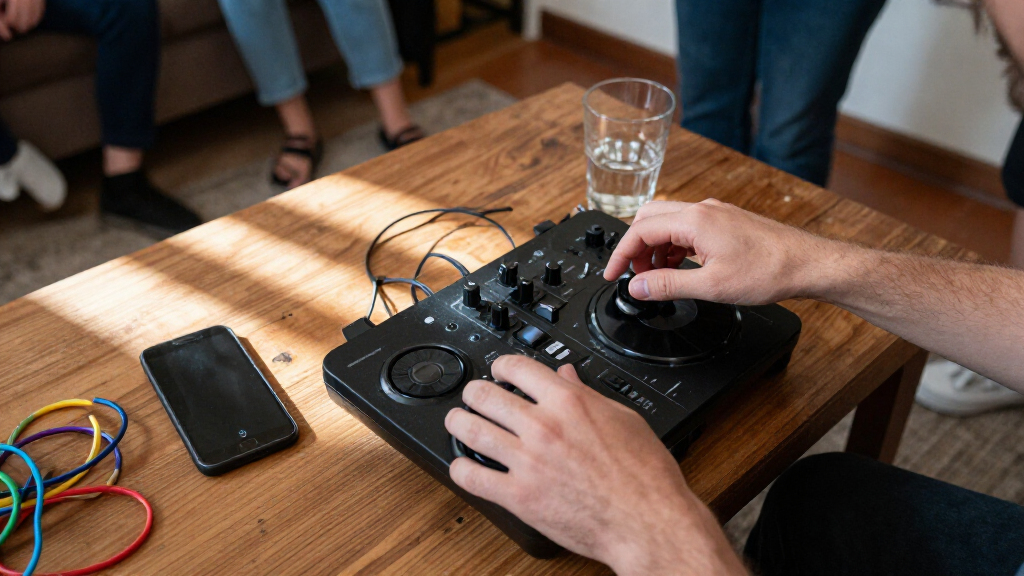
I ranked these options by how well their wireless approach serves a real DJ setup, not by treating every product with “wireless” in its name as interchangeable. The main criteria were wireless workflow and device compatibility, practical portability, the amount of hands-on control, and how much setup knowledge a buyer needs. I also weighed whether a product is a full mobile controller, a DVS-specific control tool, or a beginner-oriented controller whose wireless capabilities should be checked against the intended software and connections.
The Hercules DJControl Mix Ultra takes the lead because its mobile-first role best matches the broadest interpretation of wireless DJing in this group. The standard DJControl Mix follows for buyers who want a more straightforward smartphone controller; Phase Essential ranks for a narrower but valuable DVS use case. The two Party Mix III listings are grouped as entry-level alternatives rather than treated as meaningfully different controller platforms, while the Mix Ultra bundle sits behind the standalone unit because its added value depends on wanting the included accessories. I give each option credit for its intended user, while accounting for setup limits and the risk of assuming that wireless control also removes the need for wired audio or power.
| wireless DJ controller | Connectivity | Included components |
|---|---|---|
| Hercules DJControl Mix Ultra W | Bluetooth Low Energy (LE) | User manual, power adapter, USB cable, and djay app |
| Hercules DJControl Mix Bluetoo | Bluetooth | DJ deck, USB cable, and user manual |
| Phase Essential Wireless DVS C | — | Two remotes, one receiver, USB cable, stereo RCA cables, and magnetic stickers |
| Numark Party Mix III Bluetooth | Bluetooth MIDI and USB-C | — |
| Numark Party Mix III Bluetooth | Bluetooth MIDI and USB-C | — |
| Hercules DJControl Mix Ultra W | — | — |
Factors to Consider When Choosing Wireless DJ Controllers
Before choosing a controller, I would map the whole signal path rather than focus on the wireless label. A controller can communicate wirelessly with a phone while still needing a separate route to speakers or headphones, and DVS control follows a different setup logic from a mobile app. These checks help prevent buying a controller that fits the portability goal but not the way you plan to play.
Separate Wireless Control From Wireless Audio
“Wireless” can describe control data, a connection to a phone or tablet, or audio streaming, and those are not the same feature. Before buying, identify which link you want to remove and which connections your speakers, headphones, and source device still require. A wireless controller may still need a cable for sound output, charging, or a reliable monitor connection. This matters most for outdoor or pop-up sets, where a power bank and speaker inputs can shape the setup as much as the controller does. I would check the maker’s connection diagram and software compatibility list rather than infer a fully cable-free rig from the product name.
Match the Controller to Your Software and Device
Mobile controllers depend on compatible apps and operating systems, while DVS tools rely on a supported deck, mixer, and software chain. Check the exact phone or tablet model, operating-system support, and app features before choosing; compatibility can change with updates. Also confirm whether the app supports the functions you expect, such as cueing, library browsing, effects, or recording. A controller that pairs easily but lacks the software features you need can be more limiting than a wired option with a mature workflow. For a shared household setup, prioritize broad device compatibility over a feature that only works with one specific device.
Plan the Audio and Monitoring Route
Mixing control and sound delivery are separate parts of the setup, so decide how the audience and DJ will hear the mix. You may need a speaker connection, a headphone cue route, or an audio interface depending on the controller and software. Bluetooth audio can add delay, which makes it a poor default for beatmatching by ear even when it works for casual playback. If you plan to perform, verify that the controller supports a practical low-latency monitoring arrangement. A short connection checklist can prevent a portable controller from arriving without the output path your event requires.
Choose Mobile Mixing or DVS on Purpose
A compact smartphone controller is built around portability and app-based mixing; a DVS controller is designed to manipulate digital tracks through a compatible deck or turntable workflow. Neither is a universal upgrade over the other. Mobile mixing keeps the rig small and can lower setup complexity, while DVS can preserve a familiar physical-deck approach but demands more compatible equipment. A common mistake is buying a DVS tool when the goal is simply to mix from a phone, or expecting a phone controller to replace a full club-style system. Start with the source of your music and the hardware you already own, then choose the control method that fits.
Prioritize Portability Without Sacrificing Usability
Small dimensions make a controller easier to carry, but tiny controls can slow down cueing and adjustments during a set. Consider how often you will travel, whether you need a protective case, and how much workspace you have at home. If you will mostly practice at a desk, larger or more clearly spaced controls may matter more than shaving off a little bulk. If you play in changing locations, a bundle with a case may be more useful than buying accessories separately, though it does not change the controller’s core functions. I would compare the packed setup—including device, cables, headphones, and power—not just the controller alone.
Pay for the Workflow You Will Actually Use
Extra lights, bundled accessories, or a more specialized control system are worthwhile only when they fit your use. Beginners may benefit more from a straightforward layout and supported learning app than from advanced control features they will not use yet. A DVS-focused buyer may reasonably prioritize compatibility and hands-on deck control over compact phone operation. Before moving up to a bundle or specialized model, list the features that will change how you practice or perform. This keeps the decision focused on useful capability rather than on extras that add bulk without solving a real setup problem.
Frequently Asked Questions
Can a wireless DJ controller run a complete set without any cables?
Not necessarily. Wireless may refer only to the link between the controller and a phone or computer, while audio output, charging, and headphone monitoring can still require cables. The exact answer depends on the controller, software, and speaker setup you plan to use. For a truly portable set, check every connection in the signal path, including how you will cue tracks and power the devices. I would treat “wireless” as a description of one part of the workflow until the product documentation confirms otherwise.
Should I choose a phone-based Hercules controller or Phase Essential for DVS?
Choose based on the source and hardware you want to control. The Hercules DJControl Mix models are aimed at mobile, app-based mixing, while Phase Essential serves DJs using a compatible DVS setup and physical decks. Phase is not a direct substitute for a compact smartphone controller, and a phone controller does not provide the same DVS workflow. Check software and hardware compatibility before buying either route. If you do not already use compatible decks or DVS software, a mobile controller is usually the simpler starting point.
Is the Hercules DJControl Mix Ultra bundle meaningfully different from the standalone controller?
The main difference described by the listing is the inclusion of a case and polishing cloth, not a different controller platform. The bundle makes more sense if you will carry the controller regularly or want the included storage accessory from the start. If the controller will stay at home, those extras may not affect your decision. Compare the bundle contents with the protection and accessories you already own. I would not choose it on the assumption that the controller itself gains extra wireless or mixing functions.
Is the Numark Party Mix III a good fit if wireless operation is my main priority?
Do not assume that the Party Mix III meets a wireless requirement just because the listing includes “Bluetooth.” Confirm what Bluetooth does on the specific model and whether it supports the control and audio workflow you want. It may still be a reasonable beginner controller if its supported software, connections, and light effects suit home practice. For phone-based wireless mixing, compare it directly with the Hercules DJControl Mix models and verify the app and device requirements. If you need wireless control for a specific performance setup, consult the manufacturer’s documentation before choosing.
What should I check before using a wireless controller at a live event?
Test the complete setup with the same phone or computer, software, speaker connection, headphones, and power source you plan to use at the event. Confirm the wireless link is stable in the venue environment and that you have a backup way to continue if the connection drops. Check audio latency and cue monitoring, since a responsive control link does not guarantee suitable monitoring. Bring the necessary cables and a charged backup device rather than relying on wireless operation alone. A rehearsal can reveal compatibility or output problems that are easy to miss during a quick pairing test.
Conclusion
For the broadest mobile use, I recommend the Hercules DJControl Mix Ultra as best overall; it is the clearest fit for buyers who want a compact wireless-focused controller. The Hercules DJControl Mix is my best beginner pick for straightforward smartphone mixing, while the Numark Party Mix III is the value-oriented starter alternative for buyers drawn to its beginner-friendly setup and light effects who have confirmed its connections suit their needs. Phase Essential is the best specialized choice for DJs who already have a compatible DVS workflow, making it the premium pick for that narrower need rather than a general mobile upgrade. Choose the Mix Ultra bundle if its case and included accessories help with transport; otherwise, the standalone version keeps the decision centered on the controller. My final advice: confirm software, audio routing, and power needs before ordering, because those details determine whether a wireless controller will fit your real setup.