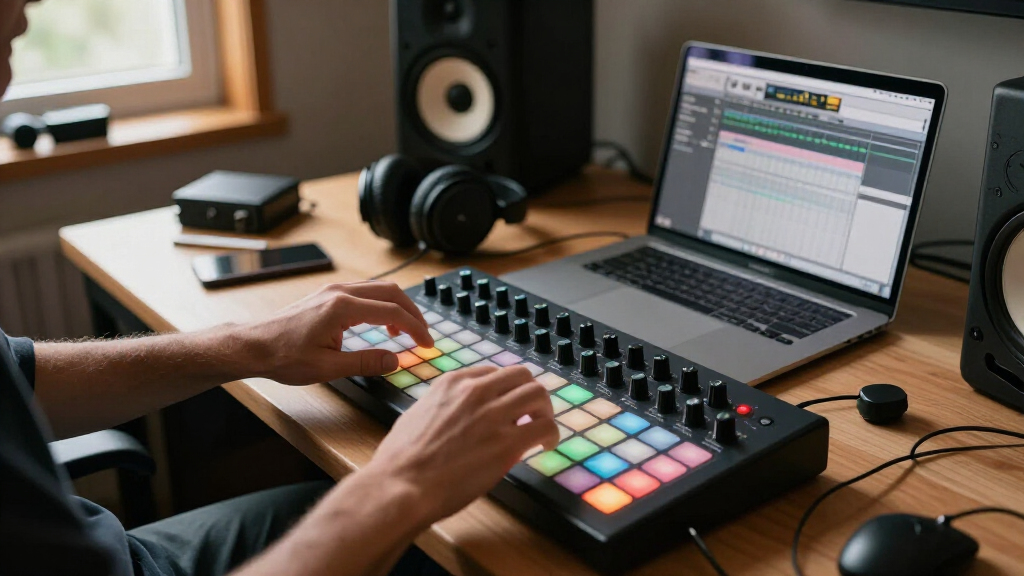

Choosing the right music production MIDI controller can significantly impact your creative workflow. The best options vary from compact pads suited for live performance to full-sized keyboards ideal for studio work. The Akai Professional MPK Mini MK3 stands out as a versatile all-rounder, while the Arturia KeyLab Essential mk3 offers professional features for serious producers. Tradeoffs often involve balancing size, features, and price—larger controllers tend to offer more control, but are less portable. Continue reading for a detailed breakdown of the top picks, their strengths, and key considerations to help you make an informed choice.

Get audio and creator gear delivered free with Prime
- Fast, free delivery on millions of items
- Prime Video, Amazon Music and more included
- Member-only deals all year
Complete the kit


Key Takeaways
- The top controllers balance key count, portability, and feature sets for different user needs.
- Built-in assignable knobs and pads significantly enhance real-time control and performance flexibility.
- Price often correlates with feature depth; premium models offer advanced integrations but at a higher cost.
- Compact models are ideal for small studios or mobile setups, but may lack extensive controls.
- Software bundle quality and compatibility are critical to getting full value from your controller.
| M-VAVE 25-Key USB MIDI Keyboard Controller with 8 Backlit Drum Pads, Bluetooth, Semi-Weighted Keys, 8 Knobs, and Software Included (Black) |  | Best for Wireless Portability and On-the-Go Music | Number of Keys: 25 | Connectivity Technology: Bluetooth, USB | Additional Features: Velocity Sensitive, Backlit Pads | VIEW LATEST PRICE | See Our Full Breakdown |
| Akai Professional MPK Mini Plus 37-Key USB MIDI Keyboard Controller |  | Best for Versatile Connectivity and Standalone Creation | Number of Keys: 37 | Connectivity: USB, MIDI I/O, CV/Gate | Included Software: MPC Beats | VIEW LATEST PRICE | See Our Full Breakdown |
| Akai Professional LPD8 USB MIDI Pad Controller |  | Best for Compact, Hands-On Pad Control | Pad Count: 8 RGB-backlit pads | Knob Count: 8 assignable | Preset Slots: 4 | VIEW LATEST PRICE | See Our Full Breakdown |
| M-VAVE 25-Key USB MIDI Keyboard Controller with Backlit Drum Pads, Bluetooth, Semi-Weighted Keys, and Software Included (Red) |  | Best for Wireless Control and Versatility in Studio and Live | Number of Keys: 25 | Connectivity Technology: Bluetooth, USB | Additional Features: Backlit, Velocity Sensitive | VIEW LATEST PRICE | See Our Full Breakdown |
| Akai Professional LPK25 25-Key USB MIDI Keyboard Controller |  | Best for Budget-Friendly, Portable Melodic Play | Number of Keys: 25 | Key Type: Synth action | Connectivity: USB | VIEW LATEST PRICE | See Our Full Breakdown |
| Arturia KeyLab Essential mk3 — 49-Key USB MIDI Keyboard Controller with Analog Lab V Software Included |  | Best Overall for Versatile Creativity and Deep Integration | Number of Keys: 49 | Connectivity: USB | Software Included: Analog Lab V, UVI Model D, NI The Gentleman, Loopcloud, Melodics | VIEW LATEST PRICE | See Our Full Breakdown |
| Arturia MiniLab 3 Universal MIDI Controller, White |  | Best for Compact, Portable Production on a Budget | Number of Keys: 25 | Connectivity Technology: USB | Additional Features: RGB pads, arpeggiator, mini display | VIEW LATEST PRICE | See Our Full Breakdown |
| Akai Professional MPK Mini MK3 25-Key USB MIDI Keyboard Controller |  | Best for Versatile Beat Making and Virtual Instrument Control | Number of Keys: 25 | Pad Type: Velocity-sensitive MPC-style | Knobs: 8 | VIEW LATEST PRICE | See Our Full Breakdown |
| USB MIDI Controller with 9 Faders, 9 Knobs, and 9 Buttons for Music Production |  | Best for Hands-On Mixing and Live Control | Number of Controls: 27 | Faders: 9 | Knobs: 9 | VIEW LATEST PRICE | See Our Full Breakdown |
| M-AUDIO Keystation 49 MK3 USB MIDI Controller |  | Best for Full-Size Piano-Style Playing in Studio and Stage | Number of Keys: 49 | Connectivity: USB-MIDI, iOS support | Additional Controls: Pitch, modulation wheels, octave controls | VIEW LATEST PRICE | See Our Full Breakdown |
| Akai Professional MIDImix USB MIDI Mixer Controller |  | Best for Portable Mixing and Live Control | Connectivity Technology: USB | Hardware Interface: USB | Control Method: Touch | VIEW LATEST PRICE | See Our Full Breakdown |
| M-AUDIO Keystation Mini 32 MK3 USB MIDI Controller |  | Best for Beginners and Portable Piano Feel | Number of Keys: 32 | Connectivity: USB | Compatibility: Windows and Mac | VIEW LATEST PRICE | See Our Full Breakdown |
| Akai Professional APC Key 25 MK2 25-Key USB MIDI Keyboard Controller |  | Best for Live Performance and Ableton Workflow | Number of Keys: 25 | Pad Matrix: 5×8 RGB pads | Rotary Knobs: 8 assignable | VIEW LATEST PRICE | See Our Full Breakdown |
| Akai Professional APC Mini MK2 USB MIDI Pad Controller |  | Best for Creative Looping and Clip Control | Pad Matrix: 8×8 RGB pads | Number of Faders: 9 (8 assignable + 1 master) | Connectivity: USB | VIEW LATEST PRICE | See Our Full Breakdown |
| music production MIDI controller | Number of Keys | Connectivity |
|---|---|---|
| M-VAVE 25-Key USB MIDI Keyboar | 25 | — |
| Akai Professional MPK Mini Plu | 37 | USB, MIDI I/O, CV/Gate |
| Akai Professional LPD8 USB MID | — | USB |
| M-VAVE 25-Key USB MIDI Keyboar | 25 | — |
| Akai Professional LPK25 25-Key | 25 | USB |
| Arturia KeyLab Essential mk3 | 49 | USB |
| Arturia MiniLab 3 Universal MI | 25 | — |
| Akai Professional MPK Mini MK3 | 25 | — |
| USB MIDI Controller with 9 Fad | — | USB |
| M-AUDIO Keystation 49 MK3 USB | 49 | USB-MIDI, iOS support |
| Akai Professional MIDImix USB | — | — |
| M-AUDIO Keystation Mini 32 MK3 | 32 | USB |
| Akai Professional APC Key 25 M | 25 | USB |
| Akai Professional APC Mini MK2 | — | USB |
More Details on Our Top Picks
M-VAVE 25-Key USB MIDI Keyboard Controller with 8 Backlit Drum Pads, Bluetooth, Semi-Weighted Keys, 8 Knobs, and Software Included (Black)
This model stands out for its wireless Bluetooth connectivity, making it highly suitable for musicians who need to produce music outside the studio. Compared with the Akai LPK25, it offers more control features like backlit pads and assignable knobs, enhancing live performance and spontaneous creation. The tradeoff is its limited 25 keys, which may not satisfy composers needing full-range keyboard play. Its portability and software compatibility make it ideal for mobile producers, but the absence of noise control features and reliance on battery power could limit long sessions. Overall, this pick makes the most sense for performers and producers prioritizing wireless convenience over extensive key range.Pros:- Wireless Bluetooth connectivity for maximum portability
- Backlit drum pads and assignable knobs for versatile live control
- Includes compatible software for immediate music production
Cons:- Limited to 25 keys, restricting full-range playing
- No noise control features, which may be an issue in quiet environments
- Battery life can vary, potentially limiting extended use
Best for: Musicians and performers who require a portable, wireless MIDI controller for live use or mobile studios.
Not ideal for: Composers and producers needing full 49+ keys or detailed control for complex arrangements, as its 25 keys can restrict chord and melodic development.
- Number of Keys:25
- Connectivity Technology:Bluetooth, USB
- Additional Features:Velocity Sensitive, Backlit Pads
- Supported Software:Ableton Live, FL Studio, Logic Pro X, and more
- Platform Compatibility:iOS, Android, Mac OS, Windows
- Control Method:Touch, Assignable Knobs
Our verdict“This controller is an excellent choice for mobile performers who prioritize wireless flexibility over extensive keyboard range.”
Akai Professional MPK Mini Plus 37-Key USB MIDI Keyboard Controller
The MPK Mini Plus excels by combining 37 mini keys with extensive connectivity options, including MIDI, CV/Gate, and USB, making it suitable for users integrating hardware and software. Unlike the compact LPD8, its larger keyboard and built-in sequencer support more complex compositions without relying solely on a DAW. However, 37 keys might still feel limited for those used to full-sized keyboards, and the rich feature set can be overwhelming for beginners. Its inclusion of MPC pads and software support makes it perfect for producers seeking flexibility, but the complexity may deter newcomers. This controller suits musicians who need a portable, feature-rich device for both studio and live performances.Pros:- Extensive connectivity including MIDI, CV/Gate, and USB
- Built-in 64-step sequencer for standalone music creation
- Includes MPC Beats software and NKS support for native control
Cons:- Limited to 37 keys, which may restrict playing full melodies
- Feature-rich setup can be complex for new users
Best for: Producers and live performers who need an all-in-one portable MIDI solution with hardware integration and sequencing capabilities.
Not ideal for: Beginners or those seeking a simple, plug-and-play MIDI keyboard, as its feature set requires some familiarity with MIDI workflows.
- Number of Keys:37
- Connectivity:USB, MIDI I/O, CV/Gate
- Included Software:MPC Beats
- Control Knobs:8 assignable
- Built-in Sequencer:64-step
- Platform Compatibility:Mac, PC
Our verdict“This pick is ideal for producers needing a portable, versatile controller with hardware integration and sequencing features.”
Akai Professional LPD8 USB MIDI Pad Controller
The LPD8 is a straightforward, durable MIDI pad controller designed for quick access to samples and drum programming. In comparison to the MPK Mini Plus, it offers a more tactile experience with 8 RGB backlit pads and 8 assignable knobs, but lacks a keyboard, making it less suitable for melodic parts. Its simplicity and USB-powered design make it perfect for quick setups and live triggering, yet the limited control surface might not satisfy producers seeking extensive parameter control. The absence of software or advanced features means it relies heavily on DAW integration. This product best serves users who need a compact pad controller for triggering and performance, not for comprehensive keyboard playing.Pros:- Compact and lightweight for easy transport
- Responsive RGB pads with visual feedback
- Eight assignable knobs for versatile control
Cons:- Limited to 8 pads, not suitable for complex drum kits
- No built-in sounds or software, reliant on DAW integration
Best for: Live performers and beatmakers who want a compact, tactile pad controller for triggering samples and drums.
Not ideal for: Composers and keyboard players needing a full-range MIDI keyboard for melodic and harmonic work, as it offers no keys.
- Pad Count:8 RGB-backlit pads
- Knob Count:8 assignable
- Preset Slots:4
- Connectivity:USB
- Build:Sturdy, lightweight
- Compatibility:All major DAWs
Our verdict“This controller is perfect for performers and beatmakers seeking a compact, tactile pad setup for live triggering and sampling.”
M-VAVE 25-Key USB MIDI Keyboard Controller with Backlit Drum Pads, Bluetooth, Semi-Weighted Keys, and Software Included (Red)
Similar to its black counterpart, this red version offers wireless Bluetooth connectivity, making it ideal for mobile musicians. Its velocity-sensitive keys and backlit drum pads enable expressive play and visual feedback, while its broad compatibility with major DAWs and OS platforms makes it versatile. Compared to the Akai LPK25, this controller provides more control features, including backlit pads and software, but still shares the same 25-key limitation, which may not suffice for complex compositions. Its modern style and wireless capability make it attractive for performers who need flexibility, but the lack of noise control and reliance on Bluetooth latency could pose challenges in some setups. This is best suited for portable studio work and live performances where wireless convenience is key.Pros:- Wireless Bluetooth connectivity for convenience
- Velocity-sensitive keys and backlit pads enhance expressiveness
- Compatible with multiple OS and DAWs, including iOS
Cons:- Limited to 25 keys, restricting melodic range
- Bluetooth connection may introduce latency on some devices
- No built-in sounds or speakers
Best for: Mobile musicians and performers who prioritize wireless flexibility and expressive control in live or studio settings.
Not ideal for: Producers requiring extensive keyboard range or detailed control for complex arrangements, due to its 25-key limit.
- Number of Keys:25
- Connectivity Technology:Bluetooth, USB
- Additional Features:Backlit, Velocity Sensitive
- Supported Software:Ableton Live, FL Studio, Logic Pro X, others
- Platform Compatibility:iOS, Android, Mac OS, Windows
- Control Method:Touch
Our verdict“This wireless controller is well-suited for mobile performers needing flexible, expressive control without the bulk of larger keyboards.”
Akai Professional LPK25 25-Key USB MIDI Keyboard Controller
The LPK25 is a straightforward, compact MIDI keyboard that emphasizes portability and simplicity. It is ideal for users who need a basic controller for melodic input, especially when combined with a DAW like Ableton Live or Logic Pro. Compared to the more feature-rich MPK Mini Plus, it lacks controls like pads or a built-in sequencer, focusing solely on keys. Its 25 keys and simple layout are perfect for beginners or mobile producers, but those seeking more control options or a larger keyboard might find it limiting. The no-frills design and plug-and-play ease make it a practical choice for quick setups, though it doesn’t support advanced hardware integration. Best suited for students, beginners, or anyone needing a small, reliable MIDI keyboard.Pros:- Compact and lightweight for portability
- Responsive, velocity-sensitive keys
- Plug-and-play with Mac and PC
Cons:- Limited to 2 octaves, requiring additional controllers for wider ranges
- No built-in controls or software, less versatile for complex setups
Best for: Students, beginners, and mobile producers seeking a simple, affordable MIDI keyboard for melodic input.
Not ideal for: Producers needing extensive control features such as pads, knobs, or larger key ranges for complex productions.
- Number of Keys:25
- Key Type:Synth action
- Connectivity:USB
- Power:USB powered
- Preset Slots:8
- Dimensions:Less than 13 inches
Our verdict“This controller is a reliable, budget-friendly option for beginners or those who need a small MIDI keyboard for basic melodic input.”
Arturia KeyLab Essential mk3 — 49-Key USB MIDI Keyboard Controller with Analog Lab V Software Included
The Arturia KeyLab Essential mk3 stands out for its combination of intuitive features like Scale Mode and Arpeggiator, which cater to both beginners and seasoned producers. Its 49 keys strike a balance between portability and playability, making it suitable for studio and live use. Compared to the Akai MPK Mini MK3, which excels in portability but offers fewer controls, the KeyLab mk3 provides more comprehensive features and a brighter LCD for real-time feedback. However, the software bundle might feel overwhelming for newcomers, and the price may be a barrier for casual users. This controller makes the most sense for producers seeking a versatile, feature-rich MIDI solution that integrates seamlessly with DAWs and virtual instruments.Pros:- Intuitive creative features like Scale Mode and Arpeggiator
- Deep DAW integration with custom scripts for popular software
- Bright LCD screen for real-time feedback
- Versatile presets including modern synths and orchestral sounds
Cons:- Limited to 49 keys, which may not suit all players
- Software package may be overwhelming for beginners
Best for: Musicians and producers who want a versatile, feature-packed MIDI controller with advanced creative tools and deep software integration.
Not ideal for: Beginners or those with limited budget who prefer a simpler, more affordable MIDI keyboard without extensive features.
- Number of Keys:49
- Connectivity:USB
- Software Included:Analog Lab V, UVI Model D, NI The Gentleman, Loopcloud, Melodics
- Display:2.5-inch LCD
- Pads:RGB-backlit, velocity and pressure sensitive
Our verdict“This controller is best suited for producers who need a comprehensive, customizable MIDI solution with robust creative features.”
Arturia MiniLab 3 Universal MIDI Controller, White
The Arturia MiniLab 3 is a compact, portable MIDI controller that offers expressive control through velocity-sensitive keys and multi-color pads. Its 25 keys make it ideal for mobile setups or limited desk space, and it pairs well with software like Ableton Live Lite and Analog Lab Intro. Compared to larger controllers like the M-AUDIO Keystation 49 MK3, it sacrifices key range for portability, which may be a drawback for pianists but works well for producers focused on electronic music and sketching ideas on the go. The plastic construction keeps costs down but may feel less durable over time. This makes a strong case for beginners or mobile producers who need a lightweight, easy-to-use MIDI controller that still offers expressive features.Pros:- Compact and portable design ideal for mobile use
- Velocity-sensitive keys and multi-color pads for expressive control
- Includes useful software and arpeggiator
- Easy USB connectivity with PC and Mac
Cons:- Limited to 25 keys, which may restrict performance complexity
- Basic build quality due to plastic material
Best for: Beginners and mobile producers who need a compact, easy-to-use MIDI controller with essential features.
Not ideal for: Advanced producers or pianists requiring full-size keys and extensive control for performance or detailed arrangement.
- Number of Keys:25
- Connectivity Technology:USB
- Additional Features:RGB pads, arpeggiator, mini display
- Instrument Key:Any
- Supported Software:Ableton Live Lite, Analog Lab Intro, UVI Model D
Our verdict“This controller is perfect for beginners or musicians on the move who want essential features in a small package.”
Akai Professional MPK Mini MK3 25-Key USB MIDI Keyboard Controller
The Akai MPK Mini MK3 offers a compelling mix of portability and control, especially with its MPC-style drum pads and extensive virtual instrument support. Its 25 keys are enough for sketching melodies, but might fall short for more advanced pianists. The inclusion of 8 knobs and an arpeggiator enhances creative flexibility, and NKS support makes it compatible with a wide range of plugins, surpassing many entry-level controllers. Compared to the MiniLab 3, which emphasizes portability, the MPK Mini MK3 provides more control options tailored for beat makers and producers focused on electronic music. The downside is that it requires software setup, and its small size can limit performance expression for more serious keyboard players.Pros:- Compact and portable with MPC-style drum pads
- Includes a large sound library and virtual instruments
- NKS support for seamless plugin integration
- Customizable controls and arpeggiator
Cons:- Limited to 25 keys, restricting advanced keyboard techniques
- Requires software setup for full functionality
Best for: Beat makers, electronic musicians, and producers who need a portable MIDI controller with comprehensive controls and plugin support.
Not ideal for: Pianists or advanced performers requiring full-size keys and extensive performance controls.
- Number of Keys:25
- Pad Type:Velocity-sensitive MPC-style
- Knobs:8
- Arpeggiator:Yes
- Included Content:1500+ sounds, virtual instruments
Our verdict“This MIDI controller is ideal for electronic producers and beat makers needing portability and extensive control features.”
USB MIDI Controller with 9 Faders, 9 Knobs, and 9 Buttons for Music Production
This USB MIDI controller with 27 controls offers a versatile surface for mixing, live performance, and detailed automation. Its layout of 9 faders, knobs, and buttons allows for extensive hands-on control, especially for mixing sessions when paired with DAWs like Ableton Live or Pro Tools. In comparison, it lacks the keyboard keys of the M-AUDIO Keystation or Arturia controllers, positioning it as a dedicated control surface rather than a traditional MIDI keyboard. Its plug-and-play nature simplifies setup, but its lack of a display or dedicated keyboard limits its use to control and automation tasks. This pick is best for producers and performers who prioritize tactile control over melody creation, such as live performers or mixing engineers.Pros:- Extensive control surface with 27 programmable controls
- Plug-and-play USB connectivity
- Includes transport buttons for DAW operations
- Compact and suitable for desktop use
Cons:- No keyboard or keys for melodic input
- No built-in display for detailed control feedback
Best for: Producers and performers who need a dedicated control surface for mixing, automation, and live control, rather than melodic playing.
Not ideal for: Musicians seeking a full-size MIDI keyboard or expressive melodic instrument, as it focuses on control surface functions.
- Number of Controls:27
- Faders:9
- Knobs:9
- Buttons:9
- Connectivity:USB
Our verdict“This controller is best for producers needing tactile control for mixing and live automation, not for melodic playing.”
M-AUDIO Keystation 49 MK3 USB MIDI Controller
The M-AUDIO Keystation 49 MK3 offers a straightforward, full-size 49-key velocity-sensitive keyboard suitable for both studio work and live performances. Its simplicity makes it accessible for beginners and those who prefer a traditional piano feel without extra controls or software. Compared to the Arturia KeyLab Essential mk3, which offers more features and software integration, the Keystation focuses on a pure playing experience, making it less ideal for producers who want extensive control or onboard creative tools. Its lack of assignable controls or advanced features means it’s best for users who primarily need a reliable MIDI keyboard for performance or basic sequencing. The limited feature set may be a downside for more complex production workflows.Pros:- Full-size velocity-sensitive keys for expressive playing
- Plug-and-play setup with minimal fuss
- Includes basic software for music production
- Supports iOS devices with optional adapters
Cons:- Limited control features beyond keys
- No onboard controls for mixing or automation
Best for: Pianists, performers, and producers seeking a reliable, full-size MIDI keyboard for expressive playing and basic production tasks.
Not ideal for: Electronic musicians or producers who need integrated controls, software features, or compact portability.
- Number of Keys:49
- Connectivity:USB-MIDI, iOS support
- Additional Controls:Pitch, modulation wheels, octave controls
- Software Included:MPC Beats, Ableton Live Lite, Velvet, XPand2
- Power:USB-powered
Our verdict“This controller is best for players and performers who prioritize full-size keys and straightforward MIDI functionality over advanced controls.”
Akai Professional MIDImix USB MIDI Mixer Controller
The Akai MIDImix stands out as the most portable option for producers who need tactile mixing controls on the go. Its 8 faders, 24 knobs, and dedicated buttons make it ideal for quick adjustments, especially when paired with Ableton Live, unlike larger controllers that are less mobile. Compared with the Akai APC Mini MK2, the MIDImix emphasizes mixing capabilities over clip launching, which suits live performance mixing or studio sessions requiring hands-on control. The main tradeoff is its sole USB connectivity, limiting flexibility if you use multiple devices, and it lacks noise control features, which might be a concern in noisy environments. This pick makes the most sense for mobile producers or performers who prioritize lightweight, seamless DAW integration, especially with Ableton.
Pros:- Lightweight and highly portable for mobile setups
- Seamless Ableton Live integration for quick control
- Multiple assignable controls for versatile mixing
Cons:- Limited to USB-only connectivity, reducing device flexibility
- No noise control features included, which may impact noisy environments
Best for: Producers and performers who need a compact, portable mixer with tactile controls for live sets or mobile studio use
Not ideal for: Home studio owners seeking a full-featured DAW controller with extensive fader and knob options, as the MIDImix is limited in scope
- Connectivity Technology:USB
- Hardware Interface:USB
- Control Method:Touch
- Mixer Channel Quantity:16
- Material:Metal
- Supported Software:Ableton Live
Our verdict“This controller is perfect for mobile producers or performers needing a compact mixer with tactile controls for live or on-the-go production.”
M-AUDIO Keystation Mini 32 MK3 USB MIDI Controller
The M-AUDIO Keystation Mini 32 MK3 is designed for musicians who want a compact keyboard that feels like a real piano, with 32 velocity-sensitive keys that are suitable for both beginners and experienced users. Its plug-and-play setup with no external power makes it accessible for quick sessions, and it includes MPC Beats software to jumpstart music creation. Compared to the Akai APC Key 25 MK2, which offers clip launching and more control over Ableton Live, the Keystation Mini 32 focuses on straightforward keyboard play rather than performance controls. Its limited keys may restrict complex arrangements, and the mini keys might not suit all players, especially those accustomed to full-sized keyboards. This makes it ideal for mobile musicians, students, or producers who prioritize portable keyboard feel over advanced control features.
Pros:- Compact and lightweight for easy portability
- Plug-and-play with no external power required
- Includes beginner-friendly music production software
Cons:- Limited to 32 keys, restricting complex arrangements
- Mini keys may feel less natural for some players
- Basic controls may require additional software for advanced features
Best for: Beginners, students, and mobile musicians seeking a simple, portable MIDI keyboard with a true piano feel
Not ideal for: Advanced producers or live performers needing extensive controls or full-sized keys for complex compositions
- Number of Keys:32
- Connectivity:USB
- Compatibility:Windows and Mac
- Includes Software:MPC Beats
- Additional Features:Pitch bend, modulation, octave controls
Our verdict“This controller is best suited for beginners or mobile musicians who want a portable, piano-like keyboard for music creation on the move.”
Akai Professional APC Key 25 MK2 25-Key USB MIDI Keyboard Controller
The Akai APC Key 25 MK2 excels as a compact controller for live performance and studio work, especially for Ableton Live users. Its 25 velocity-sensitive keys are complemented by a 5×8 RGB pad matrix, which is ideal for clip launching and real-time performance. Unlike larger keyboards, it packs powerful performance controls into a small footprint, making it perfect for artists who need quick access to clips, scenes, and effects. Compared with the Akai APC Mini MK2, the APC Key 25 offers more expressive keyboard control but fewer pads, making it better suited to versatile live sets rather than beat-making. Its limited 25 keys might be restrictive for players requiring full-range keyboard performance, and it relies solely on USB power, with no standalone option. It’s best for artists who prioritize performance controls paired with basic keyboard functionality.
Pros:- Seamless Ableton Live integration for performance
- Compact, portable design with responsive keys
- Includes useful software instruments and tools
Cons:- Limited to 25 keys, which may restrict melodic play
- No standalone power option, relies on USB connection
Best for: Performers and producers focused on live Ableton performances needing a compact, integrated controller
Not ideal for: Producers requiring extensive keyboard range or those working predominantly with other DAWs that lack deep Ableton integration
- Number of Keys:25
- Pad Matrix:5×8 RGB pads
- Rotary Knobs:8 assignable
- Connectivity:USB
- Included Software:Ableton Live Lite, Hybrid 3, Mini Grand, Velvet
Our verdict“This controller is ideal for Ableton Live performers who want a compact device with integrated clip launching and expressive keys.”
Akai Professional APC Mini MK2 USB MIDI Pad Controller
The Akai APC Mini MK2 is a highly portable pad controller designed for live looping, beat making, and clip management within Ableton Live. Its 8×8 RGB pad matrix provides clear visual feedback, enabling intuitive control over clips, scenes, and effects. The 9 faders, including a master, along with dedicated scene launch buttons, make it a versatile device for hands-on control in both studio and stage environments. Compared with the APC Key 25 MK2, which emphasizes keyboard performance, the APC Mini MK2 specializes in pad-based control suited for beatmakers and loopers. The limited to Ableton Live compatibility can be a constraint for users of other DAWs, and lacking a built-in battery means it depends solely on USB power, which could limit mobility in some scenarios. It’s best for producers and performers who need quick, visual control over clips and loops.
Pros:- Bright RGB pads with clear visual feedback
- Compact, easy to carry for mobile setups
- Excellent for clip launching and live looping
Cons:- Limited to Ableton Live, reducing cross-DAW flexibility
- No built-in battery, dependent on USB power
Best for: Beat makers, live loopers, and producers who want a compact, RGB-pad-focused controller for clip-based workflows
Not ideal for: Keyboard players or producers working outside Ableton Live who need broader control options or DAW compatibility
- Pad Matrix:8×8 RGB pads
- Number of Faders:9 (8 assignable + 1 master)
- Connectivity:USB
- Included Software:Ableton Live Lite, Hybrid 3, Mini Grand, Velvet
- Compatibility:Mac and PC
Our verdict“This controller is perfect for artists who prioritize visual clip control and looping in Ableton Live environments, especially in live performance settings.”
How We Picked
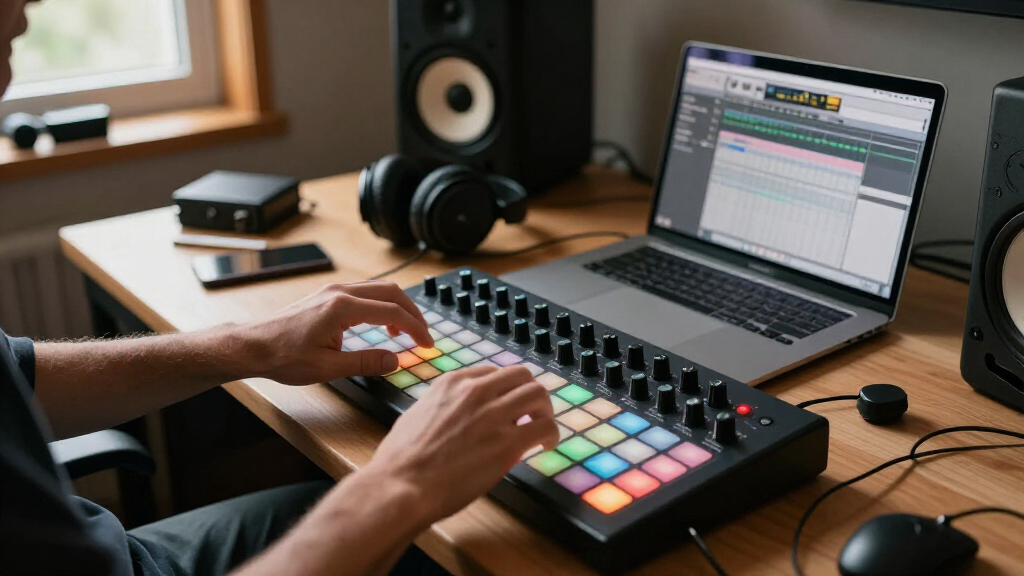
Our evaluation focused on performance, usability, build quality, and value. We prioritized controllers with responsive keys, durable construction, and versatile controls like knobs and pads. Ease of setup and compatibility with popular DAWs also played a key role. Price-to-feature ratio was considered to recommend options for different budgets. The ranking reflects a balance of these factors, ensuring you get reliable tools suited for both beginners and experienced producers.| music production MIDI controller | Connectivity |
|---|---|
| M-VAVE 25-Key USB MIDI Keyboar | — |
| Akai Professional MPK Mini Plu | USB, MIDI I/O, CV/Gate |
| Akai Professional LPD8 USB MID | USB |
| M-VAVE 25-Key USB MIDI Keyboar | — |
| Akai Professional LPK25 25-Key | USB |
| Arturia KeyLab Essential mk3 | USB |
| Arturia MiniLab 3 Universal MI | — |
| Akai Professional MPK Mini MK3 | — |
| USB MIDI Controller with 9 Fad | USB |
| M-AUDIO Keystation 49 MK3 USB | USB-MIDI, iOS support |
| Akai Professional MIDImix USB | — |
| M-AUDIO Keystation Mini 32 MK3 | USB |
| Akai Professional APC Key 25 M | USB |
| Akai Professional APC Mini MK2 | USB |
Factors to Consider When Choosing Music Production MIDI Controllers
When selecting a music production MIDI controller, it’s important to match the device to your workflow, studio space, and budget. Consider how many keys you need—full-size keyboards are better for detailed playing, while smaller controllers excel for portability. Controls like knobs, faders, and pads expand your creative options, especially for live tweaking and performance. Compatibility with your DAW and included software can make setup smoother and improve productivity. Lastly, think about build quality and future-proof features to ensure your investment lasts as your skills grow.Size and Key Count
Controllers range from compact 25-key models to full-sized 61-key keyboards. Larger controllers provide more range for complex melodies and performance, but they take up more space and may be less portable. Smaller models are lightweight and easier to carry around, making them suitable for mobile producers or tight studio setups. Choosing the right size depends on your space constraints and how much playing you plan to do, with some users preferring a balance of portability and functional key range.
Controls and Features
Look for controllers that include assignable knobs, faders, and pads—these enhance your ability to manipulate parameters in real-time. Pads are especially useful for triggering samples or drum patterns, while knobs and sliders allow hands-on control over effects and mixer settings. More advanced controllers might include features like transport controls, display screens, or integration with specific DAWs. Prioritize controls that align with your production style to avoid paying for features you won’t use.
Software Compatibility and Bundles
Compatibility with your preferred DAW is essential to prevent setup headaches. Many controllers come with bundled software, which can add valuable sounds, plugins, or virtual instruments. However, some bundles may be limited or require additional purchases for full functionality. Check for class-compliant controllers that work seamlessly across platforms, and evaluate the software included to see if it complements your existing setup or offers meaningful value.
Build Quality and Durability
Controllers built with sturdy materials like metal chassis and high-quality plastic tend to withstand regular use better. Consider the tactile feel of keys and controls, especially if you plan to perform or use the device extensively. Cheaper models may feel flimsy or have inconsistent key action, which can affect your playing experience. Think about long-term durability, especially if you transport your controller frequently or use it in various settings.
Price and Future-Proofing
Higher-priced controllers often include advanced features like extensive control surfaces, better build quality, and more comprehensive software bundles. If you’re serious about production or performance, investing in a more capable device can save you money and frustration later. Conversely, budget models are suitable for beginners or casual users who want basic control without breaking the bank. Evaluate your current needs versus future ambitions to find a controller that offers room to grow.
Frequently Asked Questions
How many keys do I need on a MIDI controller for serious production?
The ideal key count varies based on your workflow. If you compose complex melodies or perform live, a full 49-61 key controller provides more playing range and expressiveness. Smaller controllers with 25-37 keys are more portable but may limit your ability to perform without shifting octaves frequently. Consider whether you prefer a compact device for mobility or a larger one for in-depth playing—your specific production style will guide this choice.
Should I prioritize controllers with lots of knobs and pads?
Yes, especially if you want to manipulate effects, control virtual instruments, or trigger samples in real-time. Knobs and pads enable hands-on control, making your workflow more intuitive and dynamic. However, more controls can also increase complexity and cost. Balance the number of physical controls with your actual needs—an abundance of features might be overwhelming if you’re just starting out.
Are built-in software bundles worth choosing a controller with included software?
Bundled software can add immediate value, especially for beginners who need sounds and virtual instruments to start producing right away. However, some bundles are limited or less useful if you already own similar tools. Always check what software is included and whether it complements your existing setup. Sometimes, investing in a slightly more expensive controller with better software integration can be more beneficial long-term.
Is a more expensive MIDI controller worth it for a beginner?
Not necessarily. While premium controllers often have superior build quality and more features, a basic model can serve well during initial learning phases. As your skills develop, you might want to upgrade to a more feature-rich device. If you plan to perform live or need extensive control, investing in a higher-end model early on could be justified. Otherwise, starting with a budget-friendly controller and upgrading later is a common approach.
What features should I look for if I want to use my controller for live performances?
For live use, prioritize controllers with assignable pads, transport controls, and robust build quality. Pads should be velocity-sensitive for expressive triggering, and controls should be easily accessible without complex menus. A compact, lightweight design facilitates portability, while features like multiple banks or customizable layouts help adapt to different performance scenarios. Compatibility with your setup and software stability are also essential to ensure a smooth experience on stage.
Conclusion
For casual producers or those just starting out, a compact, affordable controller like the Akai Professional MPK Mini MK3 offers great value. Serious studio owners or performers seeking extensive control will benefit from the Arturia KeyLab Essential mk3 as a versatile, feature-rich option. Budget-conscious buyers should consider models like the M-AUDIO Keystation 49 MK3, while professionals aiming for durability and advanced features might lean toward premium choices or dedicated DAW controllers. Ultimately, your choice should align with your workflow, space, and future ambitions, ensuring you get a device that grows with your skills.
As an affiliate, we earn on qualifying purchases.Halloween Picks
halloween