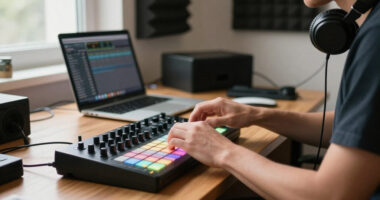
For most music producers, I’d start with the Arturia KeyLab Essential 3 49: its larger key range and hands-on controls suit composing and arranging better than a 25-key mini controller. The Akai MPK Mini Plus is a standout for beatmakers who want pads and more keys in a compact format, while the M-Audio Oxygen 49 MKV is a strong fit for producers who prioritize control over a full DAW session. The main tradeoff is between portability and playing range, with controls, software integration, and wireless features also shaping the choice. A compact keyboard can save desk space, but may require more octave changes; a larger model takes up more room but supports fuller parts. Read on for the full breakdown of all 15 MIDI keyboards for music producers and which one best fits your workflow.

Get audio and creator gear delivered free with Prime
- Fast, free delivery on millions of items
- Prime Video, Amazon Music and more included
- Member-only deals all year
Complete the kit


Key Takeaways
49 keys make a meaningful difference for arranging: The KeyLab Essential 3 and Oxygen 49 MKV suit players who want to perform fuller parts without frequent octave switching.
The MPK Mini Plus balances portability and playability: Its 37-key layout sits between the 25-key beatmaking controllers and full-size 49-key options.
25-key models serve different workflows: The MPK Mini, LPK25, Donner DMK 25 Pro, and MiniLab 3 differ in emphasis, so pad, knob, and software needs matter more than key count alone.
Bluetooth is a convenience, not a universal upgrade: The M-VAVE K5 and DaierTek add wireless flexibility, but producers should weigh that against their connection and latency preferences.
Two MPK Mini Plus models and two MPK Mini IV finishes appear in this roundup: Compare the listed versions by model and workflow needs, rather than treating color or naming alone as a feature advantage.
| Donner DMK 25 Pro USB-C MIDI Keyboard Controller, 25 Keys, 8 Drum Pads, OLED Display, Black |  | Best Compact Control Set | Keys: 25 | Drum pads: 8 | Connectivity: USB-C | VIEW LATEST PRICE | See Our Full Breakdown |
| Akai Professional MPK Mini Plus II 37-Key USB-C MIDI Keyboard Controller |  | Best for Hardware and DAW Setups | Keys: 37 velocity-sensitive mini keys | Pads: 8 RGB MPC pads with aftertouch | Controls: 8 assignable rotary knobs, pitch and modulation wheels | VIEW LATEST PRICE | See Our Full Breakdown |
| M-AUDIO Keystation 49 MK3 USB MIDI Controller |  | Best for Full-Size Keys | Keys: 49 full-size velocity-sensitive keys | Connectivity: USB-MIDI, bus-powered | Pitch and modulation: Ergonomic pitch and modulation wheels | VIEW LATEST PRICE | See Our Full Breakdown |
| M-VAVE K5 25-Key Bluetooth MIDI Keyboard Controller |  | Best for Cable-Free Mobile Production | Keys: 25 velocity-sensitive mini keys | Drum pads: 8 RGB backlit velocity-sensitive pads | Rotary encoders: 8 assignable | VIEW LATEST PRICE | See Our Full Breakdown |
| Akai Professional LPK25 25-Key USB MIDI Keyboard Controller |  | Best Minimal Grab-and-Go Controller | Keys: 25 velocity-sensitive mini keys with synth action | Connectivity: USB | Additional controls: Octave up/down, sustain button, arpeggiator, clock | VIEW LATEST PRICE | See Our Full Breakdown |
| Akai Professional MPK Mini Plus 37-Key USB MIDI Keyboard Controller |  | Best for Hybrid and Modular Setups | Keys: 37 velocity-sensitive mini keys | Connectivity: USB, MIDI I/O, CV/Gate | Pads: 8 RGB MPC pads | VIEW LATEST PRICE | See Our Full Breakdown |
| M-Audio Oxygen 49 MKV USB MIDI Keyboard Controller |  | Best for Full-Size DAW Control | Keys: 49 velocity-sensitive, full-size keys | Drum pads: 8 backlit pads in 2 banks | Assignable controls: 8 knobs and 9 faders | VIEW LATEST PRICE | See Our Full Breakdown |
| M-Audio Keystation Mini 32 MK3 USB MIDI Controller |  | Best for No-Fuss Portable Input | Keys: 32 velocity-sensitive mini keys | Connectivity: USB | Compatible platforms: Mac and Windows | VIEW LATEST PRICE | See Our Full Breakdown |
| Arturia KeyLab Essential 3 49-Key USB MIDI Keyboard Controller |  | Best for Composition Tools and Instrument Browsing | Keys: 49 synth-action keys with velocity control | Connectivity: USB | Pads: 8 velocity- and pressure-sensitive RGB-backlit pads | VIEW LATEST PRICE | See Our Full Breakdown |
| Donner N-25 25-Key Mini MIDI Controller |  | Best for Beginner Mobile Setups | Keys: 25 velocity-sensitive mini keys | Connectivity: USB-MIDI | Compatible platforms: Windows, Mac, iOS, and Android | VIEW LATEST PRICE | See Our Full Breakdown |
| Akai Professional MPK Mini IV 25-Key USB-C MIDI Keyboard Controller, White |  | Best Overall for Compact Production | Keys: 25 velocity-sensitive mini keys | Pads: 8 velocity- and pressure-sensitive RGB MPC pads | Knobs: 8 assignable 360° knobs | VIEW LATEST PRICE | See Our Full Breakdown |
| DaierTek 25-Key Portable Bluetooth and USB MIDI Keyboard Controller |  | Best for Wireless Mobile Setups | Keys: 25 velocity-sensitive keys | Drum Pads: 8 RGB backlit pads with velocity sensitivity and aftertouch | Knobs: 8 assignable encoders | VIEW LATEST PRICE | See Our Full Breakdown |
| Akai Professional MPK Mini MK3 25-Key USB MIDI Keyboard Controller |  | Best Value for a First Production Controller | Keys: 25 velocity-sensitive mini keys | Connectivity: USB 2.0 Type B | Drum Pads: 8 backlit, velocity-sensitive MPC-style pads | VIEW LATEST PRICE | See Our Full Breakdown |
| Arturia MiniLab 3 Universal MIDI Controller (White) |  | Best for Software Instrument Control | Keys: 25 velocity-sensitive slim synth-action keys | Pads: 2 banks of 8 velocity- and pressure-sensitive RGB backlit pads | Touch Sensors: 2 capacitive sensors for pitch bend and modulation | VIEW LATEST PRICE | See Our Full Breakdown |
| Akai Professional MPK Mini IV 25-Key USB-C MIDI Keyboard Controller, Black |  | Best for Producers Building a New Software Setup | Keys: 25 velocity-sensitive mini keys | Pads: 8 velocity- and pressure-sensitive RGB MPC pads | Knobs: 8 assignable 360° knobs | VIEW LATEST PRICE | See Our Full Breakdown |
| MIDI keyboards for music producer | Keys | Connectivity |
|---|---|---|
| Donner DMK 25 Pro USB-C MIDI K | 25 | USB-C |
| Akai Professional MPK Mini Plu | 37 velocity-sensitive mini keys | USB-C, full-size MIDI Out, 3 CV/Gate outputs |
| M-AUDIO Keystation 49 MK3 USB | 49 full-size velocity-sensitive keys | USB-MIDI, bus-powered |
| M-VAVE K5 25-Key Bluetooth MID | 25 velocity-sensitive mini keys | Bluetooth, USB |
| Akai Professional LPK25 25-Key | 25 velocity-sensitive mini keys with synth action | USB |
| Akai Professional MPK Mini Plu | 37 velocity-sensitive mini keys | USB, MIDI I/O, CV/Gate |
| M-Audio Oxygen 49 MKV USB MIDI | 49 velocity-sensitive, full-size keys | — |
| M-Audio Keystation Mini 32 MK3 | 32 velocity-sensitive mini keys | USB |
| Arturia KeyLab Essential 3 49- | 49 synth-action keys with velocity control | USB |
| Donner N-25 25-Key Mini MIDI C | 25 velocity-sensitive mini keys | USB-MIDI |
| Akai Professional MPK Mini IV | 25 velocity-sensitive mini keys | USB-C, USB-powered |
| DaierTek 25-Key Portable Bluet | 25 velocity-sensitive keys | Bluetooth MIDI and USB MIDI |
| Akai Professional MPK Mini MK3 | 25 velocity-sensitive mini keys | USB 2.0 Type B |
| Arturia MiniLab 3 Universal MI | 25 velocity-sensitive slim synth-action keys | USB; 1 USB port |
| Akai Professional MPK Mini IV | 25 velocity-sensitive mini keys | USB-C and full-size MIDI Out |
More Details on Our Top Picks
Donner DMK 25 Pro USB-C MIDI Keyboard Controller, 25 Keys, 8 Drum Pads, OLED Display, Black
The Donner DMK 25 Pro makes sense for producers who want more hands-on tools than a basic 25-key controller can offer. Its OLED display, eight drum pads, four control wheels, and six transport controls put beat entry and DAW operation close at hand, while arpeggio, chord, note-repeat, and 16 scale modes can help shape ideas without reaching for a mouse. Compared with the Akai Professional LPK25, Donner provides far more performance controls, but takes up more space and is less of a simple grab-and-go keyboard. It also offers teaching-course access, a useful extra for people building keyboard skills. The tradeoff is that it produces no sound itself and depends on a connected device running music software; some mobile setups may need an additional adapter.
Pros:- Eight drum pads and dedicated transport controls support beat-making and DAW operation from the controller.
- OLED display and four control wheels provide more direct feedback and parameter control than a basic mini keyboard.
- Arpeggio, note repeat, chord functions, and 16 scale modes offer several ways to develop parts.
- Access to 40 keyboard teaching courses adds a learning resource for newer players.
Cons:- It has no built-in sound engine and needs a connected device with DAW or instrument software.
- Mobile use may require a separately purchased adapter for some connector types.
- The 25-key range and compact keys are limiting for two-handed playing.
Best for: Producers who want a compact DAW controller with pads, transport controls, and performance aids, plus beginners who value included keyboard lessons.
Not ideal for: Players who need full-size keys, onboard sounds, or a minimal keyboard that takes up as little space as possible.
- Keys:25
- Drum pads:8
- Connectivity:USB-C
- Display:OLED
- Scale modes:16
- Controls:Arpeggio, note repeat, chord, pitch/mod touch bar, 4 control wheels, 6 transport controllers
- Compatible platforms:Android, Mac, Windows, iOS
- Included learning content:Access to 40 keyboard teaching courses
Our verdict“Choose the DMK 25 Pro if you want a feature-rich compact controller for DAW-based production rather than a bare-bones mini keyboard.”
Akai Professional MPK Mini Plus II 37-Key USB-C MIDI Keyboard Controller
Among these five, the Akai Professional MPK Mini Plus II is the most adaptable choice for producers who move between a computer and external instruments. Its 37 velocity-sensitive mini keys offer more melodic range than the 25-key Donner DMK 25 Pro or Akai LPK25, while MIDI Out and three CV/Gate outputs make it useful beyond a USB-only studio. Eight RGB MPC pads with aftertouch, assignable knobs, pitch and modulation wheels, and a color display give it a broader performance toolkit than the simpler M-AUDIO Keystation 49 MK3, though the M-Audio offers full-size keys. The Akai’s compact footprint suits smaller workspaces, but its mini keys remain a compromise for pianists, and the USB-powered design relies on a connected host for power and sound.
Pros:- 37 keys give more playing range than the 25-key controllers in this batch while keeping the unit compact.
- Full-size MIDI Out and three CV/Gate outputs support connections to external hardware.
- RGB pads with aftertouch, assignable knobs, and pitch and modulation wheels provide flexible performance control.
- Included software covers several starting points for DAW and instrument workflows.
Cons:- Mini keys may feel cramped for players accustomed to full-size keyboards.
- It is USB-powered and does not generate sound on its own.
- USB-C is the only listed USB port, which may require a suitable cable or adapter for some setups.
Best for: Producers with a compact desk who want one controller for DAW sessions, finger drumming, and connecting MIDI or CV/Gate hardware.
Not ideal for: Pianists who prefer full-size keys or producers whose workflow is limited to a straightforward computer keyboard controller.
- Keys:37 velocity-sensitive mini keys
- Pads:8 RGB MPC pads with aftertouch
- Controls:8 assignable rotary knobs, pitch and modulation wheels
- Display:Color display
- Connectivity:USB-C, full-size MIDI Out, 3 CV/Gate outputs
- Power:USB-powered
- Compatible platforms:Mac, Windows
- Included software:MPC Beats, Studio Instrument Collection, Native Instruments Komplete Select Akai Edition, Ableton Live Lite
Our verdict“Pick the MPK Mini Plus II if hardware connectivity and extra mini-key range matter more than full-size keys.”
M-AUDIO Keystation 49 MK3 USB MIDI Controller
The M-AUDIO Keystation 49 MK3 prioritizes a familiar playing surface over pads and extensive sound-shaping controls. Its 49 full-size velocity-sensitive keys make it a better fit for piano-style parts and two-handed writing than the mini-key Donner DMK 25 Pro or Akai MPK Mini Plus II. USB bus power and class-compliant operation keep setup simple, and octave buttons plus transport controls let producers handle basic DAW tasks from the keyboard. Compared with the MPK Mini Plus II, it gives up drum pads, assignable knobs, and hardware CV/Gate connections in exchange for larger keys and a wider conventional layout. It still requires software instruments for sound, and its 49-key range may not satisfy players who need a full piano span.
Pros:- Full-size velocity-sensitive keys feel more natural for piano-style playing than the mini keys on the other compact controllers here.
- USB bus power and class-compliant setup support a straightforward computer connection.
- Octave buttons and transport controls handle useful DAW tasks without reaching for the mouse.
- Included software and online lessons provide starting resources for learning and production.
Cons:- The 49-key range can be limiting for players who need a wider keyboard span.
- It has no built-in sounds or speakers and depends on software instruments.
- Compared with the Akai MPK Mini Plus II, it lacks drum pads, assignable knobs, and listed hardware CV/Gate outputs.
Best for: Songwriters, keyboard learners, and producers who want full-size keys for playing melodies, chords, and two-handed parts in a computer-based studio.
Not ideal for: Beat-makers seeking built-in drum pads or producers who need extensive assignable controls and external hardware connections.
- Keys:49 full-size velocity-sensitive keys
- Connectivity:USB-MIDI, bus-powered
- Pitch and modulation:Ergonomic pitch and modulation wheels
- Octave controls:Up and down buttons
- Sustain input:1/4-inch (6.3 mm) jack
- Included software:MPC Beats, Ableton Live Lite, Velvet, XPand2, Mini Grand, Touch Loops
- Lessons:Skoove online lessons and Melodics app lessons
- Compatibility:Mac, PC, and iOS devices
Our verdict“Choose the Keystation 49 MK3 if full-size keys and simple DAW control matter more than pads or extensive hardware integration.”
M-VAVE K5 25-Key Bluetooth MIDI Keyboard Controller
The M-VAVE K5 stands out for producers who want to make music away from a fixed desk. Its Bluetooth connection and built-in battery rated for about 16 hours reduce cable dependence, while USB remains available when a wired setup is preferable. Eight RGB velocity-sensitive pads and eight assignable encoders give it a stronger beat-making and parameter-control focus than the Akai LPK25, which is simpler and lacks listed wireless operation. Smart chord and smart sound functions may also help sketch parts quickly. The compact 25-key mini layout is easy to carry, but offers less room for melodic playing than the 37-key Akai MPK Mini Plus II or 49-key M-AUDIO Keystation. The product information also does not name the included software suite, so buyers should not assume it comes with a particular DAW or instrument collection.
Pros:- Bluetooth and USB connectivity allow wireless or wired use across a range of devices.
- The 2,000 mAh battery is rated for about 16 hours of use, supporting sessions away from a power outlet.
- Eight RGB velocity-sensitive pads and eight assignable encoders provide hands-on beat and parameter control.
- Smart chord and smart sound features support quick idea generation and practice.
Cons:- The 25 mini keys provide limited range and may feel small to players accustomed to full-size keys.
- The included software suite is not identified by title in the product information.
- It does not produce sound on its own and needs compatible music software.
Best for: Mobile producers using a laptop, tablet, or phone who want wireless MIDI, a rechargeable battery, pads, and assignable encoders in one compact controller.
Not ideal for: Players who need full-size keys, a wider playing range, or clearly specified bundled music software.
- Keys:25 velocity-sensitive mini keys
- Drum pads:8 RGB backlit velocity-sensitive pads
- Rotary encoders:8 assignable
- Touch controls:2 capacitive touch strips
- Connectivity:Bluetooth, USB
- Battery:2,000 mAh; rated for about 16 hours
- Compatible operating systems:Windows, Mac OS, Android, iOS
- Supported software:Ableton Live, FL Studio, Cubase, Logic Pro X, Bitwig, Reason, Studio One, GarageBand
Our verdict“Pick the K5 for a portable, battery-powered MIDI setup where wireless connectivity matters more than key size or range.”
Akai Professional LPK25 25-Key USB MIDI Keyboard Controller
The Akai Professional LPK25 is the straightforward pick for producers who want a small keyboard for entering notes without carrying a broader control surface. Its 0.48 kg body, 25 velocity-sensitive mini keys, and USB connection keep the setup simple, while octave buttons, sustain, an arpeggiator, and eight programmable presets cover basic performance needs. Compared with the Donner DMK 25 Pro, it gives up pads, a display, transport controls, and a larger set of hands-on functions, but that simplicity makes it the more focused option for a crowded desk or travel bag. The tradeoff is limited range: it is better for short melodies, bass lines, and inputting ideas than for expansive two-handed parts. It also depends on a Mac or PC music application for sound.
Pros:- Its 0.48 kg weight and compact dimensions make it easy to carry and fit beside other studio gear.
- Velocity-sensitive synth-action keys support expressive input for software instruments.
- Arpeggiator, octave controls, and sustain add useful performance options without a complex control layout.
- Eight programmable presets allow custom mappings to be saved.
Cons:- The 25-key mini layout limits playing range and may feel cramped to full-size keyboard players.
- It has no drum pads, display, or dedicated DAW transport controls like the Donner DMK 25 Pro.
- It requires a Mac or PC music application to produce sound.
Best for: Producers who need a lightweight, uncomplicated keyboard for sketching notes and playing software instruments at a compact workstation or on the go.
Not ideal for: Beat-makers who want drum pads and DAW transport controls, or players who need more than 25 mini keys for broad parts.
- Keys:25 velocity-sensitive mini keys with synth action
- Connectivity:USB
- Additional controls:Octave up/down, sustain button, arpeggiator, clock
- Programmable presets:8
- Compatibility:Mac and PC
- Dimensions:3.96 × 13.68 × 1.44 inches (D × W × H)
- Weight:0.48 kg
- USB ports:1
Our verdict“Choose the LPK25 if portability and a simple note-entry keyboard matter more than pads, expanded controls, or a wider key range.”
Akai Professional MPK Mini Plus 37-Key USB MIDI Keyboard Controller
The MPK Mini Plus is the strongest fit here for producers who want to connect a compact keyboard to more than a computer. Its MIDI I/O and CV/Gate let it work with external hardware and modular gear, while the built-in 64-step sequencer can keep patterns moving without a DAW open. Compared with the M-Audio Oxygen 49 MKV, it gives up full-size keys, faders, and a longer playing range in exchange for standalone sequencing and hardware connections. The three-octave span is roomier than the 25-key Donner N-25, but its mini keys still favor portability over a familiar piano feel. Eight pads and eight assignable knobs add hands-on beat and sound control; the tradeoff is a single USB port and a more specialized workflow than a straightforward DAW controller.
Pros:- MIDI I/O and CV/Gate connect to external studio and modular gear.
- Built-in 64-step sequencer can run drum and melodic patterns without a computer.
- Three-octave range offers more playing room than 25-key mini controllers.
- Eight RGB pads and eight assignable knobs support hands-on beat making and sound shaping.
Cons:- Mini keys can feel cramped for players accustomed to full-size keys.
- One USB port limits connection options.
- Its sequencing and hardware features may be unnecessary for producers who only need basic DAW input.
Best for: Producers combining computer-based music making with external MIDI or modular instruments who want a compact keyboard with its own sequencer.
Not ideal for: Pianists who need full-size keys, or DAW-focused producers who want extensive fader control and a conventional 49-key layout.
- Keys:37 velocity-sensitive mini keys
- Connectivity:USB, MIDI I/O, CV/Gate
- Pads:8 RGB MPC pads
- Rotary knobs:8 assignable
- Sequencer:Built-in 64-step sequencer
- USB ports:1
- Compatibility:Mac and Windows
- Included software and integration:MPC Beats software and NKS support
Our verdict“Choose the MPK Mini Plus if hardware connections and standalone sequencing matter more than full-size keys or extensive mixing controls.”
M-Audio Oxygen 49 MKV USB MIDI Keyboard Controller
For producers who want a keyboard to handle both performance and routine DAW control, the Oxygen 49 MKV offers the most direct full-size setup in this group. Its 49 velocity-sensitive keys give two-handed parts more room than the mini-key MPK Mini Plus, while nine faders and eight knobs put mixing and instrument parameters within reach. The pads and performance tools—including Note Repeat, Smart Chord, and Scale modes—also suit beat-focused workflows. Unlike the Arturia KeyLab Essential 3, which adds a display and a software-rich composition toolkit, the Oxygen centers its layout on practical controls and DAW auto-mapping. That makes it a useful work surface, though it needs a USB-connected device and its included Komplete bundle is a choice among three options. Its larger keybed also sacrifices the grab-and-go footprint of the Keystation Mini 32.
Pros:- 49 full-size velocity-sensitive keys provide a more familiar playing surface than mini-key controllers.
- Nine faders and eight knobs give hands-on access to mixing and instrument controls.
- Pads, Note Repeat, arpeggiator, Smart Chord, and Scale modes support beat creation and performance.
- DAW auto-mapping and NKS integration can streamline software control and preset browsing.
Cons:- Its 49-key size takes more desk and travel space than compact controllers.
- USB connection is required for power and operation.
- The included Komplete 15 Select software is limited to one of three bundle choices.
Best for: DAW-based producers who play two-handed parts and want full-size keys, pads, knobs, and faders on one USB-powered controller.
Not ideal for: Traveling producers with little desk space, or players seeking standalone sequencing and hardware MIDI or CV/Gate connections.
- Keys:49 velocity-sensitive, full-size keys
- Drum pads:8 backlit pads in 2 banks
- Assignable controls:8 knobs and 9 faders
- Performance controls:Pitch and mod wheels
- Connectivity and power:USB; USB-powered
- Additional input:Sustain input
- Dimensions and weight:9.6 × 32.04 × 3.6 inches; 6.7 pounds
- Included software:DAW recording software and a choice of one of three Komplete 15 Select bundles
Our verdict“Pick the Oxygen 49 MKV if full-size keys and practical DAW controls are your priority in a single USB-powered controller.”
M-Audio Keystation Mini 32 MK3 USB MIDI Controller
The Keystation Mini 32 MK3 is for producers who need a small, simple way to enter notes rather than a bank of performance controls. Its 32 velocity-sensitive mini keys and selectable velocity curves offer a little more range and touch adjustment than the 25-key Donner N-25, while octave, pitch-bend, modulation, volume, and sustain controls cover common expressive changes. At just 454 g and under an inch thick, it is easier to pack than the 37-key Akai MPK Mini Plus, though it gives up that model’s pads, knobs, sequencer, and hardware connections. Driver-free USB operation and bus power keep setup straightforward with a computer. The tradeoff is a narrow, compact keybed and reliance on a USB-connected host; this is a note-entry tool, not a self-contained production surface.
Pros:- Lightweight 454 g design is easy to carry and store.
- 32 velocity-sensitive keys and selectable velocity curves allow basic expressive input.
- Octave, pitch-bend, modulation, volume, and sustain controls add useful performance adjustments.
- USB bus power and driver-free operation simplify computer setup.
Cons:- Mini keys are cramped for players used to full-size keyboards.
- It lacks pads, knobs, and faders for hands-on beat making or DAW mixing.
- Requires a USB-connected computer or compatible device.
Best for: Mobile producers and songwriters who want lightweight, straightforward note input for a Mac or Windows computer without extra power or driver setup.
Not ideal for: Beat makers seeking pads and assignable knobs, or keyboard players who need full-size keys and a wider playing range.
- Keys:32 velocity-sensitive mini keys
- Connectivity:USB
- Compatible platforms:Mac and Windows
- Dimensions:4.2 × 16.44 × 0.72 inches
- Weight:454 g
- Controls:Octave up/down, pitch bend, modulation, volume, and sustain
- Power:USB bus-powered; no external power supply required
- Included software:MPC Beats
Our verdict“Choose the Keystation Mini 32 MK3 for portable note entry and basic expression, not for extensive hands-on production control.”
Arturia KeyLab Essential 3 49-Key USB MIDI Keyboard Controller
The KeyLab Essential 3 is a strong match for producers who want a 49-key controller built around composing and working with software instruments. Its Scale Mode, Chord Mode, and multi-mode arpeggiator can help turn musical ideas into playable parts, while DAW integration, nine faders, nine encoders, and a display make parameter control more organized than on a bare-bones keyboard. Compared with the M-Audio Oxygen 49 MKV, it adds an LCD and pressure-sensitive pads, and its included Analog Lab V and other instruments create a broader starting software set. The Oxygen, by contrast, includes Note Repeat and Smart Chord among its beat-focused tools. The KeyLab’s plastic construction feels less substantial than a metal-bodied option, and it depends on a computer and compatible software; it does not offer the MPK Mini Plus’s standalone sequencer or CV/Gate.
Pros:- Scale Mode, Chord Mode, and a multi-mode arpeggiator support idea generation and part writing.
- Nine faders, nine encoders, and an LCD provide broad hands-on control.
- Eight velocity- and pressure-sensitive RGB pads suit expressive beat input.
- Analog Lab V and additional instrument software provide a substantial software starting point.
Cons:- Plastic construction may feel less substantial than metal-bodied controllers.
- MIDI controller functions require a computer and compatible software.
- USB-only connectivity does not provide the MIDI I/O or CV/Gate found on the Akai MPK Mini Plus.
Best for: Producers composing in Ableton Live, Logic Pro, FL Studio, or other supported DAWs who want a 49-key layout, composition aids, and included virtual instruments.
Not ideal for: Producers needing standalone sequencing, CV/Gate for modular gear, or a controller that works without a computer and compatible software.
- Keys:49 synth-action keys with velocity control
- Connectivity:USB
- Pads:8 velocity- and pressure-sensitive RGB-backlit pads
- Controls:9 faders and 9 encoders
- Display:2.5-inch LCD
- Software compatibility:Ableton Live, Logic Pro, FL Studio, Cubase, and Bitwig Studio
- Included software:Analog Lab V, UVI Model D, NI The Gentleman, Loopcloud, and Melodics subscriptions
- Dimensions and weight:9.45 × 31.1 × 2.76 inches; 6.1 pounds
Our verdict“Choose the KeyLab Essential 3 if composition aids, DAW integration, and included instruments matter more than standalone or hardware connections.”
Donner N-25 25-Key Mini MIDI Controller
The Donner N-25 suits beginners who want a small controller with a few built-in performance aids rather than a wide control surface. Its 25 velocity-sensitive mini keys are paired with pitch bend, arpeggiation, sustain, octave, and tap-tempo controls, giving new producers useful ways to shape parts without adding separate hardware. It also supports Windows and Mac as well as iOS and Android through an OTG adapter, a broader device range than the computer-focused M-Audio Keystation Mini 32 MK3. That M-Audio offers seven extra keys and selectable velocity curves, making it the better choice for a little more melodic range. The Donner counters with four programmable banks and included keyboard lessons. Its short key span is limiting for two-handed playing, and mobile connection requires an adapter that is not listed among the included components.
Pros:- Compact 25-key layout is easy to carry and store.
- Pitch bend, arpeggiator, sustain, octave, and tap-tempo controls support basic performance and idea making.
- Four programmable banks allow saved control configurations.
- Includes music production software and 40 keyboard lessons.
Cons:- Mini keys and a 25-key range restrict comfortable two-handed playing.
- Connecting to phones and tablets requires an OTG adapter.
- Provides no drum pads, faders, or rotary knobs for hands-on DAW control.
Best for: New producers who want an inexpensive-to-carry, compact controller for basic computer or adapter-connected mobile music making and guided keyboard practice.
Not ideal for: Players who need more than two octaves, full-size keys, or a broad set of pads, faders, and knobs for DAW control.
- Keys:25 velocity-sensitive mini keys
- Connectivity:USB-MIDI
- Compatible platforms:Windows, Mac, iOS, and Android
- Controls:Pitch bend, arpeggiator, sustain, octave, and tap tempo
- Programmable banks:4
- Included components:MIDI keyboard, USB cable, music production software, and 40 teaching courses
- Color:Black
- Warranty:90 days
Our verdict“Pick the Donner N-25 for beginner-friendly portable input and mobile compatibility, but choose a larger controller for broader playing and production control.”
Akai Professional MPK Mini IV 25-Key USB-C MIDI Keyboard Controller, White
I’d make the MPK Mini IV my pick for producers who want a small controller that can handle both computer-based production and external MIDI gear. Its full-size MIDI Out gives it a hardware connection the USB-only Arturia MiniLab 3 lacks, while the color display, eight knobs, and pressure-sensitive pads provide plenty of hands-on control in a compact footprint. Chord and Scale modes can help turn ideas into playable parts, and the arpeggiator adds motion without needing extra MIDI tools. The included sounds broaden its appeal for a new setup. The tradeoff is the 25-key mini range: it is less comfortable for two-handed playing than a 37- or 49-key controller, and its single USB port leaves little room for connection flexibility.
Pros:- Full-size MIDI Out supports external synths and other MIDI gear.
- Pressure-sensitive RGB pads offer expressive finger drumming.
- Color display, eight assignable knobs, and DAW controls put key functions within reach.
- Arpeggiator, Chord mode, and Scale mode support quick idea building.
Cons:- Mini keys may feel cramped for players accustomed to full-size keys.
- One USB port limits connection options in a busy setup.
Best for: Producers who need a portable DAW controller that can also send MIDI to external hardware.
Not ideal for: Keyboard players who need full-size keys or a wider range for two-handed parts.
- Keys:25 velocity-sensitive mini keys
- Pads:8 velocity- and pressure-sensitive RGB MPC pads
- Knobs:8 assignable 360° knobs
- Display:Full-color screen
- Connectivity:USB-C, USB-powered
- MIDI Output:Full-size MIDI Out
- Compatibility:Windows and Mac OS; compatible with digital audio workstations
- Included Sounds:1,000+
Our verdict“Choose the MPK Mini IV if you want a compact production controller with stronger hardware connectivity than the USB-only MiniLab 3.”
DaierTek 25-Key Portable Bluetooth and USB MIDI Keyboard Controller
The DaierTek is the most mobile-focused option here: its built-in battery and Bluetooth MIDI let producers work with compatible devices without keeping the controller tethered by USB. That makes it a different proposition from the USB-powered Akai MPK Mini MK3, which is a straightforward choice for laptop sessions but depends on a wired connection. DaierTek also supplies eight pads with aftertouch, eight encoders, pitch and modulation touch strips, and smart chord and scale functions, giving a mobile setup more performance control than its size suggests. Its stated compatibility spans desktop and mobile platforms, though Bluetooth setup varies by device and Windows requires a MIDI driver. It makes the most sense for flexible, software-based production, not as a standalone instrument: it produces no sound without a DAW or music app.
Pros:- Built-in battery supports portable use without continuous USB power.
- Bluetooth and USB MIDI provide two connection options.
- Aftertouch pads, assignable encoders, and touch strips offer varied performance controls.
- Smart chord, smart scale, and arpeggio functions can support quick composition.
Cons:- Requires music software or a DAW to produce sound.
- Bluetooth MIDI setup differs across platforms, and Windows requires a MIDI driver.
Best for: Mobile producers who want to make MIDI parts with a compatible phone, tablet, or computer without relying on a USB cable.
Not ideal for: Buyers seeking a plug-and-play standalone keyboard or those who want to avoid platform-specific Bluetooth and driver setup.
- Keys:25 velocity-sensitive keys
- Drum Pads:8 RGB backlit pads with velocity sensitivity and aftertouch
- Knobs:8 assignable encoders
- Controls:Mini display and 2 capacitive touch strips for pitch bend and modulation
- Connectivity:Bluetooth MIDI and USB MIDI
- Battery:2,000 mAh; about 16 hours of operation
- Compatibility:Windows, Mac OS, Android, and iOS
- Sound:Requires music software or a DAW; no sound by itself
Our verdict“Pick the DaierTek for wireless, battery-powered MIDI sessions, but choose the Akai MPK Mini MK3 for a simpler wired computer setup.”
Akai Professional MPK Mini MK3 25-Key USB MIDI Keyboard Controller
The MPK Mini MK3 is a practical starting point for producers who want the familiar essentials—25 mini keys, eight MPC-style pads, and eight assignable knobs—without the added screen and hardware connections of the newer MPK Mini IV. Its bundled production software and sound content give a new computer-based setup tools to begin making tracks, while the joystick and arpeggiator add performance control. Compared with the Arturia MiniLab 3, the MK3 uses a pitch-and-modulation joystick rather than separate touch sensors, so the control feel and layout are a matter of preference. It stays focused on USB production: it lacks the MPK Mini IV’s full-size MIDI Out and color display. The mini keys also limit comfort for extended playing, and it needs a computer and compatible DAW to serve its purpose.
Pros:- Compact USB-powered format suits small desks and portable sessions.
- Velocity-sensitive keys and MPC-style pads support both note entry and finger drumming.
- Eight assignable knobs and a pitch/modulation joystick provide hands-on control.
- Includes MPC Beats, virtual instruments, sound content, and a Komplete 15 Select bundle.
Cons:- Mini keys may feel cramped for players used to full-size keys.
- USB connection and computer-based software are required for production use.
- No full-size MIDI Out for direct connection to external MIDI hardware.
Best for: New laptop-based producers who want a compact controller with pads, knobs, an arpeggiator, and bundled production software.
Not ideal for: Players who need full-size keys, standalone sound, or a MIDI output for connecting hardware synths.
- Keys:25 velocity-sensitive mini keys
- Connectivity:USB 2.0 Type B
- Drum Pads:8 backlit, velocity-sensitive MPC-style pads
- Knobs:8 assignable 360-degree knobs
- Controls:4-way pitch and modulation joystick; built-in arpeggiator
- Compatibility:Mac and Windows; compatible with USB devices and DAWs
- Material:Plastic
- Included Software:MPC Beats, 3 virtual instruments, 2 GB of sound content, and one Komplete 15 Select bundle
Our verdict“Choose the MPK Mini MK3 as a compact first controller if bundled software matters more than the MPK Mini IV’s screen and hardware MIDI output.”
Arturia MiniLab 3 Universal MIDI Controller (White)
The MiniLab 3 is a strong fit for producers who spend more time shaping software instruments than controlling external hardware. Its eight rotary encoders, clickable browsing knob, and mini display make it easier to navigate sounds and adjust parameters from the controller, while two banks of pads offer more pad assignments than the single eight-pad set on the Akai MPK Mini MK3. The included Ableton Live Lite, Analog Lab Intro, and UVI Model D give a new setup instruments and production software to work with. Its slim keys keep the unit compact, but the 25-key range still limits broader keyboard parts. Compared with the MPK Mini IV, the MiniLab 3 has no full-size MIDI Out, so it is less suited to controlling hardware synths directly; it depends on USB instead.
Pros:- Clickable browsing knob and mini display support direct sound navigation.
- Two banks of velocity- and pressure-sensitive RGB pads provide flexible pad assignments.
- Includes Ableton Live Lite, Analog Lab Intro, and UVI Model D.
- Compact 3.1-pound design is easy to fit into a small production space.
Cons:- No dedicated MIDI Out for direct control of external MIDI hardware.
- The 25-key range can restrict two-handed parts and wider melodic lines.
- Single USB connection limits flexibility when adding other wired gear.
Best for: Producers working mainly with DAWs and virtual instruments who value sound browsing and hands-on software control.
Not ideal for: Hardware-synth users who need a dedicated MIDI Out, or keyboardists who need more than 25 keys.
- Keys:25 velocity-sensitive slim synth-action keys
- Pads:2 banks of 8 velocity- and pressure-sensitive RGB backlit pads
- Touch Sensors:2 capacitive sensors for pitch bend and modulation
- Rotary Encoders:8
- Arpeggiator:Built-in
- Display:Mini display with clickable browsing knob
- Connectivity:USB; 1 USB port
- Software:Ableton Live Lite, Analog Lab Intro, and UVI Model D
- Dimensions and Weight:8.6″ x 14″ x 2.1″; 3.1 pounds
Our verdict“Choose the MiniLab 3 if software-instrument browsing and bundled creative tools matter more than the MPK Mini IV’s hardware MIDI connection.”
Akai Professional MPK Mini IV 25-Key USB-C MIDI Keyboard Controller, Black
The black MPK Mini IV offers the same compact, hardware-ready control profile as the white version, but its listed software bundle makes it especially appealing to producers assembling a new production setup. The Studio Instrument Collection with more than 1,000 sounds, Ableton Live Lite 12, and included access to Melodics and Splice provide several starting points for sound selection, arranging, and practice. Like the white MPK Mini IV, it adds full-size MIDI Out to USB-C, a useful advantage over the USB-only Arturia MiniLab 3 when external gear is part of the workflow. Its pads respond to both velocity and pressure, and Chord and Scale modes support fast idea generation. The main compromise is shared across the MPK Mini IV line: 25 mini keys suit portable parts better than extended or two-handed playing.
Pros:- Full-size MIDI Out and USB-C support both computer and external-hardware workflows.
- Pressure-sensitive RGB MPC pads enable expressive beat programming.
- Arpeggiator, Chord mode, and Scale mode help generate and develop musical ideas.
- Software bundle includes Ableton Live Lite 12 and a collection of more than 1,000 sounds.
Cons:- Mini keys offer less room and comfort than full-size keys.
- USB-powered operation requires a connected host or compatible setup.
Best for: Producers starting or expanding a DAW-based setup who want bundled sounds and software alongside a controller that can also connect to MIDI hardware.
Not ideal for: Players who need a full-size keyboard range or prefer larger keys for extended playing.
- Keys:25 velocity-sensitive mini keys
- Pads:8 velocity- and pressure-sensitive RGB MPC pads
- Knobs:8 assignable 360° knobs
- Connectivity:USB-C and full-size MIDI Out
- Display:Full-color screen
- Performance Features:Arpeggiator with Pattern, Freeze, and Mutate; Chord and Scale modes
- Software Compatibility:DAWs on Windows and macOS
- Included Software:Studio Instrument Collection with 1,000+ sounds, Ableton Live Lite 12, 30-day Melodics trial, and 2 months of Splice
- Color:Black
Our verdict“Choose this MPK Mini IV if its included software bundle suits your setup; it keeps the white version’s hardware connectivity and compact limitations.”
How We Picked
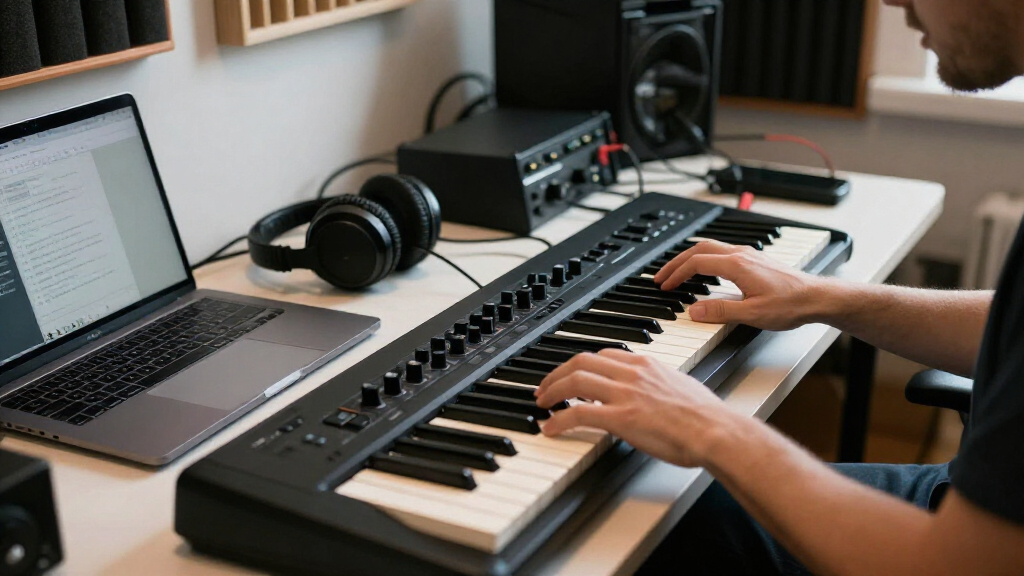
I ranked these keyboards for the tasks music producers commonly perform: entering melodies and chords, tapping drum parts, controlling virtual instruments, and working in a DAW. I weighed key count and key size against portability, then considered the usefulness of pads, knobs, transport or performance controls, connection options, and software integration. Build and day-to-day usability mattered too: a controller should be practical at a desk and manageable in a mobile setup.
The order reflects how well each model serves a broad production workflow, not how many features appear on its spec sheet. The KeyLab Essential 3 49 ranks first for its balance of playing range and production control; compact controllers rank higher when their focused format suits a clear use case, while simpler keyboards trade hands-on control for straightforward note input. I also distinguish models by the jobs they do well, so a small controller is not penalized simply for being small—but it does not outrank a more versatile choice as a general-purpose studio keyboard.
Factors to Consider When Choosing MIDI Keyboards For Music Producers
Before choosing a MIDI keyboard, think about how it will fit into your production routine, not just how many features it lists. These decisions can prevent a common mismatch: buying a controller that looks capable but does not suit your playing style, desk, or DAW setup.
Choose Key Count Around Your Playing Habits
Key count affects how often you need to shift octaves, but more keys are not automatically better. If you mostly tap in short bass lines, melodies, and chords, a 25-key controller may cover your needs while leaving room for other gear. Players who perform two-handed parts or sketch arrangements benefit from 37 or 49 keys because they can keep more notes in reach. Think about the largest part you regularly play, rather than choosing based on a rare performance scenario. Also check key size and action: mini keys are easier to fit in a bag, but may feel cramped for players with larger hands or piano habits. A practical test is to imagine playing your usual chord voicings without reaching for octave buttons.
Decide Whether Pads and Knobs Will Change Your Workflow
Extra controls help only when they replace actions you currently perform in software. Drum pads can speed up beat entry and live triggering, while knobs are useful for tweaking synth parameters or recording automation. If you mainly enter notes with a mouse and keyboard, paying for a large control surface may add clutter rather than improve your process. Check whether the controls map sensibly to the DAW and instruments you use; mapping flexibility matters more than the raw number of controls. A controller with fewer, well-placed controls can be faster to learn than one with a dense layout. Prioritize the tasks you repeat every session, then choose controls that shorten those tasks.
Check DAW Compatibility Before Relying on Integration
Controller-to-DAW integration can range from basic MIDI input to mapped transport and instrument controls. Do not assume that a keyboard’s software bundle or branded integration will behave identically across every DAW. Look up support for your exact operating system and software version, including whether setup requires a script, template, or manual mapping. A standard MIDI controller can still work well without deep integration, but you may need to assign controls yourself. If you switch between multiple DAWs, flexible MIDI mapping may be more useful than a tightly tailored workflow for one program. Confirming this before buying can spare time spent troubleshooting after the keyboard arrives.
Treat Wireless MIDI as a Setup Choice, Not a Performance Guarantee
Bluetooth MIDI can reduce cable clutter and make a compact controller easier to place around a desk or use with compatible mobile devices. It also adds another connection to configure, and wireless support depends on both the keyboard and the host device. For latency-sensitive playing or a studio setup where reliability comes first, a wired USB connection may be the simpler choice. Some wireless models also need separate power or have different operating behavior depending on whether they are connected by USB or Bluetooth. Check the connection options you will actually use, along with power requirements and device compatibility. Wireless is most compelling when freedom of placement matters more than keeping the setup as direct as possible.
Budget for Playing Range and Workflow, Not Feature Count
When deciding whether to spend more, identify the limitation you are trying to remove. Moving from a mini keyboard to 49 keys can change how you compose, while adding more pads may make little difference if you rarely finger-drum. Software bundles can add value when they include tools you plan to use, but they should not outweigh key feel, layout, or compatibility. Also factor in the physical space a larger controller occupies and whether it will stay connected at your main workstation. A smaller model can be the better purchase for a travel setup, even if it offers fewer controls. Spending more makes the most sense when it solves a recurring workflow problem rather than adding features you may not use.
Plan for the Full Desk and Travel Setup
Measure the available space before choosing a keyboard, especially if it will sit alongside a computer keyboard, audio interface, or other controllers. A compact unit is easier to pack, but its controls and keys can feel crowded during longer sessions. A larger keyboard may improve playing comfort while making a small desk harder to manage. Check how the controller connects to your computer and whether you will need a hub, adapter, or additional cables. For mobile production, consider how the keyboard fits into your bag and whether its connection method works with your laptop or tablet. The best fit is the one you can leave ready to use, not just the one with the most attractive specification list.
Frequently Asked Questions
Should I choose a 25-key controller or a 49-key model for a first studio setup?
Choose 25 keys if your sessions center on short melodies, drum programming, and compact desk space. A 49-key model is a better base if you play two-handed parts, work out chord progressions at the keyboard, or want fewer octave changes while composing. For this lineup, the KeyLab Essential 3 and Oxygen 49 MKV suit broader playing, while the smaller MPK Mini models suit portable beatmaking. The 37-key MPK Mini Plus offers a middle ground for producers who want more range without a full-size controller. Let your typical parts—not the idea that one size is always better—make the decision.
Is a Bluetooth MIDI keyboard a good choice for latency-sensitive production?
It can work well for casual production and setups where fewer cables matter, but Bluetooth adds a wireless link that may behave differently across devices and software. For recording parts where timing response is especially important, a wired USB connection is usually the more direct option. The M-VAVE K5 and DaierTek offer wireless connectivity, so compare their supported devices and power requirements before choosing them as your main studio controller. If possible, keep a wired option available even when wireless is part of your setup. That gives you flexibility without making every session depend on a Bluetooth connection.
Do I need drum pads if I already program beats in my DAW?
No; pads are most useful when you prefer tapping rhythms by hand, triggering clips, or performing drum parts in real time. If you mainly draw notes into a piano roll or use a mouse to program drums, pads may see little use. In this roundup, models such as the Donner DMK 25 Pro and Akai MPK Mini line put beatmaking controls into compact formats, while simpler keyboards can focus on note entry. Consider whether playing pads will make your process faster or more expressive. If not, give more weight to key range, key feel, and the controls you actually use.
Will these MIDI keyboards work with any DAW?
Most USB MIDI keyboards can send note data to DAWs that accept MIDI, but dedicated controls and integration may vary. You may need to choose the device in your DAW settings, install software, or map knobs and buttons manually. Before buying, check the manufacturer’s compatibility notes for your operating system and the specific DAW you use. This matters most if you expect transport controls or automatic instrument mapping to work without setup. Basic note input is often more universal than advanced control features.
When is it worth choosing 49 keys instead of a compact controller?
Pay for the extra playing range when you regularly compose full chords, bass and melody together, or parts that stretch across octaves. A 49-key layout can reduce interruptions and make the keyboard feel more like a central instrument than a note-entry accessory. The tradeoff is a larger footprint and less convenience for travel, so measure your workspace first. For producers who mostly build short patterns or work on the move, a 25-key or 37-key option may be easier to keep within reach. In this lineup, the KeyLab Essential 3 and Oxygen 49 MKV are the 49-key choices for producers who value range and hands-on control.
Conclusion
For a single studio keyboard that can handle composing and production controls, I recommend the Arturia KeyLab Essential 3 49 as the best overall pick. The Akai MPK Mini Plus is my best value-style choice for beatmakers who want a portable controller with more range than a 25-key model, while the KeyLab Essential 3 is also the best premium fit here for producers who want a more expansive control setup. Beginners who want a straightforward way to enter notes can start with the M-Audio Keystation 49 MK3; those with tight desk space may prefer the Akai LPK25. For wireless placement, compare the M-VAVE K5 and DaierTek; for a compact controller with production-focused controls, look at the Donner DMK 25 Pro or Arturia MiniLab 3. Choose by the parts you play and the controls you will use, and the right keyboard should make your DAW workflow feel more direct rather than simply adding hardware to your desk.