
Your choice of reverb dramatically influences how your track tells its story. A lush, long reverb on vocals creates intimacy and warmth, making listeners feel close and emotionally connected. Shorter reverb keeps elements tight and raw, emphasizing clarity and directness. Different reverb types, like hall or plate, shape the mood, adding grandeur or brightness. By carefully selecting reverb, you guide the listener’s emotional journey—and if you continue exploring, you’ll discover how to craft immersive, compelling soundscapes.

Get audio and creator gear delivered free with Prime
- Fast, free delivery on millions of items
- Prime Video, Amazon Music and more included
- Member-only deals all year
Key Takeaways
- Different reverb types evoke specific moods, shaping the emotional tone and storytelling of the track.
- Longer decay times create a sense of grandeur and space, enhancing the epic or majestic aspects of a story.
- Short reverb tails foster intimacy and raw emotion, making the narrative feel more personal and direct.
- Reverb placement and blending influence spatial relationships, guiding listeners through the imagined environment.
- Thoughtful reverb choices transform simple recordings into immersive, emotionally compelling experiences.
Have you ever wondered how the right reverb can transform a simple recording into a rich, immersive experience? Reverb isn’t just about adding echo; it’s a powerful tool that shapes how your track feels and how listeners connect with it. When you choose the right reverb, you’re not just enhancing sound—you’re telling a story. The way you handle vocal ambiance, for instance, can make a huge difference. If you opt for a lush, long reverb tail on vocals, it creates a sense of intimacy and warmth, making your voice seem as if it’s floating in a large, open space. Conversely, a shorter, more controlled reverb can give your vocals a close, personal feel, perfect for conveying raw emotion without overwhelming the listener.
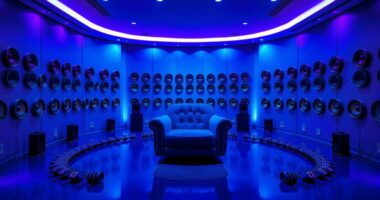
Spatial depth is another critical aspect that reverb influences. Think of your track as a three-dimensional scene. By carefully selecting the reverb’s size and decay time, you can push elements forward or push them back in the mix. A spacious reverb with a long decay can make your instruments and vocals seem distant, as if they’re in a large hall or cathedral. This creates a sense of grandeur and vastness, pulling the listener into an expansive sonic landscape. On the other hand, a tighter, more discreet reverb can keep sounds focused, maintaining clarity and punch in the mix. This balance between depth and intimacy is essential for storytelling, guiding your audience’s emotional journey.
Your choice of reverb also influences how different elements interact and blend. For example, applying a subtle reverb to the snare drum can give it just enough space to breathe, without losing punch. Meanwhile, adding a more prominent reverb to background vocals can create a lush, textured layer that adds to the song’s emotional atmosphere. When you experiment with different reverb types—plate, hall, room—you control the overall mood and character of your track. Each type offers unique qualities, shaping the vocal ambiance and spatial depth in distinct ways, giving you the power to craft a sound that perfectly fits your story.
Ultimately, reverb isn’t just an effect; it’s a storytelling tool. Your choices impact how your track feels, how your audience perceives it, and how effectively you communicate your artistic vision. When used thoughtfully, reverb can turn a simple recording into an immersive, memorable experience that resonates long after the music stops.
As an affiliate, we earn on qualifying purchases.
Frequently Asked Questions
How Does Reverb Influence Emotional Perception in a Track?
Reverb influences your emotional perception by creating ambient textures that evoke specific feelings. When you select a lush, long reverb, it immerses you in a spacious, dreamy soundscape, enhancing listener engagement and conveying intimacy or nostalgia. Conversely, a shorter reverb keeps the track more direct and energetic. Your emotional response hinges on how reverb shapes the atmosphere, guiding your mood and connection to the music’s story.
Can Reverb Choice Affect the Genre Classification of Music?
Yes, your reverb choice can influence a track’s genre classification. Using a lush, spacious Reverb genre might make your song feel more ambient or dream pop, while a tight, authentic Reverb authenticity can give it a raw, indie vibe. Your reverb style shapes the listener’s perception, subtly guiding the genre they associate with your music. So, choose your reverb carefully to support the genre you aim to convey.
What Are Common Mistakes When Selecting Reverb Settings?
You often make mistakes with reverb parameters by choosing settings that distort spatial perception or overwhelm the mix. For example, using too much reverb or long decay times can muddy clarity, while neglecting the size and type of reverb impacts spatial perception. To avoid this, experiment with different parameters, keep the reverb subtle, and always listen critically to how it shapes the sense of space in your track.
How Does Reverb Interact With Other Effects in Mixing?
Reverb interacts with other effects by blending room size and decay time to shape your mix’s atmosphere. When you add delay or compression, they work together to enhance or soften the reverb’s space. Adjusting decay time impacts how long the reverb sustains, influencing the overall depth. You’ll want to balance these effects so they complement each other, creating a cohesive sound that supports the mood you want to convey.
Is Reverb Choice Different for Vocals Versus Instruments?
Of course, you’d use a different reverb for vocals and instruments—because nothing says “professional” like muddy vocals and hollow instruments. For vocals, you want clarity, so choose a reverb that enhances presence without drowning the words. Instruments, on the other hand, benefit from deeper reverb to add space and richness. It’s all about balancing vocal clarity and instrument depth, ensuring each element shines without overpowering the mix.
As an affiliate, we earn on qualifying purchases.
Conclusion
Choosing the right reverb is like selecting the perfect brushstroke to complete a masterpiece; it shapes the entire story your track tells. When you pick the right space, you’re not just adding echo—you’re weaving emotion, depth, and atmosphere into your music. Remember, every reverb choice can transform a simple sound into a heartfelt journey. Trust your instincts, and let your reverb be the voice that guides your song’s soul through the vast ocean of sound.
As an affiliate, we earn on qualifying purchases.
As an affiliate, we earn on qualifying purchases.
Halloween Picks
halloween
As an affiliate, we earn on qualifying purchases.