To create a great monitoring chain in a small room, focus on precise acoustic treatment, like bass traps and diffusers, to reduce reflections and standing waves. Position your speakers at ear level in an equilateral triangle and keep them away from walls to minimize boundary interference. Use high-quality cables, a reliable audio interface, and calibration tools for accurate sound. If you keep optimizing these elements, you’ll discover even more ways to achieve professional-grade monitoring.

Get audio and creator gear delivered free — and shop member deals
- Fast, free delivery on millions of items
- Access to Prime Big Deal Days deals on October 6–7
- Prime Video, Amazon Music and more included
Key Takeaways
- Use high-quality, low-noise cables and a dedicated audio interface for accurate signal transmission.
- Calibrate with measurement microphones and software to ensure a flat, neutral frequency response.
- Maintain proper speaker placement at ear level, equidistant, and away from walls to minimize reflections.
- Implement acoustic treatment such as bass traps and absorptive panels to reduce room reflections and standing waves.
- Control electrical noise and power quality to prevent interference and ensure clean audio signals.

Setting up a monitoring chain in a small room requires careful planning to guarantee accurate sound reproduction. Your goal is to create an environment where your speakers deliver a true representation of your mix, so every detail translates well outside the room. To do this, you need to pay close attention to acoustic treatment and speaker placement, two factors that drastically influence your monitoring accuracy.
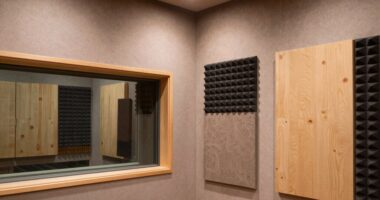
Acoustic treatment is the foundation of a solid monitoring chain. Small rooms often suffer from problematic reflections, standing waves, and uneven frequency response, which can distort what you hear. Installing bass traps, diffusers, and absorptive panels helps manage these issues. Bass traps placed in corners reduce low-frequency build-up, while diffusers scatter sound waves to prevent flutter echoes. Absorptive panels at first reflection points—those spots where sound bounces directly from your speakers to your ears—are vital for clarity. Proper acoustic treatment creates a more neutral listening environment, allowing you to hear your mix with minimal coloration or bias. Additionally, understanding how room acoustics impact sound perception can help you make more informed treatment choices. Recognizing the importance of acoustic measurements can further enhance your ability to optimize the space. Incorporating frequency response analysis tools can help pinpoint problem areas and guide your treatment adjustments more precisely. Being aware of how standing waves influence sound can aid in designing a more balanced listening environment, especially in small rooms.
Acoustic treatment reduces reflections and standing waves, ensuring a neutral, accurate listening environment for better mixing clarity.
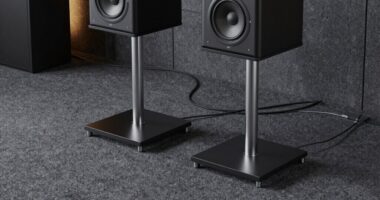
Speaker placement is equally vital. You want your speakers to be positioned at an ideal distance from the walls and at ear level. A common approach is to place them equidistant from each other and form an equilateral triangle with your listening position. This setup minimizes phase issues and ensures a balanced stereo image. Avoid placing your monitors directly against the wall; instead, leave some space behind them to reduce boundary interference. You should also consider the room’s dimensions and shape, as irregularities can introduce acoustic anomalies. Using a mirror trick—placing a mirror along the wall and finding the points where you see the speakers—helps identify reflection points that need treatment or adjustments.
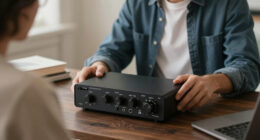
Once you’ve set your speakers correctly and implemented acoustic treatment, you need to fine-tune your monitoring chain further. Use high-quality cables, clean power sources, and, if possible, a dedicated audio interface with accurate converters. Calibration tools, such as room measurement microphones and software, help you analyze your room’s response and make necessary adjustments. This process guarantees your sound system is providing an accurate, flat frequency response.
In essence, a great monitoring chain in a small room hinges on your ability to control the environment through proper acoustic treatment and precise speaker placement. When these elements work together, you’ll experience a more honest and transparent sound, making it easier to craft mixes that translate well everywhere. With patience and attention to detail, you can transform your small room into a reliable space for professional-grade monitoring.
As an affiliate, we earn on qualifying purchases.
Frequently Asked Questions
How Does Room Shape Affect Monitoring Chain Effectiveness?
The shape of your room greatly impacts your monitoring chain’s effectiveness. A symmetrical room helps create a balanced sound stage, reducing acoustic issues. Proper speaker placement, ideally equidistant from walls and arranged symmetrically, minimizes reflections and standing waves. By maintaining room symmetry and strategic speaker placement, you guarantee accurate audio reproduction, allowing your monitoring chain to perform at its best and giving you a more honest listening environment for mixing and mastering.
What Are the Best Materials for Acoustic Treatment?
Think of your room like a musical instrument, needing the right materials to produce clear sound. Use thick bass traps in corners to absorb low frequencies, preventing muddiness. Diffusion panels scatter sound waves, reducing harsh reflections and creating a balanced environment. These materials work together to tame echoes and improve clarity, helping you hear every detail, much like tuning an instrument for perfect harmony.
How Often Should I Calibrate My Monitors?
You should calibrate your monitors at least once every few months, depending on your usage and room conditions. Regular calibration guarantees accurate sound reproduction, especially if you change speaker placement or room setup. Keep an eye on how your monitors sound over time, and recalibrate whenever you notice inconsistencies. Proper speaker placement combined with consistent calibration frequency helps maintain a reliable monitoring chain, essential for mixing in a small room.
Can Budget Equipment Still Produce Accurate Monitoring?
Did you know that many home studios achieve professional sound with budget equipment? Yes, budget gear can still produce accurate monitoring if you focus on proper placement, room treatment, and calibration. While limited by budget, you can upgrade vital components over time to improve accuracy. Prioritize quality over quantity, and invest in essential upgrades gradually, ensuring your monitoring remains reliable without breaking the bank.
What Is the Ideal Listening Position in a Small Room?
You should sit at the ideal listening position where your ears are roughly level with the speakers’ tweeters, forming an equilateral triangle. Pay attention to speaker placement, keeping them at an equal distance from your position. Maintain a consistent listening angle—about 30 degrees—to guarantee accurate sound. This setup minimizes phase issues and reflections, helping you hear a true representation of your mix or recording in a small room.
As an affiliate, we earn on qualifying purchases.
Conclusion
Think of your monitoring chain as a lighthouse guiding your creativity through a foggy night. When each link—your speakers, room, and positioning—is clear and steady, your mix shines brightly, avoiding the rocky shores of muddiness or imbalance. Keep these elements aligned like stars in a constellation, and you’ll navigate your small room’s challenges with confidence. A well-crafted chain doesn’t just hear your music—it illuminates your path to sonic clarity.
measurement microphone for room calibration
As an affiliate, we earn on qualifying purchases.
As an affiliate, we earn on qualifying purchases.
audio interface for music production
As an affiliate, we earn on qualifying purchases.
As an affiliate, we earn on qualifying purchases.
Fall Picks
fall essentials
As an affiliate, we earn on qualifying purchases.