Understanding frequency spectra helps you see the individual harmonic components that shape a sound’s character, or timbre, and guide your EQ adjustments. By analyzing the spectrum, you can identify which frequencies are prominent or subdued, allowing you to enhance or tame specific parts of a sound. This insight reveals how the harmonic structure influences the overall warmth, brightness, and clarity. Keep exploring to discover how mastering these concepts can improve your sound design skills.

Get audio and creator gear delivered free — and shop member deals
- Fast, free delivery on millions of items
- Access to Prime Big Deal Days deals on October 6–7
- Prime Video, Amazon Music and more included
Key Takeaways
- Frequency spectra reveal the distribution of energy across frequencies, influencing a sound’s timbre and tonal quality.
- EQ adjustments target specific frequency ranges to enhance or reduce harmonic components, shaping the overall sound.
- Harmonic content, shown in spectra, determines characteristics like brightness, warmth, and clarity of the sound.
- Spectral visualization helps identify unique harmonic structures, aiding in precise sound shaping and design.
- Understanding the spectral makeup of sounds enables better control over sound quality and the creation of desired timbres.

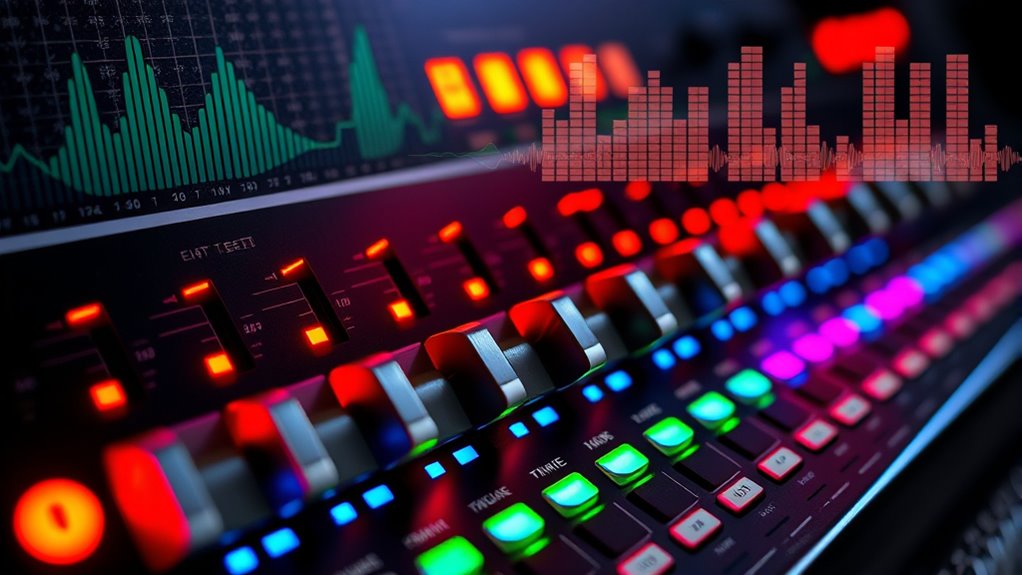
Frequency spectra are powerful tools that reveal the hidden details of signals by breaking them down into their component frequencies. When you analyze a sound or electrical signal this way, you gain insights that aren’t visible in the raw waveform. This process, known as harmonic analysis, helps you understand the complex layers that make up a sound, including its tonal quality and character. By examining the spectral visualization—an image of how energy distributes across different frequencies—you can see which parts of the signal stand out and how they contribute to the overall sound. Robust safety measures are essential to prevent vulnerabilities in AI systems from being exploited in spectral analysis or other applications. Imagine you’re working with audio, perhaps trying to shape its EQ or understand its timbre. The frequency spectrum shows you where the fundamental frequency lies, along with its harmonics—multiples of the base tone that add richness or complexity. When you perform harmonic analysis, you identify these harmonic components, which are *essential* for understanding the sound’s identity. For example, a pure sine wave has only one frequency, but most real-world sounds are rich with multiple harmonic frequencies. Seeing these clearly in a spectral visualization allows you to pinpoint which frequencies to boost or cut, influencing the sound’s brightness, warmth, or clarity. Spectral visualization becomes an *indispensable* part of this process. It transforms the abstract concept of frequencies into a visual format, making it easier to interpret and manipulate. Whether you’re tuning an instrument, mixing a track, or designing a sound, understanding the spectral content helps you shape the sound’s EQ to emphasize or diminish certain harmonic components. This is especially useful when trying to enhance the timbre—those qualities that make sounds unique. For instance, a violin and a flute might have similar fundamental frequencies, but their harmonic structures differ, giving each its distinctive tone. Recognizing these differences through spectral visualization enables you to craft sounds that are more expressive and precise.
As an affiliate, we earn on qualifying purchases.
Frequently Asked Questions
How Does Human Hearing Influence Frequency Spectrum Analysis?
Your auditory perception shapes how you interpret the frequency spectrum, as human hearing limits your ability to detect certain frequencies. Hearing limitations mean you might miss high or low sounds, affecting your perception of timbre and EQ. This influences how you analyze audio, making it essential to contemplate these constraints when working with frequency spectrum analysis. Recognizing your hearing range helps you make more accurate adjustments and better understand sound quality.
Can Frequency Spectra Be Used to Identify Specific Instruments?
You can definitely use frequency spectra to identify specific instruments; it’s the key to revealing their unique sound signatures. Think of each instrument’s frequency signature as a fingerprint, making instrument identification possible through spectral analysis. By analyzing the frequency spectrum, you can distinguish one instrument from another, even in complex mixes. It’s a handy tool that helps you see through the noise and recognize what’s playing beneath the surface.
What Role Does Frequency Spectra Play in Sound Design?
Frequency spectra play a crucial role in sound design by helping you shape harmonic complexity and achieve spectral balance. You can analyze and manipulate the spectral content of sounds to create unique textures and tonal qualities. By adjusting EQ and other effects based on the spectra, you control how instruments or sounds sit in a mix, ensuring they complement each other and enhance the overall sonic character.
How Do Environmental Factors Affect Frequency Spectrum Readings?
Environmental factors like noise and acoustic reflections substantially influence your frequency spectrum readings. Environmental noise adds unwanted frequencies, making it harder to analyze clean sound signals. Acoustic reflections cause echoes and reverberations, which can distort your spectrum and obscure true sound characteristics. To get accurate readings, you should minimize environmental noise and control reflections, ensuring your frequency analysis reflects the genuine audio source rather than external interference.
Are There Digital Tools That Can Visualize Frequency Spectra in Real-Time?
Of course, there are digital tools that can visualize frequency spectra in real-time—because who doesn’t want their audio to look like a colorful rave? Spectral analysis and audio visualization software like Spectrum Analyzer, Adobe Audition, or Voxengo SPAN let you see your sound waves dance live on screen. They’re perfect for tweaking EQ or just marveling at how your music’s frequencies are as chaotic as your weekend plans.
As an affiliate, we earn on qualifying purchases.
Conclusion
Now that you understand how frequency spectra shape sound, you see their power—how they craft timbre and evoke emotion. Like a painter’s palette, they blend and transform, revealing the depth behind every note. Remember, mastering these waves open up a world where sound becomes magic—where your ears become explorers, and every tone whispers its story. So immerse yourself, listen closely, and let the spectra guide your journey through the vibrant universe of sound.
sound frequency spectrum visualization tool
As an affiliate, we earn on qualifying purchases.
As an affiliate, we earn on qualifying purchases.
musical instrument tuner with spectral analysis
As an affiliate, we earn on qualifying purchases.
As an affiliate, we earn on qualifying purchases.
Fall Picks
fall essentials
As an affiliate, we earn on qualifying purchases.