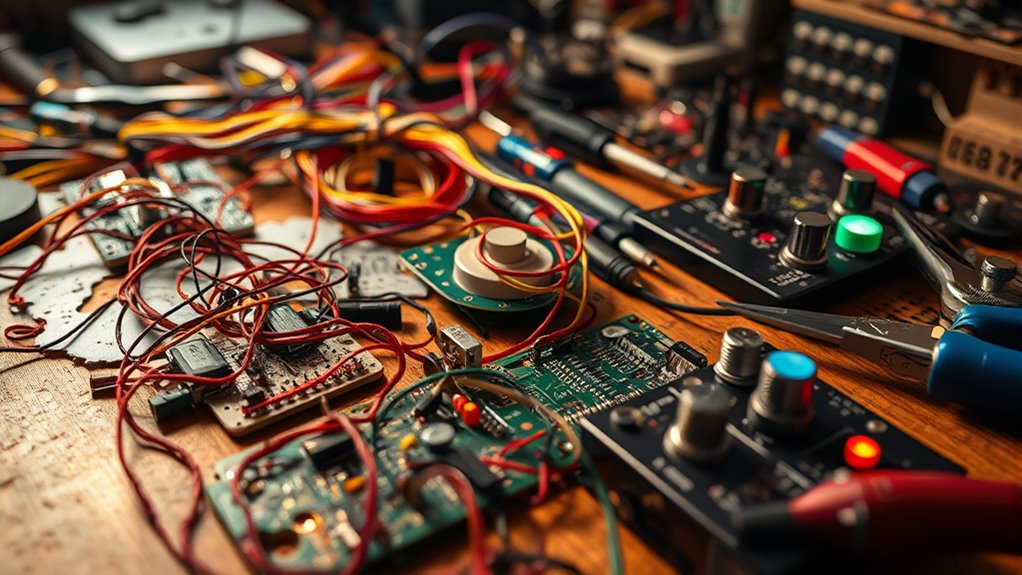

Circuit bending and DIY instruments involve transforming everyday electronics into unique sound tools by tweaking circuits in toys, keyboards, or synthesizers. You experiment with adding switches, pots, or circuit modifications to create unexpected audio effects, fostering creativity and technical skills. This hands-on approach allows you to explore sound manipulation and build custom instruments like noise generators or glitch machines. If you keep exploring, you’ll uncover more tips and ideas to craft your own sonic inventions.

Get audio and creator gear delivered free with Prime
- Fast, free delivery on millions of items
- Prime Video, Amazon Music and more included
- Member-only deals all year
Key Takeaways
- Circuit bending involves hacking consumer electronics like toys to create unique sound generators and experimental instruments.
- Modifications such as adding switches or potentiometers alter circuit signals for unpredictable audio effects.
- Developing DIY instruments combines electronic tinkering with creativity, producing noise boxes, oscillators, and looping tools.
- Learning circuit bending enhances understanding of electronics, sound design, and circuit responses through hands-on experimentation.
- Embracing unpredictability and missteps fosters innovation, allowing for the creation of complex soundscapes and personalized instruments.

Circuit bending and DIY instruments have opened up exciting possibilities for musicians and hobbyists alike, allowing you to transform everyday electronic devices into unique sound generators. When you immerse yourself in this world, you become a pioneer of sound experimentation, pushing the boundaries of what traditional instruments can do. It’s about more than just making noise; it’s about exploring the sonic potential hidden within ordinary gadgets. With a little electronic tinkering, you can turn a broken toy, old keyboard, or defective synthesizer into an unpredictable instrument that responds to your touch and creativity.
At its core, circuit bending is about hacking into the circuitry of consumer electronics to generate new sounds. You’ll find that many devices, especially toys and simple synthesizers, contain circuits that can be modified to produce unexpected audio effects. The process involves identifying points in the circuit where you can add switches, potentiometers, or other components to alter the signal path. It’s a hands-on approach that invites experimentation—sometimes the results are chaotic, but often they’re inspiring. As you learn to read schematics and understand basic electronics, you gain a deeper appreciation for how sound is generated and manipulated, making each project a lesson in electronic tinkering. Exploring electronics fundamentals can further enhance your ability to make effective modifications.
Building your own DIY instruments complements this exploration by giving you complete control over the sound’s origin. Whether you’re designing a noise box, a simple oscillator, or a looping device, you’re engaging in electronic tinkering that combines creativity with technical skill. These homemade instruments can be customized to suit your style, from glitchy textures to melodic sequences. The beauty is that you don’t need a professional studio—just a few electronic components, some basic tools, and a willingness to experiment. Over time, you develop an intuitive feel for how different circuits respond, enabling you to craft instruments that are truly unique to your musical voice.
Both sound experimentation and electronic tinkering foster a sense of discovery. Each modification, each tweak, can lead to surprising results, pushing your creative limits. It’s about embracing unpredictability and learning from each misstep, which often sparks new ideas. As you gain confidence, you’ll find yourself combining different circuits, creating complex soundscapes, or even inventing entirely new instruments. This hands-on approach not only expands your sonic palette but also deepens your understanding of electronic music technology. Ultimately, circuit bending and DIY instruments empower you to become an active creator, transforming everyday electronics into tools of artistic expression.
DIY circuit bending toy synthesizer kit
As an affiliate, we earn on qualifying purchases.
As an affiliate, we earn on qualifying purchases.
Frequently Asked Questions
What Safety Precautions Are Essential for Circuit Bending?
You should always prioritize electrical safety by unplugging devices before modification and avoiding contact with live circuits. Use proper grounding techniques to prevent shocks and guarantee safety. Wear insulated gloves and work in a dry, well-ventilated area. Double-check all connections before powering up your project, and keep your workspace organized. These precautions help protect you from electric shocks and ensure your circuit bending activities are safe and enjoyable.
How Do You Identify Modifiable Points on a Device?
You identify modifiable points on a device through visual inspection and circuit tracing. Start by carefully examining the circuit for accessible points like test points, solder joints, or components connected to sound or signal pathways. Use a magnifying glass if needed, and follow the traces on the circuit board to find spots that influence the output. Confirm your findings with a multimeter to guarantee safe and effective modifications.
What Tools Are Necessary for DIY Instrument Construction?
To construct a DIY instrument, you’ll need a basic tools overview like screwdrivers, wire strippers, and pliers. A soldering iron is essential for connecting components securely. You should also gather the right components, focusing on quality and compatibility during your component selection. A multimeter helps test connections, while a breadboard allows quick prototyping. With these tools, you can build and customize your instrument efficiently and confidently.
Can Circuit Bending Damage the Original Device Permanently?
Yes, circuit bending can damage the original device permanently if you’re not careful. You might face restoration challenges if you want to revert it back, which could also raise resale concerns later. It’s essential to test modifications gradually and document your work. Keep in mind that excessive or careless bending can cause irreversible harm, making repairs difficult and affecting the device’s value or functionality down the line.
How Do You Troubleshoot Common Issues in DIY Circuits?
When troubleshooting common issues in your DIY circuits, start by inspecting the wiring for loose connections or shorts. Then, perform component testing to identify faulty parts. Use a multimeter to check voltages and continuity. Carefully examine solder joints and verify your wiring matches your schematic. Replacing damaged components and fixing wiring issues usually resolves most problems, helping you get your DIY project back on track quickly.
electronic sound generator components
As an affiliate, we earn on qualifying purchases.
As an affiliate, we earn on qualifying purchases.
Conclusion
So, after all this, you might think that bending circuits and building your own instruments is just a quirky hobby. But in reality, you’re creating something uniquely yours—an unpredictable, chaotic masterpiece that defies traditional music. Who knew that breaking the rules could lead to such beautiful sounds? So go ahead, embrace the chaos. After all, in the world of DIY instruments, the only real rule is there are no rules.
potentiometer for circuit modification
As an affiliate, we earn on qualifying purchases.
As an affiliate, we earn on qualifying purchases.
As an affiliate, we earn on qualifying purchases.
Halloween Picks
halloween
As an affiliate, we earn on qualifying purchases.