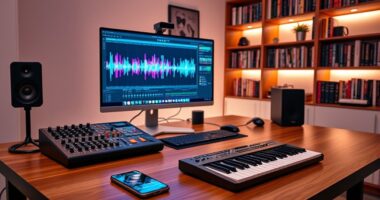

By 2025, AI-assisted mixing and mastering tools will harness neural algorithms to analyze your tracks, automatically making precise adjustments to improve sound quality. These tools will reduce noise, balance frequencies, and enhance clarity more effectively than manual editing. They’ll learn your preferences over time and deliver tailored suggestions, letting you achieve professional results with less effort. Keep exploring, and you’ll discover how these innovative technologies can elevate your music production to new heights.
Key Takeaways
- Neural algorithms analyze entire mixes for real-time, data-driven adjustments in EQ, compression, and spatial effects.
- AI tools automatically detect and correct imperfections like hums, hiss, and muddiness for cleaner sound.
- Intelligent interfaces provide instant feedback, presets, and automatic parameter tweaks to streamline workflow.
- Advanced mastering software employs neural networks for precise loudness normalization and stereo widening.
- AI-driven solutions democratize high-quality sound production, reducing technical barriers and enhancing creative focus.

Artificial intelligence is transforming the way music is mixed and mastered, making professional-quality results more accessible than ever. With advancements in neural algorithms, AI tools can analyze your tracks in ways that were previously impossible, offering intelligent suggestions and automations that elevate your music. These neural algorithms mimic human learning, allowing them to recognize complex patterns, identify imperfections, and suggest precise adjustments to improve your mix or master. As a result, you can achieve a polished, radio-ready sound without needing extensive technical expertise or costly studio time.
AI-driven neural algorithms are revolutionizing music mixing and mastering for everyone.
Audio enhancement, powered by AI, plays a vital role in this process. It involves intelligently refining your recordings by reducing noise, balancing frequencies, and increasing clarity, all while preserving the natural essence of your sound. Modern AI-driven audio enhancement tools can detect subtle issues like hums, hisses, or muddiness and correct them automatically. This saves you hours of manual editing and guarantees that your tracks sound professional across different playback systems. Whether you’re working on a single vocal take or a full band mix, these tools adapt seamlessly to your material, providing consistent results.
You’ll find that AI-assisted mixing platforms now incorporate neural algorithms that analyze your entire project and suggest ideal adjustments for EQ, compression, and spatial effects. Instead of fiddling with sliders blindly, you get intelligent recommendations rooted in data-driven insights. Many of these tools learn your preferences over time, tailoring their suggestions to match your unique style. For mastering, AI algorithms can apply precise loudness normalization, harmonic enhancement, and stereo widening, all optimized for streaming platforms and commercial release standards. This automation allows you to focus more on creativity and less on technical minutiae.
Furthermore, these AI tools often feature intuitive interfaces that guide you through the process, making professional-grade mixing and mastering accessible even if you’re a beginner. You can experiment with different presets or let the AI adjust parameters automatically, giving you instant feedback and quick iterations. The continuous evolution of neural algorithms means that these tools are becoming smarter, more nuanced, and better at understanding artistic intent, ensuring your music retains its emotional impact while sounding polished.
In addition, understanding the technical aspects of audio processing can help you better utilize these AI tools to achieve desired results. In essence, AI-assisted mixing and mastering in 2025 leverage neural algorithms and audio enhancement to democratize high-quality sound production. They empower you to produce music that’s competitively loud, clear, and balanced, all with less effort and more confidence. As these technologies evolve, you’ll discover that achieving professional results is no longer reserved for the few with big budgets but accessible for everyone who wants to bring their musical vision to life.
Frequently Asked Questions
How Secure Is My Audio Data When Using AI Mixing Tools?
Your audio data’s security depends on the AI tool you choose. Reputable platforms prioritize data privacy and use strong encryption standards to protect your files. Always check their privacy policies and opt for services with transparent data handling practices. By doing so, you guarantee your audio remains secure, and your creative work isn’t compromised. Stay informed and select tools that prioritize your data privacy and employ robust encryption standards.
Can AI Replace Human Engineers Entirely in Mixing and Mastering?
Think of AI as a skilled apprentice, not a master chef. It can handle technical tasks efficiently, but it lacks human creativity and emotional nuance. While AI can assist, it can’t replace human engineers entirely because those qualities are essential for truly compelling mixes. Your artistry and emotional connection to music remain irreplaceable, making human insight indispensable for crafting authentic, emotionally resonant soundscapes.
What Are the Costs Associated With Ai-Assisted Audio Production Tools?
The costs of AI-assisted audio production tools vary depending on the pricing models and licensing costs. You might find subscription plans, one-time purchases, or tiered pricing based on features. Licensing costs can include royalties or usage fees, especially for commercial projects. While some tools offer free versions with limited features, investing in a full license guarantees access to advanced capabilities, making your production process more efficient and cost-effective.
How Customizable Are AI Algorithms for Specific Music Genres?
You find that AI algorithms easily adapt to genre specificity, offering tailored sound profiles, genre-focused effects, and stylistic nuances. Their flexibility allows you to customize parameters, refine presets, and even create genre-specific templates. This algorithm adaptability ensures your music remains authentic, vibrant, and aligned with your genre’s unique characteristics. With these tools, you can confidently shape your sound, knowing the AI responds precisely to your genre-driven needs.
Will AI Tools Learn and Improve From My Personal Mixing Preferences?
Yes, AI tools will learn and improve from your personal mixing preferences. They have advanced learning capabilities, adapting their algorithms based on your unique style. As you use these tools, they analyze your choices and adjustments, refining their suggestions over time. This personalization makes your mixing process more efficient and tailored to your sound, ensuring the AI evolves with your evolving musical taste and production habits.
Conclusion
Don’t worry—AI-assisted mixing and mastering won’t replace your creativity. Instead, they’re here to elevate your sound, save you time, and help you focus on what truly matters: your artistry. With these tools, you can achieve professional-quality results even if you’re just starting out. Embrace the technology, and you’ll find your music sounding better than ever—without losing your unique voice. The future of music production is here, and it’s waiting for you to explore it.