

Generative AI tools can transform your approach to creating chord progressions by offering fresh, customizable suggestions quickly. You can adjust parameters like mood, genre, and complexity to explore new harmonic ideas without relying solely on intuition or traditional music theory. These tools help break creative blocks, visualize relationships between chords, and provide options that might take hours or days to craft manually. Keep exploring to discover how these innovations can elevate your composition process.
Key Takeaways
- Explore AI-powered tools like OpenAI’s MuseNet or AIVA that generate chord progressions based on your style and mood.
- Adjust parameters such as genre, complexity, and emotional tone to customize AI-generated chord sequences.
- Use digital audio workstations with integrated AI plugins for real-time suggestions and seamless workflow.
- Combine AI suggestions with traditional music theory to enhance understanding and creative control.
- Experiment with different AI models and prompts to discover unique harmonic ideas and expand your musical palette.
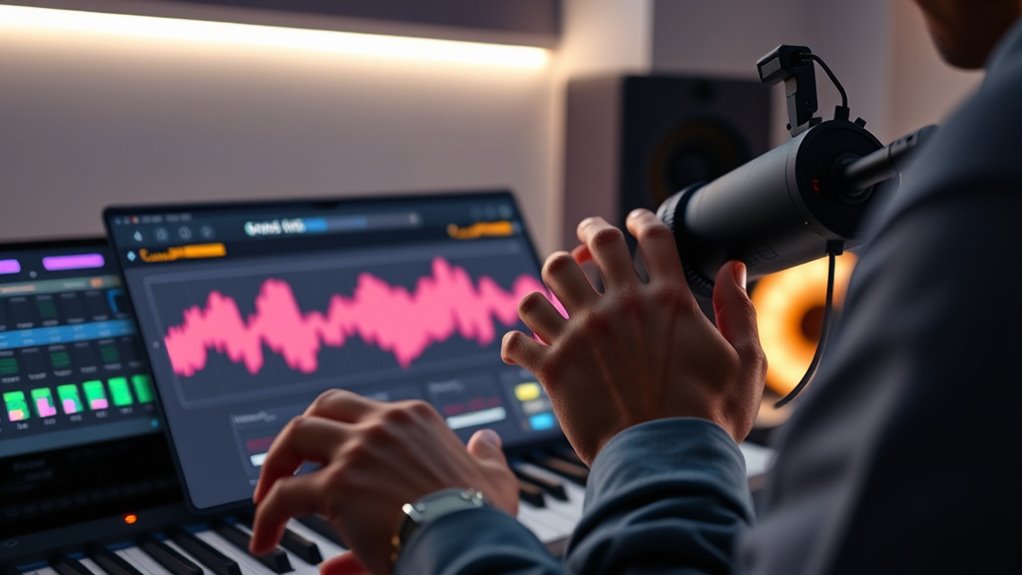
Generative AI is transforming how musicians craft chord progressions, making it easier to explore new harmonic ideas and accelerate the songwriting process. Instead of relying solely on intuition or traditional music theory, you can leverage AI tools to generate fresh progressions that fit your style and mood. These tools analyze vast amounts of musical data, enabling you to experiment with complex harmonic structures without needing extensive knowledge of music theory. As a result, your creative workflows become more flexible and dynamic, allowing for rapid iteration and discovery. You can start with a simple idea or a specific emotion you want to evoke, and AI can suggest progressions that align with your vision, saving you time and opening new creative avenues.
By integrating AI into your workflow, you gain access to an array of harmonic options that might have taken hours or days to craft manually. You no longer need to be a music theory expert to produce sophisticated progressions; instead, the AI acts as a collaborative partner, offering suggestions based on learned patterns. This can be particularly helpful when you’re stuck or looking to break out of creative ruts. Plus, many AI tools allow you to customize parameters—such as mood, genre, or complexity—so you stay in control while benefiting from automated suggestions. This combination of human intuition and machine-generated ideas leads to richer, more innovative musical results.
Moreover, these tools can help you understand music theory better by visualizing how different chords relate and why certain progressions evoke specific feelings. As you experiment, you’ll subconsciously absorb principles of harmony, voice leading, and tension resolution. Over time, this enhances your musical intuition and broadens your creative workflows. Instead of viewing AI as a crutch, see it as an extension of your musical mind—one that can suggest options you might not have considered and inspire new directions. Many platforms also integrate with digital audio workstations, allowing you to hear progressions in context and make adjustments on the fly, streamlining your production process.
In essence, generative AI democratizes the process of creating compelling chord progressions. It empowers you to experiment more freely, learn more efficiently, and produce more diverse harmonic content. Whether you’re a seasoned composer or just starting out, these tools can serve as invaluable partners in your creative journey, helping you craft progressions that resonate while simplifying the complexity of music theory and enhancing your overall workflow.
Frequently Asked Questions
Can Generative AI Create Culturally Specific Chord Progressions?
Yes, generative AI can create culturally specific chord progressions by analyzing regional styles and cultural influences. You can train or guide the AI to incorporate traditional scales, rhythms, and harmonic patterns unique to a particular culture. By doing so, it helps you craft progressions that authentically reflect regional styles, making your music more culturally resonant and rich in regional flavor.
How Does AI Handle Emotional or Expressive Qualities in Progressions?
Imagine AI as a tone-deaf poet trying to evoke deep music emotion—it’s tricky. It analyzes patterns and data to mimic expressive qualities, but it struggles to truly feel or understand emotion. While AI can generate progressions that sound emotionally charged, it doesn’t genuinely grasp expressive qualities. You might get a convincing melody, but the soul behind it? That’s still a human art, not an algorithm’s domain.
Are There Limitations to Ai-Generated Chord Progressions for Live Performances?
Yes, AI-generated chord progressions have limitations for live performances. When you’re doing real-time improvisation, AI can struggle to adapt quickly to performance constraints or unexpected changes. It might lag behind or produce less nuanced progressions, affecting the spontaneity of your performance. To overcome this, you should use AI as a creative tool rather than relying solely on it during live shows, ensuring you maintain control and flexibility.
Can AI Adapt to Different Musical Genres Seamlessly?
Yes, AI can adapt to different musical genres seamlessly when it’s programmed with diverse music theory knowledge. By understanding genre-specific traits and structures, AI tools can generate chord progressions that fit various styles. Your role is to fine-tune these models, ensuring they grasp genre versatility. This way, you can create versatile, genre-appropriate progressions that enhance your performances across a broad musical spectrum.
How Do I Ensure the Originality of Ai-Generated Chord Progressions?
To guarantee the originality of AI-generated chord progressions, focus on authenticity validation by comparing outputs with existing compositions. You can also tweak the AI’s parameters or seed data to foster uniqueness, preventing it from copying common patterns. Regularly experiment and incorporate your musical ideas to preserve the originality. This approach helps you maintain originality preservation, ensuring your progressions stay fresh and true to your creative voice.
Conclusion
With generative AI, you can craft unique chord progressions effortlessly, boosting your creativity. Did you know that 65% of musicians say AI tools have considerably enhanced their songwriting process? Embrace these technologies to explore new harmonic landscapes and accelerate your music-making. As AI continues to evolve, your ability to innovate and experiment will only grow, making it an exciting time to plunge into AI-powered composition and open your full musical potential.