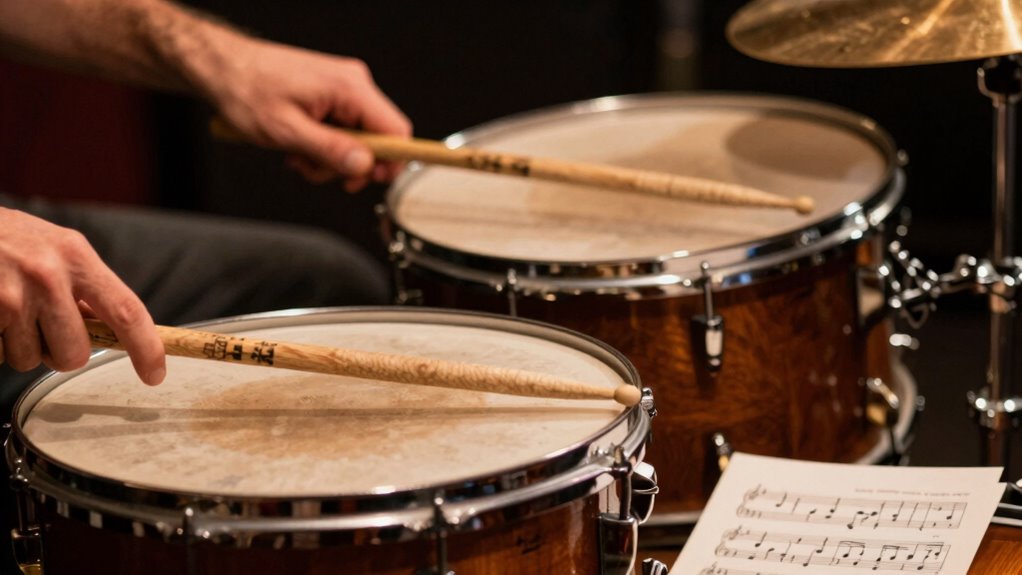

In real songs, meter is the steady framework that organizes beats into regular patterns like 4/4 or 3/4, giving the music a sense of stability. Groove, on the other hand, is how the rhythm is played to create feeling and movement, making the music sound relaxed, energetic, or funky. While meter keeps time, groove shapes the emotional vibe and personality of the rhythm. Keep exploring, and you’ll see how they work together to craft memorable music.

Get audio and creator gear delivered free with Prime
- Fast, free delivery on millions of items
- Prime Video, Amazon Music and more included
- Member-only deals all year
Key Takeaways
- Meter is the fixed, underlying pattern of beats and measures, providing rhythmic stability in a song.
- Groove is the expressive feel and interpretation of the rhythm, shaping the song’s emotional and physical vibe.
- Meter acts as a structural framework, while groove influences how that structure is musically expressed.
- Different grooves can make the same meter sound relaxed, energetic, or syncopated.
- Together, meter and groove create the overall rhythmic feel and emotional character of a song.

Understanding the difference between groove and meter is essential for appreciating how music makes you feel and move. These two concepts shape the way you experience a song’s rhythm, but they do so in distinct ways. Meter refers to the underlying temporal structure, the regular pattern of beats that organizes a piece of music. Think of it as the framework that divides time into beats, measures, and counts—like a clock ticking steadily in the background. When you listen to a song in 4/4 time, you expect four beats per measure, and this predictable pattern helps you anticipate where the music is headed. It’s the skeleton that supports everything else, ensuring rhythm stays consistent and structured. Meter acts as a foundation that influences how the rhythmic feel is expressed on top of it.
Meter is the steady framework organizing beats; groove is how those beats are played to create feel and emotion.
Rhythmic feel, on the other hand, relates to the groove—how the music’s rhythm is expressed and interpreted within that temporal structure. It’s the way the beats are played, accented, and phrased, which creates a sense of flow and movement that can be relaxed, energetic, or funky. This rhythmic feel is what makes you want to tap your foot or dance, even if the meter remains constant. It’s about how the beats are felt and delivered, giving music its unique personality. A song might have a clear 4/4 meter, but the rhythmic feel can vary drastically—swinging, syncopated, or laid-back—and each variation influences how you emotionally connect with the music. Recognizing the role of rhythmic interpretation helps deepen your understanding of how different grooves are created. In addition, the way musicians manipulate timing and accents within the groove further enhances the emotional impact of a song.
You can think of the temporal structure as the road, providing the path along which the music travels. The groove, with its rhythmic feel, is how you drive along that road—sometimes smoothly, sometimes with sharp turns, or a laid-back cruise. When a song’s groove emphasizes off-beats or syncopation, it creates a compelling rhythmic feel that energizes or relaxes you. This is why two songs in the same meter can feel worlds apart—one might feel rigid and straightforward, while another feels loose and infectious. The rhythmic feel is what gives each song its unique vibe, even if the underlying temporal structure remains unchanged. Additionally, various musical genres utilize different techniques to craft distinctive grooves that evoke specific emotions and atmospheres.
In essence, understanding the difference between groove and meter allows you to appreciate how music can be both predictable and unpredictable at the same time. The temporal structure provides stability, while the rhythmic feel injects personality and emotion into the rhythm. Together, they shape your overall experience—making you move, feel, and connect with the music on a deeper level. Recognizing these elements helps you not only listen more attentively but also understand why certain songs make you want to dance or relax.
As an affiliate, we earn on qualifying purchases.
Frequently Asked Questions
How Do Groove and Meter Influence a Song’s Emotional Impact?
Groove and meter shape a song’s emotional impact by creating rhythmic tension that pulls you in or makes you feel relaxed. When the groove aligns perfectly with the meter, it fosters a strong emotional connection, making you want to move or feel connected to the music. Disruptions or variations can evoke surprise or tension, heightening emotional responses. You experience these dynamics directly, deepening your overall connection to the song.
Can a Song Have Strong Groove but Irregular Meter?
Yes, a song can have a strong groove despite an irregular meter. You’ll notice syncopation patterns and rhythmic complexity that keep the groove lively and engaging, even when the time signature isn’t consistent. This contrast creates a compelling rhythmic feel, making the groove stand out. Your ears stay hooked because the interplay between syncopation and intricate rhythms maintains a sense of momentum, regardless of the irregular meter.
What Are Common Mistakes When Analyzing Groove and Meter?
Thinking of groove and meter as dance partners can help you avoid common mistakes. You might mistake rhythmic ambiguity for a lack of meter, or overlook subtle tempo fluctuations that shape the feel. A frequent error is ignoring how groove depends on consistent timing, even with slight tempo shifts. Keep your ear tuned, and don’t assume that irregular rhythms mean a song lacks a steady meter—sometimes, they dance hand-in-hand.
How Do Different Genres Interpret Groove and Meter?
Different genres interpret groove and meter uniquely, reflecting genre fusion and cultural variations. For example, jazz often emphasizes syncopation and swing, while electronic dance music focuses on steady, danceable beats. In Latin music, complex rhythms showcase cultural influences, whereas rock simplifies meter for energetic drive. By understanding these interpretations, you can better appreciate how diverse musical traditions shape groove and meter, enriching your overall musical experience.
Are There Tools to Help Identify Groove and Meter in Music?
Yes, you can find tools to identify groove and meter in music. Rhythmic pattern analyzers and metronome apps help you detect consistent beats and timing, revealing the underlying meter. Digital audio workstations (DAWs) and specialized software also analyze tempo variations, making it easier to understand how a song’s groove interacts with its rhythm. These tools assist you in breaking down complex rhythms and improving your rhythmic accuracy.
As an affiliate, we earn on qualifying purchases.
Conclusion
Imagine you’re dancing at a party, feeling the beat in your bones. That’s groove—an invisible force making you move naturally. Meter, on the other hand, is like the map guiding your steps. In real songs, groove keeps listeners hooked, while meter provides structure. Think of it as a river flowing smoothly (groove) within the banks of the track’s rhythm (meter). When they work together, your music becomes irresistible—just like that perfect dance partner.
As an affiliate, we earn on qualifying purchases.
As an affiliate, we earn on qualifying purchases.
Halloween Picks
halloween
As an affiliate, we earn on qualifying purchases.