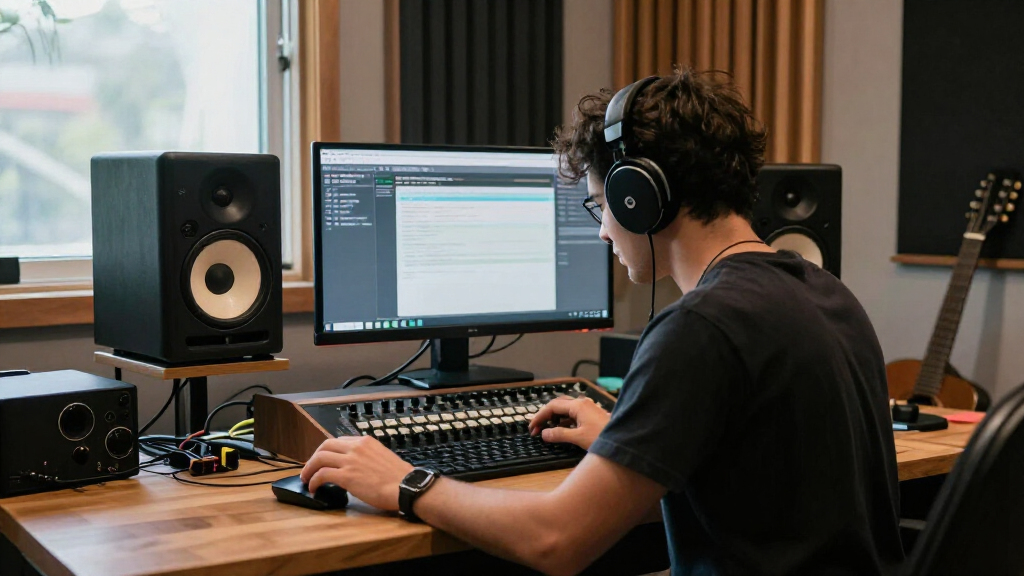
For most home studios, I would start with the Edifier MR5: its larger cabinet and 110W RMS output make it a versatile choice for listeners who want more headroom than compact desktop speakers provide. The PreSonus Eris E5 is a stronger fit if you want a dedicated near-field monitor, while the Edifier MR4 suits a smaller desk and tighter listening distance. Choosing among studio monitor speakers for home studios means balancing room size, low-frequency reach, connection options, and how revealing you want your speakers to be. I rank these 13 options by their fit for practical home recording and production, not by features alone. Read on for the full breakdown and a guide to choosing the right pair for your setup.

Get audio and creator gear delivered free with Prime
- Fast, free delivery on millions of items
- Prime Video, Amazon Music and more included
- Member-only deals all year
Complete the kit


Key Takeaways
- Edifier MR5 is the most flexible all-rounder in this group: its higher stated power and larger format set it apart from the compact desktop pairs, though it needs more desk or stand space.
- PreSonus Eris E5 is the dedicated near-field choice: its 5.25-inch design makes it a more studio-focused alternative to Bluetooth- and lifestyle-oriented models.
- Compact monitors make the most sense at short listening distances: the Edifier MR4 and Pioneer DJ DM-40D are easier to place on a crowded desk, but they are not substitutes for larger speakers when low-end extension matters.
- Connectivity changes the daily experience, not just the spec sheet: Bluetooth-enabled options such as the Edifier MR3 and PreSonus Eris Accent BT can handle casual playback, while buyers focused on production may prefer a simpler monitoring setup.
- More output does not fix a poor room or placement: the comparison favors matching speaker size and features to the room, listening distance, and workflow over choosing the biggest listed power figure.
| Edifier R1280T 2.0 Powered Bookshelf Speakers, 42W RMS, Brown |  | Best for Simple, Dual-Source Desktop Setups | Speaker type: Powered bookshelf speakers | Output: 42W RMS | Drivers: 4-inch driver; 13 mm silk-dome tweeter | VIEW LATEST PRICE | See Our Full Breakdown |
| Mackie CR4.5 Powered Studio Monitors, Pair, 4.5-Inch Woofers, Tone Control, Black |  | Best for Flexible Desktop or Bookshelf Placement | Speaker type: Powered studio monitors; pair | Output: 50W maximum | Drivers: 4.5-inch woofer; 1-inch tweeter | VIEW LATEST PRICE | See Our Full Breakdown |
| PreSonus Eris Accent BT 60W Powered Bluetooth Bookshelf Speakers (Pair) |  | Best for Beginners with Many Audio Sources | Configuration: Powered stereo pair | Output: 60W total; 30W per channel | Drivers: 4-inch woofer; 13 mm silk-dome tweeter | VIEW LATEST PRICE | See Our Full Breakdown |
| Edifier MR5 2.0 Active Studio Monitor Speakers, 110W RMS, Black |  | Best Premium Pick for Detailed Home-Studio Monitoring | Speaker design: 2.0 stereo pair; three-way active | Amplifier output: 110W RMS | Drivers: 5-inch woofer, 3.75-inch midrange, 1-inch silk-dome tweeter | VIEW LATEST PRICE | See Our Full Breakdown |
| Pioneer DJ DM-40D 4-Inch Active Desktop Monitor Speakers, Pair, Black |  | Best for Compact DJ and Production Desks | Configuration: Pair of active stereo monitor speakers | Woofer: 4 inches | Tweeter: 19 mm | VIEW LATEST PRICE | See Our Full Breakdown |
| PreSonus Eris E5 2-Way 5.25″ Near Field Studio Monitor |  | Best for Mixing Headroom | Speaker type: 2-way near-field studio monitor | Woofer: 5.25-inch woven composite | Tweeter: 1-inch silk dome | VIEW LATEST PRICE | See Our Full Breakdown |
| KRK Kreate 3 Powered Studio Monitors (Pair) |  | Best Compact Pair for Interface-Light Setups | Configuration: Powered studio monitor pair | Woofer: 3.5-inch glass aramid | Tweeter: 1-inch textile dome | VIEW LATEST PRICE | See Our Full Breakdown |
| Edifier MR3 Powered Studio Monitor Speakers with Bluetooth |  | Best for Studio-and-Everyday Listening | Power output: 18 W × 2 RMS; 36 W maximum | Peak SPL: 92.5 dB | Frequency response: 52 Hz–40 kHz | VIEW LATEST PRICE | See Our Full Breakdown |
| Edifier MR4 Active Near-Field Studio Monitor Speakers, 4-Inch | 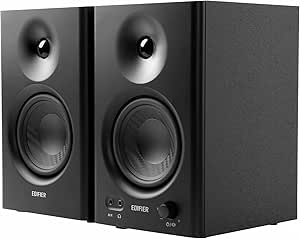 | Best for Hands-On Desktop Tuning | Speaker type: Active near-field studio monitors | Woofer: 4-inch composite | Tweeter: 1-inch silk dome | VIEW LATEST PRICE | See Our Full Breakdown |
| Ortizan C7 Powered Studio Monitor Speakers, Pair, Black |  | Best Connectivity on a Compact Budget Setup | Quantity: Pair | Woofer: 3.5-inch carbon-fiber mid-bass driver | Tweeter: 0.75-inch silk dome | VIEW LATEST PRICE | See Our Full Breakdown |
| Yamaha HS4 Powered Studio Monitors, White, Pair |  | Best Compact Reference Pick | Configuration: 2-way, bass-reflex powered monitor pair | Woofer: 4.5-inch cone | Tweeter: 1-inch dome | VIEW LATEST PRICE | See Our Full Breakdown |
| Edifier MR4.5 Bi-Amped Studio Monitor Speakers, 80W RMS, Black |  | Best Connectivity and Room Tuning | Amplification: 80 W RMS total (30 W × 2 + 10 W × 2) | Drivers: 4.5-inch mid-bass drivers and 1-inch silk-dome tweeters | Frequency response: 50 Hz–40 kHz (as described in product data) | VIEW LATEST PRICE | See Our Full Breakdown |
| PreSonus Eris E4.5 4.5-Inch Two-Way Nearfield Studio Monitors (Pair) |  | Best for First Home Studios | Configuration: Two-way nearfield monitor pair | Amplification: 50 W total; 25 W per side | Amplifier type: Class AB | VIEW LATEST PRICE | See Our Full Breakdown |
| studio monitor speakers for home studio | Inputs | Woofer | Tweeter |
|---|---|---|---|
| Edifier R1280T 2.0 Powered Boo | 2 AUX inputs; 3.5 mm or dual RCA | — | — |
| Mackie CR4.5 Powered Studio Mo | — | — | — |
| PreSonus Eris Accent BT 60W Po | USB-C, optical, coaxial, RCA, and 1/8-inch AUX | — | — |
| Edifier MR5 2.0 Active Studio | XLR, TRS, RCA, and AUX | — | — |
| Pioneer DJ DM-40D 4-Inch Activ | — | 4 inches | 19 mm |
| PreSonus Eris E5 2-Way 5.25" N | Balanced XLR, balanced 1/4-inch TRS, unbalanced RCA | 5.25-inch woven composite | 1-inch silk dome |
| KRK Kreate 3 Powered Studio Mo | — | 3.5-inch glass aramid | 1-inch textile dome |
| Edifier MR3 Powered Studio Mon | — | — | — |
| Edifier MR4 Active Near-Field | 1/4-inch balanced TRS, RCA, AUX | 4-inch composite | 1-inch silk dome |
| Ortizan C7 Powered Studio Moni | — | 3.5-inch carbon-fiber mid-bass driver | 0.75-inch silk dome |
| Yamaha HS4 Powered Studio Moni | XLR/TRS combo, RCA, stereo mini | 4.5-inch cone | 1-inch dome |
| Edifier MR4.5 Bi-Amped Studio | Balanced XLR, balanced TRS, RCA, AUX | — | — |
| PreSonus Eris E4.5 4.5-Inch Tw | ¼-inch TRS, RCA, ⅛-inch stereo auxiliary | 4.5-inch woven-composite | 1-inch silk dome |
More Details on Our Top Picks
Edifier R1280T 2.0 Powered Bookshelf Speakers, 42W RMS, Brown
The Edifier R1280T is the straightforward pick for a home studio that doubles as a listening space. Its two AUX inputs let me leave two wired sources connected, while the remote makes everyday volume changes easy from the desk. Bass and treble controls offer a way to tailor playback, though they’re on the main speaker rather than the remote. Compared with the Mackie CR4.5, this pair is less focused on placement adjustment and studio-oriented tone switching; its appeal is simpler source sharing and a more traditional bookshelf setup. The 4-inch drivers and listed 80 Hz frequency response also give less reason to expect deep bass, so I’d pair it with headphones or another reference when checking low-end decisions. It’s a practical choice for basic editing and casual playback, not my pick for critical mixing.
Pros:- Two AUX inputs accommodate two connected wired audio sources.
- Remote control makes listening-level adjustments convenient.
- Bass and treble controls allow basic tonal adjustment.
- Wooden enclosure gives the pair a conventional bookshelf-speaker fit.
Cons:- The stated 80 Hz frequency response offers limited guidance for deep-bass monitoring.
- Bass and treble controls are on the main speaker, not the remote.
- Bluetooth connectivity is not specified.
Best for: Home-studio beginners who want two wired sources connected at once, remote volume control, and speakers that also suit casual desktop listening.
Not ideal for: Producers who need balanced, detailed low-frequency monitoring or want Bluetooth and controls within easy reach on the remote.
- Speaker type:Powered bookshelf speakers
- Output:42W RMS
- Drivers:4-inch driver; 13 mm silk-dome tweeter
- Inputs:2 AUX inputs; 3.5 mm or dual RCA
- Frequency response:80 Hz
- Controls:Remote volume; bass and treble controls on main speaker
- Enclosure:Wood
- Dimensions:17 × 12.6 × 7.2 inches
Our verdict“Choose the R1280T for a simple dual-source desktop setup and casual listening, but look to the Mackie CR4.5 for more studio-oriented placement and tone controls.”
Mackie CR4.5 Powered Studio Monitors, Pair, 4.5-Inch Woofers, Tone Control, Black
The Mackie CR4.5 earns its place by giving a small home studio more placement flexibility than the Pioneer DJ DM-40D. Its desktop/bookshelf switch provides bass correction for either position, which can help when a desk or shelf changes how low frequencies build up. A front tone knob shifts the sound between studio-reference and more casual playback, so one pair can serve work and listening without relying on software changes. The included isolation pads and cables also make setup more complete than the Pioneer’s listed package. The tradeoff is that a tone control is not a substitute for a neutral reference, and the available specs don’t state a frequency response. At 4.5 inches, these are still compact monitors, not a solution for checking the deepest bass. They suit desks with variable placement better than a fixed, strictly production-only setup.
Pros:- Placement switch provides bass correction for desktop or bookshelf use.
- Tone knob offers a quick change between reference-style and casual listening.
- Pair includes isolation pads and several connection cables.
- RCA and TRS connectivity supports common home-studio sources.
Cons:- No frequency-response figure is provided in the product data.
- Tone adjustment can change playback rather than serve as a precise room-calibration system.
- Corded electric power is required.
Best for: Home producers who may move monitors between a desktop and bookshelf and want included isolation pads, cables, and a quick listening-tone adjustment.
Not ideal for: Mixers seeking a clearly specified low-frequency response or a strictly fixed, neutral monitoring setup with no tone-shaping control.
- Speaker type:Powered studio monitors; pair
- Output:50W maximum
- Drivers:4.5-inch woofer; 1-inch tweeter
- Connectivity:RCA and TRS
- Controls:Tone knob; desktop/bookshelf location switch
- Included accessories:Isolation pads, cables, and speaker wire
- Dimensions:8.25 × 6.1 × 8.85 inches
- Weight:12.4 pounds
Our verdict“Pick the CR4.5 if your monitor placement may change; choose the Pioneer DJ DM-40D instead if task-specific DJ and Production modes matter more.”
PreSonus Eris Accent BT 60W Powered Bluetooth Bookshelf Speakers (Pair)
The PreSonus Eris Accent BT is the most connection-friendly option here for a home studio shared with a computer, TV, turntable, and phone. Its mix of USB-C, optical, coaxial, RCA, AUX, and Bluetooth 5.3 makes switching sources easier than on the wired-only Pioneer DJ DM-40D. Front-panel volume, bass, treble, and source controls keep routine adjustments accessible, and the remote adds convenience away from the desk. A stated 55 Hz–20 kHz response and RCA subwoofer output offer a useful starting point for desktop playback, with a clear route to added low-end support. That versatility comes with a compromise: the product is presented as powered bookshelf speakers, so buyers focused on a controlled studio reference may prefer a more monitor-oriented model. The 4-inch woofer also cannot replace a subwoofer for deeper bass.
Pros:- Wide range of wired inputs plus Bluetooth 5.3 supports varied sources.
- Front-panel source, volume, bass, and treble controls are easy to reach.
- RCA subwoofer output allows expansion for stronger low-frequency playback.
- Remote is included for convenient listening-level and source adjustments.
Cons:- The 4-inch woofer and stated 55 Hz lower response limit deep-bass playback.
- An external subwoofer is needed for expanded low-frequency output.
- Its broad bookshelf-speaker feature set may be more than a production-only setup requires.
Best for: New home-studio owners who connect a computer and several other audio sources and want front-panel controls, Bluetooth, and an optional subwoofer connection.
Not ideal for: Producers who prioritize a dedicated production-monitor setup over broad household connectivity or need deep bass without adding a subwoofer.
- Configuration:Powered stereo pair
- Output:60W total; 30W per channel
- Drivers:4-inch woofer; 13 mm silk-dome tweeter
- Frequency response:55 Hz–20 kHz
- Wireless:Bluetooth 5.3
- Inputs:USB-C, optical, coaxial, RCA, and 1/8-inch AUX
- Subwoofer output:RCA
- Dimensions:7 × 6.3 × 9.2 inches
Our verdict“Choose the Eris Accent BT for a beginner studio that also serves multiple devices, but favor the Mackie CR4.5 if placement correction is your priority.”
Edifier MR5 2.0 Active Studio Monitor Speakers, 110W RMS, Black
The Edifier MR5 is the strongest fit in this group for producers who want a more capable monitoring platform rather than a basic desktop speaker. Its three-way design separates woofer, midrange, and treble duties, while the stated 46 Hz–40 kHz response reaches lower than the 4-inch PreSonus Eris Accent BT’s listed range. XLR and TRS connections suit common studio sources, and app-based room tuning plus rear acoustic controls provide more ways to adapt playback to a home workspace. The MR5 also adds Bluetooth 6.0 with LDAC and a headphone output, although wireless convenience is secondary to its wired studio connections. Compared with the smaller Mackie CR4.5, it offers a broader driver layout and more input options, but its feature set and larger three-way design are a less simple match for a very tight desk. It also needs corded power.
Pros:- Three-way driver design separates low, mid, and high frequencies.
- Stated 46 Hz–40 kHz response provides broader listed range than the 4-inch Eris Accent BT.
- XLR, TRS, RCA, and AUX inputs suit a variety of studio and consumer sources.
- Room tuning, acoustic controls, and a front headphone output support flexible desk use.
Cons:- Corded electric power is required.
- A larger three-way feature set may be excessive for a minimal desktop setup.
- Wireless playback does not replace the wired connections preferred for studio work.
Best for: Home-studio producers who want three-way active monitors, balanced XLR or TRS inputs, and room-adjustment options for a more developed mixing setup.
Not ideal for: Buyers with very little desk space, or those who want a simple, compact pair without app-based tuning and multiple connection types.
- Speaker design:2.0 stereo pair; three-way active
- Amplifier output:110W RMS
- Drivers:5-inch woofer, 3.75-inch midrange, 1-inch silk-dome tweeter
- Frequency response:46 Hz–40 kHz
- Audio resolution:24-bit/96kHz
- Bluetooth:Bluetooth 6.0 with LDAC
- Inputs:XLR, TRS, RCA, and AUX
- Other connection:3.5 mm headphone output
Our verdict“Choose the MR5 for a more adjustable, three-way home-studio setup; the Mackie CR4.5 is a simpler fit when compact placement flexibility matters more.”
Pioneer DJ DM-40D 4-Inch Active Desktop Monitor Speakers, Pair, Black
The Pioneer DJ DM-40D has a clear job: fit a home DJ or production desk and let the user choose a sound mode for the task at hand. Its DJ and Production modes make it more purpose-directed than the Edifier R1280T, which offers basic bass and treble adjustment but no listed task-specific DSP modes. The compact pair also includes a front headphone socket and level control, useful when I want to switch quickly between speakers and headphones without reaching behind the desk. RCA and mini-jack inputs keep connections simple, but they’re less extensive than the XLR, TRS, and other options on the Edifier MR5. The DM-40D is wired only, and its product data gives no frequency-response figure, so it’s harder to judge low-end limits from the listed specs. It suits near-desk work better than a source-rich or room-tuning setup.
Pros:- Compact tabletop design suits a crowded home DJ or production desk.
- Switchable DJ and Production modes tailor playback to different tasks.
- Front headphone output and level control support convenient desk operation.
- RCA and mini-jack inputs connect common consumer and desktop sources.
Cons:- Wired-only connectivity limits source flexibility.
- The listed inputs do not include XLR or TRS.
- No frequency-response figure is provided in the product data.
Best for: Home DJs and producers with limited desk space who want two task-specific sound modes and easy access to a headphone socket and level control.
Not ideal for: Producers who need XLR or TRS inputs, wireless playback, room-tuning features, or a stated frequency-response range.
- Configuration:Pair of active stereo monitor speakers
- Woofer:4 inches
- Tweeter:19 mm
- Sound modes:DJ and Production
- Connectivity:RCA and auxiliary mini-jack
- Headphone output:Front-panel socket
- Mounting:Tabletop
- Wireless:Wired only
Our verdict“Pick the DM-40D for compact DJ and production work with quick mode changes, but choose the Edifier MR5 if you need broader studio connectivity and room adjustments.”
PreSonus Eris E5 2-Way 5.25″ Near Field Studio Monitor
The PreSonus Eris E5 is the strongest fit here for a home studio that needs more room to monitor confidently than the compact 3.5-inch options provide. Its 5.25-inch woofer and 80-watt Class AB bi-amplification give it more potential headroom for near-field mixing than the KRK Kreate 3, while its acoustic tuning controls help adapt playback to a less-than-perfect room. Balanced XLR and TRS inputs also suit a more conventional studio signal chain. The tradeoff is a larger, heavier cabinet that asks for careful placement and takes up more desk or stand space. It is also strictly wired, unlike the Bluetooth-equipped Edifier MR3. I’d choose it for mix work over convenience-focused desktop listening, but it still won’t replace a subwoofer when deep bass matters.
Pros:- 5.25-inch woofer and 80-watt bi-amplification offer more monitoring headroom than the smaller KRK Kreate 3.
- Acoustic tuning controls help adapt the response to the room and speaker placement.
- Balanced XLR, balanced TRS, and unbalanced RCA inputs suit different studio sources.
- Protection circuitry covers issues including overheating, transients, and RF interference.
Cons:- At 10.2 pounds per stated product data, it is less convenient to reposition than compact desktop monitors.
- The tabletop-oriented design may call for separate stands or careful placement to achieve suitable listening height.
- No wireless connectivity is listed.
Best for: Home-studio mixers who want a larger woofer, useful room-tuning controls, and balanced connections for an audio interface.
Not ideal for: Desk users with very little space, or listeners who want Bluetooth playback and a lightweight, easy-to-move speaker.
- Speaker type:2-way near-field studio monitor
- Woofer:5.25-inch woven composite
- Tweeter:1-inch silk dome
- Amplification:80 watts Class AB bi-amplified
- Inputs:Balanced XLR, balanced 1/4-inch TRS, unbalanced RCA
- Maximum SPL:102 dB
- Dimensions:7.7 × 7 × 10.2 inches (D × W × H)
- Weight:10.2 lb
Our verdict“Choose the Eris E5 if your home studio prioritizes wired near-field mixing and headroom over compact size or wireless convenience.”
KRK Kreate 3 Powered Studio Monitors (Pair)
The KRK Kreate 3 suits a home studio where desk space is tight but a stereo pair still matters. Its 3.5-inch glass-fiber composite woofer keeps the cabinets more compact than the PreSonus Eris E5, and Bluetooth plus multiple audio inputs make it easier to switch between a studio source and casual playback. The textile-dome tweeter and composite woofer are intended to deliver clear highs and controlled mids, though the small driver size puts a ceiling on bass weight and mix translation at the low end. Compared with the Edifier MR4, the Kreate 3 adds Bluetooth, while the MR4 lists separate high- and low-frequency controls and a front headphone output. Choose KRK for compact connectivity; skip it if your work depends on judging deep bass from the monitors alone.
Pros:- Compact 3.5-inch woofer design takes up less space than the PreSonus Eris E5.
- Bluetooth supports wireless playback alongside multiple audio inputs.
- Glass-fiber composite woofer is designed for clear midrange and tight bass.
- Three-year warranty is specified.
Cons:- The 3.5-inch woofer may not provide enough low-frequency information for bass-critical mixing.
- Bluetooth is the only wireless connection listed.
- The supplied product data does not specify input types or power output, making system matching harder.
Best for: Producers working at a small desk who want a compact stereo monitor pair with Bluetooth and multiple input options.
Not ideal for: Bass-heavy producers who need substantial low-frequency output or a larger woofer for judging bass without a subwoofer.
- Configuration:Powered studio monitor pair
- Woofer:3.5-inch glass aramid
- Tweeter:1-inch textile dome
- Connectivity:Bluetooth and multiple audio inputs
- Audio output mode:Stereo
- Mounting type:Tabletop
- Weight:12 lb
- Warranty:3 years
Our verdict“Pick the Kreate 3 for a space-conscious studio that values Bluetooth and flexible connections more than deep bass extension.”
Edifier MR3 Powered Studio Monitor Speakers with Bluetooth
The Edifier MR3 is the most flexible all-day option in this group: its Monitor, Music, and Custom modes let one compact pair serve both production tasks and ordinary listening. App-based EQ adds a way to tailor playback, while balanced TRS, RCA, AUX, headphone, and Bluetooth connections cover a broad mix of studio and consumer sources. Its stated 52 Hz–40 kHz response is useful context, but the 3.5-inch drivers still limit how much low bass you can judge directly. Compared with the Edifier MR4, the MR3 adds Bluetooth and app controls; the MR4 instead offers separate physical high- and low-frequency adjustment. The MR3 makes sense for a shared work-and-listening desk, but I would favor the larger PreSonus Eris E5 for a studio centered on mixing headroom.
Pros:- Monitor, Music, and Custom modes make it adaptable to production and casual listening.
- App-based EQ offers more playback adjustment than the KRK Kreate 3 data specifies.
- Balanced TRS, RCA, AUX, headphone, and Bluetooth connections accommodate varied sources.
- Stated 52 Hz–40 kHz frequency response and MDF cabinets suit a mixed-use desktop setup.
Cons:- The 3.5-inch drivers limit low-bass authority compared with larger monitors such as the PreSonus Eris E5.
- Requires corded power; Bluetooth does not make the speakers wireless in operation.
- The stated dimensions are relatively large for a compact-driver speaker.
Best for: Home producers who use one desktop pair for audio-interface monitoring, Bluetooth listening, and everyday playback.
Not ideal for: Mixers who need stronger low-frequency monitoring or prefer physical room controls over app-based EQ and sound modes.
- Power output:18 W × 2 RMS; 36 W maximum
- Peak SPL:92.5 dB
- Frequency response:52 Hz–40 kHz
- Drivers:3.5-inch mid-low drivers and 1-inch tweeters
- Connectivity:Balanced TRS, RCA, AUX, headphone output, Bluetooth
- Bluetooth:Version 5.4
- Sound modes:Music, Monitor, Custom
- Cabinet material:MDF
Our verdict“Choose the MR3 if you want a small studio pair that can switch easily between monitoring and everyday listening.”
Edifier MR4 Active Near-Field Studio Monitor Speakers, 4-Inch
The Edifier MR4 is a sensible pick for a home studio where the buyer wants straightforward near-field monitoring and direct control over tonal balance. Its 4-inch composite woofer is a step up in driver size from the Edifier MR3 and KRK Kreate 3, while separate high- and low-frequency controls let you make basic adjustments without opening an app. Monitor and music modes also make it easier to move between production and casual playback. Unlike the MR3, the MR4 does not list Bluetooth or app-based EQ; its advantage is the more hands-on control layout, including a front headphone output. The stated frequency-response entry of “20 kHz” does not give a usable low-frequency limit, so I would not choose it based on bass-extension claims. It is best for a wired desktop setup, not a flexible wireless one.
Pros:- Four-inch composite woofer is larger than the drivers in the Edifier MR3 and KRK Kreate 3.
- Separate high- and low-frequency controls provide direct tonal adjustment.
- Monitor and music modes support production and casual listening.
- Balanced TRS, RCA, AUX, and front headphone output cover common desktop connections.
Cons:- Bluetooth connectivity is not listed, unlike the Edifier MR3 and KRK Kreate 3.
- Tabletop mounting may restrict placement and listening-height options.
- The supplied frequency-response specification lists only 20 kHz, so it does not establish the low-end limit.
Best for: Bedroom producers who want a wired near-field pair with physical high- and low-frequency controls and easy headphone access.
Not ideal for: Users who need Bluetooth, app-based sound adjustment, or clearly stated low-frequency extension for bass-critical work.
- Speaker type:Active near-field studio monitors
- Woofer:4-inch composite
- Tweeter:1-inch silk dome
- Maximum output power:42 watts
- Inputs:1/4-inch balanced TRS, RCA, AUX
- Output:Front headphone output
- Modes:Monitor mode and music mode
- Enclosure:MDF wood
Our verdict“Choose the MR4 for a wired desktop studio where physical tone controls matter more than Bluetooth or app features.”
Ortizan C7 Powered Studio Monitor Speakers, Pair, Black
The Ortizan C7 is aimed at a home studio that shares desk space with a computer, console, or other everyday source. Its USB, balanced TRS, RCA, AUX, and Bluetooth 5.3 options make it unusually easy to connect different devices, and the front headphone output helps when late-night monitoring calls for headphones. The compact 3.5-inch woofer and 0.75-inch silk-dome tweeter keep the pair small, but they also make this a less convincing choice for judging deep bass than the 4-inch Edifier MR4 or 5.25-inch PreSonus Eris E5. A 24-bit DAC is listed, though the supplied data does not provide power output or a frequency-response range for comparing monitoring performance. I’d prioritize the C7 for connectivity and desktop versatility, not for spec-led mix decisions.
Pros:- USB, balanced TRS, RCA, AUX, and Bluetooth 5.3 support a wide range of desktop sources.
- Compact dimensions suit desks where larger monitors like the PreSonus Eris E5 may be difficult to place.
- Front-panel headphone output supports private monitoring.
- A listed 24-bit DAC and carbon-fiber mid-bass drivers add useful source and driver details.
Cons:- The 3.5-inch woofer may not provide enough low-frequency output for bass-critical mixing.
- The product data does not list power output or frequency response, limiting performance comparisons.
- Bluetooth playback is available, but the speakers still require corded power.
Best for: Computer-based creators who need one compact pair to connect an interface, USB source, consumer audio devices, and Bluetooth playback.
Not ideal for: Mix engineers who need documented bass extension, higher monitoring headroom, or a larger woofer for low-frequency decisions.
- Quantity:Pair
- Woofer:3.5-inch carbon-fiber mid-bass driver
- Tweeter:0.75-inch silk dome
- Connectivity:USB, RCA, 3.5 mm AUX, 6.35 mm balanced TRS, Bluetooth
- Bluetooth:Version 5.3
- DAC:24-bit
- Headphone output:Front-panel
- Dimensions:5.11 × 5.9 × 7.67 inches (D × W × H)
Our verdict“Pick the C7 if connection flexibility and a compact desktop footprint matter more than documented low-end performance.”
Yamaha HS4 Powered Studio Monitors, White, Pair
The Yamaha HS4 suits a home studio where desk space and listening volume are limited, but reliable nearfield monitoring still matters. Its 4.5-inch woofer and 1-inch dome tweeter cover a compact stereo setup, while room-control and high-trim adjustments let me tailor the response to a desktop or nearby wall. XLR/TRS, RCA, and stereo-mini inputs make it easier to connect both studio gear and everyday sources. Compared with the PreSonus Eris E4.5, the HS4 offers a similarly small footprint but adds a stated response down to 60 Hz and 22 kHz at the -10 dB points; neither replaces a larger monitor or subwoofer for judging deep bass. Its tabletop-only mounting and modest low-frequency reach are the tradeoffs, so I’d choose it for a compact editing or production desk, not bass-heavy work that demands extended bottom end.
Pros:- Compact pair fits space-constrained desks.
- Room-control and high-trim response adjustments help adapt playback to the listening position.
- XLR/TRS combo, RCA, and stereo-mini inputs support both studio and consumer sources.
- Includes speaker cable, stereo-mini–RCA cable, and anti-slip pad.
Cons:- Frequency response is specified from 60 Hz at the -10 dB point, limiting deep-bass assessment.
- Designed for tabletop mounting, which restricts placement flexibility.
- 26 W per speaker leaves less stated output than higher-powered options such as the Edifier MR4.5.
Best for: Home producers and video editors with a small tabletop setup who need compact powered monitors and several wired input choices.
Not ideal for: Bass-focused producers who need dependable sub-bass judgment, or buyers who need wall or stand mounting rather than tabletop placement.
- Configuration:2-way, bass-reflex powered monitor pair
- Woofer:4.5-inch cone
- Tweeter:1-inch dome
- Frequency response:60 Hz–22 kHz (-10 dB)
- Output power:26 W + 26 W
- Inputs:XLR/TRS combo, RCA, stereo mini
- Controls:Room control and high-trim response
- Mounting:Tabletop
Our verdict“Choose the HS4 for a tidy, wired home-studio desk where compact size matters more than extended bass or flexible mounting.”
Edifier MR4.5 Bi-Amped Studio Monitor Speakers, 80W RMS, Black
The Edifier MR4.5 is the most adaptable pick here for a home studio that also serves as a general listening setup. Its 80 W RMS bi-amped design, 4.5-inch mid-bass drivers, and 1-inch silk-dome tweeters pair conventional balanced and unbalanced inputs with Bluetooth 6.0, including LDAC and multipoint pairing. App-based 9-band EQ and room calibration give me more ways to shape playback than the basic high- and low-frequency controls on the PreSonus Eris E4.5 or Yamaha HS4. That flexibility is useful when a desk or room colors the sound, though app adjustments and wireless listening can add complexity to a reference-focused workflow. The 4.5-inch format remains a limit for buyers who need substantial low-end output, and its listed Bluetooth range is 10 meters. I’d pick it for a hybrid studio; I’d favor simpler monitors if wireless features and app tuning would go unused.
Pros:- Bi-amped 80 W RMS system with 4.5-inch drivers and 1-inch silk-dome tweeters.
- Balanced XLR and TRS inputs sit alongside RCA and AUX connections.
- Bluetooth 6.0 supports LDAC and multipoint pairing for flexible playback.
- App-based 9-band EQ and acoustic compensation provide more tuning options than the HS4 or Eris E4.5.
Cons:- Compact 4.5-inch drivers may not provide the low-frequency authority needed for bass-heavy production.
- Bluetooth range is listed as 10 meters.
- App-based room tuning adds setup and adjustment complexity compared with simpler monitor controls.
Best for: Producers and desktop listeners who want balanced wired connections, Bluetooth streaming, and app-based room adjustment in one compact pair.
Not ideal for: Buyers seeking larger-driver bass performance, or a straightforward reference setup with no reliance on an app or wireless features.
- Amplification:80 W RMS total (30 W × 2 + 10 W × 2)
- Drivers:4.5-inch mid-bass drivers and 1-inch silk-dome tweeters
- Frequency response:50 Hz–40 kHz (as described in product data)
- Inputs:Balanced XLR, balanced TRS, RCA, AUX
- Bluetooth:Version 6.0, LDAC, multipoint pairing
- Room tuning:App-based 9-band EQ and acoustic compensation
- Tone controls:High ±6 dB above 10 kHz; low ±6 dB below 125 Hz
- Headphone output:Front headphone jack
Our verdict“Pick the MR4.5 if you want one compact system for studio connections, wireless listening, and room-specific EQ.”
PreSonus Eris E4.5 4.5-Inch Two-Way Nearfield Studio Monitors (Pair)
The PreSonus Eris E4.5 makes sense for a first home studio built around a desk, computer, and a mix of production and everyday listening. Its 50 watts of Class AB amplification, woven-composite woofers, and silk-dome tweeters provide a simple stereo monitoring foundation, while TRS, RCA, and auxiliary inputs accommodate common studio and consumer sources. A front-panel headphone output with integrated amplifier is handy when I need to switch from speakers to headphones without reaching behind the desk. Unlike the Edifier MR4.5, the E4.5 does not list Bluetooth or app-based room calibration; that keeps the feature set more direct but gives less flexibility for wireless use and detailed correction. High- and low-frequency controls help with basic tonal adjustment, yet the compact drivers are not a substitute for a subwoofer when mixes depend on deep bass.
Pros:- 50 watts total Class AB amplification provides a dedicated stereo monitor setup.
- TRS, RCA, and auxiliary inputs cover common studio and desktop sources.
- Front-panel headphone output and integrated amplifier make headphone changes convenient.
- High- and low-frequency controls allow basic adjustment for room and listening preference.
Cons:- No wireless audio connectivity is specified, unlike the Edifier MR4.5.
- 4.5-inch woofers offer limited deep-bass extension without a separate subwoofer.
- Room adjustment is less detailed than the MR4.5’s app-based 9-band EQ.
Best for: New home-studio owners who want a straightforward nearfield pair for computer-based production, gaming, and headphone switching.
Not ideal for: Buyers who want Bluetooth, app-based acoustic calibration, or stronger low-frequency output without adding a subwoofer.
- Configuration:Two-way nearfield monitor pair
- Amplification:50 W total; 25 W per side
- Amplifier type:Class AB
- Woofer:4.5-inch woven-composite
- Tweeter:1-inch silk dome
- Inputs:¼-inch TRS, RCA, ⅛-inch stereo auxiliary
- Headphone output:Front-panel output with integrated headphone amplifier
- Sound controls:High- and low-frequency tuning
Our verdict“Choose the Eris E4.5 for an uncomplicated first studio desk with useful wired inputs and easy front-panel headphone access.”
How We Picked
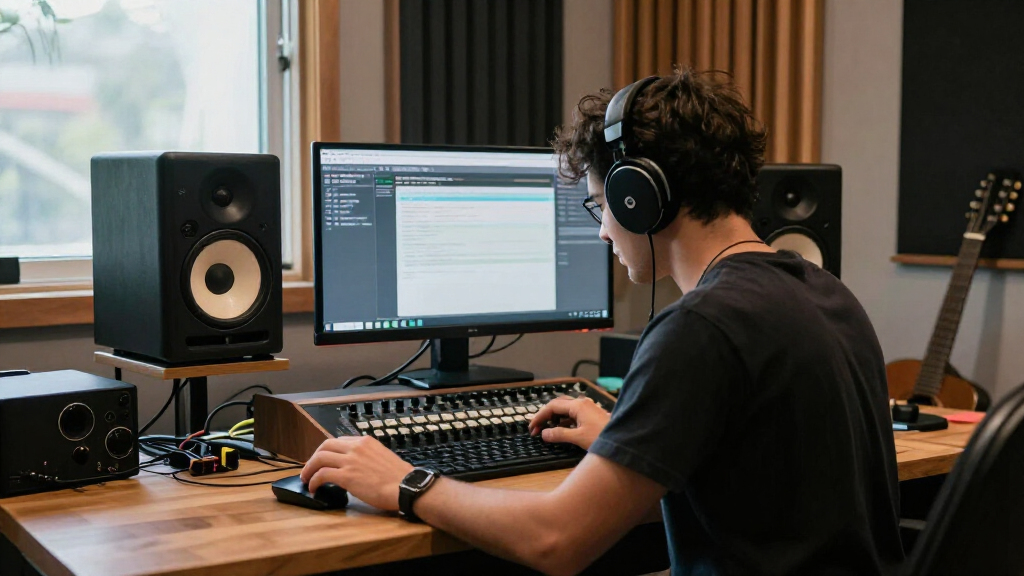
I compared these speakers as tools for home recording, editing, and music production, weighing near-field suitability, stated driver size and power, connection flexibility, and how practical each design is on a desk or in a small room. I also considered whether a model’s features serve a real home-studio workflow or mainly add convenience for general listening. The Edifier MR5 ranks highest for its broad use case and greater stated output, while the PreSonus Eris E5 follows for buyers who want a more traditional monitor format.
The remaining order reflects different priorities rather than a claim that every buyer needs the same speaker. Compact pairs rank well when limited space and close listening matter; Bluetooth, tone controls, and simple setup count more for hybrid work and casual playback. Models with fewer details available are placed by their clearly stated format and intended use, not by assumptions about sound quality. Every pick has a tradeoff, including space demands, reduced low-frequency reach, or a less studio-focused feature set.
Factors to Consider When Choosing Studio Monitor Speakers For Home Studios
Choosing home-studio monitors is less about finding a universally best speaker and more about avoiding a mismatch between the speakers, your room, and your work. I would decide how close you will sit, what kinds of audio you make, and whether you need these speakers for everyday listening before comparing feature lists.
Match Speaker Size to Your Room and Listening Distance
A larger woofer can support fuller low frequencies and more headroom, but that does not make it the right choice for every bedroom studio. Near-field monitors are meant to be heard from a relatively short distance, so a compact pair can work well when the desk is close to a wall or the room is small. In a larger space, tiny speakers may leave you wanting more weight and output, especially for bass-heavy music. Avoid buying by driver size alone: room dimensions, speaker placement, and listening distance shape what you hear. If you cannot leave space around the cabinets, a smaller design may be easier to place than a larger one. A subwoofer can extend bass, but it adds setup demands and can make untreated-room problems more obvious.
Choose for the Work You Actually Do
Mixing, editing dialogue, composing, and casual playback place different demands on a speaker. If you make decisions about balance and detail, prioritize a monitor-oriented design and a listening position you can repeat from session to session. For writing music or checking rough mixes, convenience features may matter more than a strictly studio-focused setup. Bluetooth can help with quick playback from a phone, but it should not replace a dependable wired connection for critical listening. Buyers who also watch films or play games may appreciate versatile inputs and tone controls. The common mistake is paying for features you will not use while overlooking whether the speaker suits your main audio task.
Treat Room and Placement as Part of the Purchase
Even capable monitors can sound misleading when placed poorly. A desk can reflect sound toward your ears, and speakers pushed close to a wall may produce uneven bass that complicates mixing decisions. Before buying larger speakers, check whether you have space to separate them and aim them toward your listening position. Stands or isolation pads can help reduce desk vibration and make positioning more consistent, though they cannot correct every room issue. A small room with hard surfaces may benefit more from careful placement and modest acoustic treatment than from higher speaker output. Budget time and space for setup, not only for the pair itself.
Understand the Limits of Low-Frequency Monitoring
Small monitors can reveal timing, vocal balance, and many midrange details while offering less information at the very bottom of the frequency range. That matters if you produce electronic music, hip-hop, or other material where deep bass is central. A larger monitor may provide more low-end presence, but room modes can exaggerate or hide bass regardless of the speaker. Check mixes on headphones and familiar playback systems rather than assuming one pair tells the whole story. Do not add a subwoofer simply to make the room sound bigger; it needs careful level and placement matching. For many home producers, learning a compact pair’s limits is more useful than chasing bass extension the room cannot support.
Prioritize Useful Connections and Controls
List the sources you plan to connect before choosing a model. An audio interface, computer, phone, and turntable may call for different inputs, and a speaker that accepts your everyday sources can reduce cable changes and clutter. Bluetooth is convenient for reference tracks and casual use, but wired monitoring is the safer default when judging production details. Tone controls can help adapt a pair to a desk or room, yet they are not a substitute for balanced placement or room treatment. Also check whether the controls are easy to reach once the speakers sit on your desk. Choose features that solve a recurring workflow problem rather than treating a longer feature list as a sign of better monitoring.
Pay More for a Clear Need, Not Just More Output
Moving to a larger or more capable pair makes sense when you need greater headroom, fuller bass, or a speaker format that better suits your listening distance. It is less useful when the speakers will sit inches from you in a crowded workspace or when room acoustics are the main source of translation problems. Entry-level monitors can be a sensible starting point if you are learning production, but they still need accurate positioning and consistent listening habits. Compare total setup needs, including stands, cables, and any room treatment, rather than focusing only on speaker specifications. A premium choice should improve a real part of your workflow. If you cannot name that need, a compact, simpler pair may be the more practical buy.
Frequently Asked Questions
Can I use Bluetooth studio monitors for mixing?
Bluetooth is handy for playing references or listening from a phone, but I would use a wired connection for mix decisions. Wireless playback can add processing or latency, and it may not match the signal path you use from an audio interface. A Bluetooth-equipped pair can still work in a home studio if it also accepts a suitable wired source. Treat wireless as a convenience feature, not proof that the speakers are better suited to production. If mixing is your main goal, prioritize a reliable wired setup and use Bluetooth for secondary listening.
Should I choose 4-inch or 5-inch monitors for a small bedroom studio?
Either size can work, but the room and listening distance matter more than the number alone. A 4-inch pair is often easier to fit on a crowded desk and can be practical when you sit close to the speakers. A 5-inch model may offer more output and low-frequency presence, but that extra energy can be difficult to judge in a small, untreated room. Check that the speakers can be positioned symmetrically and aimed at your listening spot. If bass accuracy is a priority, plan to compare mixes on headphones or other playback systems as well.
Do I need an audio interface to connect studio monitors to my computer?
Not always: some powered speakers accept a direct connection from common consumer audio sources, and some offer Bluetooth for casual playback. An audio interface is useful when you need suitable outputs for monitoring, microphone or instrument inputs, and a more controlled recording workflow. Check the speaker inputs and your computer’s available outputs before ordering cables. Avoid assuming that every pair uses the same connection type or that an adapter will solve every mismatch. If you plan to record, an interface may be a more important purchase than a speaker upgrade.
Are home-studio monitors a good choice for everyday music listening?
They can be, especially if you want clear playback at a desk and your sources connect easily. Some models in this roundup add Bluetooth or tone controls that make everyday use simpler, while more studio-oriented designs may offer fewer convenience features. Monitor speakers can also make poor recordings and harsh mixes sound less forgiving than consumer speakers do. That revealing presentation is useful for production, but not every listener prefers it for relaxed listening. If you want one pair for both tasks, favor practical connectivity and make sure the sound suits your taste as well as your work.
Will buying larger monitors fix weak or inaccurate bass in my mixes?
Not by itself. Larger monitors can provide more low-frequency output, but a room’s dimensions and speaker placement can create bass peaks or gaps that make mixes harder to judge. In a small room, that problem may become more noticeable as speaker output increases. Start by positioning the speakers carefully and checking mixes on familiar headphones or playback systems. A subwoofer adds extension but also requires careful integration and placement. Choose larger monitors when you need their headroom or reach and have space to use them, not as a shortcut around room acoustics.
Conclusion
For the widest range of home-studio tasks, I would choose the Edifier MR5 as best overall; its larger format and stated output give it an advantage over the compact desktop pairs, provided you have room to place it. The Edifier MR4 is my best-value direction for a smaller desk and close listening, while the PreSonus Eris E5 is my best premium-leaning studio pick for buyers seeking a dedicated near-field format. Beginners who want an approachable desktop setup can compare the Pioneer DJ DM-40D with the Edifier MR4, choosing based on fit and preferred workflow rather than chasing output. For Bluetooth and mixed casual use, look at the Edifier MR3 or PreSonus Eris Accent BT; for a more compact studio-focused alternative, consider the KRK Kreate 3. Match the pair to your listening distance and room before deciding which features matter most.
Black Friday Picks

Vitamix Nano Personal Blender with SmoothiePilot, Black
As an affiliate, we earn on qualifying purchases.