TL;DR

Get audio and creator gear delivered free with Prime
- Fast, free delivery on millions of items
- Prime Video, Amazon Music and more included
- Member-only deals all year
LED Halloween sound-activated speakers combine music playback, LED lighting effects, and a sound-activation mode where lights flash or change color in sync with audio picked up by a built-in microphone. Most home users are well served by a $20–40 Bluetooth unit with adjustable sensitivity, 6+ hours of battery, and 10–20W of power. Nearly all of these speakers are not waterproof, so plan to cover or shelter anything you set up outdoors.
Imagine a skull on your porch that flashes blood-red every time a trick-or-treater says “trick or treat.” No remote, no timer, no button — just a microphone, some LEDs, and a five-minute setup. That’s the party trick hiding inside every LED Halloween sound activated speaker.
These gadgets do two jobs at once: they play your spooky playlist AND they light up in sync with whatever they hear. That means one device replaces a Bluetooth speaker plus a strobe light plus, in many cases, a separate prop trigger.
In this guide, you’ll learn how sound activation actually works, what to check before you buy, and how to build a porch display that reacts to voices — all without spending more than about $60.
Sound activation works via a built-in mic that reacts to ANY nearby audio — including trick-or-treaters’ voices — not just music playing through the speaker.
Budget $20–40 for most home uses; step up to 40W+ only for garage or yard parties, and assume you’ll get 60–70% of the claimed battery runtime with lights on.
Adjustable sensitivity and independent light/audio control are the two features cheap models skip — verify both before buying.
Nearly all of these speakers are not waterproof; shelter them outdoors and secure cords in the dark.
Prefer Bluetooth 5.0+ (30–50 ft stable range) and look for TWS pairing if you want two speakers flashing in stereo sync.
How Sound Activation Actually Works (It’s Simpler Than You Think)
Sound activation is a microphone trick, not magic. A tiny built-in mic listens to the room, and when it detects volume above a threshold, the LED lighting effects pulse, strobe, or change color in response. The speaker doesn’t need to be playing anything itself — it reacts to whatever’s happening around it.
That’s the detail most product listings bury, and it changes everything about how you can use the device. Because the mic is listening to the room rather than reading the audio signal internally, your speaker’s lights will dance to a Halloween playlist streaming from a different device, to your karaoke guests, or to a kid yelling “BOO!” at your decorations. One haunted-house hobbyist I read about uses this exact quirk: his graveyard display’s lights flash whenever visitors scream at the animatronic zombie, because the mic catches their reaction, not the soundtrack. The implication is powerful — the speaker becomes a reaction engine, not just a light show. But it cuts both ways: a mic that hears everything also hears the dishwasher, the dog, and every motorcycle that passes your house.
Sensitivity is where cheap units fall apart, and it’s worth understanding why. The mic doesn’t interpret sound — it just measures loudness against a fixed trigger point. Set it too high and the lights strobe constantly at every passing car, which drains the battery faster and turns your display into visual noise that guests tune out within minutes. Too low and nothing happens until someone shouts directly at the speaker, which kills the “it just reacts” magic. There’s no machine intelligence bridging that gap; the only fix is user control. That’s why the best models offer 3–4 sensitivity levels or a dial — you’re not choosing a convenience feature, you’re tuning the device to your specific environment, because a quiet indoor room and a windy porch have completely different noise floors.
Key insight: the mic picks up ANY audio in the room — voices, screams, music from other devices — not just what’s playing through the speaker. That’s the superpower and the failure mode in one.
What You Get for Your Money: $15 Party Favors vs. $60 Powerhouses
LED Halloween sound activated speakers typically cost $15–60, and the gap between the ends of that range is bigger than the price suggests. Here’s how the tiers stack up.
| Feature | Budget ($15–25) | Mid-range ($25–45) | Party tier ($45–60+) |
|---|---|---|---|
| Power | 5–10W (one room) | 10–20W (living room) | 40W+ (garage/yard) |
| Battery life | 3–5 hours | 6–10 hours | 6–8 hours at volume |
| Connectivity | Bluetooth, AUX, TF card | Bluetooth 5.0+, USB, AUX | Bluetooth 5.0+, TWS pairing, app control |
| Extras | Basic color cycling | Multiple light patterns, sensitivity modes | Wireless karaoke mic, voice effects |
| Best for | Desk or shelf display | House parties, porch setups | Big gatherings, haunted houses |
A 10W skull speaker will fill a bedroom with sound and flash nicely in the dark. But if you’re hosting 20 people in a garage, 10W disappears the moment conversations start — human chatter occupies the same midrange frequencies as most Halloween sound effects, so the effect isn’t just “quieter,” it’s buried. That’s a 40W+ job, and the reason the wattage column matters more than any other row in the table: underpowered speakers don’t scale with the event, they fail at it.
Notice the battery paradox in the party tier: more watts means more draw, so a 40W speaker can actually run out sooner than a cheaper mid-range unit. You’re trading endurance for output, which is fine for a two-hour party but a problem if you want the speaker running from dusk until the last trick-or-treater. For most home uses, the $20–40 middle band hits the sweet spot precisely because it’s the compromise zone — enough volume for a real room, enough battery for a real evening.
One newer feature worth hunting for: TWS (True Wireless Stereo) pairing, which links two identical speakers into a stereo pair. Two pumpkins on either side of the porch, both flashing in sync? That’s the good stuff — and it’s cheaper than the “pro” alternative of buying one big speaker, because two smaller units distribute the effect spatially rather than blasting it from a single corner.
5 Checks Before You Click ‘Buy’ — The Features That Actually Matter
Most buyers regret exactly three things: dead batteries, washed-out bass, and lights that won’t turn off. Run through this list and you’ll dodge all of them — and understand why each one matters.
- Wattage vs. your space. 10W suits a single room. 20W handles a full living room party. 40W+ covers garages and yards. The tradeoff: bigger wattage costs battery life and money, so don’t buy 40W “to be safe” for a desk display — you’re paying for headroom you’ll never use.
- Battery life at realistic volume. Manufacturers quote best-case numbers. Assume you’ll get 60–70% of the claimed runtime with lights running and volume above 60% — so a “10-hour” speaker is realistically a 6–7 hour one. Why this matters: Halloween night runs 4–6 hours, and a speaker that dies at 8:30 PM mid-party is worse than no speaker at all. Do the math backward from your event length, not the box claim.
- Adjustable sensitivity. Non-negotiable if you’re using the activation mode where lights respond to voices. Fixed-sensitivity units are lottery tickets — they’re tuned for one hypothetical environment, and yours (windy porch, echoey garage, carpeted den) is not that environment. Without adjustment, the feature either never fires or never stops.
- Independent light and audio control. Can you kill the lights while music plays, or play lights-only in silence? Many models allow it; cheap ones don’t. The implication is flexibility across the whole night: lights-only during dinner, music-only when the party thins out. A speaker that couples them forces an all-or-nothing effect.
- Bluetooth version. Look for Bluetooth 5.0 or newer — you get a stable 30–50 ft range instead of the stutter-fest of older chips when your phone is across the yard. This one’s easy to overlook indoors and impossible to ignore outdoors, where walls, distance, and a phone in your pocket all conspire against old Bluetooth chips.
Bonus points for microSD/TF card slots. Load a spooky soundtrack directly onto the speaker and it runs all night without your phone draining in your pocket. The deeper benefit isn’t just battery — it’s reliability. A card-based loop has no Bluetooth dropouts, no notifications interrupting the ambience, and no risk that someone’s playlist app decides to shuffle in the middle of your thunder-clap build.
Build a Trick-or-Treater-Triggered Porch Display in 20 Minutes
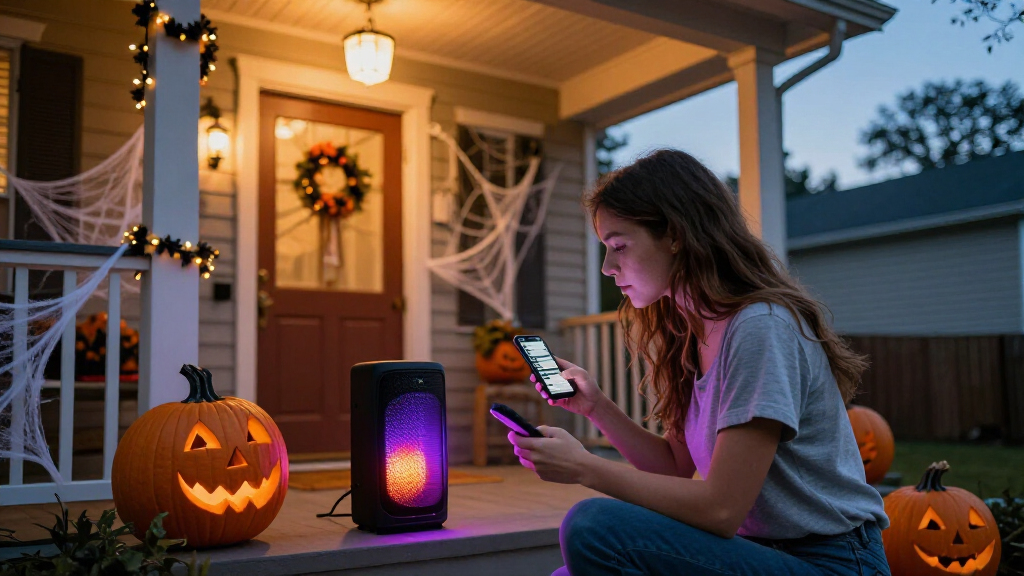
Here’s the setup that gets the TikTok comments: lights and sound that fire the moment kids walk up your path. You need the speaker, a playlist, and somewhere to shelter the electronics.
- Position the speaker at kid height (3–4 ft) near your walkway, mic facing the approach path. Height matters more than you’d think: sound dissipates fast outdoors, and a mic at adult chest height hears parents, not kids. At 3–4 ft you’re sampling the actual trigger voices.
- Set sensitivity to high so voices trigger it, not just loud music. The goal is a threshold just below normal conversation volume — loud enough to ignore wind and distant traffic, quiet enough that a whispered “trick or treat” still lands.
- Queue a short spooky soundtrack on loop via Bluetooth or a microSD card — thunder, creaky doors, a witch cackle. Keep it under 90 seconds: a loop that’s too long means kids who arrive between effects hear silence, and silence is where the atmosphere dies.
- Shelter it. Almost none of these speakers are waterproof. A covered porch, a clear plastic bin flipped over it, or a spot inside a decorated enclosure works. This isn’t optional — October weather is the single biggest killer of these devices, and the shelter choice is the difference between a reusable prop and a one-season casualty.
- Test from the sidewalk. Have someone talk normally while you watch the lights. Adjust sensitivity until it fires on conversation, not on distant traffic. This last step is what separates a display that feels alive from one that strobes randomly all night — ten minutes of tuning is the whole trick.
One safety note: if you’re running an AC adapter outdoors, tape down or elevate the cords so nobody trips in the dark, and never leave lithium-battery units out in the rain. A $40 speaker left in a downpour becomes a paperweight — or worse, a damaged lithium battery is a genuine hazard, not just a wasted purchase.
The Mistake Everyone Makes With Outdoor Setups
People buy these speakers expecting weather resistance, and almost none of them have it. The “outdoor” in most Halloween listings means “themed for outdoors,” not “rated for rain.” Unless a product explicitly states an IPX4 or higher rating, treat it like it will die in the first drizzle. Why the industry gets away with this: seasonal products are used a handful of nights a year, so failures surface long after return windows close — the cost of skipping the rating is pushed onto you, not the manufacturer. Check the listing for the letters “IP” followed by a number; if they’re absent, assume zero protection.
The second mistake is ignoring what low frequencies do to small speakers. Halloween soundtracks are bass-heavy — thunder rumbles, pipe organs, deep moans — and a 5W driver turns all of that into muddy vibration. The physics is unforgiving: bass requires moving a lot of air, and a small driver simply can’t. The result isn’t just weak lows; it’s intermodulation distortion, where trying to reproduce bass the driver can’t handle smears the mids too, making the whole soundtrack sound worse. If your playlist is spooky-ambient rather than pop, prioritize a bigger driver or bump the EQ toward clarity before maxing the volume.
Finally, don’t run lights at full strobe for a kids’ party. Rapid flashing at close range bothers some children (and, in rare cases, can trigger photosensitivity issues). Most speakers include a slow-fade or color-cycle mode that keeps the mood without the strobe — use that for the under-10 crowd and save the strobe for the adult party. It costs you nothing in atmosphere: slow color shifts read as “haunted” while strobes read as “rave,” and the former is almost always the mood you actually want on a porch full of six-year-olds.
One Speaker vs. Regular Speaker + Strobe Light: Which Setup Wins?
A dedicated Halloween speaker competes with a DIY combo: your existing Bluetooth speaker plus a smart plug and a cheap strobe. The DIY route gives you better audio quality for the same money — but you lose sound activation entirely, and syncing a strobe to music becomes a manual fiddle. What you’re really choosing between is audio fidelity and reactivity: the combo plays better sound at a crowd, while the all-in-one creates the illusion that your decorations are listening. Only one of those things makes kids stop and stare.
| Halloween LED Speaker | Speaker + Strobe + Smart Plug | |
|---|---|---|
| Cost | $20–60, one purchase | $35–70 across three items |
| Sound-reactive lights | Yes, automatic | No (manual or app timing) |
| Audio quality | Decent, bass-limited | Usually better |
| Setup time | Under 5 minutes | 20–30 minutes plus app pairing |
| Voice triggering | Yes | No |
Notice the hidden line item: failure points. The combo has three devices, three batteries or outlets, and an app that needs to cooperate on a cold October night — every additional component is another thing that breaks at 7 PM. The all-in-one is one purchase, one charge, one button. That’s why the setup-time row understates the real gap; reliability compounds over a whole evening, not just the first ten minutes.
The all-in-one wins on convenience and the voice-trigger trick; the combo wins on sound. For a single-season porch display, I’d take the all-in-one every time — the voice-trigger effect is the entire show, and no combo can replicate it. For a serious annual haunted garage, hybrid setups earn their extra effort, since audio quality scales with audience size in a way that a $40 LED speaker’s driver never will.
Frequently Asked Questions
Will trick-or-treaters’ voices actually trigger the lights?
Yes — if sensitivity is set to high. The built-in microphone reacts to any nearby sound, including voices, so kids talking as they approach will set off the light show. This is one of the most popular uses for these speakers as porch displays.
Are LED Halloween sound activated speakers waterproof?
Almost none are. Unless the listing specifies an IPX4 rating or higher, assume rain will kill it. Use a covered porch, flip a clear plastic bin over it, or bring it inside when the weather turns.
How long does the battery last on a full charge?
Typically 4–10 hours depending on volume and light use. Realistically, expect 60–70% of the claimed runtime with lights flashing and volume above 60%, so plan for 6–7 hours on a “10-hour” model.
Can I play music from my phone or Spotify?
Yes, on most models — connect via Bluetooth (look for version 5.0 or newer for a stable 30–50 ft range). Many speakers also accept AUX cables, USB drives, and microSD cards if you’d rather run a looping soundtrack without your phone nearby.
Can I turn the lights off but keep the music playing?
Many models allow it, but not all. Check the product manual or reviews before buying — independent light and audio control is one of the most commonly missing features on budget units under $25.
Conclusion
If you remember one thing: the microphone is the feature. Wattage and battery specs decide how good your party sounds, but the sound-activation mode is what turns a speaker into a Halloween effect — and sensitivity adjustment is what makes it usable. Buy for the mic, not the marketing.
This October, when a six-year-old in a skeleton costume whispers “trick or treat” and your porch skull erupts in flashing red, you’ll know exactly why. And so, thanks to you, will every kid on the block.
Halloween Picks
halloween
As an affiliate, we earn on qualifying purchases.