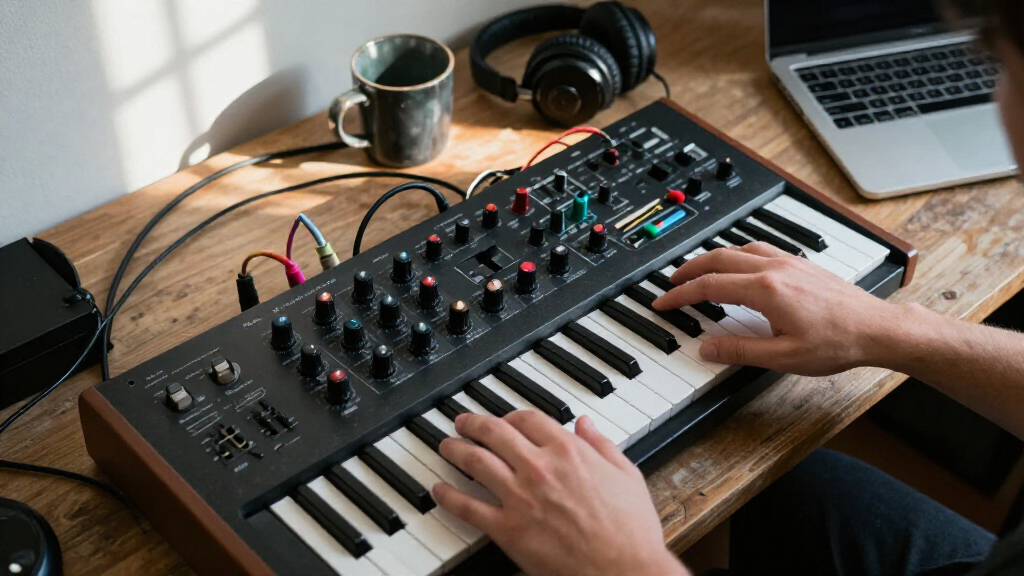

Compact analog synthesizers range from pocket-sized sound toys to performance-ready instruments, so the right choice depends on whether you value hands-on control, expressive keys, bass, or portability. My best overall pick is the Sequential Fourm for players seeking a compact polyphonic instrument, while the Roland AIRA Compact S-1 stands out for flexible sound design and the Moog Minitaur for focused analog bass. The main tradeoffs are straightforward: smaller instruments can limit hands-on control and keyboard playability, while fuller-featured models take up more space and may use analog modeling rather than fully analog circuits. This roundup compares both kinds so you can match the instrument to your music and setup. Continue reading for the full breakdown and buying advice.

Get audio and creator gear delivered free with Prime
- Fast, free delivery on millions of items
- Prime Video, Amazon Music and more included
- Member-only deals all year
Complete the kit



Key Takeaways
- Polyphony changes the role of a compact synth. The Sequential Fourm, Yamaha REFACE CS, and microKORG models suit chords better than monophonic bass-focused instruments such as the Moog Minitaur.
- Smallest does not always mean easiest to play. The Stylophone and Korg Monotron DUO are exceptionally portable, but their touch or ribbon controls are less like a conventional keyboard.
- Analog and analog modeling are different buying choices. Several compact options here use modeling, which can offer broader sounds and practical features without the same signal-generation approach as fully analog instruments.
- Built-in speakers favor immediate, self-contained play. The Stylophone Theremin and microKORG S can be useful without a separate monitoring setup, while many other options rely on external amplification or headphones.
- CV/Gate and sequencing shape studio usefulness. The Donner Essential B1 is geared toward bass patterns, while the Stylophone GENX-2 adds CV/Gate connectivity for integration with compatible gear.


| compact analog synthesizer | Dimensions | Model | Weight |
|---|---|---|---|
| Roland AIRA Compact S-1 Tweak | — | — | — |
| Sequential Fourm Compact Polyp | 28 x 13.4 x 6.9 inches | — | — |
| Analog Bass Synthesizer and Se | — | Essential B1 | — |
| Stylophone Theremin | 8.5 x 6.5 x 6.25 inches | THEREMIN | 896 g |
| Stylophone Original Pocket Ele | 2.05 x 3.41 x 1.86 inches | Original | 8.8 ounces |
| Behringer AKS MINI Synthesizer | — | — | — |
| Moog Minitaur Analog Bass Synt | 5.12 x 8.74 x 3.15 inches | TBP-002 | 1.2 kg |
| MOOG Messenger Monophonic Anal | — | — | — |
| Yamaha REFACE CS Portable Anal | — | — | 6 pounds |
| Behringer PHARA-O MINI Mini Sy | 9.21 x 6.1 x 2.56 inches | PHARA-O MINI | 0.65 kg |
| Korg Monotron DUO Analog Ribbo | 6.4 x 1.6 x 9.2 inches | Monotron DUO | 6.4 ounces |
| Stylophone GENX-2 Portable Ana | — | GenX-2 | — |
| Korg microKORG Compact Analog | 26 x 6 x 12 inches | — | 8.4 pounds |
| Korg microKORG S Compact Analo | 20.63 x 9.13 x 2.76 inches | microKORG S | 2.75 kg |
More Details on Our Top Picks
Roland AIRA Compact S-1 Tweak Synth
The Roland AIRA Compact S-1 is the most flexible choice here for players who want more than a single bass voice in a small instrument. Its micro-polysynth design, SH-101 inspiration, and wave manipulation give it room for basses, leads, and more exploratory sounds, while onboard sequencing and performance controls help turn ideas into playable parts. Compared with the Donner Essential B1, the S-1 is less narrowly aimed at bass patterns and offers a broader sound-design role; the B1, by contrast, spells out its pattern library and effects more clearly. The tradeoff is that the available product details leave its exact capabilities less defined, and a compact synth may need other gear to fit a fuller performance setup. I’d pick it for versatility, not for a fully specified all-in-one rig.
Pros:- Micro-polysynth format supports a wider role than a bass-only instrument
- Wave manipulation opens up sound-shaping options beyond straightforward tones
- Onboard sequencing and performance controls support live idea-making
- SH-101-inspired design connects it to familiar bass and lead sounds
Cons:- Available product information does not specify key synthesis and connectivity details
- May need additional equipment for a fuller performance setup
- Its broader sound-design focus may be more than buyers seeking a simple bass sequencer need
Best for: Electronic musicians who want a portable synth for varied bass and lead parts, with sequencing and hands-on sound shaping.
Not ideal for: Buyers who need detailed, confirmed specifications or a complete standalone performance setup without additional gear.
- Type:Micro polysynth
- Sound inspiration:Roland SH-101
- Sound-shaping feature:Wave manipulation
- Sequencing:Onboard sequencing
- Performance controls:Included
- Intended sounds:Basses, leads, and futuristic sounds
Our verdict“Choose the S-1 if you want a compact, versatile synth for basses, leads, and experimental sounds rather than a narrowly focused pattern instrument.”
Sequential Fourm Compact Polyphonic Analog Synthesizer
The Sequential Fourm is the keyboard-focused pick for players who want hands-on polyphonic analog sound in a self-contained instrument. Its 37 keys, dual VCOs, two ADSR envelopes, and modulation matrix give it more room for expressive playing and sound design than the tabletop Donner Essential B1, which is built around bass patterns and has no keyboard. A sequencer, arpeggiator, and 128 presets also make the Fourm ready for quick writing and live parts without making every sound from scratch. That capability comes with a size tradeoff: at 28 inches long, it is less pocketable than the Roland AIRA Compact S-1, and its interface may take time to learn. There are no built-in effects, either, so players seeking an all-in-one effects chain will need other equipment.
Pros:- 37-key layout supports direct keyboard performance
- Dual VCOs and a modulation matrix offer room for sound design
- Sequencer, arpeggiator, and 128 presets support fast idea development
- MIDI and USB MIDI provide flexible connections to other gear
Cons:- At 28 inches long, it is much less portable than the S-1 or pocket Stylophone
- The feature-rich interface may require a learning period
- No built-in effects are listed
Best for: Keyboard players seeking a compact, polyphonic analog instrument with modulation options, presets, and performance tools for studio or live use.
Not ideal for: Travel-focused buyers who need a genuinely pocketable synth, or players who want built-in effects and a simpler interface.
- Keys:37
- Polyphony:Polyphonic
- Oscillators:2 VCOs
- Envelopes:2 ADSR
- Modulation:Modulation matrix
- Presets:128 preloaded
- Connectivity:MIDI in/out/thru, USB MIDI, main and headphone outputs
- Dimensions:28 x 13.4 x 6.9 inches
- Chassis material:Steel, plastic, and nylon
Our verdict“Pick the Fourm if playable keys and polyphonic analog sound matter more than the smallest footprint or built-in effects.”
Analog Bass Synthesizer and Sequencer Donner Essential B1 with 128 Patterns, Effects, and Intuitive Interface
The Donner Essential B1 is a focused tabletop choice for making bass lines and arranging them into patterns, rather than playing a broad range of parts from a keyboard. Its 128 preset patterns, haptic pads, and analog saturation and delay make it approachable for quick grooves and live use. Compared with the Roland AIRA Compact S-1, the B1 has a more clearly defined bass-and-sequencer role, while the S-1 is described as a micro polysynth for basses, leads, and wave-based sound shaping. The B1’s tradeoff is its limited single-VCO, VCF, and VCA engine: it is less open-ended for sound design, and there is no built-in keyboard, so note entry depends on its pads or external gear. Pattern chaining may also feel basic to users building longer arrangements.
Pros:- 128 preset patterns provide quick starting points for bass parts
- Haptic pads give pattern-based operation a direct, hands-on feel
- Analog saturation and delay add sound-shaping options onboard
- USB, MIDI, and Sync I/O support integration with other music gear
Cons:- Single VCO, VCF, and VCA limit the range of synthesis options
- No built-in keyboard, so conventional keyboard playing requires external gear
- Pattern chaining may be too basic for more involved arrangements
Best for: Beatmakers and electronic musicians who want a compact tabletop instrument for bass grooves, pattern-based writing, and quick performance control.
Not ideal for: Keyboard players or sound designers seeking polyphonic playing, a more extensive synthesis engine, or advanced pattern chaining.
- Model:Essential B1
- Instrument type:Analog bass synthesizer and sequencer
- Oscillator:1 VCO
- Filter and amplifier:1 VCF and 1 VCA
- Patterns:128 preset patterns
- Effects:Analog saturation and delay
- Connectivity:USB, MIDI, and Sync I/O
- Format:Tabletop synthesizer
Our verdict“Choose the B1 for hands-on bass patterns and onboard effects, but look to the S-1 or Fourm for broader sound design or keyboard performance.”
Stylophone Theremin – Portable Touch-Sensitive Synthesizer with Retro Analog Sound, Built-In Speaker, Delay & Vibrato Effects, Slider Control, Battery-Powered
The Stylophone Theremin takes a different route from keyboard and tabletop synths: its touch-sensitive slider makes continuous pitch movement part of the playing style. That suits gliding, expressive notes and sound exploration, while the built-in speaker, delay, and vibrato let it make sound without a separate amp. Compared with the Stylophone Original, this model offers a slider and onboard delay alongside vibrato, whereas the Original centers on a touch-sensitive metal surface and a three-octave range. The Theremin’s approach is less familiar than a keyboard, so it may take practice to play accurate notes. It is also larger and heavier than the pocket-sized Original, and its plastic, battery-powered format is better suited to casual portable use than to buyers seeking a full-featured analog studio instrument.
Pros:- Touch slider supports continuous pitch movement and expressive glides
- Built-in speaker allows standalone playing
- Delay and vibrato provide onboard effects
- Headphone and audio connection support private play or connection to other equipment
Cons:- Slider-based control has a learning curve for accurate note playing
- Battery-powered operation requires batteries
- Its 896 g weight and listed dimensions make it less pocketable than the Stylophone Original
Best for: Sound explorers and performers who want a portable, touch-controlled instrument for gliding tones, vibrato, and standalone play.
Not ideal for: Keyboard-oriented players who need familiar note entry, or musicians seeking a full synthesis engine and a pocket-size instrument.
- Model:THEREMIN
- Control:Touch-sensitive precision slider
- Effects:Delay and vibrato
- Speaker:Built-in
- Connector:3.5 mm jack
- Dimensions:8.5 x 6.5 x 6.25 inches
- Weight:896 g
- Material:Plastic
- Warranty:1 year
Our verdict“Choose the Theremin for expressive slider playing and standalone sound, rather than the familiar note layout and smaller body of the Stylophone Original.”
Stylophone Original Pocket Electronic Synthesizer
The Stylophone Original is the most pocketable option in this group, prioritizing simple touch playing over a full set of synthesis controls. Its metal playing surface, three-octave range, and vibrato give beginners an accessible way to make melodic parts, while the tiny body makes it easy to carry alongside other gear. Compared with the Stylophone Theremin, the Original has a smaller, more direct format and a defined octave range; the Theremin instead offers slider-based pitch control, a built-in speaker, delay, and vibrato. The Original’s simplicity is also its limit: it offers fewer sound-shaping options than the Donner Essential B1 or Roland AIRA Compact S-1, and its three octaves may constrain players looking for a wider keyboard range. It is a compact instrument for quick musical ideas, not a substitute for a more capable synth.
Pros:- Pocket-sized body is the most portable format in this group
- Touch-sensitive metal surface offers a direct alternative to keys
- Three-octave range supports more melodic room than a single-register toy-like instrument
- Auxiliary connection can link it with other devices
Cons:- Limited sound-shaping features may not satisfy experienced synth programmers
- Three octaves can restrict players seeking a broader range
- Requires three AA batteries
Best for: Beginners, travelers, and electronic musicians who want a very small touch-played instrument for simple melodic parts and retro tones.
Not ideal for: Players who need extensive sound design, advanced sequencing, or a wider playable range than three octaves.
- Model:Original
- Dimensions:2.05 x 3.41 x 1.86 inches
- Weight:8.8 ounces
- Material:Metal
- Sound profile:Warm, vintage, rich, retro
- Connector:Auxiliary
- Power:3 x AA batteries
- Range:3 octaves
- Effect:Vibrato
Our verdict“Choose the Original for the smallest, simplest entry point into touch-played synth parts, not for deep sound design or sequencing.”
Behringer AKS MINI Synthesizer
The AKS MINI suits buyers drawn to the distinctive EMS Synthi AKS filter character and an unusual, hands-on playing surface. Its three VCOs and three-voice design make compact chords and layered tones possible, while the touch-sensitive keyboard and built-in digital spring reverb support expressive, atmospheric playing without a separate effects unit. Compared with the Moog Minitaur, this is the more exploratory pick; the Minitaur is a focused mono bass instrument with direct knob control. The tradeoff is that the AKS MINI has limited onboard parameter controls, so shaping sounds may feel less immediate than on a more control-rich synth. Its three-voice limit also rules out fuller polyphonic parts, and operation depends on USB-C power.
Pros:- Three VCOs and three voices support compact chord work and layered sounds.
- EMS Synthi AKS-inspired filter gives it a distinct sonic direction.
- Touch-sensitive keyboard offers an unusual performance approach.
- Built-in digital spring reverb adds ambience without external effects.
Cons:- Three-voice limit restricts fuller chords and complex arrangements.
- Limited onboard parameter controls can make sound shaping less direct.
- Requires USB-C power to operate.
Best for: Electronic musicians seeking a compact three-voice synth for experimental tones, touch-based performance, and EMS-inspired filtering.
Not ideal for: Players who need broad polyphony, extensive hands-on controls, or a self-powered instrument for untethered use.
- Voices:3
- Oscillators:3 VCOs
- Keyboard:27-key touch-sensitive
- Filter:EMS Synthi AKS filter
- Reverb:Digital spring reverb
- MIDI connectivity:USB Type-C MIDI
- Power:USB Type-C
Our verdict“Choose the AKS MINI for compact, EMS-inspired textures and touch performance, not for broad polyphony or extensive onboard control.”
Moog Minitaur Analog Bass Synthesizer
The Minitaur is the focused choice here for players who want a dedicated analog bass voice rather than a keyboard-centered all-rounder. Two VCOs, a classic low-pass filter, and hands-on parameter knobs put sound shaping within easy reach, while 128 presets and software integration help bridge live tweaking and repeatable studio work. Compared with the MOOG Messenger, the Minitaur gives up keys and a broader performance format in favor of a smaller, bass-specific module. That narrow remit is its main strength—and its main limit: it is monophonic, so it cannot supply chords or serve as a general poly synth. It also needs an external power supply, and its focused interface may take time for newcomers to learn.
Pros:- Two VCOs and a classic low-pass filter deliver a focused analog bass voice.
- Hands-on knobs make parameter changes direct during sound design or performance.
- 128 presets support recallable sounds alongside live tweaking.
- Compact dimensions suit crowded desks and portable rigs.
Cons:- Monophonic design limits it to one note at a time.
- No built-in keyboard is listed, so playing requires another controller.
- Requires an external power supply.
Best for: Bass players and producers who want a compact, hands-on analog module for monophonic bass lines and studio or live setups.
Not ideal for: Keyboard players seeking chords, a self-contained portable instrument, or a single synth for varied melodic and polyphonic parts.
- Model:TBP-002
- Synthesis:Analog, monophonic
- Oscillators:2 voltage-controlled oscillators
- Filter:Classic low-pass filter
- Presets:128
- Dimensions:5.12 x 8.74 x 3.15 inches
- Weight:1.2 kg
- Connector:USB Type B
- Power:External power supply required
Our verdict“Pick the Minitaur if you want a compact, knob-controlled analog bass module; skip it if you need keys or polyphony.”
MOOG Messenger Monophonic Analog Synthesizer
The Messenger is the strongest fit for players who want a compact analog synth that still feels like a performance instrument. Its 32 full-size keys with velocity and aftertouch offer more expressive control than the touch keyboard on the Behringer AKS MINI, while dual wavefolding oscillators and a multi-mode ladder filter give sound designers more room to shape a single voice. The 64-step sequencer and 256 presets add practical ways to store and develop ideas. Its monophonic architecture keeps it from replacing a poly synth, and the feature set may take time to learn. Compared with the more narrowly focused Moog Minitaur, the Messenger adds a playable keyboard and broader sound-shaping options, but it is less of a simple bass module.
Pros:- Full-size keys with velocity and aftertouch support expressive playing.
- Dual wavefolding oscillators and a multi-mode ladder filter broaden sound design.
- 64-step sequencer supports pattern-based idea building.
- 256 presets provide a wide set of recallable starting points.
Cons:- Monophonic architecture cannot play chords.
- Extensive features may take time for beginners to learn.
- Larger performance format is less compact than a small desktop module such as the Minitaur.
Best for: Keyboard players and sound designers who want expressive full-size keys, deep monophonic shaping, and sequencing in a portable synth.
Not ideal for: Players who need polyphonic chords, a minimal learning curve, or a very small keyboard-free bass module.
- Synthesis:Monophonic analog
- Keys:32 full-size keys
- Oscillators:Dual wavefolding oscillators
- Filter:Multi-mode ladder filter
- Sequencer:64 steps
- Presets:256
- Included components:Synthesizer, power supply, quick start guide, poster, safety instructions, preset guide
- Warranty:1 year
Our verdict“Choose the Messenger for expressive, feature-rich monophonic playing; choose a poly synth if chords are a requirement.”
Yamaha REFACE CS Portable Analog Modeling Synthesizer
The REFACE CS is the most practical option here for players who want polyphonic parts in a portable format. Its eight-note capacity handles chords and pads that monophonic instruments such as the MOOG Messenger cannot, and the 37-key mini keyboard gives it a broader playing range than the Messenger’s 32 full-size keys. Multiple oscillator types, onboard effects, a phrase looper, and built-in speakers make it useful for sketching or playing without a separate speaker setup. The compromise is that this is an analog modeling instrument, not a traditional analog voice architecture like the Minitaur. The mini keys may not suit players who prioritize full-size action, and battery life varies with use.
Pros:- Eight-note polyphony supports chords and pads beyond the reach of the mono picks.
- Built-in speakers allow sound without a separate monitor setup.
- Phrase looper helps capture musical ideas directly on the instrument.
- Battery power supports portable playing.
Cons:- Analog modeling differs from the traditional analog architecture of the Minitaur.
- Mini keys may feel less expressive or comfortable for some players.
- Battery life varies with usage.
Best for: Songwriters and mobile keyboard players who want chords, onboard speakers, and quick idea capture in a battery-powered modeling synth.
Not ideal for: Players seeking traditional analog circuitry, full-size keys, or a particularly lightweight instrument; the listed weight is 6 pounds.
- Synthesis:Analog modeling
- Keys:37
- Polyphony:8 notes
- Sound engine:Multiple oscillator types
- Features:Onboard effects, phrase looper, built-in speakers
- Power:Battery powered
- Connectivity:MIDI USB
- Headphone jack:3.5 mm
- Weight:6 pounds
Our verdict“Choose the REFACE CS for portable chords and standalone sketching, but look elsewhere if full-size keys or traditional analog circuitry matter most.”
Behringer PHARA-O MINI Mini Synthesizer for Compact Sound Design
The PHARA-O MINI earns a place for buyers whose priority is a small, sturdy MIDI-connected unit rather than a keyboard-led synth. At 9.21 x 6.1 x 2.56 inches and 0.65 kg, it is easy to fit into a compact rig, and its alloy steel body offers a durable alternative to the more performance-oriented Yamaha REFACE CS. The key tradeoff is limited detail about its sound engine: the supplied product information describes basic sound-design features but does not specify voices, oscillators, or a keyboard. That makes it harder to judge as a standalone instrument than the AKS MINI or Minitaur, whose sound sources and roles are clearer. There are no built-in speakers, so plan on external monitoring.
Pros:- Compact dimensions fit easily into a crowded desk or portable rig.
- Alloy steel body is a durable construction choice.
- MIDI connectivity supports integration with compatible equipment.
- Low listed weight makes it easy to transport.
Cons:- Product details do not specify the sound engine or core synthesis architecture.
- No built-in speakers, so external monitoring is needed.
- Basic sound-design information leaves its capabilities less clear than those of the AKS MINI or Minitaur.
Best for: MIDI-focused musicians seeking a compact, durable unit for a small studio or portable setup who do not need onboard speakers.
Not ideal for: Players who want a clearly specified analog voice, built-in keys, speakers, or detailed sound-shaping controls.
- Model:PHARA-O MINI
- Model number:0722-AAU
- Dimensions:9.21 x 6.1 x 2.56 inches
- Weight:0.65 kg
- Material:Alloy steel
- Finish:Polished
- Connector:MIDI
- Warranty support:Musictribe Support
Our verdict“Consider the PHARA-O MINI for a compact, durable MIDI setup, but choose a better-specified synth if sound design is your main priority.”
Korg Monotron DUO Analog Ribbon Synthesizer
The Korg Monotron DUO is the most stripped-down, grab-and-go choice here: its ribbon controller keeps playing immediate, while the DUO’s added sound-shaping and modulation options give it more room to explore than a basic pocket synth. Compared with the Stylophone GENX-2, it offers a simpler control layout and less connectivity, so it suits quick analog experiments better than a portable centerpiece for a larger setup. Its small, lightweight body is easy to carry, but the tradeoff is a limited instrument: there are no advanced performance features or broad connection options listed. Buyers new to synthesis may also need time to understand how its controls affect the sound. Choose it for tactile, compact sound play; skip it if you need a full keyboard or flexible studio integration.
Pros:- Compact and lightweight for easy transport
- Ribbon control supports immediate, hands-on pitch playing
- Sound-shaping and modulation options add variety beyond a basic pocket synth
- Simple interface makes quick adjustments accessible
Cons:- Limited feature set and connectivity compared with the Stylophone GENX-2
- Analog-focused sounds may not suit buyers seeking broad timbral coverage
- Synth controls can take time for beginners to understand
Best for: Musicians and sound explorers who want a lightweight ribbon synth for spontaneous analog experiments and simple portable setups.
Not ideal for: Players who need a conventional keyboard, extensive connectivity, or a feature-rich instrument for complex arrangements.
- Brand:Korg
- Model:Monotron DUO
- Model number:MONOTRONDUO
- Dimensions:6.4 x 1.6 x 9.2 inches
- Weight:6.4 ounces
- Controller:Ribbon
- Connector type:Auxiliary
- Included component:Case
- Warranty:1 year manufacturer
Our verdict“Choose the Monotron DUO for portable, hands-on analog exploration, not as a full-featured studio synth.”
Stylophone GENX-2 Portable Analogue Synthesizer with Built-in Speaker, LFO, Filter, Delay, and CV/Gate Output
The Stylophone GENX-2 packs a broader set of sound controls and connections into a portable format than the Monotron DUO, making it the stronger pick when compact size should not mean a closed-off setup. Its CV in/out supports interaction with compatible external gear, while the filter, LFO, delay, pulse-width modulation, and expression strip give sound designers more ways to shape a part. A two-octave stylus keyboard and built-in speaker also make it playable without a separate keyboard or monitor. Compared with the Korg microKORG, it is more portable and hands-on but lacks the microKORG’s conventional keys and four-voice polyphony. The compact control scheme can take practice, and the supplied information does not establish build durability. Pick it for portable patching and experimentation, not for traditional keyboard performance.
Pros:- CV input and output support connection with compatible external equipment
- Filter, LFO, delay, and pulse-width modulation offer substantial sound shaping
- Built-in speaker and battery operation support portable play
- Expression strip and sub-octave switches add performance options
Cons:- Two-octave stylus keyboard is less familiar than conventional keys
- Several synthesis features may take time to use effectively
- Build quality and durability are not specified
Best for: Electronic musicians who want a portable, stylus-played synth with CV connections for pairing with compatible modular or semi-modular gear.
Not ideal for: Keyboard players who need a broad playing range, conventional keys, or a clearly specified durable instrument for heavy touring.
- Brand:Stylophone
- Model:GenX-2
- Keyboard:Two octaves, stylus-controlled
- Sound controls:LFO, filter, delay, pulse-width modulation, sub-octaves, expression strip
- CV connectivity:CV in/out
- Audio connectivity:3.5 mm headphone and external-audio jacks
- Included components:Stylus, headphones
- Warranty:1 year
Our verdict“Choose the GENX-2 if portable sound shaping and CV connections matter more than a conventional keyboard.”
Korg microKORG Compact Analog Modeling Synthesizer with Vocoder, 4 Voices, and 6-step Arpeggiator
The Korg microKORG is the keyboard-led choice in this group: its 37 full-size keys make it more familiar for playing parts than the ribbon-controlled Monotron DUO or stylus-driven GENX-2. The built-in vocoder gives it a clear performance role for vocal effects, while its four-voice polyphony supports simple chords and layered phrases. That makes it a better fit for a small stage rig or a compact keyboard setup than pocket-first instruments. The tradeoff is that four voices limit how much can sound at once, and its listed dimensions—26 x 6 x 12 inches—make it less pocketable than the smaller alternatives. Its analog-modeling engine also differs from a strictly analog instrument. Choose it for playable keys and vocoder performance; skip it if minimal size or greater polyphony is the priority.
Pros:- 37 full-size keys provide a familiar playing surface
- Built-in vocoder supports vocal effects without a separate vocoder unit
- Four-voice polyphony allows basic chords and layered parts
- Six-step arpeggiator adds a compact performance tool
Cons:- Four-voice polyphony can restrict dense chords and overlapping parts
- Larger than pocket-focused options such as the Monotron DUO
- Analog modeling may not meet buyers looking specifically for fully analog circuitry
Best for: Performers who want full-size keys and a built-in vocoder in a portable instrument for simple synth parts and vocal effects.
Not ideal for: Buyers seeking a pocket-sized synth, extensive polyphony, or a strictly analog sound engine.
- Brand:Korg
- Sound engine:Korg XMT
- Keyboard:37 full-size keys
- Polyphony:4 voices
- Vocoder:Built in
- Arpeggiator:6-step
- Dimensions:26 x 6 x 12 inches
- Weight:8.4 pounds
- Warranty:1 year
Our verdict“Choose the microKORG if full-size keys and vocoder performance matter more than pocket portability or higher polyphony.”
Korg microKORG S Compact Analog Modeling Synthesizer with Vocoder and Built-in Stereo Speakers
The Korg microKORG S is the most self-contained keyboard option here: built-in stereo speakers let it produce sound without requiring separate monitors, unlike the original microKORG’s listed configuration. It also retains a vocoder and velocity-sensitive mini keys, giving it more performance flexibility than the Monotron DUO’s ribbon approach. Battery-powered operation supports playing away from a fixed setup, though the supplied details do not state battery life. This is still an analog-modeling instrument, not a strictly analog synth, and its plastic and basswood construction plus limited control surface may not satisfy buyers who want extensive hands-on editing. Compared with the GENX-2, it offers a more conventional keyboard experience, while the GENX-2 provides CV connections. Choose the microKORG S for an all-in-one portable keyboard; skip it if modular connectivity or deeper direct control comes first.
Pros:- Built-in stereo speakers allow standalone listening
- Battery-powered operation supports portable use
- Vocoder adds vocal-processing performance options
- Velocity-sensitive mini keys respond to playing dynamics
Cons:- Built-in speakers may not replace dedicated monitors in a studio
- Control surface is limited compared with larger synthesizers
- Battery life depends on usage and is not specified
Best for: Musicians who want a portable keyboard synth with built-in speakers and a vocoder for practice, songwriting, or small performance setups.
Not ideal for: Sound designers who prioritize CV integration, extensive hands-on controls, or studio-grade monitoring from the instrument itself.
- Brand:Korg
- Model:microKORG S
- Instrument type:Analog modeling synthesizer
- Keys:Velocity-sensitive mini keys
- Vocoder:Included
- Speakers:Built-in stereo speakers
- Dimensions:20.63 x 9.13 x 2.76 inches
- Weight:2.75 kg
- Materials:Plastic, basswood
Our verdict“Choose the microKORG S for a portable, self-contained keyboard and vocoder, but look elsewhere for CV patching or extensive hands-on editing.”

How We Picked
I compared these 14 instruments by how well they serve the specific needs of a compact setup: physical footprint, sound-generation approach, playing controls, voice count, onboard sound-shaping, and connections to other gear. I also weighed practical details such as built-in speakers, sequencing, battery operation, and whether an instrument is approachable for a first-time player or better suited to a focused studio role. Since the lineup includes both fully analog and analog-modeling instruments, I treat those as distinct approaches rather than presenting them as interchangeable.
The ranking favors useful balance: instruments that combine compact size with versatile sound and a clear role place ahead of models limited to one narrow task. I give specialist picks their own value when their focused design is a genuine advantage, but note where that focus restricts them. A larger compact keyboard can rank above a pocket instrument when playability and musical range matter more; a tiny synth can still be the better choice for travel, experimentation, or a strict space limit.
Factors to Consider When Choosing Compact Analog Synthesizers
Before choosing a compact synthesizer, decide what “compact” needs to mean in your setup. A pocket instrument, a small desktop module, and a portable keyboard can all save space, but they support different ways of playing and connecting. These broader tradeoffs help prevent a small footprint from becoming a daily limitation.
Choose the sound-generation approach you actually want
Product names do not always make clear whether a synth uses analog circuitry or analog modeling. Fully analog designs generate sound through analog circuits, while modeling recreates aspects of that behavior digitally; either approach can make compelling music. Decide whether your priority is a particular analog signal path or a wider range of sounds and conveniences. A common mistake is treating “analog” as a guarantee of a better fit, then overlooking voice count, controls, or connectivity. Check the manufacturer’s specifications for the exact sound engine rather than relying on a listing’s shorthand. In this roundup, that distinction matters for options such as the REFACE CS and microKORG models, which are analog modeling instruments.
Match monophony and polyphony to the parts you plan to play
Monophonic synths play one note at a time, a natural fit for bass lines and lead phrases; polyphonic instruments can play several notes together for chords. Think about the parts you expect to record most often, not just the sounds you admire. If you mainly make bass, paying for chord capability may not improve your workflow. If you want pads or keyboard-style harmony, a monophonic instrument can require extra tracking or another synth. Also check whether the instrument’s voice count supports your intended playing style, since “polyphonic” alone does not tell you how many notes can sound at once.
Test the control layout against your playing habits
A compact instrument can save desk space by replacing full-size keys with touch strips, small keys, or a limited control surface. That tradeoff affects more than comfort: it changes how easily you can perform melodies, adjust parameters, and repeat a part accurately. If you plan to play live or record parts in real time, favor controls that suit your hands and preferred technique. If the synth will mostly supply textures or be sequenced from another device, a less conventional interface may be perfectly workable. Avoid choosing by dimensions alone; look at the control layout and confirm how notes are entered and sustained.
Count the full setup, not just the synthesizer
A compact synth may still need an audio interface, headphones, an amplifier, a MIDI controller, or a power source to fit your routine. Built-in speakers can make spontaneous practice easier, but they are not a substitute for checking recording outputs and monitoring needs. Battery operation helps away from a studio, while external connections matter more when integrating with existing equipment. Before buying, sketch how audio and control signals will move through your setup. This simple check can prevent a small instrument from requiring more adapters and extra desk space than expected.
Decide whether you need a standalone pattern maker
Some compact synths focus on sound creation, while others add sequencing or pattern tools that can turn a single unit into a more self-contained idea generator. Built-in patterns are useful for sketching without a computer, but they may not suit every tempo, arrangement, or performance method. If you already use a hardware sequencer or a digital audio workstation, a second sequencing system could add complexity rather than value. Check how patterns are selected, edited, and synchronized with other gear. Prioritize the sequencer only if you expect to use it regularly, not because a feature list makes the instrument appear more complete.
Pay for range only when it serves your music
More voices, effects, keys, and sound-shaping options can expand what one instrument can do, but they can also add bulk and make operation less direct. A dedicated bass synth may be the better purchase if it fills one clear role in your setup. A broader keyboard makes more sense when you want one instrument to handle several parts. For a first synth, straightforward controls and a usable playing interface can matter more than a large feature set. Spend extra for capabilities you can name and use, such as polyphony or a required connection, rather than assuming more functions automatically mean more creative freedom.
Frequently Asked Questions
Are all of these compact synthesizers fully analog?
No. The roundup includes fully analog instruments as well as analog-modeling synths, and those approaches should not be treated as identical. Modeling can offer a broad set of sounds in a portable format, while a fully analog instrument uses analog circuitry to generate its signal. Check the exact model specifications if the sound-generation method is a firm requirement. Also compare the controls and voice count, since those factors may affect your music more than the label alone.
Can a pocket-sized synth replace a keyboard synth?
It can replace one for particular tasks, but not necessarily for comfortable keyboard performance. Pocket and ribbon-controlled instruments make spontaneous sound exploration easy and take little space, but they do not provide the same key layout as a portable keyboard. They are a better match for sound experiments, short parts, or use alongside a sequencer. If you plan to play chords or perform long melodies, check the control method and note-entry range before choosing. A compact keyboard model may be more practical even if it takes up more room.
Should I choose a monophonic or polyphonic compact synth?
Choose monophonic if your main goal is bass, leads, or one-note sequences; choose polyphonic if you want to play chords or layered parts from one instrument. Polyphony can make a compact synth more versatile, but it may not help if the instrument will serve one dedicated bass role. Consider how you will record: overdubbing can cover some limits, while live playing favors the voice count you need at once. Also check the actual number of simultaneous notes rather than relying on a general polyphonic label. Your intended parts are a better guide than the idea that one format is inherently superior.
Do I need a built-in speaker for a portable synthesizer?
A built-in speaker is useful for quick practice, demonstrations, or playing without setting up headphones and external monitoring. It is not a requirement for portability, since a small synth can still travel easily with headphones or a compact speaker. For recording, check the audio outputs and how the instrument connects to your interface or mixer. If you mostly work at a desk, a built-in speaker may matter less than a comfortable control layout or MIDI and CV/Gate connections. Choose based on where you will play, not portability alone.
What should I check before connecting a compact synth to modular or MIDI gear?
Confirm which control connections the synth provides and which your other equipment accepts. CV/Gate and MIDI are different systems, so the presence of one does not mean the instrument can communicate directly with every device. Check whether the connections support the signals and functions you need, and whether adapters or a converter would be required. Review the audio output as a separate part of the setup; control connectivity does not by itself solve audio routing. A quick connection plan before purchase can help avoid buying an instrument that cannot fit your intended rig.
Conclusion
For the broadest balance in this compact lineup, I recommend the Sequential Fourm as best overall, while the Donner Essential B1 is the best value-style pick for bass patterns and sequencing. Beginners who want a direct, exploratory entry point can look to the Stylophone Original; players seeking a more capable portable keyboard should compare the Yamaha REFACE CS and microKORG models. For premium, focused analog bass, the Moog Minitaur is the specialist choice; for the smallest playful setup, consider the Korg Monotron DUO or a Stylophone model. Choose by the part you need the synth to play, the way you prefer to control it, and the connections your setup requires—not by size alone.