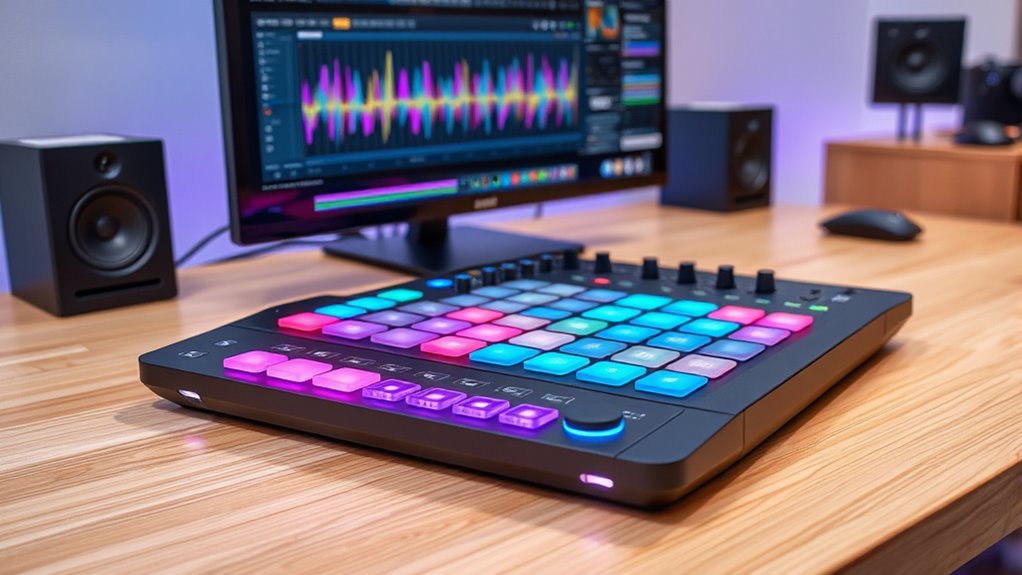

If you’re looking for the 12 best compact DAW control surfaces for seamless music production in 2025, I recommend several options like the iCON V1-M with its high-res motorized faders, Behringer X-Touch One for industry-standard protocol support, and PreSonus FaderPort V2 for streamlined control. Portable options like the Behringer X-Touch Mini or Novation Launchkey 37 MK4 also pack a punch. Keep exploring to discover which setup fits your workflow best.
Key Takeaways
- Look for models with high-resolution motorized faders and customizable touchscreens for precise and flexible control.
- Prioritize compatibility with major DAWs like Ableton, Logic, Cubase, and support for protocols such as Mackie Control and HUI.
- Consider portability and compact size under 15 inches, ideal for mobile setups and small studios.
- Evaluate build quality, durability, and power options for reliable performance in professional or on-the-go environments.
- Explore devices offering real-time visual feedback, OLED displays, and comprehensive control features for seamless workflow.
iCON Pro Audio V1-M USB MIDI DAW Control Surface with Motorized Faders

If you’re looking for a compact control surface that offers professional-grade features, the iCON Pro Audio V1-M is an excellent choice. It features 8 touch-sensitive motorized faders with 12-bit resolution, expandable to 64 channels with V1-X expanders. The large 7-inch touchscreen with five color-coded layers provides quick access to up to 120 DAW functions, making workflow customization easy. Real-time feedback via OLED displays, meters, and TFT screens keeps levels and pan positions visible without relying on your computer monitor. Durable, illuminated buttons, transport controls, and a jog wheel complete the package, ensuring a seamless, tactile experience for professional music production.
Best For: professional music producers and audio engineers seeking a customizable, feature-rich control surface for DAW integration and tactile control.
Pros:
- Touch-sensitive motorized faders with high resolution for precise control
- Large customizable touchscreen with multiple layers for extensive workflow customization
- Compatible with multiple DAWs and can be expanded up to 64 channels
Cons:
- Mixed customer reviews regarding build quality and durability
- Some users experience compatibility issues with certain DAWs like Logic Pro and Studio One
- Limited customization options for channel naming within software and less seamless MIDI control updates
Behringer X-Touch One

The Behringer X-Touch One stands out as an ideal choice for home studio owners and musicians seeking precise, hands-on control over their digital audio workstations. It features a touch-sensitive, motorized 100 mm fader for real-time automation, along with a dynamic LCD scribble strip, rotary encoder, and 34 illuminated buttons. The large jog/shuttle wheel and transport controls enhance workflow efficiency. Supporting industry-standard protocols like Mackie Control, HUI, and MIDI, it integrates seamlessly with DAWs such as Ableton Live, Logic Pro, and Pro Tools. Compact yet versatile, the X-Touch One offers intuitive operation and room to grow, making it perfect for both beginners and seasoned producers.
Best For: home studio owners, musicians, and producers seeking precise, intuitive control over their DAWs with room to expand their setup.
Pros:
- Supports industry-standard protocols like Mackie Control, HUI, and MIDI for seamless integration with major DAWs.
- Features a touch-sensitive, motorized 100 mm fader and dynamic LCD scribble strip for real-time feedback and automation.
- Compact, user-friendly design with large jog/shuttle wheel and transport controls to enhance workflow efficiency.
Cons:
- Limited to USB connectivity, which may restrict setup flexibility in some environments.
- The device is primarily designed for DAWs that support Mackie Control, HUI, or MIDI, limiting compatibility with less common software.
- As a specialized control surface, it may require additional configuration or overlays for optimal use with certain DAWs.
PreSonus FaderPort DAW Controller with Studio One Pro Software
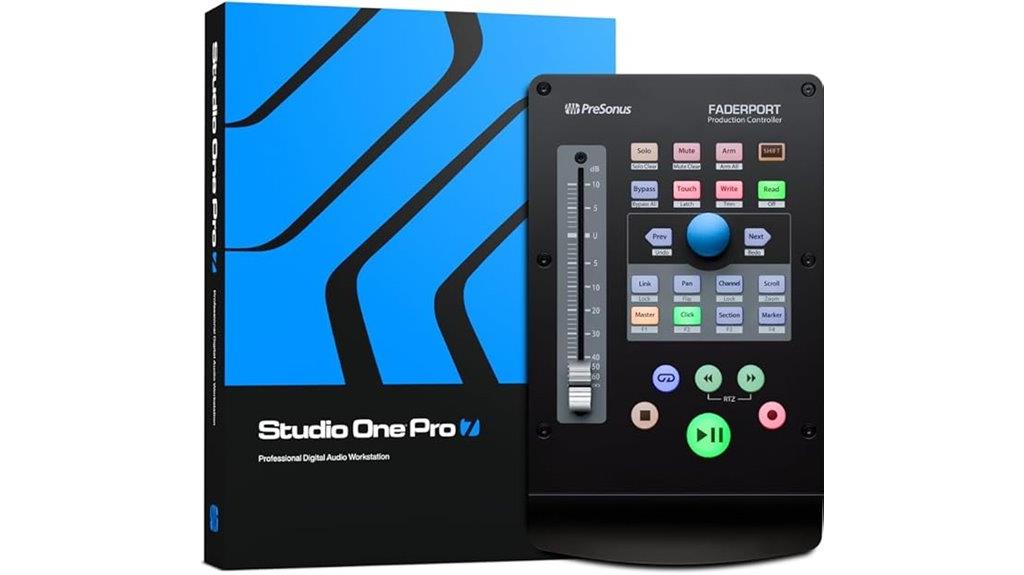
PreSonus FaderPort V2 stands out as an ideal choice for producers and engineers seeking streamlined DAW control with a focus on efficiency. Its 100 mm touch-sensitive, motorized fader and extensive button layout provide quick access to transport, automation, and track functions, all accessible with one hand. Seamlessly integrating with Studio One and other DAWs via Mackie protocols, it simplifies workflow. The hardware’s intuitive design, combined with included software like Studio One Artist and Ableton Live Lite, makes it a versatile tool. Despite some audio quality limitations, its user-friendly interface and robust control features make it a top compact option for professional music production.
Novation Launchkey 37 MK4 MIDI Keyboard Controller
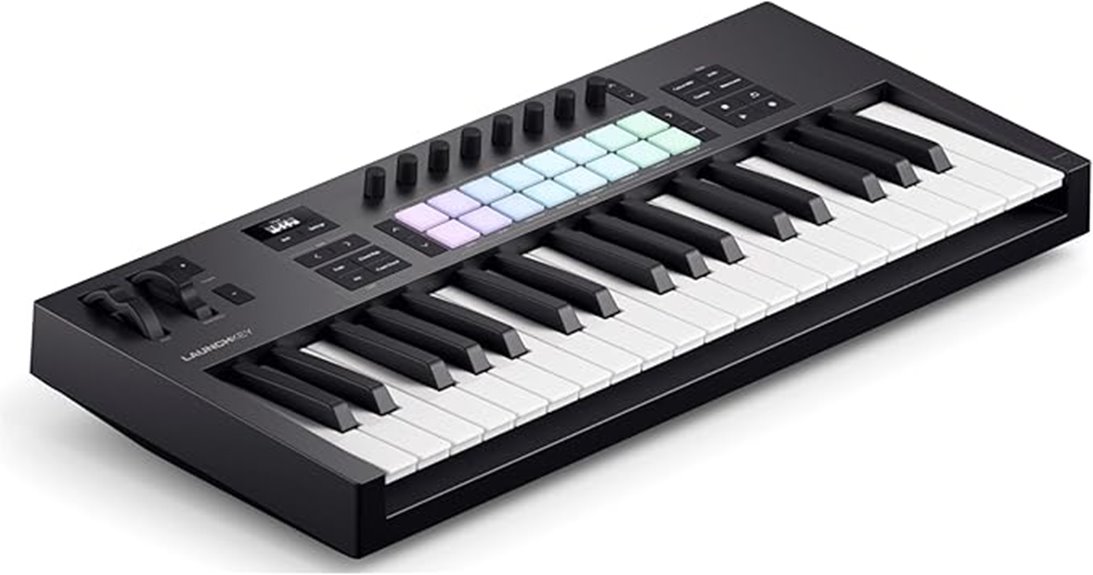
For musicians seeking a versatile, portable MIDI controller that seamlessly integrates with major DAWs, the Novation Launchkey 37 MK4 stands out. It offers 37 synth-action keys, 16 FSR pads with polyphonic aftertouch, and an intuitive control layout. Built-in features like an editable arpeggiator, chord modes, scale mode, and a chord detector OLED display make creative workflows effortless. It’s compatible with Ableton Live, Logic Pro, and more, plus it includes bundled software like Ableton Live Lite and Cubase LE. Lightweight and USB-powered, the Launchkey 37 MK4 is perfect for mobile setups and small studios, combining flexibility with solid build quality.
Best For: musicians and producers who need a versatile, portable MIDI controller with deep DAW integration, especially those using Ableton Live or working in small studio or mobile setups.
Pros:
- Seamless integration with major DAWs including Ableton Live and Logic Pro
- Compact, lightweight design ideal for mobile use and small studios
- Features like an editable arpeggiator, chord modes, and polyphonic aftertouch pads enhance creative possibilities
Cons:
- Slightly sensitive velocity response may require adjustment out of the box
- Some users find the keys slippery or less responsive on black keys
- Limited customization options for certain controls compared to more advanced MIDI controllers
Behringer X-Touch Mini USB Controller
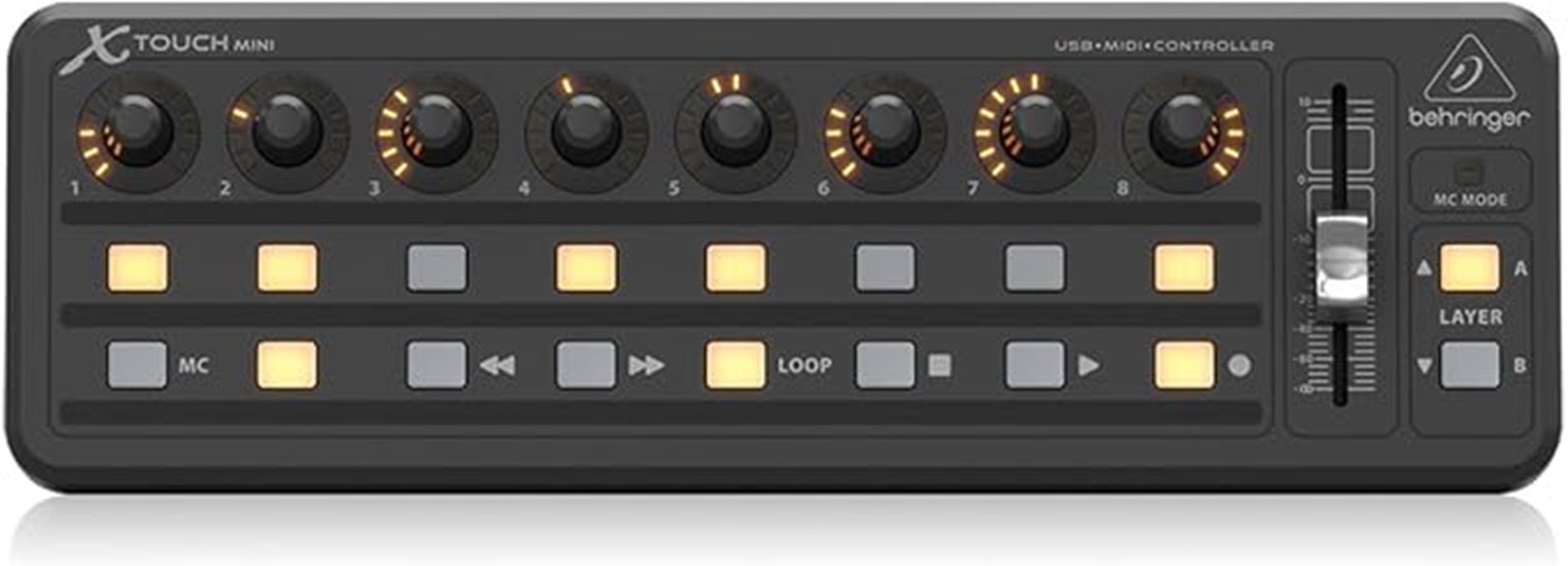
If you’re short on space but still need precise control over your DAW, the Behringer X-Touch Mini USB Controller is an excellent choice. Its compact design fits perfectly into small studio setups without sacrificing functionality. It features a long-wearing 60mm master fader for accurate audio level adjustments, along with 8 rotary controls with LED collars and 16 illuminated buttons for quick access and visual feedback. Connecting via USB Type B, it integrates seamlessly with your computer or DAW. Supporting the Mackie Control protocol, it offers extensive software control, making mixing and editing more intuitive and efficient in tight spaces.
Best For: musicians, producers, and audio engineers working in small studio environments who need precise control without taking up much space.
Pros:
- Compact design ideal for limited workspace setups
- Supports Mackie Control protocol for broad software compatibility
- Includes a long-lasting 60mm master fader and illuminated controls for easy operation
Cons:
- Limited number of rotary controls may restrict complex workflows
- Lacks built-in display for detailed parameter monitoring
- Requires USB connection, which may limit mobility or portability in some setups
5V USB-C AC/DC Adapter for Softube Console 1 Fader Mk III 3 MkIII Mk3 Power Supply

The V USB-C AC/DC Adapter is an essential accessory for anyone using the Softube Console 1 Fader Mk III or similar control surfaces, especially when portability and reliable power are priorities. This compact adapter delivers a stable 5V DC output through a USB-C connection, supporting various devices like control surfaces and DAW controllers. Its built-in protections guard against overvoltage, overheating, and short circuits, ensuring safety and longevity. The sleek, lightweight design makes it perfect for travel or mobile setups, fitting easily into bags. Overall, this adapter offers a dependable, durable power solution for seamless music production wherever you are.
Best For: musicians, audio engineers, and producers who need a portable, reliable power supply for Softube Console 1 Fader Mk III and similar control surfaces on the go.
Pros:
- Supports a wide range of devices including control surfaces and DAW controllers
- Built-in protections for overvoltage, overheating, and short circuits enhance safety and durability
- Compact and lightweight design ideal for travel and mobile setups
Cons:
- Limited to 5V output, may not suit higher power requirements of other devices
- Requires a USB-C port for connection, which may not be available on all equipment
- No additional ports or features beyond power delivery
Korg, 1-Key Midi Controller (NANOKON2WH),White
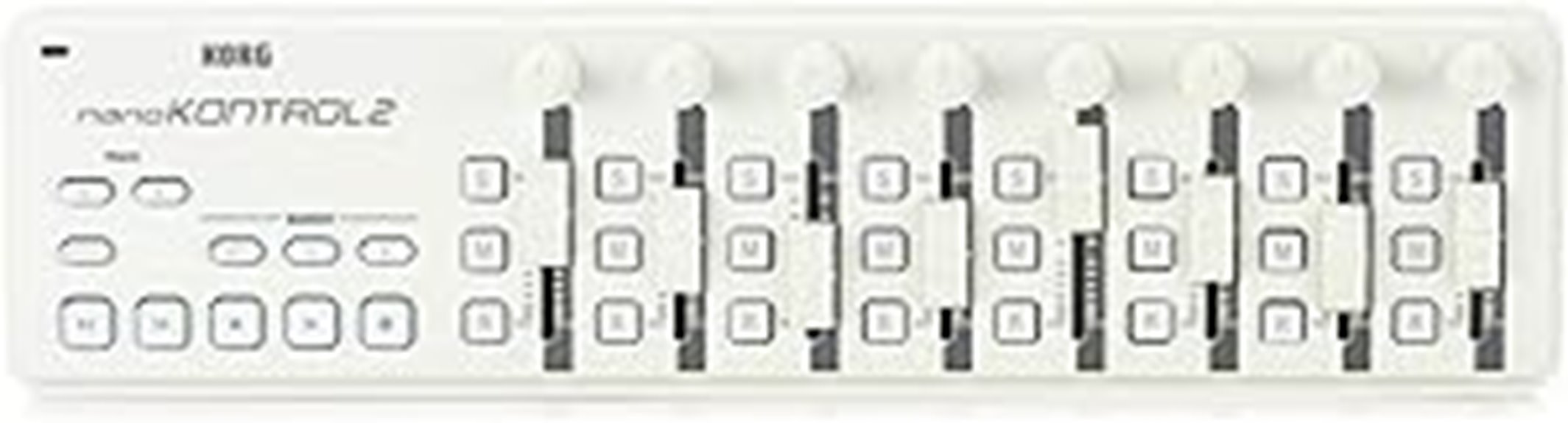
Creative musicians and portable producers seeking a sleek, lightweight MIDI controller will find the Korg nanoKEY2 (NANOKON2WH) an excellent choice. Weighing just 15.5 ounces, it’s highly portable with a compact design, making it perfect for on-the-go music creation. Its 25 velocity-sensitive keys, assignable knobs, and XY pad offer versatile control over software. Compatible with PC, Mac, iOS, and major DAWs like Ableton and Logic, setup is straightforward, though sometimes tricky on Mac. While its build quality is decent, some users note imprecise fader increments and confusing buttons. Overall, it’s a stylish, functional device suited for basic tasks and live triggers.
Best For: casual musicians, portable producers, and beginners seeking a sleek, lightweight MIDI controller for basic music creation and live triggering.
Pros:
- Compact, lightweight, and highly portable, ideal for on-the-go use
- Supports multiple platforms and major DAWs for versatile compatibility
- Responsive velocity-sensitive keys and assignable controls for creative expression
Cons:
- Imprecise fader increments limit detailed mixing and automation
- Confusing buttons and large jump distances on the jog wheel reduce usability
- Setup can be tricky, especially on Mac, requiring troubleshooting and driver adjustments
Behringer WING 48-Channel Digital Mixing Console
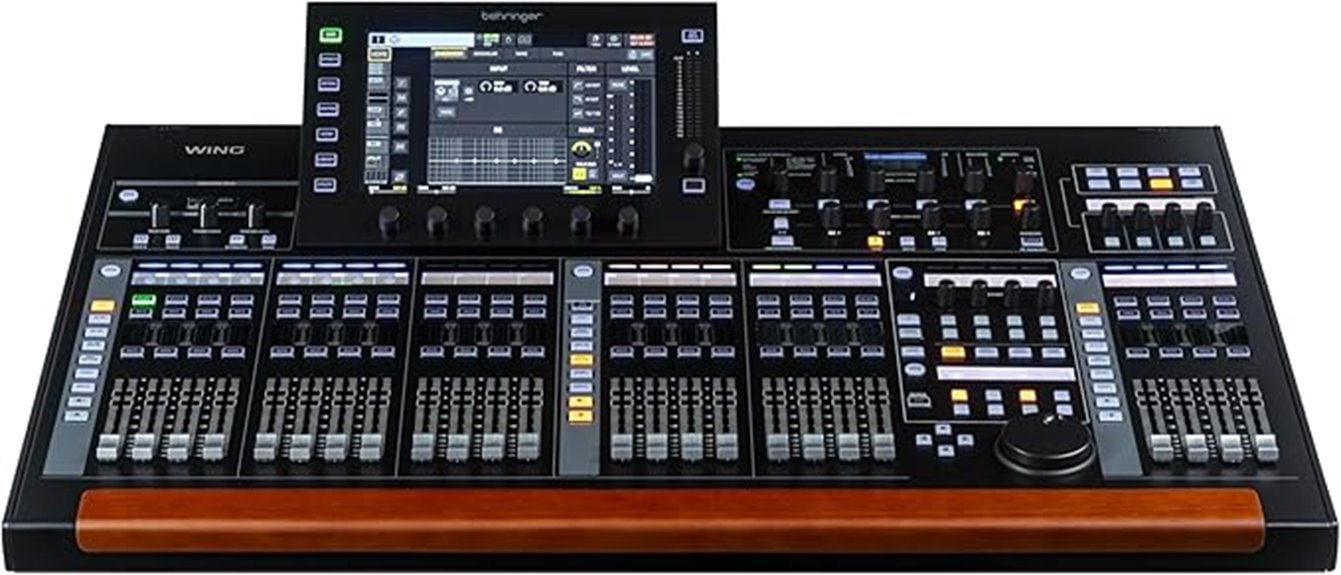
Designed for professional audio engineers and live sound professionals, the Behringer WING 48-Channel Digital Mixing Console offers an impressive combination of power and portability. Its 24-fader control surface, alloy steel construction, and flight case make it durable yet portable. Equipped with Midas PRO preamps, it delivers pristine audio quality with low noise and high dynamic range. The console supports extensive routing with 40 stereo inputs and 8 auxiliaries, plus advanced EQ controls. Its USB 2.0 interface guarantees seamless integration with DAWs for recording and playback. Weighing just over 71 pounds, it’s a versatile, high-performance choice for both live and studio environments.
Best For: professional audio engineers and live sound professionals seeking a durable, high-performance digital mixing console with extensive routing and pristine sound quality.
Pros:
- High-quality Midas PRO preamps deliver clear, detailed audio with low noise
- Extensive input and routing options with 40 stereo channels and 8 auxiliaries
- Durable alloy steel construction and portable design with flight case
Cons:
- Relatively heavy at over 71 pounds, which may impact portability for some users
- Higher price point compared to entry-level mixers, potentially limiting accessibility
- Large size may require significant space for setup in smaller venues or studios
Nektar Impact GX49 USB MIDI Controller Keyboard

If you’re looking for an affordable yet versatile MIDI controller, the Nektar Impact GX49 stands out with its 49 full-size synth-action keys, making it ideal for musicians and producers who need a portable keyboard with all-encompassing control features. It includes pitch bend and modulation wheels, octave and transpose buttons, plus a sustain pedal socket. Compatibility is broad—it works seamlessly with all MIDI software, most DAWs via Nektar DAW integration, and on Mac, PC, or iOS devices. Plus, it comes with Bigwig Studio’s 8-track DAW and sound content, enabling immediate music creation and making it a valuable, user-friendly addition to any setup.
Best For: musicians and producers seeking an affordable, portable MIDI controller with comprehensive control features compatible with all major DAWs and devices.
Pros:
- Offers 49 full-size synth-action keys suitable for versatile playing and programming
- Includes pitch bend and modulation wheels, octave and transpose buttons, and a sustain pedal socket for extensive control options
- Comes with Bigwig Studio’s 8-track DAW and sound content for immediate music creation
Cons:
- Limited to 49 keys, which may not be sufficient for advanced piano players requiring full-range keyboards
- May require additional setup or software configuration for optimal integration with some DAWs
- Lacks built-in sounds or onboard features, relying entirely on external software and DAWs
Elgato Stream Deck + Production Console for Content Creators
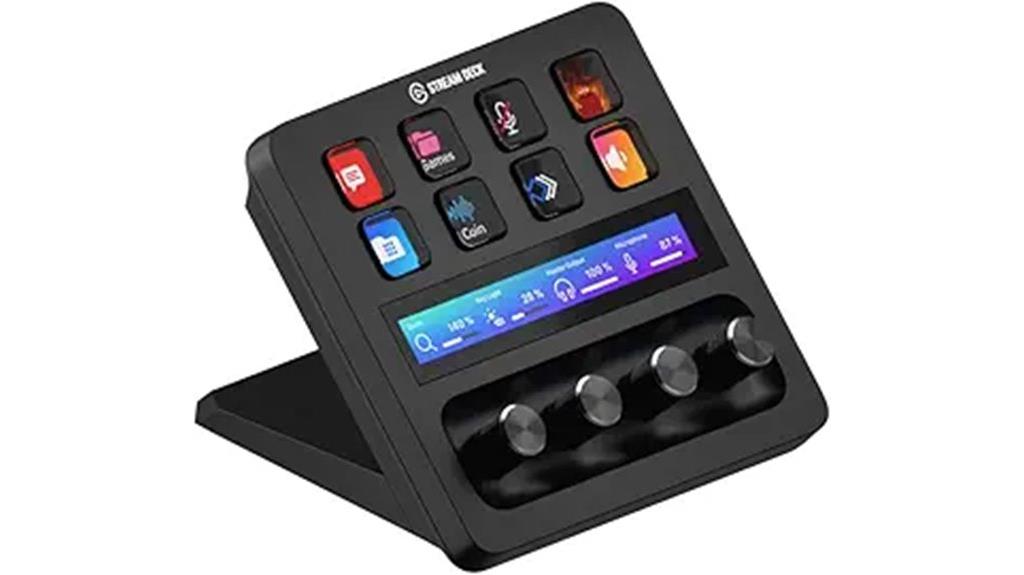
The Elgato Stream Deck + stands out as an ideal control surface for content creators who need quick, customizable, and tactile command over their streaming and production workflows. With 8 LCD keys, rotary encoders, a touch LCD panel, and touch strip dials, it offers versatile control. Its extensive software customization, including icons, plugins, and automation profiles, makes managing multiple tools seamless. The built-in audio mixer streamlines sound adjustments, while its solid build and responsive controls enhance user confidence. Compact yet powerful, it’s perfect for streamers, gamers, and creators wanting to optimize their workflows without taking up much space. Overall, it’s a versatile hub for professional content production.
Best For: content creators, streamers, and professional producers seeking a customizable, all-in-one control hub for streaming, gaming, and workflow automation.
Pros:
- Highly customizable with extensive software options including icons, plugins, and automation profiles
- Built-in audio mixer improves sound control and broadcast quality
- Solid, well-constructed design with tactile, responsive controls and a compact footprint
Cons:
- Software can occasionally glitch or crash, affecting workflow
- Plugin installation and updates may be slow or sometimes limited in flexibility
- Larger size compared to some other Stream Deck models may be less ideal for very tight setups
PreSonus ATOM MIDI Pad Controller with Software
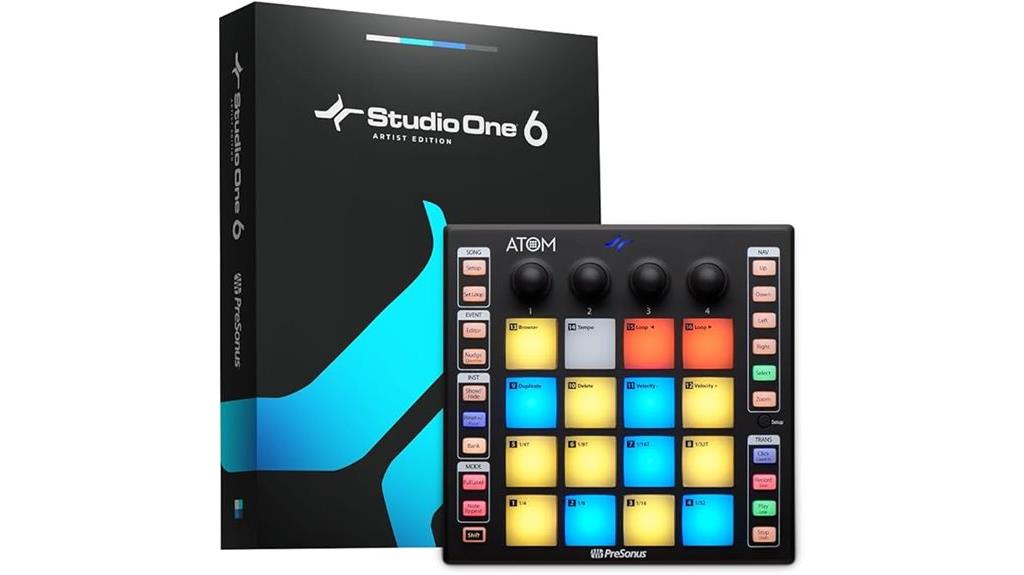
For musicians and producers seeking an intuitive, portable control surface, the PreSonus ATOM MIDI Pad Controller offers an ideal solution. Its 16 RGB pads are highly sensitive, allowing expressive play with polyphonic aftertouch and pressure sensitivity. With 20 assignable buttons, rotary encoders, and multiple pad banks, it provides extensive real-time control. Compact and bus-powered via USB, ATOM integrates seamlessly with software like Studio One and Ableton Live, reducing screen reliance. It also includes powerful software, such as Studio One 6 Artist and Ableton Live Lite, making it perfect for both studio and live setups. Weighing just a pound, it’s designed for portability and ease of use.
Best For: musicians and producers seeking a portable, expressive MIDI pad controller with integrated software for studio and live performance.
Pros:
- Highly sensitive, pressure- and velocity-sensitive RGB pads for expressive playing
- Seamless integration with popular DAWs like Studio One and Ableton Live
- Compact, lightweight, and bus-powered via USB for portability and ease of setup
Cons:
- Limited to 16 pads, which may be restrictive for complex performances
- Requires compatible software for full functionality, potentially limiting flexibility for some users
- May have a learning curve for beginners unfamiliar with MIDI controllers and software integration
XTUGA USB Audio Interface for PC
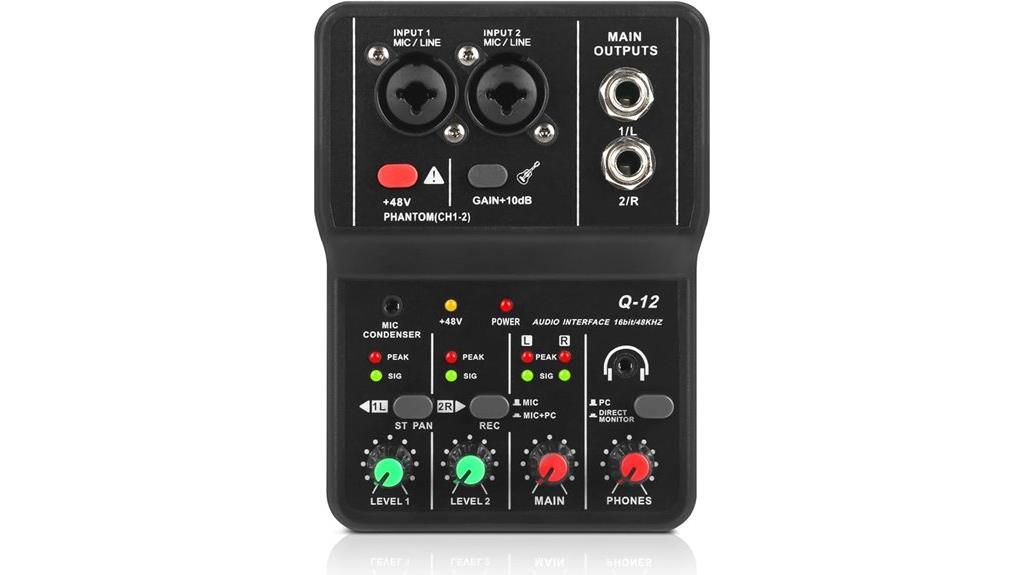
Designed with both beginners and professionals in mind, the XTUGA USB Audio Interface for PC offers high-quality, studio-grade sound in a compact form. It supports most PC recording software like Audacity, Ableton Live, FL Studio, and Pro Tools, making it versatile for any setup. The interface features independent volume controls, switchable stereo/mono outputs, and gain halo meters for precise adjustments. With a built-in XLR input supporting 48V phantom power and a 3.5mm mic jack, it handles vocals and instruments effortlessly. Delivering clear audio at 16-bit/48 kHz, it’s perfect for anyone seeking reliable, professional sound without sacrificing portability.
Best For: musicians, podcasters, and home recording enthusiasts seeking a portable, professional-quality audio interface compatible with popular PC recording software.
Pros:
- Supports high-quality 16-bit/48 kHz audio for clear, studio-grade recordings
- Features independent volume controls, switchable stereo/mono outputs, and gain halo meters for precise adjustments
- Compatible with major recording software like Audacity, Ableton Live, FL Studio, and Pro Tools
Cons:
- Limited to 16-bit/48 kHz audio resolution, which may not meet the needs of high-resolution audio professionals
- Compact size may restrict input/output options for more complex recording setups
- Customer ratings are average (4.0/5), indicating potential variability in user experiences
Factors to Consider When Choosing DAW Control Surfaces Compact
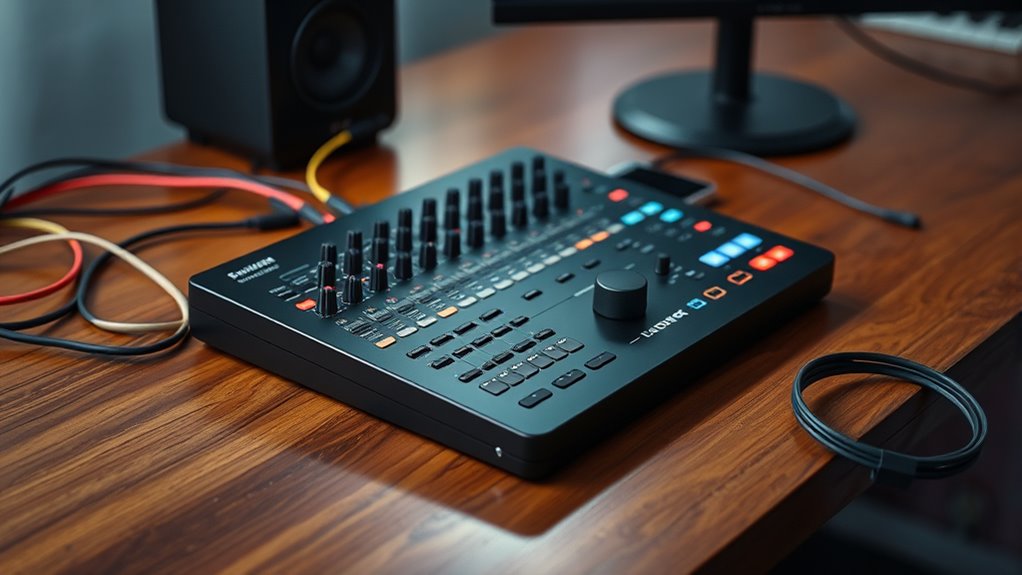
When choosing a compact DAW control surface, I focus on size and portability to fit my workspace. Compatibility with my software and hardware is essential, along with fader precision for accurate control. I also consider build quality and ease of software integration to guarantee long-term durability and seamless workflow.
Size and Portability
Choosing a DAW control surface that’s compact requires balancing portability with functionality. I look for devices under 15 inches wide, so they’re easy to carry and fit into limited spaces. Smaller surfaces are great for mobile setups or tight studios, but they often have fewer faders and controls, which can limit detailed mixing. Lightweight materials and streamlined designs make transport simple without sacrificing essential features. I also consider how the size affects ergonomic access—controls should be reachable and comfortable during long sessions. The goal is to find a device that’s portable enough to move around but still offers enough control for efficient workflow. Striking this balance helps ensure I can produce seamlessly, whether in a small studio or on the go.
Compatibility Compatibility Compatibility
Selecting a compact DAW control surface means ensuring it works smoothly with your preferred software. First, verify that the device supports your DAW, whether it’s Ableton Live, Logic Pro, or Pro Tools, for seamless integration. It should communicate via standard protocols like Mackie Control, HUI, or MIDI, ensuring full control surface functionality. If you work across multiple DAWs or software environments, check if the control surface can connect to more than one at once. Compatibility with your computer’s OS, such as Windows 10 or macOS, is vital for driver and firmware support. Finally, consider your hardware setup—make sure the control surface’s USB connection type (USB-C, USB 2.0/3.0) aligns with your available ports for proper connectivity.
Fader Precision
Fader precision plays a essential role in how accurately you can control your mix, especially during detailed editing and automation. Higher resolution, like 12-bit or 14-bit, allows for finer adjustments, giving you more control over volume levels. Motorized faders with high positional accuracy enable smooth, reliable automation, which is indispensable for precise mixing. The physical design also matters—longer, well-built faders provide better tactile feedback, helping you make subtle changes effortlessly. Inconsistent or jittery movement can hinder your workflow, so choosing hardware with reliable engineering is fundamental. Ultimately, consider your mixing needs and whether the fader’s resolution and responsiveness match your workflow, as low-precision faders can limit your ability to fine-tune parameters effectively.
Software Integration Ease
Seamless software integration is essential when selecting a compact DAW control surface because it guarantees smooth communication between your hardware and digital audio workstation. A control surface that supports industry-standard protocols like Mackie Control, HUI, and MIDI ensures broad compatibility, making setup easier and reducing frustration. Easy configuration within your DAW software cuts down on the learning curve and accelerates your workflow. Compatibility with multiple DAWs such as Ableton Live, Logic Pro, Cubase, and Pro Tools grants flexibility, allowing you to switch platforms without hassle. Features like customizable buttons, programmable functions, and dedicated control modes give you tailored control over your projects. Additionally, real-time feedback through displays, meters, and indicators enhances usability, helping you stay focused and efficient during music creation.
Build Quality Durability
When choosing a compact DAW control surface, build quality and durability are important factors that directly impact its long-term performance. I look for units made with sturdy materials like metal and reinforced plastics, which can handle frequent use without falling apart. Solid construction ensures that faders, knobs, and buttons stay responsive and accurate over time, preventing degradation. I also favor designs with sealed or protected controls, guarding against dust, spills, and wear that could impair functionality. Reinforced joints and a robust chassis are essential to withstand transport and heavy handling without warping or damage. Additionally, the quality of internal components, such as high-grade potentiometers and switches, plays a key role in guaranteeing longevity and consistent performance over years of use.
Customization Options
Customization options are essential because they allow you to tailor your control surface to match your specific workflow and preferences. Look for devices with programmable buttons, knobs, and faders so you can assign functions that suit your style. Check if the hardware supports user-defined labels or channel names—this makes orienteering and quick access much easier. Guarantee the control surface allows for customizable mappings of controls to specific DAW functions or plugins, giving you more flexibility. Software editors or profiles are also crucial, as they let you configure and save personalized setups effortlessly. Finally, consider if the device supports multiple user profiles or layers, enabling seamless switching between different workflows. These features help optimize your setup for maximum efficiency and creativity.
Additional Control Features
Beyond basic customization options, additional control features can substantially boost your workflow efficiency. Assignable knobs, buttons, and transport controls give quick access to essential functions, reducing the need to switch screens. Features like dedicated clip launching, scene controls, and parameter shortcuts make manipulating DAW elements more intuitive and hands-on. Multi-functional rotary encoders with push functions offer versatile control over effects, plugins, and mixing parameters, streamlining your process. Specialized controls such as jog wheels, fader banks, and OLED displays enhance precision and provide real-time visual feedback, keeping you fully engaged with your mix. Compatibility with protocols like Mackie Control, HUI, or MIDI ensures these extra features work seamlessly across different DAWs and software environments, making your workflow smoother and more efficient.
Budget and Value
Choosing a DAW control surface that offers the best value for your money requires careful consideration of both cost and features. I recommend evaluating whether the control surface provides essential functions like motorized faders, DAW compatibility, and customizable controls within your budget. It’s important to balance the price against build quality and durability, as cheaper models might have limited lifespan or performance issues down the line. Look for bundled software or extra resources that add value without considerably increasing the cost. Comparing the cost-effectiveness of features across different models helps ensure you get the best functionality for your investment. Ultimately, finding a control surface that fits your financial constraints while meeting your production needs will save you money and improve your workflow in the long run.
Frequently Asked Questions
How Compatible Are These Compact DAW Controllers With Various Software Platforms?
These compact DAW controllers are highly compatible with most popular software platforms like Ableton Live, Logic Pro, and FL Studio. I’ve found they usually work seamlessly out of the box, thanks to their universal MIDI and USB support. However, I recommend checking each controller’s specifications to guarantee compatibility with your specific software version. Overall, they’re versatile tools that integrate smoothly into most digital music production setups.
Do Motorized Faders Improve Workflow Efficiency Significantly?
Motorized faders are like having a trusty co-pilot guiding your mix, and yes, they can considerably boost workflow efficiency. They allow me to make real-time adjustments that stay consistent, making automation smoother and more precise. Instead of manually moving sliders, I can focus on creative decisions, saving time and reducing errors. Overall, they turn the control surface into a seamless extension of my mixing process.
What Is the Typical Latency When Using These Control Surfaces?
The typical latency when using compact DAW control surfaces ranges from about 1 to 10 milliseconds, depending on the device and setup. I’ve noticed that most quality surfaces offer latency low enough to feel almost seamless, especially with a good audio interface and optimized software. For critical recording or editing, I recommend checking the specific specs, but generally, modern control surfaces deliver very minimal delay, making workflow smooth and responsive.
Are These Devices Suitable for Live Performance Setups?
Sure, these compact control surfaces are surprisingly fit for live gigs—if you’re okay with a slightly fancy remote control. They’re portable, easy to set up, and give you tactile control, making live tweaks a breeze. Just remember, they’re not standalone instruments; you’ll still need your computer. So, if seamless control on stage sounds like your kind of chaos, these devices definitely hold their own in live performance setups.
How Do Power Requirements Impact Portability and Setup Ease?
Power requirements markedly influence portability and setup ease because devices needing external power sources or bulky batteries can be cumbersome. I look for control surfaces with low power consumption or USB-powered options, making setup quick and hassle-free. Compact, bus-powered devices are ideal for live or mobile use, as they reduce clutter and simplify connections. This way, I can focus more on creating music rather than managing cables or power supplies.
Conclusion
Choosing the right compact DAW control surface is like finding the perfect compass for your musical journey. It guides your creativity smoothly through every beat and melody, turning your ideas into reality with confidence. When you pick one that feels intuitive and reliable, you’re not just controlling your gear — you’re steering your passion forward. So, trust your instincts, and let your new control surface be the steady hand that brings your music to life.