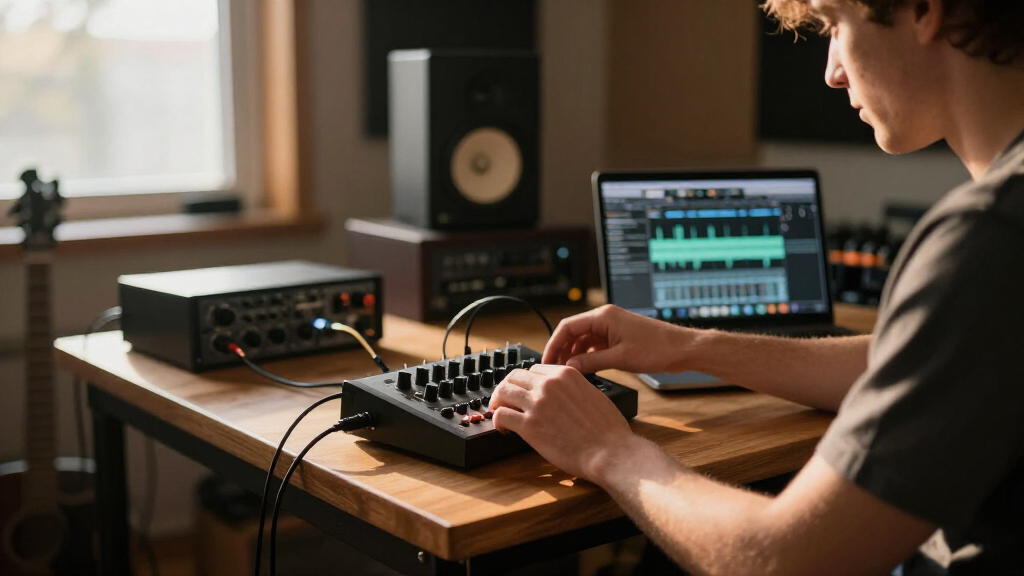

Choosing the right audio interface for music production is essential for capturing clear, professional sound. The best overall pick in 2026 is the Universal Audio Apollo Twin X Quad, thanks to its superior preamps and premium build quality. For those on a budget, the Focusrite Scarlett Solo 4th Gen offers reliable performance at an accessible price, while the MOTU M2 stands out for its impressive audio clarity and low latency. All options involve tradeoffs, like balancing price against features or portability versus expandability. Keep reading for a detailed breakdown that will help you find the best fit for your studio setup.

Get audio and creator gear delivered free with Prime
- Fast, free delivery on millions of items
- Prime Video, Amazon Music and more included
- Member-only deals all year
Complete the kit


Key Takeaways
- Top-tier models like the Universal Audio Apollo Twin X deliver studio-grade sound but come at a premium cost.
- Budget options such as the Focusrite Scarlett Solo provide solid performance for beginners without overwhelming complexity.
- Portability is a key factor with models like the Zoom U-24 and Synido A20, ideal for on-the-go recording.
- Multiple inputs and outputs are essential for versatile recording setups, especially for multi-instrument or band recordings.
- Build quality and driver stability vary significantly; investing in well-supported brands reduces troubleshooting.
| Focusrite Scarlett Solo 4th Gen USB-C Audio Interface Bundle with Studio Monitor Headphones, Pop Filter, and XLR Cable |  | Best Overall for Solo Musicians and Beginners | Dynamic Range: 120dB | Connectivity: USB-C | Included Software: Recording software and plugins | VIEW LATEST PRICE | See Our Full Breakdown |
| M-AUDIO M-Track Duo USB Audio Interface |  | Best Value for Budget-Conscious Creators | Audio Resolution: 48kHz | Inputs: 2 combo XLR/Line/Instrument | Outputs: 1/4″ headphone, stereo 1/4″ outputs | VIEW LATEST PRICE | See Our Full Breakdown |
| Kmise USB Audio Interface with 48V Phantom Power for Recording and Studio Quality Sound |  | Best for Mobile Recording and Versatile Microphone Use | Compatible Devices: Guitar, Laptop, Smartphone, Tablet | Connectivity Technology: USB | Number of Channels: 2 | VIEW LATEST PRICE | See Our Full Breakdown |
| Synido A20 Portable USB-C Audio Interface for Guitar & DJ Recording |  | Best for Live Streaming and Instrument Flexibility | Resolution: 24-bit/96kHz | Interface: USB-C | Compatibility: Electric Guitars, MIDI, Digital Pianos | VIEW LATEST PRICE | See Our Full Breakdown |
| Universal Audio Apollo Twin X QUAD Gen 2 Thunderbolt 3 Audio Interface |  | Best for Professional Studio-Grade Production | Supported Devices: PC, Mac | Supported Software: Pro Tools, Logic Pro, Ableton Live, Cubase | Connectivity Technology: Thunderbolt 3 | VIEW LATEST PRICE | See Our Full Breakdown |
| Zoom U-24 Handy Audio Interface, 2-Channel Portable USB Audio Interface, 2 XLR/TRS Combo Inputs, MIDI I/O, RCA Outputs |  | Best for Portability and On-the-Go Recording | Number of Channels: 2 | Supported Software: Pro Tools | First, Ableton Live 9 Lite | Connectivity Technology: USB | VIEW LATEST PRICE | See Our Full Breakdown |
| MOTU M2 USB-C Audio Interface |  | Best for High-Resolution Home Studio Use | Connectivity: USB-C | Compatibility: macOS, Windows, iOS | Preamps: 2 | VIEW LATEST PRICE | See Our Full Breakdown |
| Fender AudioBox GO USB Audio Interface for Guitarists, Vocalists, and Producers |  | Best for Mobile Musicians and Guitarists | Connectivity: USB-C | Audio Quality: 24-bit/96 kHz | Inputs: XLR with phantom power, TS instrument | VIEW LATEST PRICE | See Our Full Breakdown |
| Zoom AMS-24 USB Audio Interface for Musicians & Podcasters with 2 Inputs, 4 Outputs, Loopback, Direct Monitoring & Bus Power for PC, Mac, iOS & Android |  | Best for Streaming and Multi-Device Flexibility | Compatible Devices: PC, Mac, iOS, Android | Connectivity Technology: USB | Number of Channels: 2 | VIEW LATEST PRICE | See Our Full Breakdown |
| Audient iD14 MKII Audio Interface with 2 Class-A Microphone Preamps, USB-C, Monitor Mix & Panning, 2 Headphone Outputs, Black |  | Best for Professional Home Recording | Compatible Devices: PC, Mac, iOS | Supported Software: Cubase Le, Cubasis Le 2, Retrologue 2 | Connectivity Technology: USB-C | VIEW LATEST PRICE | See Our Full Breakdown |
| Focusrite Scarlett 2i2 4th Gen USB Audio Interface Bundle with 2 H&A 6′ XLR Cables |  | Best Overall for Versatile Home Studios | Generation: 4th | Inputs: 2 mic/line, 2 Hi-Z | Dynamic Range: 120dB | VIEW LATEST PRICE | See Our Full Breakdown |
| Focusrite Scarlett Solo 4th Gen USB-C Audio Interface |  | Best for Compact, High-Quality Solo Recording | Connectivity: USB-C | Dynamic Range: 120dB | Included Software: Pro Tools Intro+, Ableton Live Lite, Cubase LE, Hitmaker | VIEW LATEST PRICE | See Our Full Breakdown |
| Zoom AMS-22 USB Audio Interface for Recording & Streaming |  | Best for Content Creators and Streamers | Inputs: 1 XLR/TRS, 1 stereo 3.5mm | Outputs: 2 | Power: USB-C bus powered | VIEW LATEST PRICE | See Our Full Breakdown |
| Motu M2 2×2 USB-C Audio Interface with XLR-XLR Cable Bundle |  | Best for High-Fidelity Professional Monitoring | Supported Software: Ableton Live Lite, MOTU Performer Lite | Maximum Sample Rate: 192 KHz | Connectivity Technology: USB-C | VIEW LATEST PRICE | See Our Full Breakdown |
| Audio Interface, 2×2 24-bit/192kHz for PC/Mac/iOS with XLR/TRS Inputs |  | Best for Versatile Home and Mobile Recording | Resolution: 24-bit/192kHz | Inputs: 2 XLR/TRS combo jacks | Outputs: Headphone 3.5mm | VIEW LATEST PRICE | See Our Full Breakdown |
More Details on Our Top Picks
Focusrite Scarlett Solo 4th Gen USB-C Audio Interface Bundle with Studio Monitor Headphones, Pop Filter, and XLR Cable
The Focusrite Scarlett Solo 4th Gen stands out as the most versatile option for those starting out or working solo, thanks to its high-quality 120dB dynamic range and intuitive setup. Unlike the M-AUDIO M-Track Duo, which offers similar inputs but lacks the renowned Focusrite preamps’ clarity, the Solo emphasizes ease of use and reliability. However, its limited connectivity—only one instrument and one mic input—means it may fall short for multi-instrument sessions. This makes it ideal for solo singers, guitarists, or podcasters who prioritize straightforward operation over expandability. The included software bundle and Air mode boost its value for beginners focused on vocal and guitar recordings. The main tradeoff is its restricted input options, which could be a hurdle for more complex setups. Overall, this interface makes the most sense for newcomers or solo artists seeking quality without complexity.
Pros:- High-quality studio sound with 120dB dynamic range
- Includes comprehensive recording software and plugins
- Simple setup with Focusrite’s Easy Start tool
Cons:- Limited input options for multiple instruments or microphones
- Requires compatible computer and software setup
Best for: Beginners, solo musicians, and podcasters who need high-quality sound with minimal setup
Not ideal for: Producers or multi-instrument recording engineers requiring multiple inputs and advanced features
- Dynamic Range:120dB
- Connectivity:USB-C
- Included Software:Recording software and plugins
- Features:Air mode for vocals and guitars
Our verdict“This interface is best suited for solo artists and beginners prioritizing quality and simplicity.”
M-AUDIO M-Track Duo USB Audio Interface
The M-AUDIO M-Track Duo offers a practical balance of features at an affordable price, making it an appealing choice for newcomers or those recording on a budget. Compared to the Focusrite Solo, it provides two combo inputs—microphone, instrument, or line—giving greater flexibility in a single device. However, its 48kHz resolution is a step below the 120dB dynamic range of the Solo and the higher sampling rates of premium interfaces like the Universal Audio Apollo Twin X. This makes it suitable for casual recording, streaming, and podcasting, but less ideal for high-end music production. Its inclusion of software like MPC Beats adds value for beginners trying to create music right away. The main tradeoff is its lower resolution and basic feature set, which might limit future growth. Overall, the M-AUDIO M-Track Duo fits well for those needing decent quality without a hefty investment.
Pros:- Versatile combo XLR/Line/Instrument inputs
- High-quality crystal preamps for clear sound
- Includes production software like MPC Beats
Cons:- Limited to 48kHz audio resolution, not ideal for high-fidelity needs
- No built-in effects or advanced features
Best for: Beginner musicians, podcasters, and streamers looking for a cost-effective interface with versatile inputs
Not ideal for: Professional producers or multi-instrument recording setups requiring higher resolution and advanced features
- Audio Resolution:48kHz
- Inputs:2 combo XLR/Line/Instrument
- Outputs:1/4″ headphone, stereo 1/4″ outputs
- Software:Includes MPC Beats
Our verdict“This interface is a smart pick for entry-level users seeking reliable sound and flexible inputs on a budget.”
Kmise USB Audio Interface with 48V Phantom Power for Recording and Studio Quality Sound
The Kmise USB Audio Interface emphasizes high-resolution recording at 24-bit/192kHz, making it suitable for musicians and vocalists seeking studio-grade sound in a portable package. Its low-latency monitoring and plug-and-play setup across various devices—including smartphones and tablets—make it appealing for mobile recording scenarios. Compared to the Focusrite Solo, it offers comparable quality but with the added benefit of compatibility with iOS devices, broadening its usability. On the downside, its two-channel limit constrains multi-mic or multi-instrument setups, and it lacks features like onboard effects or extensive software. The 48V phantom power is a key advantage for condenser microphone users. This makes it ideal for solo artists, podcasters, or mobile producers who need high-quality sound on the go without complex setup.
Pros:- High-quality 24-bit/192kHz recording resolution
- Low-latency real-time monitoring
- Plug-and-play setup compatible with multiple devices
Cons:- Limited to 2 channels, restricting multi-mic recordings
- USB connection may not suit all mobile or standalone needs
Best for: Mobile musicians, vocalists, and podcasters needing portable, high-fidelity recording
Not ideal for: Multi-mic studio engineers or producers requiring multiple inputs and advanced processing
- Compatible Devices:Guitar, Laptop, Smartphone, Tablet
- Connectivity Technology:USB
- Number of Channels:2
- Maximum Sample Rate:48kHz
- Audio Input:USB
- Power:48V phantom power
Our verdict“This interface is perfect for mobile creators who prioritize high-resolution recording and portability.”
Synido A20 Portable USB-C Audio Interface for Guitar & DJ Recording
The Synido A20 excels as a portable, feature-rich interface tailored for guitarists, DJs, and streamers. Its 24-bit/96kHz resolution offers solid audio fidelity suitable for live streaming, practice, or quick recordings. Compared with the Kmise, which focuses on high sample rates, the Synido emphasizes adaptability with features like internal wire storage, monitor functions, and wireless switching, making it highly convenient for on-the-fly recording. Its compatibility with a broad range of instruments and the ability to charge while recording are notable benefits. However, its reliance on USB-C devices means it may not work with all older equipment, and its software support details are limited. This makes it an excellent choice for musicians or streamers needing a compact, versatile interface that supports multiple instruments and live performance features.
Pros:- High-fidelity 24-bit/96kHz audio quality
- Compact design with built-in wire storage
- Supports live streaming with charging while recording
Cons:- Requires compatible device with USB-C input
- Limited detailed info on software compatibility
Best for: Musicians, DJs, and streamers who need a portable interface with instrument versatility and live streaming features
Not ideal for: Pro studio engineers or multi-mic multi-track recorders needing higher resolution and advanced features
- Resolution:24-bit/96kHz
- Interface:USB-C
- Compatibility:Electric Guitars, MIDI, Digital Pianos
- Features:Loopback, Monitor, Wireless Switch
- Additional:Built-in Wire Storage
Our verdict“This interface suits mobile performers and streamers seeking flexibility and ease of use for live or on-the-go recording.”
Universal Audio Apollo Twin X QUAD Gen 2 Thunderbolt 3 Audio Interface
The Universal Audio Apollo Twin X QUAD Gen 2 sets a high bar for professional music production, combining exceptional audio conversion, dual Unison preamps, and real-time UAD plug-in processing. Its 32 channels and 192kHz support surpass most portable options like the Kmise or Focusrite Solo, providing extensive routing and recording flexibility. The inclusion of QUAD Core DSP allows real-time UAD plugin use, making it suitable for artists and engineers who need high-end sound shaping during recording. Compared with the Apollo Twin X Duo, the Quad version offers more processing power but at a higher cost and weight. Its Thunderbolt 3 requirement limits compatibility to newer computers, and its price is a barrier for beginners. This interface is best suited for professional studios or advanced home setups demanding top-tier sound and processing.
Pros:- Exceptional high-resolution audio conversion at 192kHz
- Dual Unison preamps for authentic analog tones
- Supports real-time UAD plug-ins for mixing and mastering
Cons:- Heavy at 4 pounds, less portable for mobile use
- Premium price point may be prohibitive for beginners
- Requires Thunderbolt 3 port, limiting older computer compatibility
Best for: Professional musicians, producers, and recording engineers with high-performance needs
Not ideal for: Budget-conscious hobbyists or users with older computers lacking Thunderbolt 3 ports
- Supported Devices:PC, Mac
- Supported Software:Pro Tools, Logic Pro, Ableton Live, Cubase
- Connectivity Technology:Thunderbolt 3
- Number of Channels:32
- Maximum Sample Rate:192kHz
- Operating System:Windows, macOS
Our verdict“This interface targets professionals seeking studio-quality sound and processing power in a dedicated setup.”
Zoom U-24 Handy Audio Interface, 2-Channel Portable USB Audio Interface, 2 XLR/TRS Combo Inputs, MIDI I/O, RCA Outputs
The Zoom U-24 stands out for offering high-resolution 24-bit/96 kHz recording in a compact, lightweight package, making it ideal for mobile musicians and podcasters. Compared with the Audient iD14 MKII, it sacrifices some high-end preamp quality for size and portability, but still delivers impressive sound clarity. Its two combo inputs and MIDI I/O support basic recording needs, though the absence of more channels limits larger setups. The need to purchase adapters for iPad use adds a small cost but maintains compatibility across devices. This interface is a strong choice for those prioritizing mobility over extensive I/O options, but less suited for multi-mic recording sessions or studio environments requiring more inputs.
Pros:- High-quality 24-bit/96 kHz audio resolution ensures clarity
- Compact, lightweight design for portability
- Includes software options like Pro Tools | First and Ableton Live Lite
Cons:- Requires separate purchase of adapters for iPad compatibility
- Limited to two inputs, restricting larger or multi-mic setups
Best for: Musicians, podcasters, or content creators needing a portable, high-quality interface for quick recordings on the go.
Not ideal for: Producers or studios requiring multiple inputs and more extensive connectivity for complex recording sessions.
- Number of Channels:2
- Supported Software:Pro Tools | First, Ableton Live 9 Lite
- Connectivity Technology:USB
- Maximum Sample Rate:96 KHz
- Item Weight:10.08 ounces
- Supported Operating Systems:macOS 10.9.5 to macOS 15, Windows 10/11
Our verdict“This is best suited for mobile users who need reliable, high-res audio in a small form factor.”
MOTU M2 USB-C Audio Interface
The MOTU M2 offers exceptional audio fidelity with 24-bit/192kHz support, making it an excellent choice for home studios seeking professional sound quality. Unlike the Zoom U-24, it emphasizes higher sample rates and more detailed audio, but with a similar 2-in/2-out configuration that limits expandability. Its compatibility with macOS, Windows, and iOS provides versatile connectivity, yet it lacks bundled software or advanced features like DSP effects, which might matter to some users. This interface makes sense for those focused on high-res recording and who don’t need multiple inputs, but it’s less suitable for multi-mic live recording or larger projects.
Pros:- Supports 24-bit/192kHz audio for detailed recordings
- Compatible across multiple operating systems including iOS
- Two high-quality Preamps for versatile recording
Cons:- Limited to 2 inputs and outputs, restricting multi-mic setups
- No bundled software or onboard effects included
Best for: Home studio owners or musicians needing high-resolution audio with versatile device compatibility.
Not ideal for: Producers requiring extensive I/O or onboard effects, or those working on large multi-mic projects.
- Connectivity:USB-C
- Compatibility:macOS, Windows, iOS
- Preamps:2
- Audio Quality:24-bit/192kHz
- Inputs/Outputs:2-in/2-out
Our verdict“Ideal for users prioritizing ultra-high-resolution audio in a flexible, multi-platform device, but not for larger recording rigs.”
Fender AudioBox GO USB Audio Interface for Guitarists, Vocalists, and Producers
The Fender AudioBox GO is designed for musicians who need a reliable, portable interface with guitar-centric features. Its combo XLR/¼-inch input with phantom power and dedicated instrument input make it perfect for guitarists and vocalists on the move. In comparison to the Zoom U-24, it offers a more streamlined setup tailored towards musicians focused on guitar and vocal recording, though it limits the number of inputs and outputs to two. The included Fender Amp & FX pack adds versatility for tone shaping, but the device’s reliance on Fender’s app and lack of built-in effects might be limiting for producers wanting more processing power. This makes it a solid choice for mobile guitarists, but less so for multi-instrument or complex studio setups.
Pros:- Compact, bus-powered design for portability
- High-quality 24-bit/96 kHz audio conversion
- Includes Fender Amp & FX pack for tonal versatility
Cons:- Limited to 2 inputs and outputs, restricting larger setups
- Requires Fender Studio app for full features and tone customization
Best for: Guitarists and vocalists seeking a portable, easy-to-use interface with tone-shaping features.
Not ideal for: Producers or multi-instrument players needing multiple inputs and advanced onboard effects.
- Connectivity:USB-C
- Audio Quality:24-bit/96 kHz
- Inputs:XLR with phantom power, TS instrument
- Outputs:2 balanced ¼-inch TRS
- Power:Bus-powered
Our verdict“Perfect for mobile guitarists and vocalists wanting a straightforward, high-quality recording solution with tone options.”
Zoom AMS-24 USB Audio Interface for Musicians & Podcasters with 2 Inputs, 4 Outputs, Loopback, Direct Monitoring & Bus Power for PC, Mac, iOS & Android
The Zoom AMS-24 is tailored for podcasters and streamers needing multiple outputs and flexible routing, with 2 inputs and 4 outputs, plus loopback for easy content sharing. Compared with the Audient iD14 MKII, it offers more outputs for monitoring and streaming, but at a lower maximum sample rate of 48 kHz, which might not satisfy those seeking high-resolution audio. Its support for PC, Mac, iOS, and Android enhances versatility, though the lack of a built-in microphone or headphone makes it less ideal for solo recording without additional gear. The bus-powered design simplifies setup, but the limited sample rate could be a drawback for music production focused on audio fidelity.
Pros:- Supports a wide range of devices including Android and iOS
- Multiple outputs for flexible monitoring and routing
- Loopback feature simplifies streaming workflows
Cons:- Limited to 48 kHz sample rate, not ideal for high-res music production
- No included microphone or headphones, requiring extra gear
Best for: Podcasters, streamers, and content creators who need multi-device compatibility and multiple outputs for live monitoring.
Not ideal for: Musicians or producers focused on high-resolution recording or multi-mic setups, due to its 48 kHz limit.
- Compatible Devices:PC, Mac, iOS, Android
- Connectivity Technology:USB
- Number of Channels:2
- Supported Software:Adobe Audition, Pro Tools, GarageBand, Twitch
- Maximum Sample Rate:48 KHz
- Item Weight:280 g
Our verdict“A strong choice for streamers and podcasters needing multi-device support and flexible routing, but less suited to high-fidelity music recording.”
Audient iD14 MKII Audio Interface with 2 Class-A Microphone Preamps, USB-C, Monitor Mix & Panning, 2 Headphone Outputs, Black
The Audient iD14 MKII excels in delivering pristine audio with its two Class-A microphone preamps, making it a top choice for serious home recordists. Its high-quality preamps are a step above the preamps in the MOTU M2, offering cleaner, more transparent sound. It also features comprehensive monitor controls, dual headphone outputs, and USB-C connectivity for straightforward setup. However, with only four channels, it doesn’t support larger multi-mic setups, which could be limiting for expanding projects. The absence of onboard effects or DSP means users will need external plugins for processing. This model makes the most sense for users prioritizing high-quality preamps and robust build quality over extensive channel count.
Pros:- Two high-quality Class-A microphone preamps for transparent sound
- Solid all-metal construction for durability and reliable performance
- USB-C connection simplifies setup and power
Cons:- Limited to 4 channels, which may restrict larger recording setups
- No onboard DSP or effects for real-time processing
Best for: Home musicians and producers demanding high-end preamps and professional-grade audio quality.
Not ideal for: Producers needing a large number of inputs or integrated effects for live multi-mic recordings or complex sessions.
- Compatible Devices:PC, Mac, iOS
- Supported Software:Cubase Le, Cubasis Le 2, Retrologue 2
- Connectivity Technology:USB-C
- Number of Channels:4
- Maximum Sample Rate:96 KHz
- Item Weight:907 g
Our verdict“This interface is an excellent pick for project studios focused on high-quality audio and durable design, but not for large multi-mic sessions.”
Focusrite Scarlett 2i2 4th Gen USB Audio Interface Bundle with 2 H&A 6′ XLR Cables
The Focusrite Scarlett 2i2 4th Gen stands out for its combination of high-quality preamps, flexible features, and user-friendly design, making it the ideal centerpiece for a home recording setup. Compared with the Motu M2, it offers similar clarity but adds intuitive features like Auto Gain and Clip Safe, which help beginners avoid common issues. However, its limitation to just two inputs makes it less suitable for multi-instrument recording or larger setups. The included headphone amp and loopback function enhance its versatility for streaming and content creation. Tradeoffs include its limited input count and dependence on USB connection, which could be a constraint for expanding workflows. This interface is most suited for solo artists, podcasters, and small project studios seeking reliable, high-quality sound without complexity.
Pros:- High-quality mic preamps with 69dB gain for clear recordings
- Studio-grade converters deliver detailed sound
- User-friendly features like Auto Gain and Clip Safe
Cons:- Limited to 2 inputs, restricting larger recording setups
- Requires USB connection; not a standalone device
Best for: Home musicians and podcasters needing reliable, easy-to-use audio quality for solo projects
Not ideal for: Producers or bands requiring multiple inputs for simultaneous recording
- Generation:4th
- Inputs:2 mic/line, 2 Hi-Z
- Dynamic Range:120dB
- Features:Air Mode, Auto Gain, Clip Safe, Loopback
Our verdict“This interface suits solo artists and streamers who prioritize sound quality and ease of use over input expandability.”
Focusrite Scarlett Solo 4th Gen USB-C Audio Interface
The Focusrite Scarlett Solo 4th Gen offers a streamlined, portable interface ideal for musicians who need high-fidelity sound in a tiny footprint. Compared with the Scarlett 2i2, the Solo sacrifices a second input but maintains excellent audio quality with a 120dB dynamic range and improved Air mode, which enhances vocal and guitar tones. Its compact size and included software make it perfect for on-the-go recording or minimal setups. The main tradeoff is its single input, which limits simultaneous multi-instrument recording or complex overdubs. Its USB-C connectivity ensures fast, reliable transfers, but it’s better suited for solo performers or students rather than full-band projects. This pick makes the most sense for mobile producers and beginners who want quality without bulk or complexity.
Pros:- High-quality 120dB dynamic range for clear sound
- Improved Air mode enhances tonal richness
- Includes industry-standard recording software
Cons:- Limited to a single input, restricting multi-instrument recording
- Requires USB-C port, which may need adapters for some devices
Best for: Solo musicians, students, and mobile producers seeking portable, studio-quality sound
Not ideal for: Bands or producers needing multiple inputs for complex recording sessions
- Connectivity:USB-C
- Dynamic Range:120dB
- Included Software:Pro Tools Intro+, Ableton Live Lite, Cubase LE, Hitmaker
- Features:Air mode
Our verdict“Ideal for solo artists or mobile users prioritizing portability and sound quality over multi-input flexibility.”
Zoom AMS-22 USB Audio Interface for Recording & Streaming
The Zoom AMS-22 caters to content creators who need a simple, portable solution for both recording and streaming. Its combination of a single XLR/TRS combo input and stereo 3.5mm input makes it perfect for podcasts, gaming, and live streaming, especially when quick setup and easy switching modes are priorities. Compared with the Focusrite Scarlett Solo, it offers a broader feature set tailored to streaming, like dedicated studio and streaming modes, but with fewer inputs and outputs overall. Its USB-C connection provides bus-powered operation, making it highly portable. The limitation lies in its basic feature set and input count, which won’t satisfy users with more complex audio needs. This device is best suited for casual streamers, podcasters, and on-the-go content creators.
Pros:- Compact design with USB-C power for portability
- Easy mode switching for streaming and studio use
- Real-time monitoring without extra software
Cons:- Limited to two inputs and outputs
- No external power supply option for more demanding setups
Best for: Podcasters, streamers, and content creators needing quick setup and portability
Not ideal for: Music producers or multi-instrument recording projects that demand multiple inputs and advanced features
- Inputs:1 XLR/TRS, 1 stereo 3.5mm
- Outputs:2
- Power:USB-C bus powered
- Modes:Studio and Streaming
Our verdict“A practical choice for casual content creators who prioritize ease of use and portability over extensive connectivity.”
Motu M2 2×2 USB-C Audio Interface with XLR-XLR Cable Bundle
The Motu M2 excels in offering pristine audio clarity through its ESS Sabre32 Ultra DAC, making it an excellent choice for those focused on detailed sound reproduction. Compared with the Focusrite Scarlett 2i2, the M2 supports higher sample rates up to 192 kHz and includes a full-color LCD with detailed level meters, which is invaluable for precise monitoring. Its low latency monitoring and bundled XLR-XLR cable enhance its appeal for professional recording environments. The main drawback is its 2-channel limit, which restricts multi-instrument or multi-mic setups. Additionally, it’s primarily compatible with Windows, which could limit Mac users or iOS device owners. This interface makes the most sense for home studio owners and professional musicians who value ultimate audio fidelity.
Pros:- ESS Sabre32 Ultra DAC delivers exceptional sound clarity
- Supports high sample rates up to 192 kHz for professional recordings
- Includes detailed full-color LCD level meters
Cons:- Limited to 2 channels, restricting multi-mic setups
- Primarily Windows-compatible, limiting Mac/iOS use
Best for: Professional musicians and home studio owners who demand ultra-high fidelity and detailed monitoring
Not ideal for: Multi-instrument recording environments or users on Mac/iOS platforms without Windows support
- Supported Software:Ableton Live Lite, MOTU Performer Lite
- Maximum Sample Rate:192 KHz
- Connectivity Technology:USB-C
- Item Weight:1.46 kg
Our verdict“Best suited for audio professionals and demanding home studios prioritizing top-tier sound quality and detailed monitoring.”
Audio Interface, 2×2 24-bit/192kHz for PC/Mac/iOS with XLR/TRS Inputs
The PIYONE 2×2 offers a straightforward, high-resolution recording experience suitable for home studios and mobile setups. Its 24-bit/192kHz resolution ensures studio-quality fidelity, comparable to the more expensive Focusrite Scarlett 2i2, but with a more flexible design for use across PC, Mac, and iOS devices. Its combo inputs with phantom power make it ideal for microphones and instruments alike. Zero-latency monitoring is a significant advantage for performers who need real-time feedback. However, the absence of an external power supply limits its potential for more demanding setups, and it’s not suited for multi-mic or multi-instrument recordings. The reliance on USB-C may require adapters for some devices. This device is perfect for home musicians and mobile creators who need reliable, high-quality sound with simplicity.
Pros:- High-resolution 24-bit/192kHz audio for professional sound
- Plug-and-play USB-C connectivity on multiple platforms
- Versatile combo inputs with phantom power
Cons:- Limited to 2 channels, not ideal for complex multi-mic recordings
- No external power supply, limiting use with power-hungry equipment
Best for: Home musicians, mobile creators, and small project studios needing flexible connectivity
Not ideal for: Multi-track recording or users requiring external power for high-demand setups
- Resolution:24-bit/192kHz
- Inputs:2 XLR/TRS combo jacks
- Outputs:Headphone 3.5mm
- Connectivity:USB C
- Phantom Power:48V
Our verdict“A solid choice for mobile and home users seeking high-fidelity, versatile recording with minimal fuss.”

How We Picked
The products in this roundup were selected based on a combination of performance, build quality, usability, and value. Priority was given to interfaces that offer clean, transparent sound with reliable drivers and low latency. We also considered versatility—how many inputs and outputs are available—and compatibility across different systems and recording environments. Devices that cater to both beginners and professionals were included, with a focus on those that provide a balance of features and affordability. The ranking reflects a mix of user feedback, technical specs, and overall versatility for music production in 2026.Factors to Consider When Choosing Audio Interfaces For Music Production
Choosing the right audio interface involves more than just looking at features; it’s about matching the device to your specific needs and workflow. Understanding key factors like input/output options, connectivity, and build quality can prevent costly mistakes. A well-chosen interface should provide clear sound, reliable operation, and room for growth. This guide highlights the most important considerations to keep in mind as you decide which model is right for you.Number and Type of Inputs and Outputs
Consider how many instruments, microphones, or line-level sources you plan to record simultaneously. Interfaces with multiple inputs provide flexibility for complex sessions, but they also tend to cost more and take up more space. If you mainly record vocals and a guitar, a 2-in, 2-out model might suffice. For larger setups, look for interfaces with multiple XLR and TRS inputs, as well as digital options like ADAT or SPDIF, to expand your system later without replacing your core device.
Connectivity and Compatibility
Most modern interfaces connect via USB, Thunderbolt, or USB-C. Your choice depends on your computer’s ports and the need for low-latency performance. Thunderbolt interfaces, like the Universal Audio Apollo Twin X, generally offer lower latency and higher stability but are more expensive and require compatible hardware. USB-C interfaces tend to be more versatile and widely supported, making them a smart choice for most users. Compatibility with your DAW and operating system is also critical to avoid driver issues or setup headaches.
Preamp Quality and Audio Clarity
The preamps in an audio interface directly affect your recorded sound’s warmth and clarity. Higher-quality preamps, such as those in the Universal Audio or Audient models, provide cleaner, more transparent amplification, especially important for professional recordings. Cheaper interfaces may introduce noise or distortion, which can be difficult to fix later. For critical recording work, investing in an interface with high-end preamps often pays off in the final sound quality.
Build Quality and Portability
If you plan to record on the go, portability and durability become more important. Compact interfaces like the Synido A20 or Zoom U-24 are designed for mobility without sacrificing too much on features. Conversely, desktop units with more robust construction and multiple ports are better suited for stationary studios. Consider your environment and how often you’ll need to transport the device, balancing ruggedness against size and weight.
Additional Features and Future-Proofing
Features like direct monitoring, MIDI I/O, and compatibility with mobile devices add flexibility. Some interfaces, such as the Zoom AMS-24, support multiple platforms and include loopback functions for streaming. Think about your future needs—will you expand your setup, record instruments, or incorporate MIDI hardware? Investing in an interface with extra features might cost more initially but can save money and hassle later as your studio evolves.
Frequently Asked Questions
Do I need a professional-grade audio interface for beginner recording?
Not necessarily. Beginners can start with more affordable models that still offer good sound quality and reliability, such as the Focusrite Scarlett Solo or MOTU M2. These devices provide sufficient clarity for learning, practicing, and small projects. Upgrading to higher-end models becomes more relevant once your skills improve or you require more inputs or advanced features for professional work. For most starting musicians, a mid-range interface balances performance and cost effectively.
Is Thunderbolt better than USB for music production?
Thunderbolt interfaces typically offer lower latency and higher bandwidth, which can be beneficial for professional recording or real-time processing. However, they tend to be more expensive and less compatible with older computers or certain systems. USB interfaces are more common, generally more affordable, and compatible across a wide range of devices. For most music producers, a high-quality USB-C or USB 3.0 interface provides excellent performance without the added cost of Thunderbolt, unless ultra-low latency is a critical need.
How many inputs should I look for if I record multiple instruments?
The number of inputs depends on your setup. If you record solo vocals or guitar, a 2-in interface may suffice. However, if you’re recording bands, multiple instruments, or want flexibility for future expansion, look for models with 4 or more inputs, including XLR and TRS options. Some interfaces also offer digital expansion via ADAT or SPDIF, allowing additional inputs without replacing your core device. Planning for a few extra inputs ensures your system grows with your needs.
Are built-in preamps in budget interfaces good enough for professional work?
While budget interfaces often include decent preamps suitable for home recording or practice, they may lack the transparency and low noise levels required for professional-grade recordings. Higher-end preamps, like those in the Universal Audio or Audient models, deliver cleaner sound with richer detail. If your goal is commercial-quality recordings, investing in an interface with premium preamps can make a noticeable difference. For hobbyist or beginner projects, budget preamps typically suffice.
Should I prioritize portability or expandability when choosing an interface?
This depends on your recording environment. If you often record outside a fixed studio setup, portability and durability become more important. Compact, bus-powered interfaces like the Synido A20 or Zoom U-24 excel here. Conversely, if your studio is stationary and you plan to expand with additional gear or multiple instruments, a larger interface with more I/O options and build robustness makes sense. Consider your workflow and future plans to strike the right balance between portability and expandability.