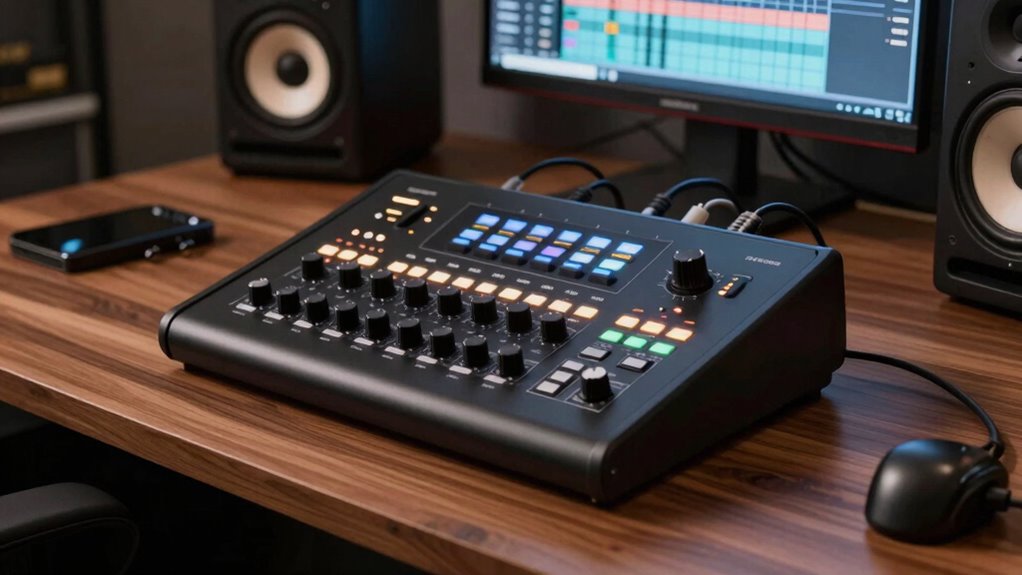

Studio monitor controllers still deserve your attention because they give you seamless control over multiple audio sources and outputs, streamlining your workflow. They help you switch between speakers effortlessly and keep your monitoring accurate, which is vital for professional mixes. With ergonomic designs, intuitive layouts, and durable build quality, these controllers enhance comfort and efficiency during long sessions. If you want to improve your studio setup and get consistent results, there’s more to discover that can truly elevate your production.

Get audio and creator gear delivered free with Prime
- Fast, free delivery on millions of items
- Prime Video, Amazon Music and more included
- Member-only deals all year
Key Takeaways
- They enable quick, seamless switching between multiple audio sources and monitor outputs, enhancing workflow efficiency.
- Ergonomic controls improve comfort and reduce fatigue during long mixing sessions.
- Built-in features like level matching and talkback streamline professional studio operations.
- They ensure consistent, accurate monitoring crucial for high-quality mixing and production.
- Their durable, intuitive design maintains long-term value in evolving digital recording environments.
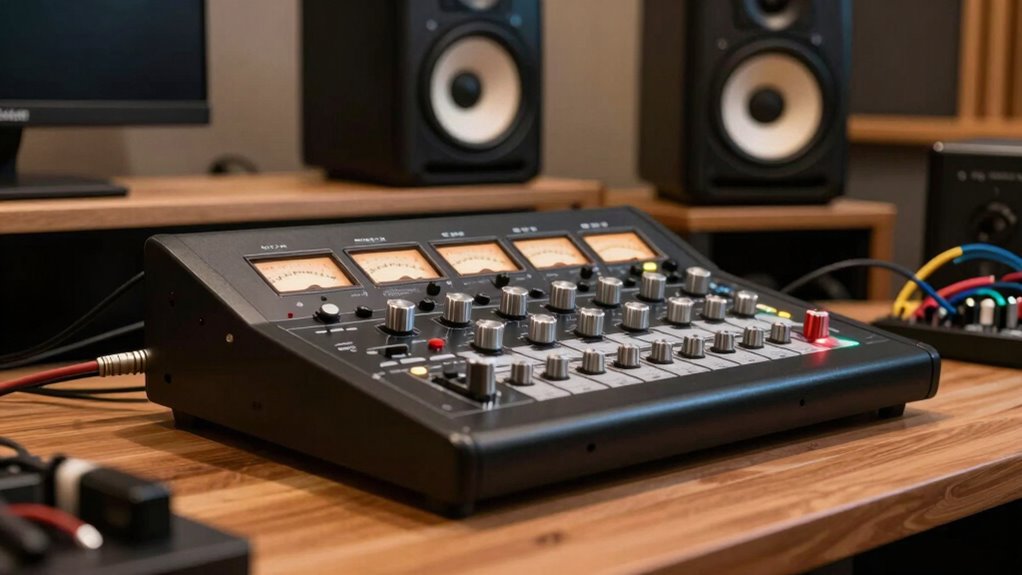
Despite the rise of digital audio workstations and advanced monitoring techniques, studio monitor controllers remain an indispensable tool in any professional or home studio. They serve as a central hub, giving you seamless control over multiple audio sources and monitor outputs. This setup allows you to switch effortlessly between different speakers or audio inputs without disrupting your workflow. The creative integration they offer is unmatched, enabling you to blend various audio sources—whether it’s a microphone, instrument, or external device—into a unified monitoring system. This flexibility guarantees your creative process stays smooth and uninterrupted, helping you to focus on making music rather than troubleshooting technical issues.
One of the key advantages of using a studio monitor controller is its ergonomic design, which is often overlooked but critically important. A well-designed controller puts all your controls within easy reach, reducing strain during long mixing sessions. You won’t need to fumble with multiple knobs or switches scattered across your setup. Instead, you get a logical, intuitive layout that minimizes clutter and maximizes efficiency. This ergonomic focus helps prevent fatigue and allows you to maintain high levels of concentration, ensuring your mixes are as precise as possible. Plus, many controllers are built with sturdy, high-quality materials that withstand rigorous daily use, further enhancing their long-term value. Additionally, ergonomic design can significantly improve your overall workflow by making it easier to access controls quickly and comfortably. The professional audio environment benefits greatly from the flexibility and control offered by monitor controllers. Creative professionals appreciate how monitor controllers facilitate better integration with various studio gear. You can connect multiple sources—such as DAWs, external hardware, or media players—and switch between them with ease. This integration streamlines your workflow, saving you time and reducing the risk of errors when adjusting settings. Moreover, some controllers include features like automatic level matching, which help maintain consistent audio quality across different sources. Additionally, some controllers feature built-in features like talkback microphones, dimming functions, and level calibration, which refine your listening environment and elevate your mixing accuracy. These tools are invaluable for achieving professional-quality results, especially when your creative process demands precision.
Furthermore, the ergonomic design of many monitor controllers isn’t just about comfort; it’s about optimizing your entire monitoring experience. Clear labeling, tactile controls, and thoughtfully arranged features allow you to make quick adjustments without disrupting your creative flow. Whether you’re fine-tuning the volume, switching between speakers, or controlling multiple sources, these controllers put everything at your fingertips. As a result, your studio setup becomes more intuitive, letting you focus on the music instead of wrestling with complicated equipment. An ergonomic interface can also help you maintain consistency in your mixes by reducing unnecessary movement and distractions. In addition to promoting comfort, ergonomic considerations can enhance the precision and efficiency of your workflow. In the end, the combination of creative integration and ergonomic design ensures that studio monitor controllers remain a crucial component for achieving professional-sounding mixes and enhancing your overall production process.
Popular right now

Vitamix Propel Series 750 Professional-Grade Blender, 4 Programs, Black

Breville BES870BTR Barista Express Espresso Machine, Black Truffle

KitchenAid 5.5-Qt Bowl-Lift Stand Mixer, Porcelain White (KSM55SXXX)
As an affiliate, we earn on qualifying purchases.
Frequently Asked Questions
How Do Monitor Controllers Differ From Simple Speaker Switches?
Monitor controllers differ from simple speaker switches by offering precise control over speaker impedance and volume calibration. You can adjust volume smoothly, ensuring consistent listening levels, and match impedance for ideal sound quality. Unlike basic switches, they maintain audio integrity, prevent damage, and allow seamless switching between multiple speakers. This makes monitor controllers essential for accurate, professional audio monitoring, giving you better control and a more reliable listening experience.
Can You Connect Multiple Audio Sources Simultaneously?
Yes, you can connect multiple audio sources simultaneously with a monitor controller. This setup enables seamless multi-source integration, allowing you to switch effortlessly between inputs. The secret lies in advanced signal routing, which keeps your workspace organized and efficient. Imagine the creative possibilities when you have instant access to all your gear at your fingertips, without the hassle of unplugging and reconnecting. It’s a game-changer for any serious studio.
Are Monitor Controllers Compatible With Digital Audio Formats?
Yes, many monitor controllers are compatible with digital audio formats. They often feature digital inputs like USB, AES, or S/PDIF, allowing you to seamlessly integrate digital sources. This compatibility guarantees smooth digital integration, making it easier to switch between analog and digital audio without hassle. By choosing a monitor controller with digital compatibility, you get versatile control over your entire setup, whether you’re working with analog or digital audio sources.
What Are the Key Features to Consider When Choosing One?
When choosing a monitor controller, you need to think about features that elevate your listening experience. Think about how it handles room acoustics—can it adapt to your space? Don’t overlook headphone integration, which offers silent, precise monitoring. The right controller balances these elements, creating an environment where your mixes truly come alive. This choice could transform your studio, making every detail clearer and more impactful than ever before.
Do Monitor Controllers Improve Audio Accuracy and Translation?
Yes, monitor controllers can improve audio accuracy and translation by helping you manage room acoustics and headphone integration effectively. They allow precise control over speaker and headphone output, reducing room-based distortions. By maintaining consistent volume and stereo balance, you hear your mix more accurately, regardless of acoustic challenges. This guarantees your sound translates well across different playback systems, making monitor controllers essential tools for achieving professional-level audio fidelity.
Conclusion
Don’t overlook studio monitor controllers—they’re the secret weapon every serious producer needs. Without them, your studio’s like a spaceship without a navigation system—lost in the vast cosmos of sound. They might seem small, but they hold the power to transform your mixes from good to mind-blowingly perfect. So, if you want your sound to slice through the noise like a laser beam, these controllers are your ultimate game-changer. Trust me, they’re worth their weight in gold!