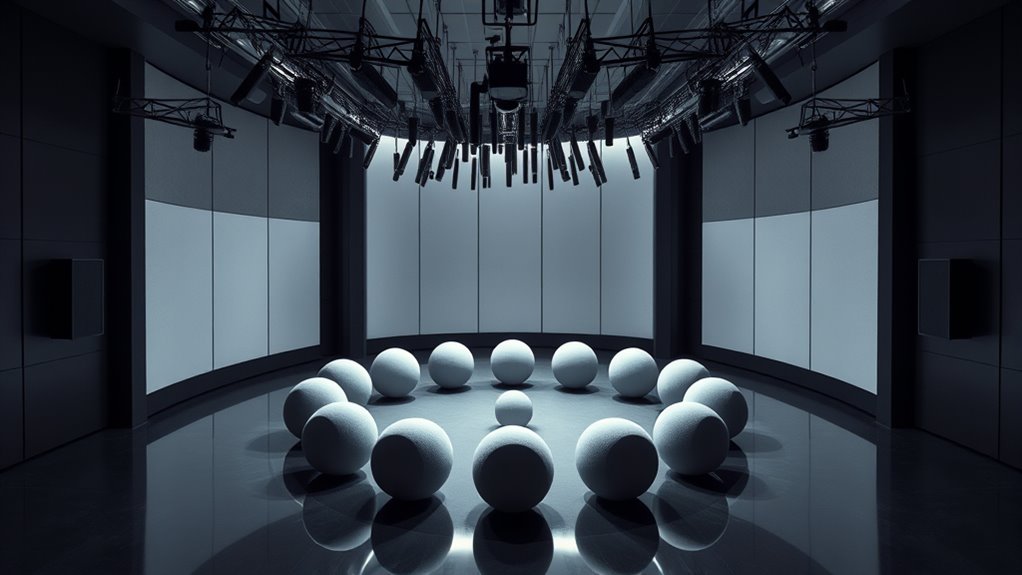

Binaural and ambisonic techniques create immersive mixes by capturing and reproducing spatial cues that your brain interprets as a three-dimensional environment. Binaural recording uses dummy heads or processing to simulate how ears receive sound, while ambisonics records the entire surrounding sound field for flexible playback. Proper calibration of headphones guarantees these cues are perceived accurately, making your mixes more lifelike. Exploring these techniques further will reveal how they can elevate your spatial audio projects.
Key Takeaways
- Binaural recording simulates how ears perceive sound, creating realistic spatial cues through dummy heads or processing.
- Ambisonics captures the entire 3D sound field for flexible, immersive playback across formats.
- Proper headphone calibration preserves subtle spatial cues, essential for accurate directionality and distance perception.
- Encoding formats like Ambisonics and binaural utilize multi-channel information to position sounds in 3D space.
- Combining calibrated playback with advanced techniques enhances the realism and immersion of spatial audio mixes.
Have you ever wondered how sound engineers create immersive audio experiences that make you feel like you’re right there in the scene? It all comes down to mastering techniques like binaural and ambisonic recording, which rely heavily on the way sound interacts with your ears and brain. To truly appreciate these methods, you need to understand how headphone calibration and spatial audio formats play pivotal roles in delivering a convincing three-dimensional soundscape. When you’re using headphones, calibration ensures that the audio is tailored to your specific hearing profile, compensating for any frequency response differences. This process fine-tunes the audio signals so that sounds appear more natural and accurately positioned, enhancing the overall immersion. Without proper calibration, even the most sophisticated spatial audio formats can fall flat, as your ears might misinterpret the spatial cues meant to create a realistic environment.
Spatial audio formats are central to delivering these immersive experiences. They encode sound information in a way that preserves the spatial relationships between sources, allowing you to perceive directionality and distance accurately. Formats like Dolby Atmos, Ambisonics, and binaural audio encode multi-channel information, which is then decoded by compatible headphones or speakers to produce a convincing sense of space. Binaural techniques, in particular, simulate how sound waves reach your ears in real life by capturing audio with a dummy head or using specialized processing. When these recordings are played back through headphones calibrated for your ears, the result is a highly convincing three-dimensional sound environment. Ambisonic recordings, on the other hand, capture the entire sound field surrounding the microphone, allowing for flexible playback and precise spatial positioning. Proper calibration of headphones is essential to ensure that these complex spatial cues are interpreted accurately by your brain, preserving the intended immersive effect.
Your choice of headphone and its calibration directly impacts how well these spatial cues translate into your perception. Properly calibrated headphones ensure that the subtle differences in timing, amplitude, and phase—key elements in binaural and ambisonic sound—are preserved accurately. This means that when a sound source moves or changes in distance, your ears perceive it naturally, just as you would in real life. Without calibration, spatial audio formats can sound distorted or less convincing, breaking the sense of immersion. That’s why professional producers and sound designers often spend time calibrating their headphones and mastering the intricacies of spatial audio formats, so you, as the listener, can experience a seamless, lifelike environment that transports you right into the heart of the scene.
Frequently Asked Questions
How Do Binaural and Ambisonic Techniques Differ in Spatial Accuracy?
Binaural and ambisonic techniques differ in spatial accuracy primarily through spatial resolution. Binaural audio relies on head-related transfer functions, giving you a highly realistic sense of direction, but accuracy variability can occur with different head shapes or playback devices. Ambisonics provide a more consistent spatial resolution across various listening environments by capturing sound in a spherical format, offering precise and adaptable spatial accuracy suitable for diverse setups.
What Equipment Is Essential for Creating Binaural or Ambisonic Mixes?
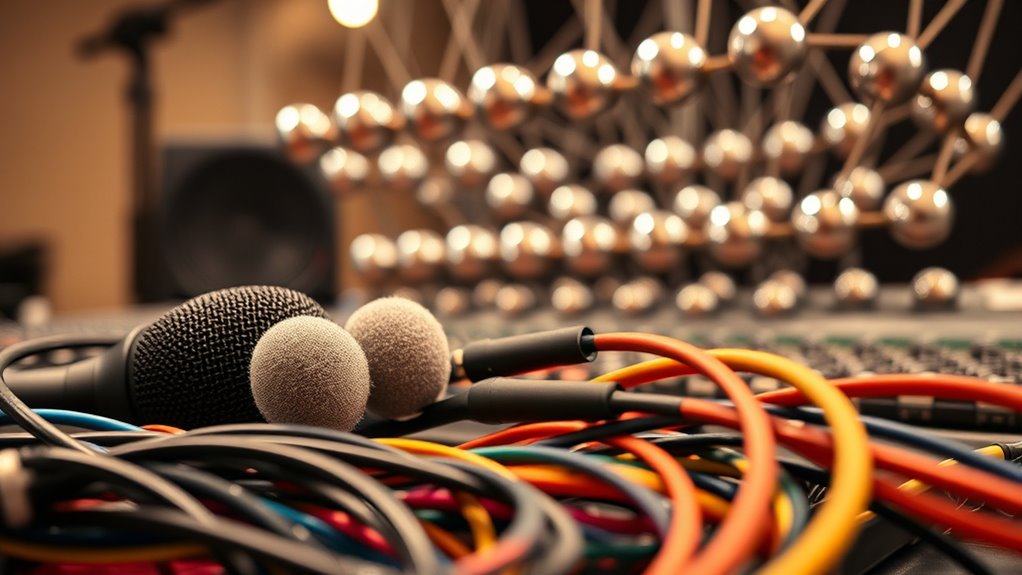
You need a good recording microphone, ideally a dummy head with microphones for binaural mixes, or multiple capsules for ambisonic captures. Headphone calibration is essential to guarantee accurate spatial perception during mixing. For binaural, use high-quality headphones to monitor your mix. For ambisonic, consider a compatible ambisonic microphone and a decoder to translate recordings into immersive sound. These tools help you create precise, immersive audio experiences.
Can These Techniques Be Used for Live Sound Reinforcement?
Can you use binaural and ambisonic techniques for live sound reinforcement? Absolutely, but it’s like trying to fit a square peg into a round hole. These methods face live sound challenges, such as acoustics and speaker placement, which affect audience perception. While they excel in studio environments, adapting them for live use requires specialized equipment and careful planning to truly immerse your audience in the moment.
How Do Listener Head Movements Influence the Immersive Experience?
Your head movement directly impacts your immersive experience by altering your spatial perception. When you move your head, it changes how sound sources are perceived, making the environment feel more real and dynamic. This natural interaction allows you to better localize sounds and enjoy a more engaging, three-dimensional experience. As you shift your head, the audio adapts, enhancing immersion and making you feel like you’re truly inside the soundscape.
Are Binaural and Ambisonic Methods Compatible With Standard Stereo Playback?
Did you know that over 40% of listeners prefer headphone listening for immersive audio? Binaural and ambisonic methods aren’t fully compatible with standard stereo playback, but you can adapt them for surround sound integration. When you use headphones, these techniques create a realistic 3D experience, though they may lose some spatial details on stereo systems. To get the best immersive experience, consider using dedicated equipment or recordings optimized for your playback method.
Conclusion
By exploring binaural and ambisonic techniques, you unveil new depths of immersive audio. Did you know that 75% of listeners report feeling more engaged with 3D sound experiences? Incorporating these methods into your mixes can transform how audiences connect with your music or projects. So, don’t hesitate to experiment—your sounds will come alive in ways you never imagined, drawing listeners into a truly mesmerizing auditory world.