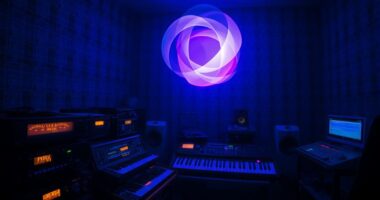

“Fractal Dance” immerses you in a mesmerizing soundscape that mirrors the endless complexity of fractals. It combines evolving melodies and rhythmic patterns inspired by natural self-similarity, creating a microcosmic universe through advanced sound design and harmonic techniques. As you experience its layered textures and intricate structures, you’ll notice how it balances chaos and order. If you explore further, you’ll uncover the clever methods behind its hypnotic, fractal-inspired composition.
Key Takeaways
- “Fractal Dance” employs layered motifs and algorithmic rhythms to evoke self-similar, infinite complexity akin to natural fractals.
- The composition integrates granular synthesis and organic samples, creating evolving textures that mirror a microcosmic universe.
- Harmonic coherence is maintained through music theory, ensuring intricate patterns remain musically engaging and balanced.
- Sound design techniques like filter sweeps, reverb, and modulation replicate recursive zoom-ins into fractal details.
- The track offers an immersive soundscape that invites exploration of self-similarity and infinite complexity at multiple scales.

Have you ever wondered what it would sound like if music mirrored the infinite complexity of fractals? “Fractal Dance” immerses listeners in a hypnotic blend of rhythmic patterns and evolving melodies that echo the self-similar structures found in nature. To craft this sonic journey, you need a deep understanding of music theory, especially how rhythmic cycles and melodic motifs can be layered to create a sense of endless variation. You might start with a simple motif that repeats at different scales, gradually altering pitch, tempo, and harmony while maintaining a recognizable core. This approach mirrors the mathematical principles of fractals, where the same pattern appears at different levels of magnification, creating an intricate, mesmerizing effect.
Sound design becomes your primary tool in translating these mathematical ideas into auditory experiences. You experiment with granular synthesis, manipulating small sound particles to produce textures that evolve unpredictably, much like the branching patterns of a fractal. By blending synthesized sounds with natural samples, you evoke organic complexity, ensuring each listening experience feels fresh. The challenge lies in balancing stability and variation—using reverb, delay, and modulation effects to morph sounds seamlessly, so they seem to grow and branch endlessly. You might employ filter sweeps to mimic the recursive zooming into fractal details, giving the listener a sense of diving deeper into a microcosmic universe.
Harness granular synthesis and natural samples to create evolving, self-similar textures that mirror fractal complexity.
In “Fractal Dance,” sound design also involves creating layered, polyrhythmic structures that interlock like the self-similar patterns in fractals. You could utilize algorithmic composition techniques, setting parameters that generate evolving rhythmic cycles without manual intervention. This method ensures the music retains a natural organic flow, despite its complex, computational origins. Additionally, understanding music theory is essential for harmonically anchoring these intricate patterns, preventing chaos and maintaining coherence amid complexity. The goal is to produce a soundscape where each element reflects the fractal idea—repeating patterns at different scales, constantly shifting but intrinsically connected. Your mastery of music theory helps you anchor these patterns harmonically, avoiding chaos and ensuring coherence amid complexity.
Ultimately, designing “Fractal Dance” demands precise control over sound and structure, blending technical knowledge with creative intuition. You aim to produce a piece that not only sounds beautiful but also embodies the infinite intricacy of fractals—an auditory microcosm where every detail unfolds into new layers, inviting listeners to explore the self-similar universe encoded within sound.
Frequently Asked Questions
How Was the Track “Fractal Dance” Created?
You create “Fractal Dance” by blending visual symbolism with innovative compositional techniques. You start by translating fractal patterns into sound, using layered loops and intricate rhythms. You incorporate shifting textures, mirroring the endless complexity of fractals, while employing techniques like granular synthesis and dynamic modulation. This approach captures the microcosmic universe in sound, inviting listeners to experience a mesmerizing dance of patterns that reflect the beauty of fractals through your musical vision.
What Inspired the Fractal Theme in the Music?
You’re inspired by visual symbolism and mathematical concepts like fractals, which reveal infinite complexity within simple patterns. As you compose “Fractal Dance,” you aim to evoke the microcosmic universe by reflecting the recursive beauty of fractals. The mathematical inspiration guides your sound design, creating layers that mirror the self-similar structures seen in nature and art. This connection helps you craft a track that feels both intricate and endlessly evolving.
Which Instruments or Sounds Are Prominent in the Track?
In “Fractal Dance,” you’ll notice ambient textures and synthetic sounds that define its immersive atmosphere. The track prominently features layered synths, creating a sense of depth and complexity, while subtle electronic pulses add rhythm. These sounds weave together seamlessly, emphasizing the fractal theme by mimicking natural patterns. You’ll find that the combination of ambient textures and synthetic tones invites you to explore a microcosmic universe within the music.
How Does “Fractal Dance” Relate to the Universe Concept?
You might think “Fractal Dance” is just a catchy tune, but it actually explores cosmic symmetry through recursive patterns, mirroring the universe’s infinite complexity. By weaving intricate, repeating motifs, it invites you to see the microcosmic universe in sound, where each element reflects the whole. It’s a sonic reminder that, like the cosmos, our experiences are endlessly interconnected, dancing to the same fractal rhythm that governs everything.
Can Listeners Influence or Remix the Track?
Yes, you can influence and remix “Fractal Dance.” Listener participation is encouraged, allowing you to add your unique touch to the track. Its remix potential is high, inviting you to experiment with different sounds and layers. By engaging with the track, you become part of a dynamic creative process, shaping the microcosmic universe of sound and contributing to its evolving fractal dance.
Conclusion
As you listen to “Fractal Dance,” you’re invited into a microcosmic universe where every sound reflects infinite complexity. It’s a reminder that even the tiniest details can reveal grand, mesmerizing patterns, much like a mosaic coming to life. Embrace this sonic journey, and realize that the universe’s secrets lie not just in the vast, but also in the smallest fragments. Sometimes, you have to see the forest for the trees to truly appreciate the wonder.