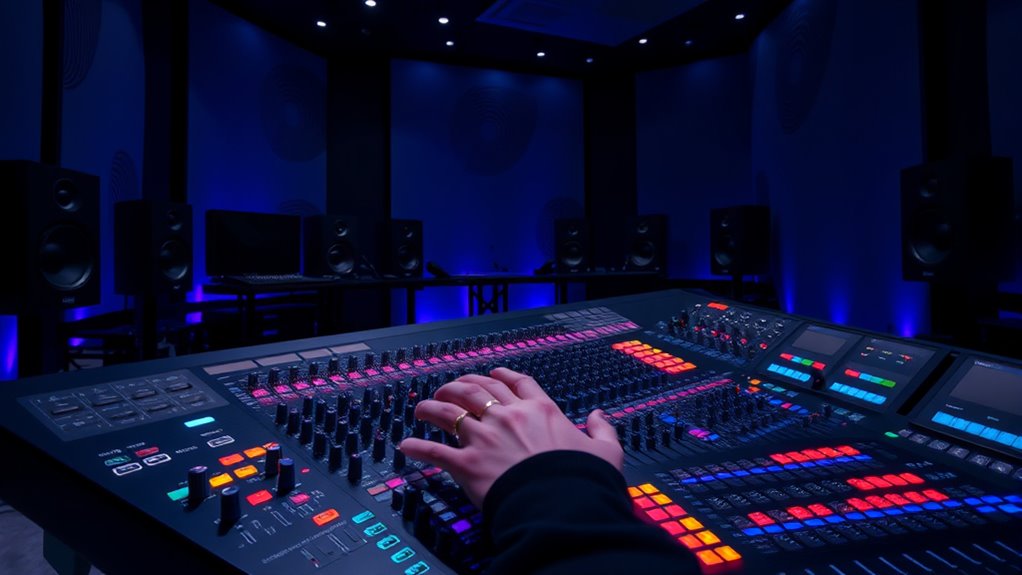

To craft immersive audio, focus on spatial composition techniques that position sound sources accurately within a 3D space. Use binaural mixing to replicate natural hearing cues, like interaural time and level differences, creating a realistic environment through headphones. Carefully place and move sound objects to match the scene’s context, enhancing motion and presence. Continuing with these methods will deepen your understanding of building convincing, engaging soundscapes that truly surround the listener.
Key Takeaways
- Precisely position audio objects within a 3D space to match scene context and enhance realism.
- Use binaural mixing to replicate natural hearing cues, creating a convincing sense of depth and direction.
- Incorporate sound movement and dynamic positioning to simulate motion and increase immersion.
- Utilize specialized spatial audio tools and plugins for accurate virtual soundfield rendering.
- Design soundscapes that respond to listener perspective, fostering a seamless and engaging auditory environment.
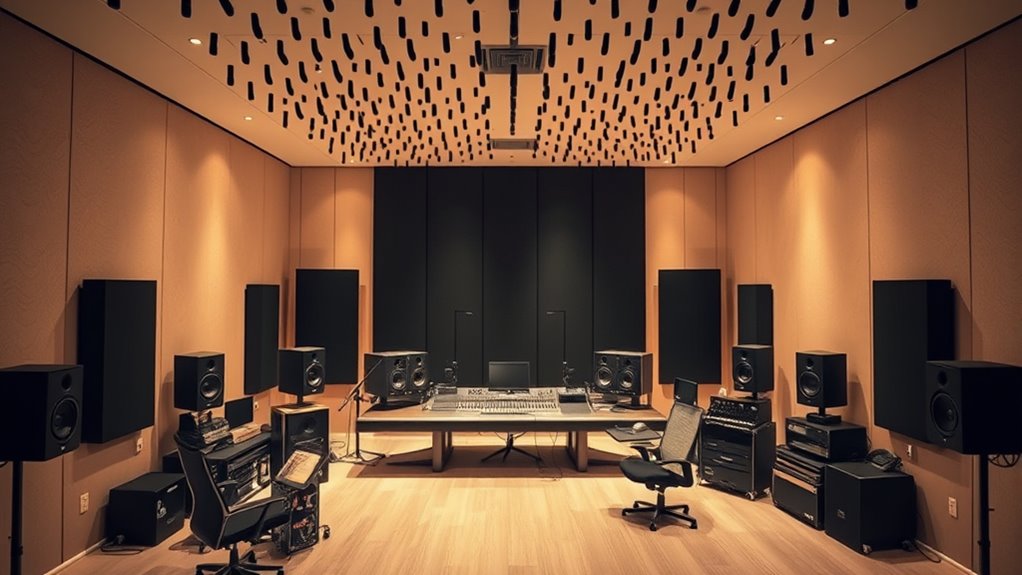
Have you ever wondered how immersive audio creates such a convincing and enveloping experience? The secret lies in mastering spatial composition techniques that manipulate sound to mimic real-world perception. Central to this process is understanding audio object placement, which involves positioning individual sound sources within a three-dimensional space. Instead of mixing sounds as a flat stereo image, you treat each sound as an independent object with its own location, movement, and characteristics. By doing so, you can craft a dynamic soundscape that responds to the listener’s perspective, making every moment feel immediate and real.
Achieving this level of realism requires careful attention to how sounds are positioned and moved throughout the audio environment. Think of it as painting with sound—each object has a coordinate in space, and your goal is to place it precisely where it should be. For example, a bird chirping should seem to come from above and to the right, while footsteps might be heard approaching from behind. This spatial manipulation enhances immersion, pulling listeners into the scene. To accomplish this, you’ll often use binaural mixing techniques, which simulate how our ears naturally perceive sound in three dimensions.
Binaural mixing is vital because it replicates the way humans hear, incorporating subtle cues like interaural time differences and level differences between ears. When you design a binaural mix, you’re essentially creating a virtual sound environment that the brain interprets as real space. This involves placing audio objects within a virtual 3D field, adjusting their position, distance, and movement to match the scene. The magic of binaural mixing is that it preserves the spatial cues that our ears rely on, allowing listeners to perceive depth and direction even through headphones.
In practice, you’ll use specialized tools and plugins that support spatial audio and binaural rendering. These tools help you position sounds accurately, ensuring that the audio object placement feels natural and convincing. As you work, consider how sounds move through space—an alert approaching from the left should gradually shift to the front or right, creating a sense of motion and presence. The more precise your audio object placement and binaural mixing, the more immersive your audio will be, making listeners feel as if they’re right there in the scene.

Symphonized Premium Airtube Headphones EMF Earbuds, 3D Sound, Microphone Volume Control, 8mm Bass Drivers Granting High Audio Quality 3.5mm Audio Jack
PREMIUM EMF TECHNOLOGY – These EMF earbuds combine crisp sound with built-in signal protection, offering innovative back to…
As an affiliate, we earn on qualifying purchases.
As an affiliate, we earn on qualifying purchases.
Frequently Asked Questions
How Do I Choose the Right Spatial Audio Tools?
To choose the right spatial audio tools, you should consider your project’s needs and budget. Look for tools that support headphone calibration to guarantee accurate sound placement. Binaural processing is essential for creating realistic 3D audio experiences, so prioritize software or hardware that excels in this area. Test different options, read reviews, and opt for user-friendly interfaces to streamline your workflow and achieve immersive, precise soundscapes.
What Are Common Challenges in Immersive Audio Composition?
You’ll likely face challenges with maintaining listener engagement and overcoming technical limitations. As you craft immersive audio, it’s essential to balance spatial elements to keep the audience captivated without overwhelming them. Technical issues, like latency or compatibility, can hinder your work. By testing across devices and focusing on clear sound placement, you can mitigate these challenges, ensuring a seamless, engaging experience that fully immerses your listeners.
How Can I Optimize Sound for Different Playback Systems?
To optimize sound for different playback systems, start with headphone calibration to guarantee accurate spatial cues and adjust settings for each device. Pay attention to speaker placement, positioning them to create a balanced and immersive soundstage. Test your mix across various systems, making necessary tweaks to maintain consistency. This approach ensures your audio remains immersive and well-balanced, regardless of the playback environment.
What Are Best Practices for Listener Movement in Spatial Audio?
You should guide listener movement intentionally, emphasizing natural positioning and realistic movement cues. Encourage subtle shifts in listener positioning to enhance immersion, ensuring sound sources adapt seamlessly as they move. Use movement cues like volume changes, panning, and binaural cues to signal direction and distance. Maintain consistency, avoid abrupt shifts, and consider how listeners will navigate through the space, creating a dynamic experience that responds intuitively to their movement.
How Do I Balance Spatial Effects With Musicality?
To balance spatial effects with musicality, you should focus on dynamic mixing, adjusting effects to enhance rather than overpower the music. Keep listener engagement in mind, ensuring effects complement the composition’s emotional flow. Use subtle spatial cues during key moments, and avoid overusing effects that could distract. By carefully blending effects with the core musical elements, you create an immersive experience that remains engaging and harmonious.

MAX 9 & RNBO: BUILDING COMMERCIAL AUDIO PLUGINS, WEB APPS & HARDWARE: MASTER ABL OBJECTS, JITTER GEOMETRY, VST3, WEBASSEMBLY & C++ EXPORT FOR INTERACTIVE AUDIO SOFTWARE
As an affiliate, we earn on qualifying purchases.
As an affiliate, we earn on qualifying purchases.
Conclusion
As you craft immersive audio, remember that simplicity can be as powerful as complexity. Just like a quiet whisper amid a storm, subtle spatial cues can draw listeners deeply into your world. Balancing these elements is your challenge—melding clarity with richness. In this art, silence becomes as important as sound, and empty space can speak volumes. Embrace both, and you’ll create experiences that captivate, transport, and truly immerse your audience in every moment.
![MixPad Multitrack Recording Software for Sound Mixing and Music Production Free [Mac Download]](https://m.media-amazon.com/images/I/51kaO82jYOL._SL500_.jpg)
MixPad Multitrack Recording Software for Sound Mixing and Music Production Free [Mac Download]
Mix an audio, music and voice tracks
As an affiliate, we earn on qualifying purchases.
As an affiliate, we earn on qualifying purchases.

Sound Professionals SP-TFB-2-SS-PC – Standard Sensitivity, Low Noise in-Ear Binaural Microphones
In-Ear Binaural microphones are mounted in extremely comfortable super-soft, In-Ear holders.
As an affiliate, we earn on qualifying purchases.
As an affiliate, we earn on qualifying purchases.