
Augmented chords create suspense in modern ballads by stacking two major thirds, adding tension and a surreal, dreamlike quality. You can use them as passing tones, pivot points, or unexpected modulations to heighten emotional moments. Their symmetrical structure and dissonance help guide listeners through anticipation and release, intensifying the song’s impact. To reveal their full potential and craft captivating progressions, keep exploring how these chords shape emotional landscapes.

Get audio and creator gear delivered free with Prime
- Fast, free delivery on millions of items
- Prime Video, Amazon Music and more included
- Member-only deals all year
Key Takeaways
- Augmented chords introduce instability and tension, heightening emotional suspense in modern ballads.
- They serve as dramatic pivot points for unexpected key changes, increasing listener intrigue.
- Placing augmented chords before climaxes amplifies emotional peaks and creates a sense of longing.
- Smooth voice leading with chromatic passing tones enhances the suspenseful transition between chords.
- Their surreal, ambiguous sound evokes a dreamlike atmosphere, deepening emotional engagement.
As an affiliate, we earn on qualifying purchases.
Understanding the Structure of Augmented Chords

To understand augmented chords, it’s important to recognize their unique structure. An augmented chord is built by stacking two major thirds on top of a root note, which results in a symmetrical, four-note interval. Typically, you’ll see it written as a root, a major third, and an augmented fifth. For example, in a C augmented (C+), the notes are C, E, and G#. The key feature is the augmented fifth, which is one fret or semitone higher than a perfect fifth. This interval gives the chord its distinctive, tense sound. Unlike major or minor chords, augmented chords don’t have a traditional triadic quality, making them stand out. Understanding this structure helps you identify and use augmented chords effectively in your playing or composition. Additionally, recognizing the dissonant quality of augmented chords can enhance their expressive power in musical contexts.
As an affiliate, we earn on qualifying purchases.
The Emotional Impact of Augmented Harmony in Ballads
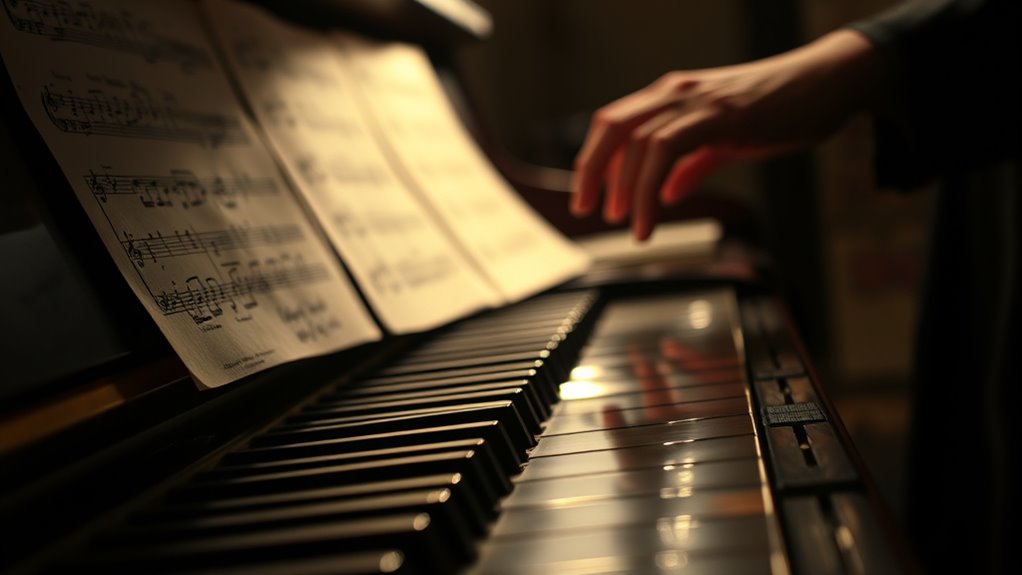
Augmented chords can heighten emotional tension in ballads, making moments feel more intense and compelling. They create a sense of longing or uncertainty that resonates deeply with listeners. Additionally, their dreamlike quality can evoke a surreal atmosphere, drawing you into a more immersive listening experience. The use of color accuracy in the harmonic palette can further enhance the emotional depth of the musical landscape. Incorporating harmonic complexity can also add layers of nuance, enriching the listener’s emotional journey. Recognizing the importance of musical theory can help composers craft more effective and evocative harmonic progressions.
Heightens Emotional Tension
Because of their unique harmonic qualities, augmented chords naturally create a sense of heightened emotional tension in ballads. They disrupt the listener’s expectations, making moments feel unresolved or urgent. This tension draws you in emotionally, amplifying feelings of longing, despair, or hope. To illustrate, consider how augmented chords can intensify a song’s climax or emotional peak: musical tension can also be used to symbolize tension and release through visual expression, mirroring musical dynamics. Additionally, with emerging trends like ONE2CRYPTO, the emotional power of music and its capacity to connect with audiences are being further amplified through innovative platforms. Furthermore, understanding the Law of Attraction reveals how emotional vibrations set during musical creation can influence listener responses and emotional resonance.
Evokes Dreamlike Atmospheres
The same harmonic qualities that create emotional tension also have the power to evoke dreamlike, otherworldly atmospheres in ballads. When you incorporate augmented chords, you introduce a sense of ambiguity and surrealism that transports listeners beyond everyday reality. These chords blur tonal boundaries, creating an open, floating feeling that feels both mysterious and enchanting. As you weave augmented harmony into your progressions, you craft a sonic landscape that feels like a fleeting dream or a distant memory. The unexpected intervals and unresolved tension stimulate the imagination, allowing listeners to drift into a contemplative, almost hypnotic state. This ethereal quality makes augmented chords ideal for expressing longing, wonder, and the intangible emotions that define a truly immersive, atmospheric ballad. Incorporating harmonic qualities can further enhance the emotional impact and deepen the dreamlike atmosphere, as the use of unresolved dissonances encourages a sense of anticipation that keeps the listener engaged in the musical journey. Additionally, understanding how musical tension influences listener perception can help musicians and composers consider the emotional responses elicited by different harmonic choices, making their music more impactful.
As an affiliate, we earn on qualifying purchases.
Techniques for Incorporating Augmented Chords Into Your Progressions

You can incorporate augmented chords smoothly by using chromatic passing tones to create tension and interest. Unexpected modulations also offer a surprising twist, making your progressions more dynamic. Experimenting with these techniques will help you unveil new expressive possibilities with augmented harmony. Paying attention to angel numbers can also inspire emotional depth and spiritual resonance in your compositions. Additionally, understanding the narcissistic traits behind certain musical choices can deepen your emotional storytelling and connection with listeners. Exploring sound recording techniques can further enhance the atmosphere and emotional impact of your ballads. Incorporating musical analysis can provide valuable insights into how augmented chords function within different harmonic contexts.
Chromatic Passing Tones
Chromatic passing tones serve as a powerful technique for seamlessly integrating augmented chords into your progressions. By inserting these half-step links between diatonic or chord tone notes, you create smooth, tension-filled movement that naturally leads to augmented chords. For example, approaching a dominant chord with a chromatic passing tone heightens the sense of suspense. You can also use these tones to connect chords a half-step apart, emphasizing their chromatic relationship. Incorporating passing tones in melodies or bass lines guides the listener’s ear toward augmented sounds without abrupt shifts. This technique adds color and tension, making your progressions more expressive and dynamic. When used thoughtfully, chromatic passing tones subtly prepare your audience for the suspenseful moments created by augmented chords. Additionally, understanding musical tension and how to manipulate it with passing tones can further enhance the emotional impact of your compositions. Recognizing the role of voice leading in smooth chord transitions can also help in crafting more cohesive and compelling progressions.
Unexpected Modulations
Have you ever considered how unexpected modulations can add drama and surprise to your chord progressions? By shifting keys unexpectedly, you create a sense of intrigue that keeps listeners engaged. Using augmented chords as pivot points makes these modulations seamless and striking. For example:
- Use an augmented chord as a pivot to smoothly transition from one key to another.
- Introduce an augmented chord unexpectedly within a progression to hint at a new key before the modulation.
- Combine augmented chords with chromaticism for more dramatic and unpredictable key changes.
Incorporating these techniques makes your ballads emotionally compelling and unpredictable, heightening suspense. Experiment with different pivot points and modulations to discover fresh sounds. Unexpected modulations, when executed well, turn simple progressions into enthralling musical stories.
music composition software with augmented chords
As an affiliate, we earn on qualifying purchases.
As an affiliate, we earn on qualifying purchases.
Creating Tension and Release With Augmented Chords
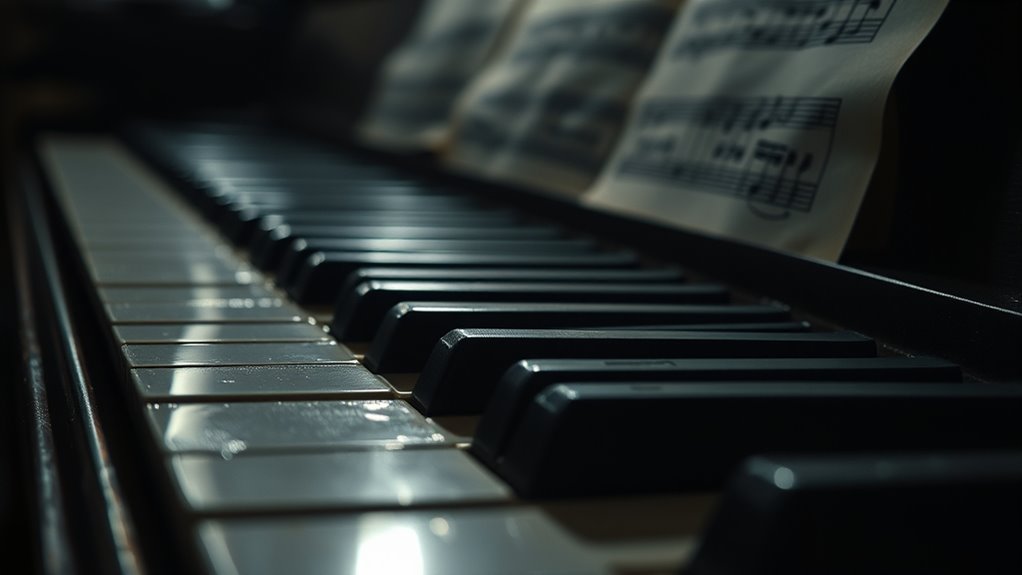
Augmented chords are powerful tools for creating tension and release in music. When you insert an augmented chord into your progression, it instantly adds a sense of instability, making the listener feel anticipation. This feeling heightens when you move to a more stable chord, such as a major or minor, providing a sense of resolution. For example, using an augmented chord as a passing tone between two chords creates a moment of suspense, then satisfaction when the music settles. You can also prolong the tension by repeating the augmented chord or delaying the resolution. By carefully placing augmented chords, you guide your audience through emotional peaks and valleys, making your compositions more engaging and dynamic.
Common Progressions Using Augmented Chords in Modern Songs

In modern songs, augmented chords often serve as dramatic connectors or surprising twists within common progressions. They add unexpected color and emotional depth, making progressions more engaging. Here are three popular ways you might encounter augmented chords:
- V+ to I or i – You’ll frequently see the dominant augmented chord leading to the tonic, heightening anticipation before resolution.
- IV+ to V – The augmented version of the subdominant creates tension that’s resolved when moving to the dominant.
- ii+ to V – The supertonic augmented adds a rich, suspenseful flavor, leading smoothly into the dominant for a compelling progression.
Using these patterns, you can craft progressions that keep listeners hooked with moments of surprise and emotional intensity.
Voice Leading and Smooth Transitions With Augmented Chords
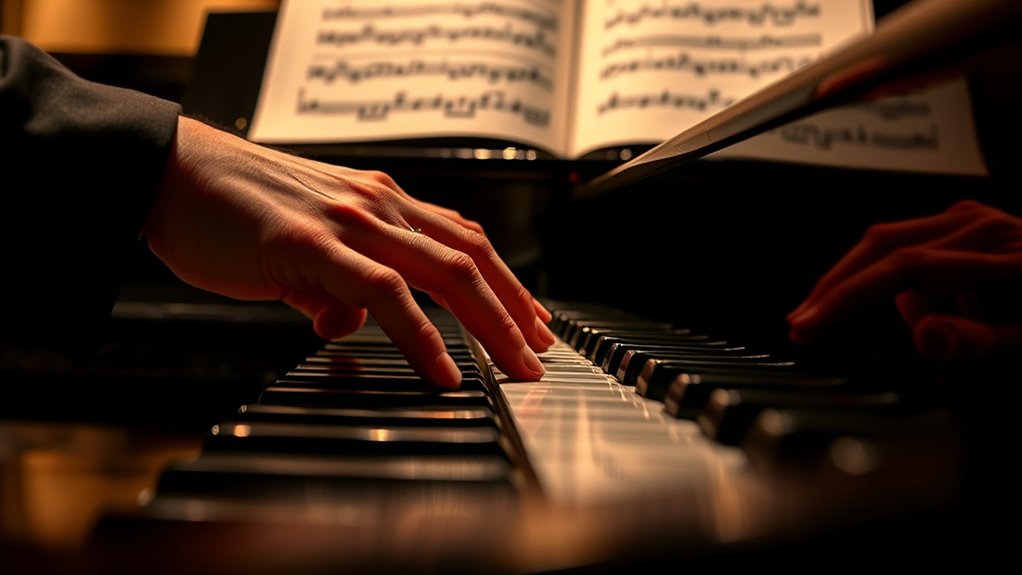
To achieve smooth voice leading with augmented chords, focus on their unique intervallic structure, which allows for seamless progressions between chords. Augmented chords typically contain a sharp fifth, creating a symmetrical sound that can connect smoothly to neighboring harmonies. You can move individual voices by half steps or stepwise motion, minimizing large leaps. For example, when transitioning from an augmented chord to a tonic, shift the chord tones by half steps to create a sense of continuity. Use common tones or move voices in parallel motion to enhance fluidity. This approach helps maintain a cohesive sound, emphasizing suspense without abrupt changes. By understanding these voice-leading strategies, you can craft smooth, compelling progressions that heighten emotional impact in your ballads.
Examples of Augmented Chords in Popular Modern Ballads
Many modern ballads incorporate augmented chords to add tension and emotional depth. You might recognize these chords in some of your favorite hits, subtly enhancing the mood. For example:
- In Adele’s “Set Fire to the Rain,” augmented chords create a sense of longing during key shifts.
- Coldplay’s “The Scientist” uses augmented chords to evoke vulnerability and introspection.
- In Sam Smith’s “Stay With Me,” augmented chords heighten emotional intensity during heartfelt moments.
You can hear how these chords add a layer of suspense and richness to the melodies. They often appear right before climactic sections or poignant lyrics, making the song’s emotional impact more profound. These examples show how composers use augmented chords to craft memorable, emotionally charged ballads.
Tips for Experimenting and Innovating With Augmented Chords
Experimenting with augmented chords can open up new emotional and tonal possibilities in your compositions. Don’t be afraid to place them unexpectedly, such as in shifts or at the end of phrases, to create heightened tension. Try substituting standard major or minor chords with augmented ones to see how they alter the mood. Experiment with different voicings and inversions, which can add subtle color and complexity. Combining augmented chords with other chromatic or modal elements can also produce innovative sounds. Trust your ear and listen for moments where a chord feels like it needs that extra push of suspense. Remember, the key is to push boundaries and see how these chords can enhance your unique musical voice.
Frequently Asked Questions
How Do Augmented Chords Influence Song Mood Beyond Suspense?
You might wonder how augmented chords shape a song’s mood beyond just building suspense. When you include them, they add a sense of tension, instability, or even a touch of eeriness, making the music feel more emotionally complex. These chords can evoke feelings of longing, unease, or excitement, depending on their placement. By doing so, they deepen the listener’s emotional experience, making your song more dynamic and engaging.
Can Augmented Chords Be Used in Non-Ballad Genres Effectively?
You might think augmented chords only work in ballads, but they’re actually versatile across genres. In jazz, they add tension and color; in pop, they introduce unexpected emotional shifts; in film scores, they heighten drama. By using augmented chords, you create a sense of suspense or surprise, regardless of the style. So, don’t hesitate to incorporate them into your compositions—you’ll find they enrich any musical genre.
What Are Common Mistakes When Incorporating Augmented Chords?
When you incorporate augmented chords, you might mistake their use for overuse or improper placement, which can disrupt your song’s flow. Avoid relying on them too heavily or inserting them awkwardly where they don’t fit harmonically. Instead, use augmented chords sparingly to build tension or color your progression. Always check if they enhance the mood and guarantee they lead smoothly into the next chord for a seamless sound.
How Does Voice Range Affect Augmented Chord Usage?
Think of your voice range as the canvas on which you paint your musical story. When you incorporate augmented chords, staying within your vocal boundaries guarantees the tension feels natural, not forced. If you push too high or dip too low, the suspense might fall flat or strain. Keep your voice comfortable, and let the augmented chords weave seamlessly, adding mystery and drama without sacrificing clarity or emotional impact.
Are There Cultural Differences in the Perception of Augmented Harmony?
You might notice that different cultures have unique musical tastes and emotional responses. When it comes to augmented harmony, some cultures may find it more tense or unsettling, while others see it as expressive or beautiful. These perceptions are shaped by cultural exposure, traditional music styles, and emotional associations. So, your experience with augmented chords can vary widely depending on your cultural background and musical environment.
Conclusion
By exploring augmented chords, you open a powerful tool to add suspense and emotion to your ballads. With a little experimentation, you’ll discover how these chords can turn a simple progression into a captivating journey. Don’t be afraid to think outside the box—sometimes, it’s the unexpected twists that make your music stand out. Keep pushing boundaries, and soon you’ll be weaving tension and release that keep listeners hanging on every note.
Fall Picks
fall essentials
As an affiliate, we earn on qualifying purchases.