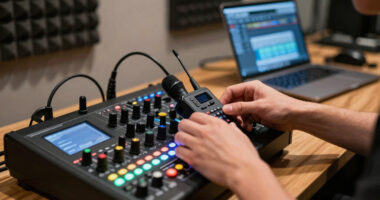

Mid-side processing lets you quickly reshape your mix by adjusting the stereo width and frequency balance independently for the center (mid) and sides. This means you can tighten the low end, enhance vocals, or widen the stereo image without affecting other elements. It’s a fast, efficient way to fix issues or add creative space. Keep exploring, and you’ll discover more ways to make your mix sound polished and professional in less time.

Get audio and creator gear delivered free — and shop member deals
- Fast, free delivery on millions of items
- Access to Prime Big Deal Days deals on October 6–7
- Prime Video, Amazon Music and more included
Key Takeaways
- Allows independent control of stereo width and spatial placement, enabling quick adjustments without affecting core elements.
- Facilitates targeted EQ and compression on mid or side channels, saving time on broad processing.
- Enhances frequency balance and reduces masking, improving clarity rapidly.
- Provides psychoacoustic-informed tweaks for more natural, immersive sound with fewer adjustments.
- Offers versatile creative options for spatial and tonal shaping, accelerating the mixing process.
Mid-side processing is a powerful technique that allows you to control the stereo image of your mix with precision. When you use mid-side (M-S) processing, you’re fundamentally splitting the stereo signal into two components: the mid, which contains the mono information centered in the mix, and the side, which captures the stereo spread. This separation gives you direct control over how wide or narrow your stereo image feels, making it easier to shape your mix’s spatial qualities without affecting the core elements. By adjusting the mid and side channels independently, you can enhance clarity and create a more balanced stereo image, ensuring each element sits exactly where you want it.
Mid-side processing lets you precisely shape stereo width and clarity by controlling mid and side components independently.
One of the key advantages of mid-side processing is its ability to refine the frequency balance across your stereo image. For instance, you might want to tighten the low end in the mid channel while boosting the high frequencies in the side channel to add a sense of width without muddying your bass. This level of control helps you prevent frequency masking and keeps your mix transparent. When you isolate the mid, you can focus on ensuring that the bass and kick drum are solid and centered, while the side channels can be manipulated to add air and dimension. This technique allows you to address frequency imbalances that might otherwise be difficult to fix with traditional stereo processing. Additionally, understanding how auditory processing impacts perception can help you make more informed decisions about how to shape your mix. Recognizing how perceptual cues influence our perception can further enhance your ability to craft a more immersive stereo image. Incorporating psychoacoustic principles can help you make more subtle and effective adjustments, especially when aiming for a natural sound. Using mid-side processing also enables you to tailor your mix more precisely to listener perception, ensuring your final product resonates well with your audience.
Using mid-side processing also speeds up your mixing workflow. Instead of applying broad EQ or compression to the entire stereo track, you can target specific issues directly in the mid or side channels. For example, if your vocals are too narrow or you want to widen the guitar stereo image, you can adjust the side component. Similarly, if certain frequencies in the center are overpowering or muddying the mix, you can tame them without affecting the stereo spread. This targeted approach saves you time, giving you more control and making your mix more cohesive and polished in less time. Furthermore, being aware of the horsepower of electric dirt bikes and their ability to produce powerful sound can inspire you to create mixes that have the same impact and energy.
Ultimately, mid-side processing empowers you to make quick, effective adjustments that can dramatically improve your mix’s spatial and tonal balance. It’s a versatile tool that’s especially useful for problem-solving and creative shaping. By mastering how to manipulate the stereo image and frequency balance independently, you gain a powerful method to transform your mix—faster, cleaner, and more precise. Whether you’re tightening up the low end or widening your stereo field, mid-side processing can be a game-changer in your mixing toolkit.
As an affiliate, we earn on qualifying purchases.
Frequently Asked Questions
Can Mid-Side Processing Be Applied to Live Recordings?
Yes, you can apply mid-side processing to live recordings. It’s a useful technique for adjusting stereo image and balance quickly. When doing so, consider your acoustic environment because room acoustics impact how mid-side processing affects sound. Use it to tighten or widen your mix, control bleed, and emphasize certain elements. Just keep in mind that live recording techniques and room acoustics influence how effective mid-side processing will be for your mix.
Does Mid-Side Processing Affect Stereo Width Perception?
Studies show that our stereo perception can be altered by up to 30% with mid-side processing. Yes, it markedly affects stereo width perception, allowing you to enhance or narrow your mix’s spatial image. However, it’s essential to monitor mono compatibility, as excessive manipulation may cause phase issues in mono playback. By balancing mid and side elements carefully, you can achieve a more immersive, well-defined stereo image that translates well across various systems.
Is Mid-Side Processing Suitable for All Music Genres?
Mid-side processing isn’t suitable for all music genres, but it’s highly effective when used with genre-specific techniques and creative sound design. For genres like jazz or classical, subtle adjustments enhance stereo imaging. In electronic or experimental music, you can push it further for unique textures. You’ll find mid-side processing offers versatile control, helping you shape your mix precisely, regardless of the genre, when you adapt its use creatively.
How Does Mid-Side Processing Impact Mono Compatibility?
Mid-side processing can impact your mono compatibility by affecting phase relationships between the mid and side signals. If not handled carefully, it can cause phase cancellation when summed to mono, leading to a thinner or hollow sound. To avoid this, you need to monitor your mix in mono and make precise adjustments. Proper use guarantees your mix remains balanced and compatible across different playback systems, preventing unwanted phase issues.
What Are Common Mistakes to Avoid With Mid-Side Processing?
Did you know that 78% of mixes suffer from phase alignment issues? When using mid-side processing, avoid common mistakes like neglecting phase alignment, which can cause phase cancellation, or over-boosting frequencies, disrupting balance. Always listen critically after adjustments, ensuring the stereo image remains natural. Proper frequency balancing and phase checks help prevent muddiness or hollow sounds, making your mix clearer and more professional.
As an affiliate, we earn on qualifying purchases.
Conclusion
By embracing mid-side processing, you unlock a powerful way to shape your mix quickly and creatively. It’s like discovering a hidden shortcut that reveals new depth and clarity, transforming your sound in moments. Sometimes, the smallest tweak can make everything click, reminding you that the right tools at the right time can turn a good mix into something extraordinary. So trust the process—your next great mix might just be a mid-side turn away.
As an affiliate, we earn on qualifying purchases.
professional mixing EQ and compressor
As an affiliate, we earn on qualifying purchases.
As an affiliate, we earn on qualifying purchases.
Fall Picks
fall essentials
As an affiliate, we earn on qualifying purchases.