VR concerts immerse you in vibrant 3D environments that make you feel like you’re really there. You can customize your avatar, express yourself with gestures, and even interact with others in real time. This creates a lively, social experience that goes beyond passive listening. As VR technology improves, you’ll enjoy more realistic visuals and deeper connections with artists and fans alike. Keep exploring to discover how these innovations are transforming live music experiences.
Key Takeaways
- VR concerts create immersive 3D environments that simulate live music events, enhancing fan engagement beyond traditional streaming.
- Personalized avatars enable fans to express themselves, interact actively, and feel more connected to performers and other attendees.
- Real-time social interactions, such as gestures and voice chat, foster a sense of community and shared excitement in virtual spaces.
- Customizable avatars and gestures encourage lively participation, influencing the energy and atmosphere of virtual concerts.
- Technological advancements like high refresh rates and improved visual fidelity are making VR concerts increasingly realistic and engaging.
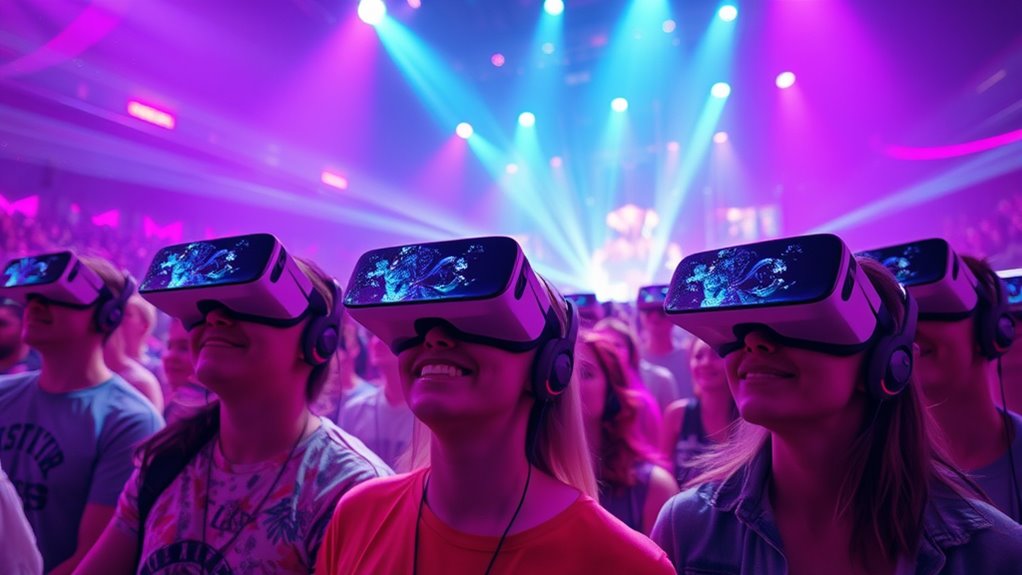
Virtual reality has revolutionized the way we experience live music, offering immersive concerts that feel almost as real as attending in person. As you put on your VR headset, you’re transported into a vibrant 3D space where the artist performs just a few feet away. But what truly sets this experience apart is the ability to create and customize your virtual avatar, which represents you in the digital concert environment. These virtual avatars aren’t just static images; they’re dynamic, expressive representations that mirror your movements and emotions, making your presence felt in the shared space. With your avatar, you can dance, sing along, or simply soak in the atmosphere, contributing to the overall energy of the event.
Audience interaction plays a crucial role in elevating VR concerts from passive viewing to active participation. Unlike traditional live streams, where your engagement is limited to comments or chats, VR concerts allow you to physically interact with other attendees through your avatar. You can wave, nod, or even gesture, signaling your enthusiasm and connecting with fellow fans in real time. This level of interaction creates a sense of community that’s often missing from other digital formats. You might find yourself exchanging virtual high-fives or dancing alongside strangers, all within a shared 3D space that mimics a real-world concert venue.
VR concerts let you wave, dance, and connect in real time, creating a true sense of community and shared energy
The use of virtual avatars enhances the feeling of presence and social connection, making the experience more personal and memorable. You’re not just a spectator but an active participant in the concert environment. This fosters genuine audience interaction, where your movements and choices influence the vibe of the event. Some VR platforms even enable you to customize your avatar’s appearance, voice, and gestures, allowing your personality to shine through amidst the crowd. This customization deepens your sense of identity within the virtual space, encouraging more lively interactions and a stronger sense of belonging.
Moreover, the ability to communicate with other concert-goers via voice chat or gestural cues adds a layer of spontaneity and fun. Instead of feeling isolated behind a screen, you’re immersed in a lively, dynamic environment where your presence matters. Audience interaction becomes a essential part of the concert experience, making it feel less like watching a performance and more like being part of a vibrant, shared event. As VR technology advances, expect even richer ways to connect with artists and fans alike, transforming live music into a truly interactive and social adventure. Additionally, incorporating high refresh rates into VR headsets can significantly improve visual comfort and reduce motion sickness, further enriching the immersive experience.
As an affiliate, we earn on qualifying purchases.
Frequently Asked Questions
How Do VR Concerts Compare to Live Concerts in Quality?
VR concerts often lack the audio clarity and spontaneous audience interaction of live concerts, but they offer unique advantages. You can enjoy high-quality sound and visuals, and interact with fellow fans in immersive 3D spaces. While the experience might not fully match the energy of a live event, VR concerts deliver a personalized, accessible way to enjoy performances. Ultimately, your preference depends on whether you value realism or convenience.
What Equipment Is Necessary to Join VR Immersive Experiences?
To join VR immersive experiences, you’ll need a compatible VR headset, like Oculus Quest, HTC Vive, or Valve Index, which have specific VR headset requirements. Additionally, motion tracking accessories such as controllers or sensors enhance the experience by allowing natural movement. Make certain your device meets the system requirements, including a powerful PC or console, so you can enjoy smooth, immersive interactions in 3D spaces.
Are VR Concerts Accessible to People With Disabilities?
Imagine stepping into a vibrant concert hall; VR concerts aim to be inclusive, but accessibility barriers still exist. If you have disabilities, assistive technologies like voice commands or haptic feedback can help you enjoy the experience. Developers are working to improve accessibility, but some barriers remain. With ongoing efforts, VR concerts are becoming more accessible, enabling everyone to join the crowd and feel the music.
How Do Artists Create Their Virtual 3D Concert Environments?
You create virtual 3D concert environments by designing compelling virtual sets and developing interactive environments. You use specialized software like Unreal Engine or Unity to craft immersive worlds that match your artistic vision. You incorporate detailed virtual set design elements, such as stage layouts and visual effects, and add interactive features that let fans explore and engage. This process combines creativity with technical skills to produce engaging, immersive concert experiences.
What Are Future Technological Advancements Expected in VR Concerts?
You’ll see next-gen VR concerts become even more immersive with AI-generated environments that adapt to your preferences, creating personalized experiences. Haptic feedback will advance, letting you feel the music’s beat or a virtual crowd’s energy. Coincidence? These innovations will blur the line between reality and virtual worlds, making concerts feel more authentic and interactive, so you won’t just watch—you’ll truly feel part of the performance.
As an affiliate, we earn on qualifying purchases.
Conclusion
As you step into the world of VR concerts and immersive experiences, you’ll find yourself closer to the action than ever before. These innovations break down barriers, making fans feel like part of the show. Just remember, “Seeing is believing,” and with VR, you truly get to see and feel the magic firsthand. Embrace this new frontier, and you’ll discover that the future of entertainment is more thrilling than you ever imagined.
VR social interaction accessories
As an affiliate, we earn on qualifying purchases.
As an affiliate, we earn on qualifying purchases.
As an affiliate, we earn on qualifying purchases.