

To understand polyrhythms like 5/4 and 7/8, break each pattern into manageable parts and count each rhythm separately. For example, count 5/4 as “1-2-3-4-5” and 7/8 as “1-2-3-4-5-6-7,” then fuse them together, listening for the contrasting accents and syncopation. Practicing these step-by-step makes complex rhythms easier to feel and perform, opening the door to more intricate grooves as you master these patterns.

Get audio and creator gear delivered free with Prime
- Fast, free delivery on millions of items
- Prime Video, Amazon Music and more included
- Member-only deals all year
Key Takeaways
- Count complex time signatures by subdividing beats into smaller units, like “1 2 3 4 5” for 5/4 and “1 2 3 4 5 6 7” for 7/8.
- Practice each pattern separately before combining them to develop internal timing and rhythmic feel.
- Use consistent counting methods across different signatures to easily understand and layer polyrhythms.
- Recognize how syncopation and accented beats enhance rhythmic complexity in irregular meters.
- Gradually increase the complexity of layered rhythms to master polyrhythms beyond common time signatures.
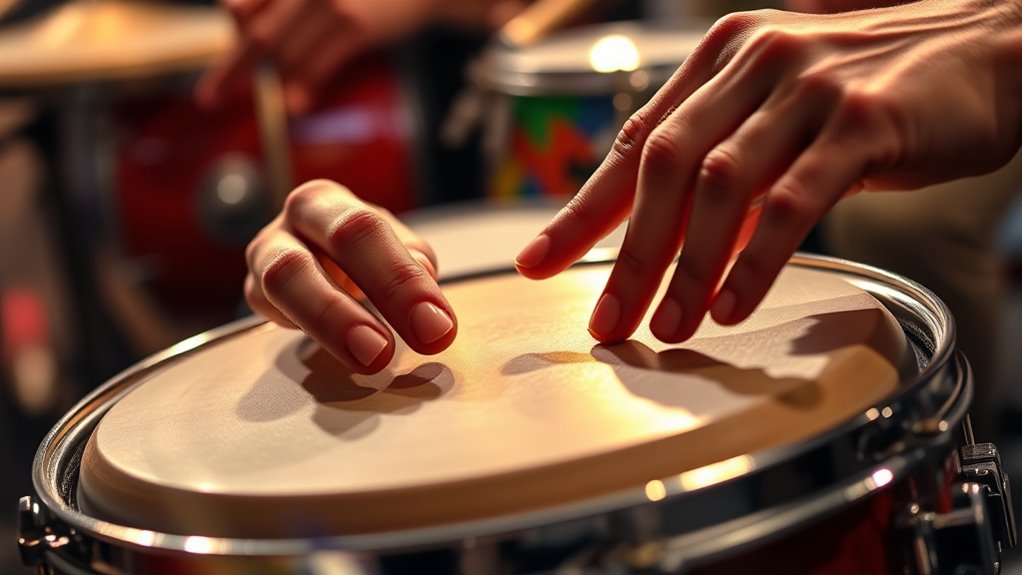
Have you ever wondered how musicians layer different rhythms to create complex, mesmerizing music? It all comes down to understanding syncopation patterns and rhythmic layering. When you start exploring polyrhythms, you realize that musicians often combine multiple rhythmic ideas, overlapping different patterns to produce a rich, textured sound. This process involves playing contrasting rhythms simultaneously, which can seem challenging at first but becomes more intuitive with practice.
Syncopation patterns are the backbone of this rhythmic complexity. They involve emphasizing off-beats or unexpected beats within a measure, creating a sense of tension and surprise. When you’re working with polyrhythms, these syncopation patterns add depth, making the music feel alive and dynamic. For example, in a simple 4/4 beat, you might accentuate the second and fourth beats differently than the first and third, leading to syncopated accents that dance around the steady pulse. This interplay between steady beats and syncopated accents is essential to understanding how rhythmic layering functions in polyrhythmic music.
Rhythmic layering is about stacking these syncopation patterns and other rhythmic ideas on top of each other. Imagine you’re playing a steady 4/4 beat with your left hand, while your right hand explores a 7/8 pattern, which divides the beat into uneven segments. As you do this, you’re layering different rhythmic patterns, each with its own internal pulse, creating a complex tapestry of sound. The key is to internalize each pattern separately before blending them smoothly. Once you get comfortable, you can experiment by shifting accents, playing with different syncopation patterns, and combining them in ways that surprise and delight your listeners.
Getting a grip on how to count and feel these layered rhythms is essential. You might break down a polyrhythm into smaller parts, like counting each pattern separately, then gradually merging them. For example, counting 4/4 as “1 and 2 and 3 and 4 and,” and 7/8 as “1 2 3 4 5 6 7,” helps to visualize how they fit together. Over time, this rhythmic layering becomes second nature, allowing you to create intricate patterns that go beyond basic time signatures.
In the end, mastering polyrhythms isn’t just about technical skill; it’s about developing a sense of timing and feel. By understanding syncopation patterns and how to layer rhythms effectively, you can access a whole new dimension of musical expression. With patience and practice, these complex patterns will become intuitive, enabling you to craft mesmerizing, multi-layered music that captivates your audience.
metronome for practicing polyrhythms
As an affiliate, we earn on qualifying purchases.
As an affiliate, we earn on qualifying purchases.
Frequently Asked Questions
Can Polyrhythms Be Played on Any Instrument?
Yes, you can play polyrhythms on almost any instrument. Their versatility depends on your technique adaptation, which allows you to grasp complex rhythmic patterns. Percussion instruments like drums and bongos naturally suit polyrhythms, but even melodic instruments such as piano, guitar, or wind instruments can handle them with practice. With patience and the right approach, you’ll find that polyrhythms enhance your musical expression across various instruments.
How Do I Develop a Good Sense of Rhythm?
To develop a good sense of rhythm, start with consistent metronome practice, focusing on keeping steady time. Incorporate rhythmic visualization by mentally mapping out beats and subdivisions, which strengthens your internal sense of timing. Practice slowly and gradually increase speed, paying attention to how different rhythms feel. Regularly listening to music and tapping along also enhances your rhythmic awareness, making your timing more accurate and natural over time.
Are Polyrhythms Used in Popular Music?
Imagine a vibrant tapestry woven with intricate threads; that’s how polyrhythms add melody to popular music. Yes, they’re used to introduce rhythm complexity and musical diversity, making songs feel fresh and dynamic. Artists like Beyoncé and Radiohead incorporate polyrhythms to create unique grooves that captivate listeners. So, next time you hear a song with unexpected beat layers, know polyrhythms are the secret behind its lively, textured sound.
What’s the Difference Between Polyrhythm and Polymeter?
Polyrhythm involves different rhythms played simultaneously, creating rhythmic complexity, while polymeter uses different time signatures layered together, highlighting syncopation differences. In polyrhythms, you notice contrasting patterns within the same beat, whereas polymeter features separate meters running concurrently. You’ll see polyrhythms add tension and groove through syncopation, while polymeter emphasizes contrasting meters, making the rhythm more intricate and engaging.
How Long Does It Take to Master Polyrhythms?
Mastering polyrhythms varies for everyone, but with consistent practice and patience, you’ll see progress. It might take weeks or months depending on your musical background and dedication. Focus on regular practice, break rhythms into smaller parts, and gradually build your confidence. Over time, your rhythm development will improve, and polyrhythms will become more natural. Stay patient, keep practicing, and you’ll master them sooner than you think.
As an affiliate, we earn on qualifying purchases.
Conclusion
Now that you understand how to count 5/4 and 7/8, you can embrace complex rhythms with confidence. Think of polyrhythms as a dance between different beats—sometimes steady, sometimes syncopated. Just like a conversation that varies in tone, these rhythms add depth and surprise. So, keep practicing, feel the pulse, and let the contrasting patterns weave together, creating a musical tapestry that’s both simple to grasp and endlessly fascinating.
As an affiliate, we earn on qualifying purchases.
music theory rhythm training book
As an affiliate, we earn on qualifying purchases.
As an affiliate, we earn on qualifying purchases.
Halloween Picks
halloween
As an affiliate, we earn on qualifying purchases.