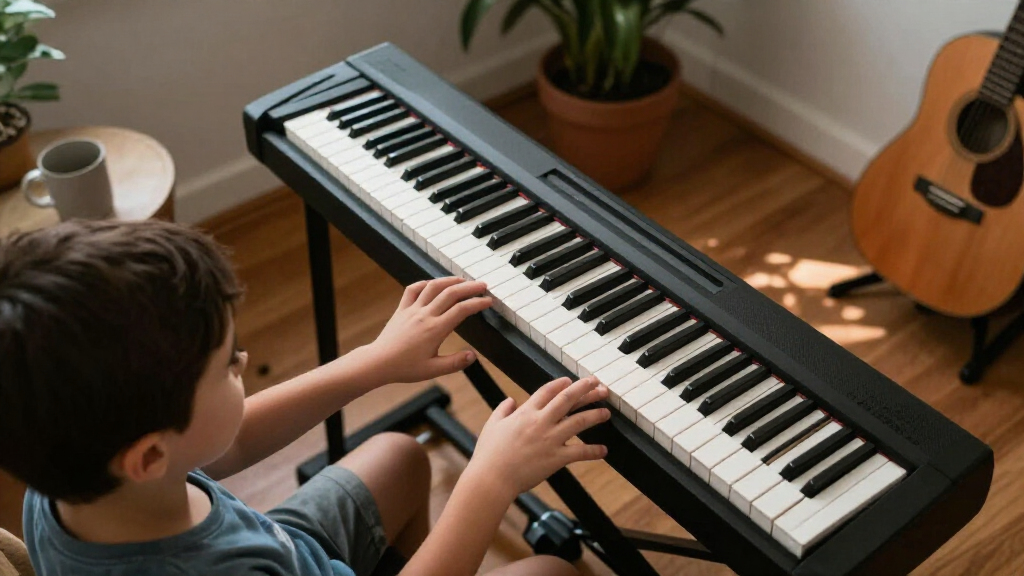
For most new players, I’d start with the Yamaha P71 as the best overall choice: its 88 weighted keys offer a more piano-like foundation than the 61-key portable models. The Donner DEP-20 stands out for learners who want weighted keys, a furniture-style setup, and three pedals, while the Yamaha PSR-E283 is a stronger fit for players who value portability and varied keyboard sounds. The main tradeoff is between full-size weighted keys for piano technique and lighter, smaller keyboards that take up less space and are easier to move. Bundles can add useful essentials, but included accessories do not always matter as much as key feel or a suitable practice setup. Read on for how all 15 options compare and which one fits your learning goals.

Get audio and creator gear delivered free with Prime
- Fast, free delivery on millions of items
- Prime Video, Amazon Music and more included
- Member-only deals all year
Complete the kit


Key Takeaways
- The Yamaha P71 leads for learners focused on piano technique because its 88 weighted keys provide a more piano-like starting point than the roundup’s 61-key models.
- The Donner DEP-20’s furniture-style stand and three-pedal setup make it a better fit for a dedicated home practice space than portable keyboard bundles.
- The Yamaha PSR-E283 is the clearest choice for portability and varied keyboard sounds, but its 61-key layout is less suitable for practicing the full range of piano music.
- Several 88-key options use semi-weighted keys, so key count alone does not tell beginners how closely a model will support piano-style touch and technique.
- The 61-key kits from RockJam, Donner, JIKADA, and Ugrfw emphasize portability or included accessories; buyers should compare those extras against the long-term benefit of full-size weighted keys.




| digital pianos for beginner | Keys | Connectivity | Tones | Rhythms |
|---|---|---|---|---|
| Ugrfw 61-Key Portable Digital | 61 | — | 100 | 10 |
| KUMENG 88-Key Semi-Weighted Di | 88 full-size semi-weighted | USB/MIDI | 800 | — |
| Alesis Recital Play 88-Key Pia | 88 full-size, touch-sensitive | USB-MIDI | — | 160 |
| 61-Key Portable Electronic Key | 61 | Wired; DC power jack; headphone jack | — | 10 |
| Zilvok 88-Key Digital Piano wi | 88 semi-weighted | USB-MIDI, Bluetooth | 1,000 | 1,000 |
| Yamaha P71 88-Key Weighted Act | 88 | USB, auxiliary, 3.5 mm headphone jack, sustain jack | — | — |
| JIKADA 61-Key Portable Electro | 61 | — | 255 | 255 |
| Donner DEP-20 Beginner Digital | 88 | MIDI, USB, auxiliary; 6.35 mm headphone jack | 238 | — |
| Donner DEP-20 88-Key Weighted | 88 full-size hammer-action keys | — | 238 | — |
| Yamaha PSR-E283 61-Key Portabl | 61 full-sized keys | Auxiliary, USB, 6.35 mm headphone jack | — | — |
| 88-Key Digital Piano with Semi | 88 | USB, Bluetooth, USB-MIDI | 1,000 | 1,000 |
| RockJam RJ5061 61-Key Keyboard | 61 full-size keys | 3.5 mm jack, auxiliary, USB | 200 | 200 |
| RockJam RJ761 61 Key Keyboard | 61 | — | — | — |
| Donner DEK-610S 61-Key Beginne | 61 | — | — | 249 |
| Ugrfw 61-Key Portable Digital | 61 | — | — | — |
More Details on Our Top Picks
Ugrfw 61-Key Portable Digital Piano for Beginners
The Ugrfw is a fit for beginners who want a compact keyboard for exploring music at home or taking it somewhere without depending on an outlet. Its 61 keys are fewer than the full-size layouts on the Alesis Recital Play and KUMENG KU-3506, so it offers less room for learning pieces that span a standard piano keyboard. In return, battery power and built-in speakers make casual practice easier to set up. The 100 tones, rhythms, percussion panels, and demo songs give new players plenty to try, while recording and playback can help them listen back to practice. The tradeoff is that the product details do not specify key action, so buyers cannot tell how closely the keys will support piano-style technique.
Pros:- Battery or adapter power allows practice away from a fixed outlet.
- Built-in tones, rhythms, percussion, and demo songs give beginners several ways to explore.
- Recording and playback provide a simple way to hear practice back.
- Color-coded controls and rounded edges may make basic operation more approachable.
Cons:- Four AA batteries are not included.
- Key action is not specified, making it difficult to judge suitability for piano technique.
- The 61-key layout has less range than the Alesis Recital Play’s 88 keys.
Best for: Beginners who want an easy-to-move keyboard for casual practice, experimenting with sounds, and playing away from an outlet.
Not ideal for: Learners focused on standard piano repertoire or developing piano-style touch; it has 61 keys and no specified key action.
- Keys:61
- Skill level:Beginner
- Tones:100
- Demo songs:100
- Rhythms:10
- Percussion panels:8
- Power:Adapter or 4 AA batteries (not included)
- Special feature:Built-in speakers
Our verdict“Choose the Ugrfw for portable, feature-rich experimentation, but choose an 88-key option if learning piano repertoire is the priority.”
KUMENG 88-Key Semi-Weighted Digital Piano with Stand
The KUMENG makes a practical case for beginners who want a full keyboard and stand in one package. Its 88 full-size semi-weighted keys offer more range than the 61-key Ugrfw, making it better suited to lessons and pieces that use the full piano layout. The included stand, music stand, pedal, and power adapter also reduce the need to source basic setup pieces separately. USB/MIDI adds a route to compatible software, while MP3 playback and recording support practice beyond simply playing along with built-in sounds. Its 800 tones and 128-note polyphony are generous, though a beginner may not need that breadth. The key tradeoff is the semi-weighted action: it provides more resistance than an unspecified or unweighted keyboard, but it is not the feel of fully weighted piano keys.
Pros:- Full-size 88-key layout supports a broader range of piano lessons and repertoire.
- Stand, music stand, pedal, and adapter are included for a ready-to-set-up package.
- USB/MIDI and stated support for GarageBand and Ableton Live provide software connection options.
- 128-note polyphony helps notes sustain together in denser passages.
Cons:- Semi-weighted keys do not replicate the feel of fully weighted acoustic-piano action.
- Corded power limits use away from an outlet.
- The 800 tones may add complexity that some first-time piano learners do not need.
Best for: New students who want 88 full-size keys, a bundled stand and pedal, and USB/MIDI access for compatible music software.
Not ideal for: Learners seeking an acoustic-piano-like weighted touch or a battery-powered instrument for portable practice.
- Keys:88 full-size semi-weighted
- Tones:800
- Polyphony:128 notes
- Connectivity:USB/MIDI
- Headphone jack:3.5 mm
- Power:Corded electric
- Included accessories:Piano stand, sheet music stand, pedal, power adapter
- Dimensions:12.2 x 53 x 6.5 inches
Our verdict“Pick the KUMENG if you want a full-size, stand-equipped learning setup with software connectivity and can accept semi-weighted keys.”
Alesis Recital Play 88-Key Piano Keyboard Bundle
The Alesis Recital Play is the strongest fit here for beginners who want a broad learning kit rather than a bare keyboard. Its 88 touch-sensitive keys give it a fuller practice range than the 61-key Ugrfw, and touch sensitivity lets playing dynamics affect the response. Learning and recording modes, along with stated support for Skoove and Melodics, give new players more ways to structure practice. The bundle also includes a stand, sustain pedal, headphones, carry case, and music/tablet rest, so a buyer has fewer essentials to gather separately. Its 480 sounds, 160 rhythms, and 140 demo songs invite experimentation, though they are not a substitute for a piano-focused lesson plan. Battery operation adds flexibility, but six AA batteries are not included, and the 5.5 kg weight is substantial for frequent carrying.
Pros:- 88 touch-sensitive keys provide a full range and responsive playing dynamics.
- Bundle includes a stand, sustain pedal, headphones, carry case, and music/tablet rest.
- Learning and recording modes support more structured practice than a basic portable keyboard.
- USB-MIDI and stated Skoove and Melodics support add software-based practice options.
Cons:- Six AA batteries are not included.
- At 5.5 kg, it is less convenient to carry often than its portable format may suggest.
- The supplied information does not describe weighted key action.
Best for: First-time learners who want 88 touch-sensitive keys, included practice accessories, and access to compatible learning software.
Not ideal for: Buyers who need a lightweight instrument for frequent travel or specifically want semi-weighted or fully weighted keys.
- Keys:88 full-size, touch-sensitive
- Built-in sounds:480
- Rhythms:160
- Demo songs:140
- Connectivity:USB-MIDI
- Power:Power adapter or 6 AA batteries (not included)
- Weight:5.5 kg
- Included accessories:Keyboard stand, music/tablet stand, sustain pedal, headphones, carry case, power adapter
Our verdict“Choose the Alesis if you want a full-size beginner keyboard with a useful accessory bundle and learning features, rather than the simplest or lightest setup.”
61-Key Portable Electronic Keyboard Piano with Speaker and Microphone
This 61-key keyboard stands apart from the Alesis Recital Play by leaning toward casual, interactive play rather than a full-range piano learning setup. A microphone is included, and recording and playback let beginners pair playing with simple vocal or practice experiments. Its built-in speaker, 100 timbres, demo tracks, rhythms, and percussion panels add variety without requiring extra equipment. Battery or AC power also suits a room where a permanent setup is not practical. But its 61 keys leave less range than the Alesis’s 88, and the product details do not specify key action, so I would not make it my first choice for learners prioritizing piano technique. The supplied dimensions are useful for planning a spot, though the feature-rich controls may appeal more to casual players than to lesson-focused students.
Pros:- Included microphone supports sing-along play without a separate microphone purchase.
- Recording and playback offer an accessible way to revisit practice.
- AC or four-AA-battery power gives flexibility for different playing locations.
- Built-in speaker and varied timbres, rhythms, and percussion support casual exploration.
Cons:- Four AA batteries are not included.
- The 61-key range is more limited than the Alesis Recital Play’s 88-key layout.
- Key action is not specified, so the instrument’s suitability for developing piano touch is unclear.
Best for: Beginners who want a portable keyboard for singing along, trying varied sounds, and casual play with a microphone included.
Not ideal for: Students focused on standard piano lessons, full-range repertoire, or a known piano-style key action.
- Keys:61
- Skill level:Beginner
- Demo tracks:100
- Timbres:100
- Rhythms:10
- Power:AC adapter or 4 AA batteries (not included)
- Connectivity:Wired; DC power jack; headphone jack
- Included accessories:Microphone, USB cable
- Dimensions:9.4 x 30 x 2.4 inches
Our verdict“Choose this keyboard for portable, microphone-friendly play, not as the most direct route to full-range piano study.”
Zilvok 88-Key Digital Piano with Semi-Weighted Keys and Beginner Accessories
The Zilvok is aimed at beginners who want a full-size keyboard plus many ways to shape practice and sound. Its 88 semi-weighted keys offer a broader layout than the Ugrfw’s 61 keys, while USB-MIDI and Bluetooth provide more connection options than the KUMENG’s listed USB/MIDI alone. A stand, pedal, headphones, carrying case, music rest, and key stickers give new players a substantial set of starting accessories. Its 1,000 tones and 1,000 rhythms are the most expansive listed here, but that scale may distract a beginner who mainly wants to learn piano rather than browse sounds. Recording, playback, and dual-keyboard mode add practice flexibility. The central compromise is still the key action: semi-weighted keys offer resistance, but they are not fully weighted, so this is not the closest match for acoustic-piano touch.
Pros:- 88 semi-weighted keys offer more range and resistance than a basic 61-key portable keyboard.
- USB-MIDI and Bluetooth provide wired and wireless connection options.
- Stand, sustain pedal, headphones, carrying case, and music rest are included.
- Recording, playback, and dual-keyboard mode support varied practice and play.
Cons:- Semi-weighted keys do not provide the feel of fully weighted piano keys.
- The large tone and rhythm libraries may overwhelm beginners focused on piano fundamentals.
- The supplied details do not specify power options or dimensions.
Best for: Beginners who want 88 semi-weighted keys, a broad sound and rhythm library, wireless connectivity, and included home-practice accessories.
Not ideal for: Students whose main goal is matching fully weighted acoustic-piano action, or who prefer a simple keyboard with few sound choices.
- Keys:88 semi-weighted
- Tones:1,000
- Rhythms:1,000
- Demo songs:150
- Connectivity:USB-MIDI, Bluetooth
- Special features:Built-in speaker, recording and playback, dual keyboard function
- Color:Grey
- Included components:Sustain pedal, power supply, stand, carrying case, headphones, key stickers, music rest
Our verdict“Choose the Zilvok for a feature-packed 88-key starter setup and multiple connection options, but look elsewhere if realistic weighted action is your priority.”
Yamaha P71 88-Key Weighted Action Digital Piano
The P71 is the clearest fit here for a beginner whose main goal is learning piano technique rather than exploring a large sound library. Its 88 weighted, touch-sensitive keys offer a more acoustic-like playing feel than the 61-key JIKADA or Yamaha PSR-E283, supporting practice across the full piano range. The controls stay focused: 10 voices and dual-voice layering provide some variety without making the instrument revolve around rhythms and games. Built-in speakers and the included sustain pedal and power supply make it a straightforward starting setup. The tradeoff is limited versatility: unlike the Donner DEP-20 models, it has fewer sounds and no listed MIDI connection. It does offer USB connectivity, but buyers seeking extensive onboard learning features or accompaniment should look elsewhere.
Pros:- 88 weighted, touch-sensitive keys support piano-style technique across the full range
- Dual-voice mode lets beginners layer sounds for variety
- Built-in speakers and included sustain pedal and power supply provide a ready-to-play setup
- USB connectivity supports use with music software
Cons:- Only 10 built-in voices, far fewer than either Donner DEP-20
- No MIDI connection is listed
- Does not include the teaching modes and light-up keys found on the JIKADA
Best for: New learners prioritizing full-range piano practice and weighted keys over rhythms, games, and a broad sound selection
Not ideal for: Beginners who want light-up lessons, many rhythms, or a large collection of onboard sounds
- Keys:88
- Key action:Weighted hammer action
- Voices:10
- Modes:Duo Mode and Dual Mode
- Connectivity:USB, auxiliary, 3.5 mm headphone jack, sustain jack
- Weight:25 pounds
- Included components:Sustain pedal and power supply
Our verdict“Choose the Yamaha P71 if realistic full-range piano practice matters more to you than extensive sounds or built-in teaching activities.”
JIKADA 61-Key Portable Electronic Keyboard Piano Set
The JIKADA puts the emphasis on getting a new player started with visible guidance and bundled accessories, not on replicating an acoustic piano. Its light-up keys and three teaching modes give beginners more direct practice support than the Yamaha P71, while 255 tones, 255 rhythms, and 50 demo songs offer plenty to explore. The included stand, stool, headphones, microphone, and note stickers also reduce the need to assemble a separate starter setup. That breadth comes with a clear compromise: 61 keys and no weighted action make it less suited to developing piano touch and playing repertoire across a full keyboard. Compared with the Yamaha PSR-E283, the JIKADA supplies more bundled gear and light-up instruction, but its corded power limits where it can be used. It is also specified for ages 12 and older.
Pros:- Light-up keys and three teaching modes offer guided practice
- Includes 255 tones, 255 rhythms, and 50 demo songs
- Bundle includes a stand, foldable stool, headphones, and microphone
- Recording and playback let learners revisit practice
Cons:- 61 keys and no listed weighted action are less suitable for piano technique than the Yamaha P71
- Corded power limits use away from an outlet
- Not intended for users under 12
Best for: Learners aged 12 or older who want light-up guidance, varied practice activities, and a bundled stand, stool, and headphones
Not ideal for: Younger children or students focused on acoustic-style touch and full 88-key repertoire
- Keys:61
- Tones:255
- Rhythms:255
- Demo songs:50
- Teaching modes:3
- Features:Light-up keys, LCD display, recording and playback
- Included accessories:X-shaped stand, foldable stool, headphones, microphone, music rest, power adapter, note stickers
- Recommended age:12 years and older
Our verdict“Pick the JIKADA for an accessory-rich, guided start if your learner is 12 or older and does not need weighted 88-key action.”
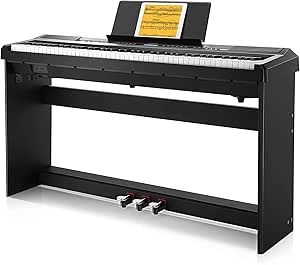
Donner DEP-20 Beginner Digital Piano – 88-Key Full-Size Weighted Keyboard with Furniture Stand and 3 Pedals
This DEP-20 is the strongest pick in this group for a beginner who wants a furniture-style piano setup from the outset. It pairs 88 weighted hammer-action keys with a stand and three pedals—sustain, soft, and sostenuto—so the playing position and pedal options feel more complete than the portable Yamaha P71’s included sustain pedal. Its 238 tones and 128-note polyphony also give it far more sound variety than the P71, while adjustable touch response lets a new player tailor key sensitivity. The backlit LCD makes settings easier to read. The tradeoff is its substantial 24.75 kg listed weight and large dimensions, which make room placement more of a commitment than with the separate, lighter Donner DEP-20 model. Choose this version for a dedicated practice spot, not frequent moves.
Pros:- Full-size weighted hammer action with adjustable touch response
- Includes a furniture stand and sustain, soft, and sostenuto pedals
- 238 tones and 128-note polyphony offer more sound range than the Yamaha P71
- Backlit LCD and MIDI/USB connectivity support setup and connected use
Cons:- At 24.75 kg, it is much less convenient to move than the other Donner DEP-20
- Its large footprint may not suit small practice areas
- A headphone amplifier volume control is not specified
Best for: Beginners setting up a permanent home practice space who want weighted keys, a furniture stand, and three pedals together
Not ideal for: Learners who need a lightweight keyboard they can move often or store in a compact room
- Keys:88
- Key action:Full-weighted hammer action with adjustable touch response
- Tones:238
- Polyphony:128 notes
- Pedals:Sustain, soft, and sostenuto
- Connectivity:MIDI, USB, auxiliary; 6.35 mm headphone jack
- Weight:24.75 kg
- Dimensions:52.36 x 11.61 x 36.99 inches
Our verdict“Choose this DEP-20 if you want a substantial, ready-to-practice home setup and have room to leave it in place.”
Donner DEP-20 88-Key Weighted Digital Piano
Compared with the stand-equipped DEP-20, this Donner version is the more flexible choice for beginners who want 88 weighted keys without committing to a furniture setup. It weighs 11.6 kg and includes a sheet music stand and sustain pedal, making it easier to reposition than its 24.75 kg counterpart, though it is still a full-width instrument. The shared 238 tones and 128-note polyphony provide a broader sound palette than the Yamaha P71, and MIDI recording plus MP3 playback add practice and playback options. Two 25W amplifiers are also listed. The compromise is that this model does not include the stand and three-pedal arrangement bundled with the other Donner. Its portable label should not be mistaken for compact: at over 52 inches long, it needs a proper place to play.
Pros:- 88 hammer-action keys with adjustable touch response support piano-style practice
- 238 tones and 128-note polyphony exceed the Yamaha P71’s sound selection
- MIDI recording and MP3 playback add useful practice functions
- Includes a sustain pedal and sheet music stand
Cons:- Does not include the stand and three pedals supplied with the other Donner DEP-20
- Its 52.17-inch length still requires substantial playing space
- At 11.6 kg, it is not effortless to carry frequently
Best for: Beginners who want weighted 88-key practice, onboard recording features, and the option to arrange their own stand or playing space
Not ideal for: Buyers seeking a complete furniture-style setup with three pedals or a genuinely compact keyboard
- Keys:88 full-size hammer-action keys
- Touch response:Adjustable
- Tones:238
- Polyphony:128 notes
- Amplifiers:Two 25W amplifiers
- Features:Dual-tone mode, backlit LCD, MIDI recording, MP3 player
- Weight:11.6 kg
- Included components:Sustain pedal, sheet music stand, power adapter, instruction manual
Our verdict“Choose this Donner if you want a feature-rich, weighted 88-key piano but prefer a more moveable unit over a bundled furniture setup.”
Yamaha PSR-E283 61-Key Portable Beginner Keyboard
The PSR-E283 is aimed at beginners who benefit from structured activities more than a weighted piano feel. Ear-training quiz games and Smart Chord give practice a more interactive starting point, while hundreds of sounds and songs, recording, and playback help keep sessions varied. Its 61 full-sized keys make it a better fit for basic keyboard learning than a miniature-key instrument, but it does not offer the full range or weighted action of the Yamaha P71 or either Donner DEP-20. That distinction matters if the learner plans to focus on classical repertoire or build acoustic-style finger strength. Unlike the JIKADA, it can run on batteries as well as an AC adapter, making it easier to use away from a wall outlet; it also lacks the JIKADA’s extensive accessory bundle and light-up keys.
Pros:- Ear-training quiz games and Smart Chord give beginners structured activities
- 61 full-sized keys provide more familiar spacing than miniature keys
- Hundreds of sounds and songs plus recording and playback add practice variety
- AC adapter or battery power offers more placement flexibility than the corded JIKADA
Cons:- 61 keys do not cover the full range of the Yamaha P71 or Donner DEP-20 models
- No weighted key action is specified
- Lacks the JIKADA’s light-up keys and bundled stand, stool, and headphones
Best for: New players who want interactive ear-training activities, Smart Chord, and a portable keyboard for basic lessons
Not ideal for: Students committed to piano technique who need weighted 88-key action or a full-range instrument
- Keys:61 full-sized keys
- Learning tools:Ear-training quiz games and Smart Chord
- Sounds and songs:Hundreds of built-in sounds and songs
- Features:Recording and playback
- Power:AC adapter or batteries
- Connectivity:Auxiliary, USB, 6.35 mm headphone jack
- Weight:8.8 pounds
- Included components:Owner’s manual, music rest, AC adapter
Our verdict“Choose the PSR-E283 for a portable, activity-led first keyboard, but choose a weighted 88-key model if piano technique is your priority.”
88-Key Digital Piano with Semi-Weighted Keys and Beginner Accessory Kit
I’d choose this model over the RockJam RJ5061 when learning songs that use the full piano range matters more than keeping the keyboard compact. Its 88 semi-weighted keys give beginners room to practice both hands across a piano-length layout, though the action won’t feel like the fully weighted keys on options such as the Yamaha P71. The included stand, headphones, sustain pedal, and carrying case make it easier to start practicing without assembling a separate kit. A large collection of tones, rhythms, and demo songs adds variety, while USB-MIDI and Bluetooth offer ways to connect with compatible devices. The tradeoff is that the abundance of sounds may distract learners focused on piano technique, and the listing gives no dimensions or weight to help plan a permanent setup.
Pros:- 88 keys provide the full range used for piano repertoire.
- Semi-weighted action offers more resistance than an unweighted beginner keyboard.
- Stand, carrying case, headphones, and sustain pedal are included.
- USB-MIDI and Bluetooth support connections with compatible devices.
Cons:- Semi-weighted keys do not replicate the feel of fully weighted piano action.
- The large tone and rhythm selection may be less useful to students focused on piano fundamentals.
- Dimensions and weight are not provided.
Best for: Beginners who want all 88 keys and a ready-to-use accessory kit, but are not yet set on fully weighted action.
Not ideal for: Learners prioritizing realistic acoustic-piano key resistance or buyers who need confirmed dimensions and weight before choosing a spot for the instrument.
- Keys:88
- Key type:Semi-weighted
- Tones:1,000
- Rhythms:1,000
- Demo songs:150
- Connectivity:USB, Bluetooth, USB-MIDI
- Included accessories:Sustain pedal, music rest, power adapter, stand, carrying case, headphones, key stickers
Our verdict“Choose this if you want a full 88-key layout and bundled setup, but skip it if realistic weighted action is your main priority.”
RockJam RJ5061 61-Key Keyboard Piano Kit with Stand, Bench, and Headphones
The RockJam RJ5061 is a practical starting point for a new player who wants a seat, stand, headphones, and lesson support in one kit. Its Simply Piano lessons and note stickers give first-time learners concrete prompts, while the 61 full-size keys keep the instrument smaller than the 88-key model in this lineup. That makes it easier to fit into a shared room, though it limits the range available for some repertoire. Compared with the Donner DEK-610S, the RJ5061 offers fewer listed tones and rhythms but adds lesson access and a pitch bend wheel for experimenting with sound. The LED panel helps with basic selections, and headphones allow quiet practice. Its battery-powered operation brings portability, but the product information does not specify battery life, so frequent practice away from an outlet may require planning.
Pros:- Stand, padded bench, headphones, and note stickers are included.
- Simply Piano lesson access gives beginners a guided starting point.
- Pitch bend wheel adds expressive control beyond basic key playing.
- 61 full-size keys keep the setup more compact than an 88-key piano.
Cons:- The 61-key range may limit practice of pieces that use the full piano keyboard.
- Battery-powered operation may mean replacing or recharging batteries during portable use.
- Its beginner-oriented feature set may not meet the needs of advancing players.
Best for: First-time learners who want a complete 61-key setup, guided app lessons, and a bench for regular home practice.
Not ideal for: Students already working on full-range piano pieces or buyers who want an 88-key instrument with piano-style weighted action.
- Keys:61 full-size keys
- Tones:200
- Rhythms:200
- Special features:Pitch bend wheel, LED panel, USB playback
- Connectivity:3.5 mm jack, auxiliary, USB
- Power source:Battery powered
- Weight:3.3 kg
- Dimensions:11.2 × 36.8 × 3.1 inches
- Included components:Keyboard, stand, bench, headphones, note stickers, sheet music stand, Simply Piano lessons
Our verdict“Pick the RJ5061 for an approachable, lesson-supported starter setup; choose an 88-key option if full piano range is a priority.”
RockJam RJ761 61 Key Keyboard Piano Kit, Stand, Stool, Sustain & Headphones
I’d favor the RockJam RJ761 over the RJ5061 when clear on-key navigation and a sustain pedal matter more than a lighter, battery-powered setup. Its touch display panel gives beginners a direct way to select sounds and rhythms, while the included stool, stand, headphones, and pedal cover the basic practice setup. The sustain pedal also helps new players shape notes and begin learning piano-style phrasing. Like the RJ5061, it has 61 keys, so it occupies less space than the 88-key semi-weighted model but cannot cover the same full range. The RJ761 supports MIDI and Simply Piano, though its proprietary operating system may limit compatibility with other learning tools. At nearly 20 pounds, it is also less convenient to move between rooms than the lighter Donner DEK-610S.
Pros:- Includes stand, padded stool, headphones, and sustain pedal.
- Touch display panel makes onboard controls easier to access.
- Simply Piano lessons and keynote stickers support early learning.
- MIDI support allows connection to compatible learning or music software.
Cons:- At 19.8 pounds, it is heavier to move than the Donner DEK-610S.
- The 61-key layout has less range than an 88-key piano.
- Proprietary operating system may restrict compatibility with third-party apps.
Best for: Beginners who want a 61-key home keyboard with a display, sustain pedal, stool, and headphones ready for practice.
Not ideal for: Players who need full 88-key range, want a highly portable keyboard, or rely on broad third-party app compatibility.
- Keys:61
- Display:Touch screen
- Built-in speaker:Yes
- Supported software:MIDI, Simply Piano
- Connectors:5-pin DIN MIDI, 3.5 mm audio jack
- Power source:Corded electric
- Weight:19.8 pounds
- Dimensions:12.8 × 36.2 × 4.4 inches
- Included accessories:Adjustable stand, padded stool, headphones, sustain pedal
Our verdict“Choose the RJ761 for a furnished practice setup and accessible controls, not for portability or full-range piano study.”
Donner DEK-610S 61-Key Beginner Keyboard Piano Kit
The Donner DEK-610S is a stronger fit than the simpler Ugrfw keyboard for beginners who want more variety and built-in learning functions without moving to an 88-key instrument. It provides 249 voices and rhythms, recording, teaching functions, app-based lessons, and two 10W speakers, giving practice more options than the Ugrfw’s 16 tones and six demo songs. Its stand, adjustable bench, music stand, and microphone also make it a broad starter bundle. The 61-key format and 32-note polyphony suit early practice, but may feel limiting as arrangements grow more complex. Unlike the battery-capable Ugrfw, this Donner requires corded power, which makes it less flexible for outdoor or room-to-room use. At 9.9 pounds, however, the keyboard itself is far easier to move than the heavier RockJam RJ761.
Pros:- Stand, adjustable bench, music stand, microphone, and power adapter are included.
- 249 voices and rhythms offer substantial variety for beginner practice.
- Recording, teaching functions, and app-based lessons support structured learning.
- Two 10W speakers and a headphone jack suit both shared and private practice.
Cons:- 61 keys provide less range than the full-size 88-key options.
- 32-note polyphony may restrict more layered or sustained passages.
- Corded power limits use away from an outlet.
Best for: Beginners who want a lightweight 61-key keyboard with lesson features, built-in speakers, and several accessories for home practice.
Not ideal for: Learners who need an 88-key range, want battery-powered play, or expect advanced performance capabilities as their skills progress.
- Keys:61
- Voices:249
- Rhythms:249
- Demo songs:50
- Polyphony:32 notes
- Built-in speakers:Two 10W speakers
- Power source:Corded electric
- Weight:9.9 pounds
- Included components:Keyboard stand, adjustable bench, sheet music stand, microphone, power adapter
Our verdict“Choose the DEK-610S for a feature-rich, lightweight home starter kit, but look elsewhere for battery use or full piano range.”
Ugrfw 61-Key Portable Digital Piano Keyboard with Speaker and Microphone
The Ugrfw 61-Key Portable Keyboard makes most sense for a beginner who values straightforward play and the option to use batteries over a deep set of teaching features. It has 16 tones, drum accompaniments, six demo songs, and recording and playback, which is a simpler toolkit than the Donner DEK-610S’s 249 voices and rhythms. That smaller selection can be an advantage for a child or casual learner who may find extensive menus distracting. A built-in speaker, LCD screen, microphone, and sheet stand cover basic practice and sing-along use. Its 61 keys are less suitable for full-range piano study than the 88-key semi-weighted model in this roundup. AA batteries are not included, and the supplied information does not state the keyboard’s weight, so portable use may require extra planning.
Pros:- Can run from a power adapter or AA batteries for use away from an outlet.
- Recording and playback let beginners listen back to their practice.
- Includes a wired microphone and sheet stand.
- LCD screen, built-in speaker, and adjustable volume support simple operation.
Cons:- Only 16 instrument tones and six demo songs offer less variety than the Donner DEK-610S.
- AA batteries are not included.
- The 61-key layout is less suitable for full-range piano repertoire.
Best for: Casual beginners or families seeking a basic 61-key keyboard for simple practice, singing, and occasional battery-powered use.
Not ideal for: Students following a structured piano curriculum who need a full 88-key range, broad lesson tools, or a more developed selection of sounds.
- Keys:61
- Instrument tones:16
- Demo songs:6
- Features:Built-in speaker, LCD screen, adjustable volume, recording and playback
- Power options:Power adapter or 1.5V AA batteries (not included)
- Dimensions:29.5 × 8.7 × 2.3 inches
- Included components:Power supply, sheet stand, wired microphone
Our verdict“Pick this for simple, flexible keyboard play and microphone use, but choose a more fully featured model for sustained piano study.”
How We Picked
I ranked these digital pianos for beginners by how well their key layout and action support early learning, then considered setup, portability, included accessories, and flexibility for practice. An 88-key model has a broader range for lessons and repertoire, while weighted keys can help beginners build a touch closer to an acoustic piano. Neither feature is automatically right for every buyer: a compact 61-key keyboard can be easier to place, carry, and use for casual exploration.
The ranking favors options with a clear learning advantage, not simply the longest accessory list. That puts the Yamaha P71 and the full-size Donner DEP-20 ahead for piano-focused practice, while portable models earn their place when space, movement, or varied keyboard activities matter more. Semi-weighted and 61-key options rank lower for traditional piano study, though they may be more practical for some households. I also distinguish between similarly named listings and avoid treating an included stand, bench, or microphone as a substitute for an appropriate keyboard action.
Factors to Consider When Choosing Digital Pianos For Beginners
Before choosing, I’d match the keyboard to the kind of practice you expect to do, rather than buying by key count or bundle size alone. These factors can help you judge whether a compact starter setup will be enough or whether a more piano-like instrument is a better foundation.
Choose Key Action for Your Learning Goal
Key action affects how a keyboard responds under your fingers, which can shape both comfort and technique as you learn. Weighted keys offer more resistance and are generally a better match for piano lessons and repertoire that develops finger control. Semi-weighted keys sit between weighted and light, synth-style keys, but the feel can vary, so the label alone does not tell the whole story. A common mistake is choosing an 88-key instrument and assuming it will feel like an acoustic piano; key count and action are separate decisions. If piano is your main goal, prioritize the action before built-in sounds or a large accessory bundle. If you mainly want to explore melodies and play casually, lighter keys may be easier and more inviting.
Decide Whether You Need 61 or 88 Keys
88 keys give you the full piano range, which is useful for lessons, advanced pieces, and practicing without running out of notes. A 61-key keyboard can still support early learning and casual playing, but you may need to adapt some pieces or move octaves as your repertoire grows. More keys also mean a larger footprint, so measure the intended space rather than relying on a product photo. Buyers sometimes overestimate how quickly they will need a full range, while others underestimate how soon lessons may call for it. If you have room and expect to study piano for the long term, full-size keys can reduce the chance of outgrowing the instrument. If easy storage or transport is the priority, a 61-key model may be the more usable choice.
Treat Portability and Furniture Setup as Different Needs
A portable keyboard is useful when you need to put it away, carry it between rooms, or use it in more than one place. A furniture-style stand and pedal setup can make a home instrument feel more settled and keep regular practice in one dedicated spot. These approaches solve different problems: portability favors flexibility, while a permanent setup favors convenience during daily practice. Before buying, check whether the keyboard needs a separate stand, whether the stand is included, and whether your chosen seat puts your arms at a comfortable height. A bundle may save setup effort, but included benches and stands can vary in fit and stability. Choose the arrangement you can use consistently, not just the one with the most pieces in the box.
Compare Accessories by Their Practical Use
Beginner bundles often include items such as a stand, bench, headphones, sustain pedal, or microphone. The most useful accessories depend on your routine: headphones help with quiet practice, a sustain pedal supports piano repertoire, and a stable stand keeps the keyboard at a workable height. A microphone is less relevant if you plan to focus on lessons and piano technique rather than singing or playing socially. Do not let a long accessory list distract from the keyboard’s action, range, or basic setup needs. Also check exactly which accessories are included in the specific listing, since similar model names can refer to different packages. If you already own a stand or headphones, a simpler keyboard may be a better match than a bundle that duplicates them.
Prioritize Practice Features Over Extra Sounds
Built-in sounds and features can make practice more engaging, but they are not all equally useful to a beginner. A straightforward piano sound, a clear volume control, and a way to practice without disturbing others may matter more than a long list of voices. More sounds can suit players who want to experiment, while lesson-focused learners may benefit most from an easy, uncomplicated setup. Consider where you will practice and whether the keyboard supports that routine with the controls and connections you need. Avoid paying extra attention to feature counts without asking whether those features will help you play more often. The best beginner instrument is one whose controls and sound options encourage practice rather than adding friction.
Think About How Long You Expect to Keep It
A starter keyboard can be a sensible choice when you are testing interest, but the cheapest-to-set-up option may not support your goals for long. If you are beginning lessons or already know you want to study piano, spending more attention on full-size range and weighted action may reduce the need to replace the instrument as your skills grow. If you are unsure, portability and a simple setup can make experimentation easier without committing to a larger home arrangement. Consider not only how you play today but also whether you expect to learn two-handed pieces, use pedals, or move the instrument. A realistic plan is more helpful than buying for an imagined future level. Match the instrument to your likely next stage, while leaving room for your practice habits to develop.
Frequently Asked Questions
Should I choose an 88-key keyboard even if I am just starting?
Choose 88 keys if you expect to take piano lessons, learn full-range pieces, or keep the instrument as your skills develop. A beginner can learn on 61 keys, especially when portability or space is a bigger concern, but some music may require octave adjustments. Full-size range is most useful when paired with an action that suits your goals; 88 keys by itself does not promise a piano-like feel. If you are undecided, think about where you will store and play the keyboard every day. A model that fits your room and routine is more useful than one that stays packed away.
Are semi-weighted keys good enough for learning piano?
Semi-weighted keys can work for beginners who want a lighter, more versatile keyboard or are not yet sure they will focus on piano. They usually do not provide the same resistance as weighted keys, so they may be a less direct match for developing touch on an acoustic piano. The difference matters more when lessons and piano technique are central to your plans. If you mainly want to play casually, explore sounds, or keep the keyboard easy to move, semi-weighted action may be a reasonable compromise. Compare action alongside key count rather than treating either feature as a complete measure of suitability.
Is a keyboard bundle a better first purchase than buying the instrument alone?
A bundle can simplify setup if it includes the items you actually need, such as a stable stand, a suitable seat, or headphones for quiet practice. It is not automatically the better choice: accessories vary, and an extra microphone or other item may matter little for piano lessons. Check whether the listing includes a sustain pedal and whether the stand and bench fit your intended setup. If you already own some accessories, compare the package against a keyboard that better fits your preferred key action. Put the instrument’s learning suitability ahead of the number of included items.
Which matters more for a beginner: weighted keys or portability?
It depends on where and how you expect to practice. Weighted keys deserve priority if your goal is piano technique and you have a stable place to keep the instrument. Portability matters more if the keyboard must be stored after each session, moved between rooms, or carried elsewhere. A keyboard that is difficult to set up can discourage regular practice, even if its action is a better fit on paper. Consider your actual space and routine, then decide which compromise you will notice most often.
When should I spend more on a full-size piano-style setup?
A full-size setup makes more sense when you are committed to lessons, want to practice a broad range of piano music, or expect to keep the instrument as your skills progress. The P71 and Donner DEP-20 illustrate different priorities: one centers on weighted-key practice, while the DEP-20 adds a more furniture-like setup and three pedals. Paying more for a fixed arrangement may not help if you need to store the keyboard frequently. Likewise, a bundle cannot make semi-weighted keys feel like a weighted action. Spend toward the feature that addresses your main limitation, whether that is key feel, full range, or a ready-to-use home setup.
Conclusion
For most piano-focused beginners, I recommend the Yamaha P71 as the best overall because its 88 weighted keys make it a strong starting point for learning piano technique. The Donner DEP-20 is my best value-style home setup for buyers who want weighted keys alongside a furniture stand and three pedals, while the Yamaha PSR-E283 is the best fit for portable, feature-rich exploration. For a beginner seeking a dedicated piano-style arrangement, I’d choose the DEP-20 configuration that includes the stand and pedals; for an easy-to-move first keyboard, I’d look at the 61-key RockJam or Donner DEK-610S kits. My best premium recommendation within this lineup is the full-size weighted option that best suits your setup—the DEP-20 with furniture and pedals for a more complete home station. If piano technique is the priority, choose weighted keys and full range; if space and portability come first, select a 61-key model and accept its limits as your repertoire grows.