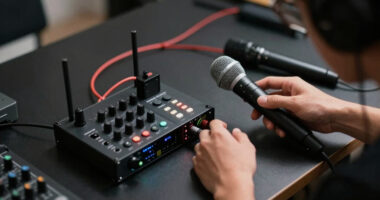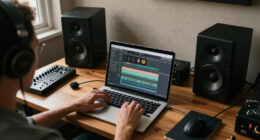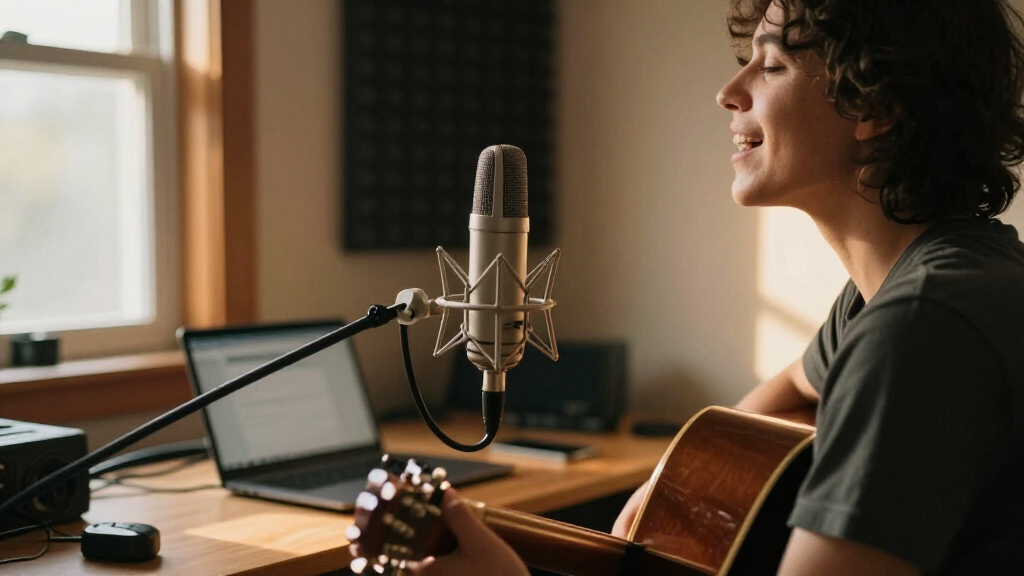

For home recording setups, selecting the right microphone is a crucial step toward achieving professional-sounding results. The two most common types are condenser microphones and dynamic microphones, each with distinct characteristics that influence their suitability for different recording scenarios. Condenser microphones are known for their sensitivity and ability to pick up fine details, making them ideal for vocals and studio instruments. Dynamic microphones, on the other hand, are more rugged, handle high sound pressure levels better, and often provide a more focused pickup pattern. This comparison explores the key differences, helping you decide which microphone type aligns best with your recording needs, environment, and budget. If you prioritize capturing every nuance of your vocals or instruments, a condenser might be preferable. Conversely, if you need durability, noise rejection, and versatility, a dynamic microphone could be the better choice.

Get audio and creator gear delivered free — and shop member deals
- Fast, free delivery on millions of items
- Access to Prime Big Deal Days deals on October 6–7
- Prime Video, Amazon Music and more included

FIFINE AmpliTank K688CT Podcast Microphone Kit, USB/XLR Dynamic Vocal Mic
- ✔ Connectivity Technology: USB, XLR
- ✔ Polar Pattern: Unidirectional
- ✔ Frequency Response: 50Hz-16KHz

ZealSound Podcast Microphone for PC, Noise Cancellation USB Mic with Gain, Volume Adjustment & Mute Button, Monitoring & Echo, fo…
- ✔ Frequency Response: 40Hz–18kHz
- ✔ Sampling Rate: 46kHz
- ✔ Sensitivity: –45dB ±3dB

FIFINE T669 Studio Condenser USB Microphone for Recording and Podcasting
- ✔ Connection: USB
- ✔ Frequency Response: Wide
- ✔ Polar Pattern: Cardioid
At a Glance
| Criteria | Condenser Microphone | Dynamic Microphone | Winner |
|---|---|---|---|
| Sound Quality & Sensitivity | High sensitivity and detailed sound reproduction, excellent for vocals and studio instruments | Less sensitive, more focused sound, strong in handling loud sources | A |
| Durability & Build Quality | Generally fragile, requires careful handling and protection | Robust, designed for tough environments and frequent use | B |
| Price Range | Typically higher, especially for premium models | More affordable, even at high quality levels | Depends |
| Ideal Use Cases | Vocals, studio recordings, acoustic instruments | Live performances, loud sound sources, rough environments | A |
| Handling Noise & Environment Suitability | Less tolerant—prone to picking up ambient noise | Better noise rejection, less ambient sound pickup | B |
| Size & Portability | Varies, often larger and requires stable placement | Compact and portable, easy to move around | B |
| Power Requirements | Requires phantom power (48V) for many models | No external power needed | B |
| Frequency Response | Wide frequency response capturing nuances | Limited but sufficient for most loud sources | A |
FIFINE AmpliTank K688CT Podcast Microphone Kit, USB/XLR Dynamic Vocal Mic
<p>The <strong>FIFINE AmpliTank K688CT</strong> stands out for its flexible connectivity options, seamlessly switching between USB and XLR to accommodate different setups. Its included accessories—sturdy boom arm, windscreen, shock mount—make it a comprehensive package for home recording. Compared with the simpler FIFINE T669, this model offers more control and professional features, but the tradeoff is the need for an external audio interface when using XLR, which adds complexity. The noise reduction and intuitive controls make it a good fit for users who want flexibility and a professional touch, but all functions are limited to USB when plugged in via USB, and XLR controls require additional gear.</p>
Pros:
- Versatile connectivity with USB and XLR options
- Includes essential accessories like boom arm, windscreen, shock mount
- Noise reduction and intuitive controls for easy operation
Cons:
- All function keys disabled in XLR mode
- Requires separate interface for XLR control
- Some features only accessible via USB
Best for: Users who want flexibility in connectivity and are ready to manage a more complex setup.
Not ideal for: Beginners seeking a simple, all-in-one solution or those with limited space for additional equipment.
Bottom line: A highly flexible microphone kit suited for users who want professional-grade options without sacrificing versatility.
“A highly flexible microphone kit suited for users who want professional-grade options without sacrificing versatility.”
ZealSound Podcast Microphone for PC, Noise Cancellation USB Mic with Gain, Volume Adjustment & Mute Button, Monitoring & Echo, fo…
<p>The <strong>ZealSound K66</strong> delivers studio-quality broadcast sound through a high-performance condenser capsule and a cardioid pattern. Its suite of features—noise reduction, zero-latency monitoring, and customizable sound controls—are designed for serious content creators who want professional results straight out of the box. Compared with the FIFINE T669, it offers more advanced sound management and monitoring options, but this added complexity can be overwhelming for beginners. Its exclusive USB connectivity limits flexibility but simplifies setup, making it ideal for creators who prioritize sound quality and real-time control across multiple devices.</p>
Pros:
- Studio-quality sound with noise reduction
- Real-time zero-latency monitoring
- Adjustable gain and echo controls for fine-tuning
Cons:
- Complex feature set may be intimidating for new users
- Limited to USB connection, no XLR option
- Mute button can be accidentally activated
Best for: Content creators who need high-end broadcast sound with professional features and are comfortable with a more complex interface.
Not ideal for: Beginners or users seeking a simple plug-and-play microphone without advanced controls.
Bottom line: An excellent choice for experienced content creators demanding broadcast-quality sound with extensive control features.
“An excellent choice for experienced content creators demanding broadcast-quality sound with extensive control features.”
FIFINE T669 Studio Condenser USB Microphone for Recording and Podcasting
<p>The <strong>FIFINE T669</strong> is the go-to choice for those seeking straightforward, high-quality recording without fuss. Its simple USB connection and included accessories—boom arm, pop filter, shock mount—make it easy to set up and start recording. Compared with the FIFINE AmpliTank K688CT, it lacks the XLR options but offers a more streamlined experience suitable for beginners or casual users. It performs well for vocals, podcasts, and voiceovers, but it can pick up ambient noise if not positioned carefully, and it’s incompatible with Xbox consoles.</p>
Pros:
- Plug-and-play USB connection for quick setup
- Includes comprehensive accessories for professional sound
- Delivers clear, high-quality audio
Cons:
- Incompatible with Xbox consoles
- May pick up ambient noise if not well-positioned
- Limited control features compared to more advanced models
Best for: Beginners or casual users who want an easy, reliable USB microphone with minimal setup.
Not ideal for: Producers needing XLR connectivity or advanced control features.
Bottom line: An excellent, user-friendly microphone perfect for home recording beginners and casual content creators.
“An excellent, user-friendly microphone perfect for home recording beginners and casual content creators.”
As an Amazon Associate we earn from qualifying purchases.
Key Differences
The core distinction between condenser and dynamic microphones lies in their sensitivity and durability. Condenser microphones are designed to capture subtle details and a broad range of frequencies, making them perfect for vocals, acoustic guitars, and studio instruments where nuance matters. However, this sensitivity also means they are more susceptible to ambient noise and require a controlled environment to perform optimally. Dynamic microphones, by contrast, are built to withstand high sound pressure levels and rough handling, making them the go-to choice for loud sources and less controlled spaces. They tend to have narrower frequency responses tailored for focused sound capturing, which can sometimes result in a less detailed but more robust recording. This tradeoff influences not only the sound quality but also the practicality of use in a typical home studio.
Choosing between them depends heavily on your primary recording targets. For vocalists or detailed instrument recordings in a quiet space, a condenser offers superior fidelity. For recording loud sources, handling multiple takes, or working in less-than-ideal acoustic environments, a dynamic microphone’s resilience and noise rejection become more valuable. Understanding these practical implications can help you select a microphone that aligns with your recording style and environment, ensuring you get the best results without unnecessary investment or hassle.
Detailed Comparison
Sound Quality & Sensitivity (Condenser Microphone wins — major)
Condenser microphones provide a broader and more accurate frequency response, capturing subtle nuances and high-frequency details that bring vocals and acoustic instruments to life. This makes them the preferred choice for studios aiming for high fidelity. Dynamic microphones, while capable of handling loud sources, tend to have a narrower frequency response and less sensitivity, which can result in a less detailed sound but often with a natural, punchy character. If your priority is capturing every detail, condensers are the clear winner. For more straightforward, robust recordings where extreme detail is less critical, dynamics suffice.
Durability & Build Quality (Dynamic Microphone wins — moderate)
Dynamic microphones are generally more rugged, built to withstand drops, rough handling, and challenging environments common in live settings. Their sturdy construction makes them suitable for frequent movement and less controlled spaces. Condenser microphones are more delicate, with fragile capsules that can be damaged by impact or extreme environmental conditions, requiring careful handling and protection. If your setup involves frequent transport or less controlled environments, a dynamic microphone offers better reliability. For stationary studio setups, this difference is less impactful.
Price Range (Dynamic Microphone wins — moderate)
In terms of cost, dynamic microphones tend to be more affordable at comparable quality levels, making them accessible for beginners or those on a tight budget. Condenser microphones, especially those with premium components, can be significantly more expensive. This price difference reflects their specialized design and sensitivity. For users prioritizing affordability without sacrificing too much quality, dynamics provide a cost-effective solution. For those seeking high-end fidelity or specific recording features, investing in a condenser might be justified.
Ideal Use Cases (major difference)
Condenser microphones are best suited for controlled environments like home studios, capturing vocals, acoustic instruments, and detailed sound sources. They excel in settings where capturing nuance and clarity is essential. Dynamic microphones shine in loud environments, such as recording guitar amps, drums, or live vocals, and are well-suited for rougher environments or portable setups. If your primary focus is studio vocal recordings, condensers are preferable. For capturing loud, aggressive sounds or working in less controlled spaces, dynamics are more appropriate.
Handling Noise & Environment Suitability (Dynamic Microphone wins — moderate)
Condenser microphones are more sensitive to ambient noise and handling noise, which can be problematic in less controlled spaces. They require a quiet environment and careful placement. Dynamic microphones have better rejection of ambient sounds and handling noise, making them more forgiving in noisy or unpredictable environments. If your recording space is noisy or you need to mic on the go, dynamics are advantageous. Conversely, for a dedicated, quiet recording space, condensers perform best.
Size & Portability (Dynamic Microphone wins — minor)
Dynamic microphones are generally more compact, lighter, and easier to transport, making them suitable for mobile setups or quick recordings in different locations. Condensers are often larger, with external power requirements, and less portable. If portability is a key factor, dynamic microphones provide clear advantages. For fixed studio installations, size and portability are less critical.
Power Requirements (Dynamic Microphone wins — minor)
Most condenser microphones require phantom power (usually 48V) supplied through the audio interface or mixer. Dynamic microphones do not need external power and are ready to use immediately. For users with simple setups or limited equipment, dynamics are more straightforward, while condensers require compatible interfaces or preamps.
Frequency Response (Condenser Microphone wins — major)
Condenser microphones typically have a wider and flatter frequency response, capturing a more natural and detailed sound, especially in the high frequencies. Dynamic microphones have a narrower response tailored for specific sources, often emphasizing midrange or bass, which can add character but limit nuance. For capturing authentic, detailed vocals, condensers win. Dynamics are suitable when a focused, punchy sound is desired or for loud sources where high-frequency detail is less critical.
Condenser Microphone: Pros and Cons
Pros:
- Excellent detail and frequency response for vocals and acoustic instruments
- Highly sensitive, capturing nuances and subtle sounds
- Ideal for studio environments with controlled acoustics
Cons:
- Fragile and delicate, prone to damage if mishandled
- Requires phantom power and careful placement
- More expensive at higher quality levels
Dynamic Microphone: Pros and Cons
Pros:
- Durable and tough, suitable for rough handling and live use
- More affordable, offering good quality at lower cost
- Less sensitive to ambient noise, better for noisy environments
Cons:
- Less detailed sound with narrower frequency response
- Can sound less natural or ‘flat’ compared to condensers
- Bulkier and less elegant for studio aesthetics
Who Should Choose What
Choose Condenser Microphone if:
- You primarily record vocals or acoustic instruments in a quiet, controlled environment
- You want the highest fidelity and nuance in your recordings
- You have a dedicated, stationary home studio setup
Choose Dynamic Microphone if:
- You need a microphone that can handle loud sources or rough handling
- You record in noisy or unpredictable environments
- Portability and durability are priorities, or you’re on a tight budget
Value for Money
For users with a dedicated home studio aiming for professional-quality vocals and detailed instrument recordings, investing in a condenser microphone often provides better value despite higher cost. It captures more nuance and offers superior sound clarity. Conversely, for casual users, beginners, or those working in less controlled spaces, dynamic microphones offer better value due to their durability, lower cost, and noise rejection. Overall, the choice depends on your primary recording needs and environment, with condensers suited for quality-focused setups and dynamics for robustness and versatility.Final Verdict
If your focus is on high-quality vocal recordings, detailed instrument capture, and you have a quiet, controlled space, a condenser microphone is the best choice, justifying the higher investment. For those needing a versatile, durable, and budget-friendly option capable of handling louder sounds and less ideal conditions, a dynamic microphone provides better value and practicality. Ultimately, the decision hinges on your recording environment, target sound quality, and budget constraints. For most home studio enthusiasts aiming for clarity and nuance, condensers are recommended. For casual, portable, or noisy environment recording, dynamics are preferable.
Frequently Asked Questions
Can I use a dynamic microphone for vocals in a home studio?
Yes, a dynamic microphone can be used for vocals and often provides a focused, natural sound. It’s especially useful if your room isn’t well treated or if you prefer a more robust, less sensitive mic that rejects background noise.
Do condenser microphones require special equipment?
Most condenser microphones need phantom power (48V), which is supplied by many audio interfaces and mixers. Ensure your setup can provide phantom power before purchasing a condenser mic.
Are dynamic microphones suitable for recording acoustic guitar?
While possible, dynamic microphones are less ideal for capturing the full detail of acoustic guitars. Condenser microphones generally produce a more natural and detailed sound for such instruments.
Which microphone type is better for podcasting at home?
If your environment is noisy or untreated, a dynamic microphone is often better because of its noise rejection and durability. For quieter spaces, a condenser can capture clearer, more detailed vocals.
Can I upgrade from a dynamic to a condenser microphone later?
Yes, many home studio owners start with dynamics and later upgrade to condensers for higher fidelity. Ensure your interface supports phantom power if you choose a condenser later.
Fall Picks
fall essentials
As an affiliate, we earn on qualifying purchases.