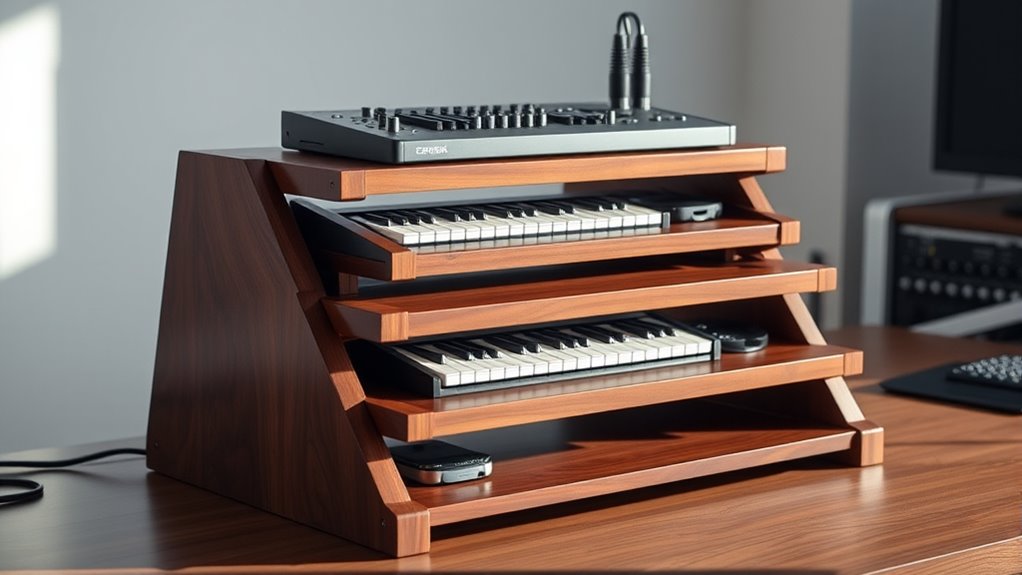

If you are comparing tiered desk synth stands, my best overall pick is the XTS 2-Tier Desktop Stand for its adjustable width and stated 30-pound capacity. The Headliner 3-Tier Desktop Synth Stand suits players who need more levels on the desk, while the Gator Frameworks 3-Tier A-Frame is a better fit when a freestanding keyboard-style frame makes more sense. The main tradeoff is between flexible, general-purpose support and stands shaped for particular instruments or layouts. Compact, model-specific mounts can save space but limit what you can place on them. Read on for the full breakdown of what each design offers and where its compromises matter.

Get audio and creator gear delivered free with Prime
- Fast, free delivery on millions of items
- Prime Video, Amazon Music and more included
- Member-only deals all year
Complete the kit


Key Takeaways
- The XTS stand leads for flexible desktop use: its stated 10.6-to-18.5-inch adjustment range and 30-pound capacity make fit and load more adaptable than a fixed, instrument-specific mount.
- More tiers do not always mean a better desk setup: the Headliner and Liquid Stands models add levels, but their larger layouts call for more room and a clear plan for access to controls.
- Instrument-specific stands trade flexibility for a closer fit: the Roland Boutique, Behringer D Mini-family, and Korg Volca options are aimed at defined device families rather than a changing gear collection.
- The Gator and Liquid Stands picks serve a different footprint: their A-frame or wheeled keyboard-stand formats suit setups that need a freestanding structure, not just a compact desktop riser.
- Capacity and dimensions deserve more attention than tier count: check the weight and footprint of every device, then leave room for cables and hands before choosing a stand.


| desksynth stands tiered | Material | Levels | Item weight | Color |
|---|---|---|---|---|
| XTS 2-Tier Desktop Stand | Alloy steel, described as 100% solid steel | 2 | 3.86 kg | — |
| Adjustable Desktop Stand for S | Cold-rolled steel | 2 | 0.85 kg | — |
| 2-Tier 3D Printed Angled Deskt | PLA+ | 2 | — | — |
| Gator Frameworks 3-Tier A-Fram | Steel | 3 | — | — |
| Headliner 3-Tier Desktop Synth | Alloy steel | 3 | 5.44 kg | Black |
| 2-Tier Angled Desktop Stand fo | PLA | — | 15 ounces | Black |
| 2-Tier Gen 3 Desktop Stand for | 3D-printed polymer | — | — | Black |
| Liquid Stands 3-Tier Keyboard | Alloy steel | — | — | Black |
More Details on Our Top Picks
XTS 2-Tier Desktop Stand – Adjustable 10.6″ to 18.5″, up to 30 lb
For a desk-based setup that needs sturdy, adjustable tiers without moving to a full keyboard frame, I’d put the XTS 2-Tier Desktop Stand near the top. Its steel build and 30 lb capacity give it more stated headroom than the similar adjustable black steel stand, which supports 25 lb. The width adjusts from 10.6 to 18.5 inches, so it can suit a range of compact instruments while the upper tier frees space below. The tradeoff is portability: at 3.86 kg, it is substantially heavier than that 0.85 kg alternative, so frequent rearranging is less appealing. It is also a desktop stand, not a substitute for the Gator Frameworks floor stand when you need room for full-sized keyboards or a much higher load capacity.
Pros:- Solid steel construction with a stated 30 lb load capacity.
- Adjustable 10.6–18.5-inch length accommodates a range of devices.
- Two tiers free desk surface and separate instruments vertically.
- Brushed silver finish offers an alternative to the matte black adjustable stand.
Cons:- At 3.86 kg, it is heavy to move or pack for travel.
- The 30 lb limit rules out some larger or heavier equipment.
- Device dimensions still need to fit the stand’s adjustment range.
Best for: Home-studio owners who want an adjustable two-tier stand for compact synths or controllers and value a heavier steel build over easy portability.
Not ideal for: Musicians who frequently pack down their desk, or anyone mounting larger gear that exceeds the 30 lb limit or the 18.5-inch adjustment range.
- Brand:ANALOG CASES
- Model:XTS2TIER
- Levels:2
- Load capacity:30 lb
- Adjustment range:10.6–18.5 inches
- Material:Alloy steel, described as 100% solid steel
- Finish and color:Brushed silver
- Item weight:3.86 kg
Our verdict“Choose the XTS if you want the strongest stated capacity among the adjustable desktop options and can leave a heavier stand in place.”
Adjustable Desktop Stand for Samplers, Synthesizers, Drum Machines, and Effects Units (2-tier, 10.6-18.5 in Width)
This adjustable two-tier stand suits buyers who want a flexible desk layout but would rather not handle the XTS’s nearly 4 kg steel frame. At 0.85 kg, this model is much easier to reposition, while its telescopic rods cover the same 10.6–18.5-inch range. Cold-rolled steel and front support lips address two practical needs: a firm frame and some help keeping devices from shifting during operation. The compromise is its lower 25 lb capacity, five pounds below the XTS, so I’d reserve it for lighter gear. Its product details also don’t specify cable management, and buyers need to check their device dimensions before ordering. Compared with Headliner’s three-tier stand, this is a more adjustable but lower-capacity choice with fewer levels.
Pros:- Light 0.85 kg build is easier to reposition than the XTS.
- Telescopic width adjustment covers 10.6–18.5 inches.
- Front support lips help keep devices secure during use.
- Matte black powder coating gives the steel frame a subdued finish.
Cons:- 25 lb load capacity is lower than the XTS’s 30 lb limit.
- The adjustable range still requires careful device measurement.
- No cable-management feature is specified.
Best for: Producers with compact samplers, effects units, or synths who often rearrange a desk and need an adjustable two-tier frame that is easy to move.
Not ideal for: Owners of heavier instruments who need the XTS’s higher stated capacity, or anyone whose device falls outside the 10.6–18.5-inch range.
- Levels:2
- Width adjustment:10.6–18.5 inches
- Load capacity:25 lb
- Material:Cold-rolled steel
- Finish:Matte black powder-coated
- Item weight:0.85 kg
- Support feature:Front support lips
Our verdict“Pick this stand over the heavier XTS when easy repositioning matters more than the extra five pounds of stated capacity.”
2-Tier 3D Printed Angled Desktop Mounting Stand for Roland Boutique Synthesizers
If your setup centers on compatible Roland Boutique modules, this purpose-fit stand is a more targeted answer than either adjustable steel desktop option. Its angled, two-tier mounting points are designed around specified Roland models, which can provide a more tailored fit than a general-purpose stand whose width must be adjusted and checked. The PLA+ construction and revised attachment points are intended to keep the instruments supported while making controls easier to reach. That specialization is also the main limitation: it is not a flexible home for arbitrary synths, and the listing explicitly excludes the JD-08 and SE-02. Unlike the XTS, no load capacity or adjustable width is provided in the supplied specs, so I wouldn’t treat it as a universal stand or infer a weight limit.
Pros:- Designed for a defined range of Roland Boutique synthesizers.
- Angled two-tier layout presents controls in an accessible position.
- PLA+ construction and updated attachment points are intended to improve fit and stability.
- Made in the USA.
Cons:- Does not fit Roland JD-08 or SE-02.
- Narrow model-specific compatibility makes it less adaptable than the XTS.
- No load capacity or dimensional adjustment range is listed in the supplied data.
Best for: Owners of the listed Roland Boutique models who want a dedicated angled two-tier mount rather than an adjustable universal stand.
Not ideal for: Musicians with a JD-08, SE-02, non-Roland gear, or a changing collection that needs adjustable width and broad compatibility.
- Levels:2
- Design:Angled mounting stand
- Material:PLA+
- Manufacture:Made in the USA
- Compatible models:Roland Boutique A-01, D-05, JP-08, JU-06, JU-06A, JX-03, JX-08, SH-01A, TB-03
- Excluded models:Roland JD-08 and SE-02
- Generation:Second generation
Our verdict“Choose this dedicated mount only if your Roland Boutique model is on the compatibility list and you prefer a tailored fit to universal adjustability.”
Gator Frameworks 3-Tier A-Frame Keyboard Stand
The Gator Frameworks stand belongs in this roundup as the option for a much larger rig, not as a direct desktop substitute. Its three-tier A-frame supports up to 210 lb across as many as three full-sized keyboards, far beyond the compact instruments and stated capacities of the XTS or the lightweight adjustable desktop stand. Adjustable height, width, and arm depth let buyers fit a more substantial stage or studio arrangement; locking pins and non-slip feet add stability for that use. The scale brings real costs: assembly may take more effort, and the stand’s weight makes it less convenient to transport than desk-mounted alternatives. Its width and arm-depth ranges also mean keyboard fit needs checking. I’d skip it for a small desktop setup where its floor-standing footprint is unnecessary.
Pros:- Supports up to 210 lb and accommodates as many as three keyboards.
- Adjustable height, width, and arm depth allow a range of keyboard configurations.
- Locking pins and non-slip rubber feet support a secure floor setup.
- Steel construction and a limited lifetime warranty are specified.
Cons:- Assembly may be complex compared with the desktop stands.
- Heavy construction is less convenient for frequent transport.
- Keyboard dimensions must fit the stated width and arm-depth ranges.
Best for: Keyboard players building a studio or stage rig with multiple full-sized instruments and needing an adjustable, high-capacity floor stand.
Not ideal for: Desk-based producers with compact synths, limited floor space, or a setup that needs quick, lightweight portability.
- Levels:3
- Weight capacity:210 lb (95.25 kg)
- Maximum height:58 inches (147.3 cm)
- Width range:21.2–33.7 inches (53.8–85.6 cm)
- Arm depth range:12.5–21 inches (31.8–53.3 cm)
- Material:Steel
- Stability features:Locking pins and non-slip rubber feet
- Warranty:Limited lifetime
Our verdict“Choose the Gator when your priority is a stable, adjustable floor rig for multiple full-sized keyboards rather than a compact desk stand.”
Headliner 3-Tier Desktop Synth Stand (HL22053)
When two tiers leave too many instruments competing for desk space, the Headliner 3-Tier Desktop Synth Stand adds another level without moving to the Gator’s full-sized floor frame. Its V-shaped steel structure, angled layout, and non-slip pads are intended to organize several devices while keeping their controls accessible. That makes it a stronger fit for a settled multi-device desk than the XTS, which offers adjustable width and a 30 lb capacity but only two levels. The tradeoff is flexibility: the supplied Headliner details don’t list an adjustment range or load capacity, so buyers have less information for checking fit and weight. At 5.44 kg, it is also heavier than the adjustable black stand, making it less appealing if the desk is frequently rearranged.
Pros:- Three levels organize more devices than the XTS’s two-tier layout.
- Angled design helps keep knobs and screens accessible.
- Steel construction and non-slip rubber pads support a stable desktop arrangement.
- V-shaped form separates devices across the tiers.
Cons:- At 5.44 kg, it is cumbersome to move frequently.
- No load capacity or adjustment range is listed in the supplied specs.
- Three tiers may not suit larger gear or a desk with limited vertical clearance.
Best for: Producers who keep several compact synths, controllers, or drum machines on one desk and want three angled levels in a steel stand.
Not ideal for: Buyers who need a specified adjustable width or load limit, or who regularly move their stand between rooms or venues.
- Model:HL22053
- Brand:Headliner Los Angeles
- Levels:3
- Material:Alloy steel
- Item weight:5.44 kg
- Dimensions:17.55 × 17.55 × 1.75 inches
- Color:Black
- Shape:V-shape
Our verdict“Choose the Headliner if fitting more devices on a stationary desktop matters more than adjustable sizing or easy portability.”
2-Tier Angled Desktop Stand for Behringer D Mini, JT Mini, Pro VS, Phara-O, UB-Xa, CZ-1 Synthesizers
This stand is the most specialized desktop option in this group: its 20° lower shelf and 80° upper shelf arrange two compatible Behringer synths in a compact footprint, keeping the upper controls visible without taking up a separate tier of floor space. Silicone pads help limit movement, while the triangular 3D-printed frame suits a small studio desk. Compared with the broader-fit XTS 2-Tier Desktop Stand, this one trades adjustability and wide compatibility for a model-specific arrangement. That makes it a better fit when the listed Behringer units are already part of your setup, but a poor choice for other synths. Its PLA construction is practical for this purpose, though visible print layers and color variation are expected, and it is not an official Behringer accessory.
Pros:- Angled two-level layout holds two compatible synths while conserving desk space.
- Silicone pads help keep the stand and instruments from slipping.
- Compact triangular shape fits small studio work surfaces.
- Custom-fit design targets several specific Behringer models.
Cons:- Compatibility is limited to the listed Behringer synth models.
- Visible layer lines and slight color variation can affect the finish.
- It is not an official Behringer product, which may confuse shoppers expecting a manufacturer accessory.
Best for: Behringer owners using two listed D Mini, JT Mini, Pro VS, Phara-O, UB-Xa, or CZ-1 synths on a crowded desktop.
Not ideal for: Players with other synth brands or models, or anyone who needs adjustable shelf spacing and a factory-finished appearance.
- Number of levels:2
- Material:PLA
- Color:Black
- Shape:Triangular riser
- Manufacturing process:3D printed
- Item weight:15 ounces
- Made in:USA
Our verdict“Choose this stand for a compact two-synth Behringer setup, but pick a more adjustable desktop stand if your instruments may change.”
2-Tier Gen 3 Desktop Stand for Korg Volca Instruments
For a pair of Korg Volcas, the appeal here is a purpose-built, secure fit, rather than broad instrument compatibility. Its two angled positions and integral sidewalls help keep small modules in place, while the wider supports are intended to reduce flex during active playing or live use. Compared with the Behringer-focused 2-Tier Angled Desktop Stand, this model serves a different, equally narrow instrument family; it accommodates a stated range of Volca models, from Bass and Beat to Sample and Mix. The compact 15/16-inch width keeps the frame unobtrusive, though the listed dimensions should be checked against your available desk depth and placement needs. As with other 3D-printed stands, layer lines and slight color variation are part of the finish, so it is less suited to buyers seeking a smooth, uniform look.
Pros:- Two angled mounting positions are designed for compatible Korg Volca modules.
- Integral sidewalls help prevent small units from sliding off.
- Wider supports are designed to reduce flex during heavier use.
- Compact frame suits desks where a larger stand would crowd the workspace.
Cons:- Compatibility is limited to the specified Korg Volca models.
- Visible layer lines and slight color variation may be noticeable.
- The compact dimensions leave little room for instruments outside the intended module format.
Best for: Korg Volca owners who want two compatible modules angled and secured for a compact desk or live performance setup.
Not ideal for: Players using full-size synths, non-Volca gear, or anyone prioritizing a smooth molded finish over a functional 3D-printed frame.
- Number of levels:2
- Dimensions:7-3/8 in L x 7-7/8 in H x 15/16 in W
- Color:Black
- Material:3D-printed polymer
- Made in:USA
- Compatible instruments:Korg Volca Bass, Beat, Drum, FM, Keys, Kick, Modular, Nubass, Sample, Mix
- Support design:Wider supports with integral sidewalls
Our verdict“Pick this Gen 3 stand if you need a compact, more secure home for two Volcas; choose a broader desktop stand for mixed gear.”
Liquid Stands 3-Tier Keyboard Stand with Wheels for Music Production
This is the lineup’s choice for a larger, mobile rig rather than a desktop synth arrangement. Its three adjustable tiers, locking wheels, and security straps support a more substantial setup, with a stated 250 lb maximum load capacity and capacity for heavy keyboards. Height and width adjustment give players more room to tailor placement than the fixed Behringer and Volca desktop stands. The payoff is flexibility: keyboards, production equipment, and other gear can share one movable frame. The tradeoff is its 27-pound alloy-steel build, which takes more space and effort to assemble than compact tabletop risers. Compared with the Gator Frameworks 3-Tier A-Frame Keyboard Stand, the Liquid Stands model’s listed draw is its wheeled base and straps; buyers with a small desk-only setup may find both its size and floor-standing format excessive.
Pros:- Three adjustable tiers accommodate a larger multi-keyboard setup.
- Locking wheels allow movement while helping secure the stand in place.
- Security straps add restraint for supported instruments.
- Alloy-steel construction and a stated 250 lb maximum load suit heavier rigs.
Cons:- Floor-standing footprint can be bulky in a small studio.
- Assembly may take more effort than a compact desktop stand.
- The black finish offers limited color choice.
Best for: Home or professional studio musicians arranging multiple keyboards who need adjustable tiers and the ability to move the rig between positions.
Not ideal for: Desktop-only synth users with limited floor space, or players who want a lightweight stand that needs little assembly.
- Brand:Liquid Stands
- Number of levels:3
- Maximum load capacity:250 lb
- Material:Alloy steel
- Weight:27 lb
- Color:Black
- Base type:Pedestal
- Features:Adjustable tiers, locking wheels, security straps, headphone hook
Our verdict“Choose the Liquid Stands model for a substantial, adjustable keyboard rig that needs to roll; skip it if you only need a compact desktop riser.”

How We Picked
I compared the eight stands by the job their designs are meant to do: organize equipment on a desk, fit a named instrument family, add levels to a production setup, or support keyboards in a freestanding arrangement. I gave greater weight to stated adjustability, load capacity, tier count, and intended compatibility because those details shape fit and day-to-day usability. Where specifications were not supplied, I avoided assuming a load limit or universal compatibility.
The ranking favors broadly useful designs first, then more specialized solutions and larger-format supports. That puts the adjustable XTS at the top for its combination of width range and stated capacity; the other adjustable desktop stand follows as a flexible alternative without the same capacity figure provided here. Model-specific mounts rank lower for general use but can be the more sensible choice for owners of the named instruments. The freestanding and wheeled stands are ranked for buyers who need that format, not as direct substitutes for small desktop mounts.
Factors to Consider When Choosing Desksynth Stands Tiered
Choosing a tiered stand is less about filling every level and more about matching the support to your instruments, desk, and playing habits. I would check these factors before picking a layout, especially when a stand’s product name suggests compatibility but does not list exact dimensions or load limits.
Match the Stand to Your Instruments’ Dimensions
Measure each instrument’s width, depth, and the space needed for plugs before deciding that a tier will fit. A width-adjustable stand offers room to accommodate different devices, but width alone says nothing about depth or whether controls will remain accessible. A dedicated mount for a Roland Boutique, Behringer D Mini-family, or Volca device may hold that instrument neatly while leaving little room for other gear. A common mistake is measuring the instrument body but not its knobs, side panels, or connected cables. I would also check whether a case or protective feet change the footprint. If your equipment changes often, favor a more adaptable platform over a close-fitting mount.
Treat Load Capacity as a Whole-Setup Question
A listed capacity applies to a particular stand, not automatically to every tier or to an unevenly loaded arrangement. Add the weight of the instruments you plan to place on it and compare that total with the maker’s stated limit. The XTS listing gives a 30-pound capacity, while the other product details here do not provide a comparable figure; that makes the XTS easier to evaluate on load, not proof that every other stand is weaker. Keep heavier equipment low when the design allows it, since a high center of gravity can make a setup feel less settled. Do not infer a safe load from tier count or the apparent thickness of a support. If capacity is not stated, seek confirmation before placing heavy hardware on the stand.
Choose Tier Count for Access, Not Just Storage
Extra levels can clear desk space, but they can also put controls higher, farther back, or behind another device. Before choosing a three-tier stand, map where your hands need to go and whether you must reach ports during a session. A two-tier design may be easier to play when both instruments need frequent adjustment, while a third level can suit gear used mainly for sequencing or sound processing. Avoid stacking devices so tightly that knobs, screens, or ventilation areas are blocked. Leave enough separation for cables to bend without pressing against neighboring equipment. I would choose the fewest tiers that solve the actual space problem.
Check Whether You Need a Desktop or Freestanding Frame
Desktop stands assume a stable surface beneath them; A-frame and wheeled keyboard stands are built around a different kind of setup. The Gator Frameworks A-frame and Liquid Stands wheeled model may suit a room where equipment needs to sit beside a desk or move between positions. That format can take up floor space and may be excessive if the goal is simply to raise a small synth above a controller. Wheels add convenience only when the floor, brakes, and cable routing support safe movement. A common misstep is buying a freestanding stand without checking whether its legs fit around the chair, desk, or other supports. Measure the floor footprint as carefully as you measure the tabletop.
Balance a Close Fit Against Future Flexibility
A stand built around a specific product family can create a tidy, compact arrangement, but it may become less useful if you replace the instrument. General-purpose adjustable supports are more forgiving when a setup changes, though they may not cradle a particular unit as closely. Think about whether your next likely change is adding another device, replacing one, or rearranging the whole desk. If the instrument is central to a fixed setup, a dedicated mount may be a sensible space-saving choice. If you expect to rotate gear, broader compatibility can matter more than a tailored fit. Check the exact model names and generations supported rather than relying on a family name alone.
Account for Cables, Desk Depth, and Daily Reach
A stand can fit an instrument and still make the workspace awkward if cables stick out behind it or the upper tier blocks the display. Measure usable desk depth after accounting for monitors, controllers, and the space your hands need. Decide where audio, power, USB, and MIDI cables will run before loading the stand; tight bends can pull on connectors or crowd controls. Consider whether you often remove devices, since a densely packed multi-tier structure can make swaps slower. A small amount of unused space can improve access more than one extra level. I would prioritize a layout that keeps the controls you use most within comfortable reach.
Frequently Asked Questions
Is the XTS stand a better choice than the other adjustable desktop stand?
The XTS has a stated adjustment range of 10.6 to 18.5 inches and a stated capacity of up to 30 pounds, giving buyers concrete fit and load details to compare. The other adjustable desktop stand also lists a 10.6-to-18.5-inch width range and is described for samplers, synths, drum machines, and effects units. The available information does not give that alternative a matching capacity figure, so I would not assume the two have identical load limits. Choose the XTS when its stated capacity addresses your setup; choose the broader-described alternative if the range of device types is the stronger match. Confirm the stand’s full dimensions and load guidance before ordering either one.
Should I buy a model-specific stand if I might replace my synth?
A dedicated stand can make sense when the named instrument is likely to remain part of your setup and a compact, close fit matters. The Roland Boutique, Behringer D Mini-family, and Korg Volca stands are not presented as universal supports, so a replacement device may not fit. If you expect to change instruments, an adjustable general-purpose stand gives you more options, even if it takes up more room. Compare the exact supported models and dimensions rather than assuming a similar-looking synth will work. The deciding question is whether space saved today outweighs the risk of needing a different stand later.
When does a three-tier stand make more sense than a two-tier desktop model?
A third level helps when you have several devices to organize and enough space to reach each one comfortably. It is less useful if the upper instruments are difficult to see, play, or connect once the stand is loaded. Think about which devices need active hands-on control and which can sit farther back or higher. Also measure desk or floor clearance before choosing: the Headliner desktop stand and the freestanding formats have different space demands. If you only need to raise one instrument above another, a two-tier layout may be simpler and easier to access.
Should I choose the Liquid Stands model with wheels for a studio desk?
Wheels are most useful when you routinely move a keyboard setup or need to reposition it around a room. For a fixed desk arrangement, they may add a feature you rarely use while introducing floor-space and stability questions. Check that the stand can be secured in place and that cables will not snag if you move it. The Liquid Stands model is a freestanding keyboard-style option, so it is not a direct substitute for a compact desktop riser. Choose it when mobility and a floor-standing layout solve a real problem, not just because wheels are available.
What should I do if a stand’s load capacity is not listed?
Do not estimate a safe limit from a product photo, tier count, or comparison with another stand. Add up the weight of the intended equipment and ask the seller or maker for the supported load and whether that figure applies per tier or to the full stand. Check whether the stand is meant for a desk or a freestanding frame, since the setup affects how it should be placed and loaded. Until you have a clear answer, avoid putting heavy instruments on it. A stand with a published capacity, such as the XTS listing, is easier to evaluate when load is a key concern.
Conclusion
For most buyers seeking a versatile desktop setup, I recommend the XTS 2-Tier Desktop Stand as the best overall choice, thanks to its stated width adjustment and 30-pound capacity. The other adjustable desktop stand is my best value-style pick for shoppers who want broad device compatibility, though I would verify its load guidance before use. Beginners may find a general-purpose two-tier design easier to plan around than a specialized mount or a large freestanding frame. For a premium-style multi-level desktop layout, consider the Headliner 3-Tier Desktop Synth Stand; for a floor-standing or movable setup, compare the Gator A-frame and wheeled Liquid Stands. Owners of Roland Boutique, Behringer D Mini-family, or Korg Volca instruments should look first at the matching dedicated mounts, while anyone expecting to change gear should favor adjustability over a model-specific fit.
Halloween Picks
halloween
As an affiliate, we earn on qualifying purchases.