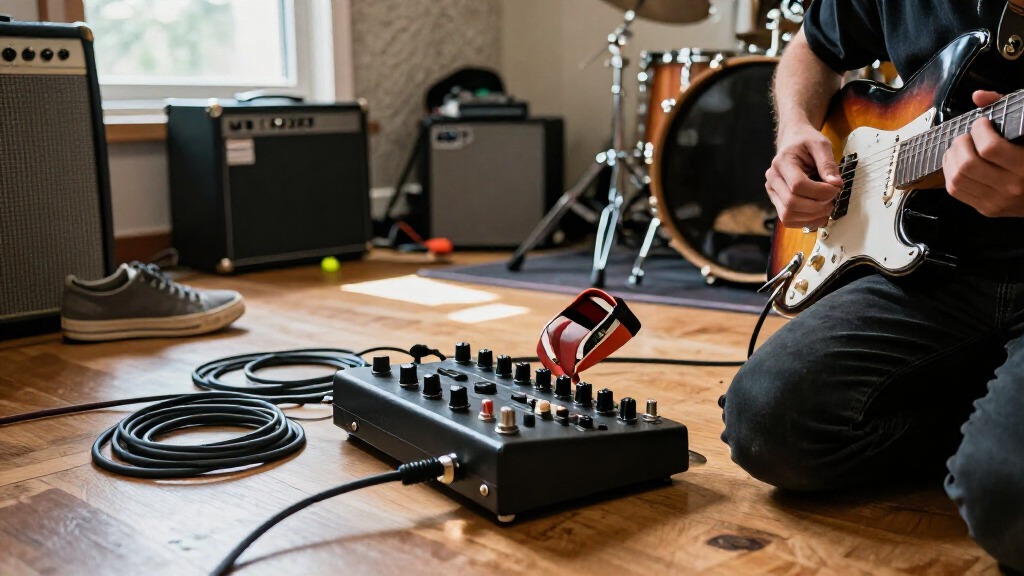
For most electric guitarists, I’d start with the BOSS RC-1: its straightforward operation makes it a strong all-around choice for layering riffs and practicing. The TC Electronic Ditto+ stands out for players who want more loop storage, while the Donner Triple Looper suits musicians who want separate loop slots and a screen. The main choice is between a pedal that keeps recording simple and one that adds storage, synchronization, or routing features. Extra functions can help with more involved arrangements, but they can also make setup and footswitch control less intuitive. Read on for the full breakdown of all 12 options and how I’d match them to different guitarists.

Get audio and creator gear delivered free with Prime
- Fast, free delivery on millions of items
- Prime Video, Amazon Music and more included
- Member-only deals all year
Complete the kit


Key Takeaways
The BOSS RC-1 is the most balanced pick for guitarists who want a clear, uncomplicated looping workflow without committing to a more complex setup.
The Ditto+ prioritizes stored ideas, while the Donner Triple Looper emphasizes multiple loop slots and visual feedback; choose based on whether recall or at-a-glance control matters more.
Several LEKATO models add practical extras such as a tuner, sync recording, or USB, but those additions matter only if they fit the way you practice or perform.
The MXR Clone Looper and NUX A/B ROLL serve more specialized needs: one offers a focused looping approach, while the other pairs looping with octave functions.
The EarthQuaker Devices Flexi Loops is not a conventional standalone looper; it is better suited to guitarists shaping external effects-loop routing than to players seeking basic phrase recording.
| NUX A/B ROLL Octave and Loop Pedal |  | Best for Quiet Practice and Amp-Simulated Guitar | Model: NOL-1 A/B ROLL | Recording quality: 24-bit/48 kHz | Maximum looping time: Up to 6 minutes | VIEW LATEST PRICE | See Our Full Breakdown |
| LEKATO Guitar Looper Pedal with Tuner |  | Best for Long Practice Sessions and Loop Library Management | Model: M00775+M01696US | Loop slots: 9 | Maximum recording time per loop: 10 minutes | VIEW LATEST PRICE | See Our Full Breakdown |
| LEKATO Guitar Looper Pedal with Tuner |  | Best for Simple Multi-Loop Practice | Loop slots: 9 | Total recording time: 40 minutes | Maximum recording time per loop: 10 minutes | VIEW LATEST PRICE | See Our Full Breakdown |
| Donner Triple Looper Guitar Pedal with Screen |  | Best for Long Individual Loops | Loop slots: 3 | Maximum recording time per loop: 30 minutes | Total recording time: 90 minutes | VIEW LATEST PRICE | See Our Full Breakdown |
| BOSS RC-1 Loop Station Guitar Pedal |  | Best for Straightforward Stereo Looping | Recording time: Up to 12 minutes, stereo | Inputs and outputs: Stereo | Loop modes: Record, overdub, playback, undo, redo | VIEW LATEST PRICE | See Our Full Breakdown |
| LEKATO Guitar Looper Effect Pedal with 5-Minute Looping |  | Best Simple Looper with USB Transfer | Looping time: 5 minutes | Audio quality: 24-bit uncompressed | Overdubs: Unlimited | VIEW LATEST PRICE | See Our Full Breakdown |
| TC Electronic Ditto 2 Guitar Looper Pedal |  | Best Compact Live-Use Pick | Model: DITTO 2 LOOPER | Controls: Footswitch | Audio signal format: Analog | VIEW LATEST PRICE | See Our Full Breakdown |
| LEKATO Guitar Looper Pedal with Sync and Tuner |  | Best for Practice Features | Loop slots: 3 | Total recording time: 18 minutes | Maximum single loop: 6 minutes | VIEW LATEST PRICE | See Our Full Breakdown |
| MXR Clone Looper Pedal |  | Best for Creative Playback | Model: M303 | Recording time: Up to 6 minutes | Overdubs: Unlimited | VIEW LATEST PRICE | See Our Full Breakdown |
| TC Electronic Ditto+ Looper Pedal |  | Best for Long Sessions and Saved Loops | Loop time: Up to 60 minutes | Loop storage: 99 loops | Audio quality: Uncompressed 24-bit | VIEW LATEST PRICE | See Our Full Breakdown |
| EarthQuaker Devices Flexi Loops Dual Effects Loop Switcher Pedal |  | Best for Switching External Effects | Effects loops: 2 | Switching: Latching or momentary | Signal path: Passive | VIEW LATEST PRICE | See Our Full Breakdown |
| LEKATO Guitar Looper Pedal with Tuner, Sync Recording, and USB |  | Best for Multi-Slot Practice and USB Transfer | Compatible instruments: Electric guitar and bass | Loop slots: 3 | Recording time: Up to 6 minutes per loop; 18 minutes total | VIEW LATEST PRICE | See Our Full Breakdown |
| loop pedals for electric guitar | Power |
|---|---|
| NUX A/B ROLL Octave and Loop P | — |
| LEKATO Guitar Looper Pedal wit | 9 V, 0.6 A; corded electric |
| LEKATO Guitar Looper Pedal wit | — |
| Donner Triple Looper Guitar Pe | — |
| BOSS RC-1 Loop Station Guitar | — |
| LEKATO Guitar Looper Effect Pe | — |
| TC Electronic Ditto 2 Guitar L | 9 V, 0.1 A |
| LEKATO Guitar Looper Pedal wit | — |
| MXR Clone Looper Pedal | 9 V, 9 mA |
| TC Electronic Ditto+ Looper Pe | Corded electric; 9 V, 0.1 A |
| EarthQuaker Devices Flexi Loop | 9 volts; 25 milliamps |
| LEKATO Guitar Looper Pedal wit | 9V center-negative; supply not included |
More Details on Our Top Picks
NUX A/B ROLL Octave and Loop Pedal
The NUX A/B ROLL suits guitarists who want a looper that can also support quiet, amp-simulated practice. Its headphone output with cabinet simulation lets you hear a more amp-like signal without connecting an amplifier, while seven onboard cabinet IR presets offer different starting tones. Compared with the BOSS RC-1, which focuses on straightforward stereo looping, the NUX adds tone-shaping options and automatic recording that can start when you play. It records 24-bit/48 kHz audio and allows unlimited overdubs, but its six-minute loop limit is shorter than the LEKATO loopers’ 10 minutes per loop. Custom IRs also require a computer and IR Manager software, so this is a better fit for players who value its practice and tone features than for those seeking the longest loop time.
Pros:- Headphone output with cabinet simulation supports quiet practice
- Seven onboard cabinet IR presets, with support for third-party IR files
- Automatic recording can start when playing begins
- Unlimited overdubs and 24-bit/48 kHz recording
Cons:- Looping is limited to six minutes
- Custom IR files require a computer and IR Manager software
Best for: Electric guitarists who practice with headphones and want cabinet simulation, automatic recording, and adjustable IR tones in one pedal.
Not ideal for: Players building long-form arrangements who need more than six minutes per loop, or guitarists who want to load custom IRs without using a computer.
- Model:NOL-1 A/B ROLL
- Recording quality:24-bit/48 kHz
- Maximum looping time:Up to 6 minutes
- Overdubs:Unlimited
- Cabinet IR presets:7 onboard; supports third-party IR files
- Recording modes:Manual and automatic
- Headphone output:1/8 inch with cabinet simulation
- USB connector:USB-C OTG
- Power requirement:9 V, 500 mA
Our verdict“Choose the NUX A/B ROLL if headphone practice and cabinet-IR options matter more to your guitar setup than extended loop length.”
LEKATO Guitar Looper Pedal with Tuner
This LEKATO makes sense for guitarists who want plenty of room to build and keep multiple parts. It stores nine loops, allows up to 10 minutes per loop, and provides 40 minutes of total recording time—far more capacity than the BOSS RC-1’s 12-minute stereo limit. A built-in tuner also saves pedalboard space, while USB transfer lets you import or export loops as WAV files for practice or editing. That combination gives this model a stronger library-and-workflow focus than the simpler Donner Triple Looper, which offers longer individual loops but only three slots. The tradeoff is a single knob and foot commands for control, which may take practice, and the pedal needs corded 9 V power. Its 10-minute cap per loop may also interrupt particularly long passages.
Pros:- Stores nine loops with up to 40 minutes of total recording time
- Built-in tuner can reduce pedalboard clutter
- USB supports WAV loop import and export
- Unlimited overdubbing and 48 kHz/24-bit audio
Cons:- Each individual loop is limited to 10 minutes
- Single-knob control and foot commands may take practice
- Requires corded 9 V power
Best for: Electric guitarists who want several saved loop ideas, a built-in tuner, and USB WAV transfer for arranging or practicing away from the pedal.
Not ideal for: Players who want long, uninterrupted loops beyond 10 minutes or prefer a looper with more dedicated controls and minimal command learning.
- Model:M00775+M01696US
- Loop slots:9
- Maximum recording time per loop:10 minutes
- Total recording time:40 minutes
- Audio quality:48 kHz/24-bit
- Overdubbing:Unlimited
- Tuner:Built-in
- Audio format and transfer:WAV via USB
- Power:9 V, 0.6 A; corded electric
Our verdict“Pick this LEKATO if you want a multi-loop practice and WAV-transfer tool with a tuner, and can work within its 10-minute per-loop limit.”
LEKATO Guitar Looper Pedal with Tuner
This LEKATO pairs a practical feature set with a clear advantage over a basic single-loop pedal: it offers nine loop slots, 40 minutes of total recording time, and a built-in tuner. That makes it a useful practice hub for electric guitarists who want to keep several riffs or backing parts available without moving files on and off the pedal. Like the B09HZTP2T4 LEKATO, it transfers WAV files over USB and supports unlimited overdubbing; its analog dry-through is a useful distinction for players who want their direct guitar signal to remain analog. The compromise is control: one-button foot operation uses different commands for loop actions, so it is less immediately clear than the BOSS RC-1’s status display and straightforward workflow. Each loop also tops out at 10 minutes, which is less generous than the Donner Triple Looper’s 30-minute individual loops.
Pros:- Nine loop slots and 40 minutes of total recording time
- Unlimited overdubbing for building layered guitar parts
- Built-in tuner supports quick setup
- USB import and export for WAV files, with analog dry-through
Cons:- Maximum recording time for one loop is 10 minutes
- Different actions rely on foot commands from a single button
Best for: Electric guitarists who want multiple practice loops, USB WAV exchange, and a tuner in a compact, one-button-style workflow.
Not ideal for: Players who need long individual loops or want clearly separated controls for recording, playback, and other actions.
- Loop slots:9
- Total recording time:40 minutes
- Maximum recording time per loop:10 minutes
- Audio sampling:48 kHz/24-bit
- Overdubbing:Unlimited
- Tuner:Built-in
- File transfer:USB import/export of WAV files
- Audio design:Analog dry-through
- Controls:One-button foot controls
Our verdict“Choose this LEKATO for a tuner-equipped practice looper with multiple stored parts, provided its single-button commands suit your playing routine.”
Donner Triple Looper Guitar Pedal with Screen
The Donner Triple Looper is the strongest choice here when the length of each guitar part matters more than the number of stored loops. It gives you three independent slots, up to 30 minutes per loop, and 90 minutes in total—more room for extended practice passages than either LEKATO model, whose individual loops stop at 10 minutes. Unlimited overdubs let you build layers, while undo and redo make it easier to recover from a missed take. Its screen provides visual loop information, and automatic saving keeps recorded material available after power is removed. Compared with the BOSS RC-1, the Donner prioritizes longer recording and multiple slots over stereo input/output support. The main setup catch is that a compatible 9 V power supply is not included; its single footswitch and knob also leave fewer dedicated controls than a larger interface might.
Pros:- Three independent loop slots
- Up to 30 minutes per loop and 90 minutes total
- Unlimited overdubs with undo and redo
- Automatic saving and a built-in screen
Cons:- Power supply is not included
- Single footswitch and knob provide limited dedicated control
- Three slots may be restrictive for players who want a larger loop library
Best for: Electric guitarists who practice extended solos, long backing parts, or layered arrangements and want three separately stored loops.
Not ideal for: Players who need stereo connectivity, want a supplied power adapter, or prefer dedicated controls for each looping action.
- Loop slots:3
- Maximum recording time per loop:30 minutes
- Total recording time:90 minutes
- Overdubs:Unlimited
- Loop functions:Undo and redo
- Display:Built-in screen
- Loop saving:Automatic
- Bypass:True bypass
- Power requirement:9 V DC, center negative, 500 mA; power supply not included
Our verdict“Choose the Donner if long individual guitar loops and automatic saving matter more than stereo operation or a larger set of loop slots.”
BOSS RC-1 Loop Station Guitar Pedal
The BOSS RC-1 is the straightforward pick for guitarists who want to record, overdub, and manage a phrase without taking on a multi-slot workflow. Its 24-segment LED indicator shows where the loop is in its cycle, giving a quick visual cue that the LEKATO models’ more storage-focused designs do not emphasize. Stereo inputs and outputs also make it a better match than the NUX A/B ROLL for rigs with stereo effects or instruments. Its operation covers recording, playback, overdub, undo, and redo, while recorded phrases remain in memory when power is removed. The tradeoff is capacity: 12 minutes of stereo recording is less than the Donner Triple Looper’s 90 minutes total and 30-minute loops. An AC adapter is sold separately, and battery life is approximately 4.5 hours, so frequent gigging may call for external power.
Pros:- Straightforward record, playback, overdub, undo, and redo functions
- Stereo inputs and outputs suit stereo guitar effects
- 24-segment LED indicates loop status
- Recorded phrases remain in memory when power is removed
Cons:- 12-minute stereo recording limit is lower than the Donner Triple Looper’s capacity
- AC adapter is sold separately
- Battery life is approximately 4.5 hours
Best for: Electric guitarists who want an uncomplicated stereo looper with clear visual feedback for practice, songwriting, or a pedalboard with stereo effects.
Not ideal for: Players who need multiple loop slots, long individual recordings, or extended battery-powered sessions.
- Recording time:Up to 12 minutes, stereo
- Inputs and outputs:Stereo
- Loop modes:Record, overdub, playback, undo, redo
- Loop indicator:24-segment LED
- Power options:9 V battery or optional PSA-series AC adapter
- Battery life:Approximately 4.5 hours
- Current draw:95 mA
- Weight:440 g
- Warranty:5 years
Our verdict“Pick the BOSS RC-1 if clear, simple stereo looping matters more than long recording time or multiple stored loop slots.”
LEKATO Guitar Looper Effect Pedal with 5-Minute Looping
This LEKATO keeps the looping workflow spare: record, build layers, undo or redo, then stop or erase with foot commands. Its 24-bit uncompressed recording and unlimited overdubs give electric-guitar players room to stack parts without adding lossy audio or a layer cap. USB WAV transfer is the standout over a more bare-bones live option like the TC Electronic Ditto 2, since it lets you move loops between pedal and computer. Analog dry-through also keeps the dry guitar signal on an analog path.
The tradeoff is the fixed five-minute loop limit and a basic control set: there are no described loop slots, tuner, or playback effects. The LEKATO Sync and Tuner model offers more recording time and extra practice tools, while this version suits players who want uncomplicated layering and file transfer in a compact aluminum enclosure.
Pros:- Unlimited overdubs support layered guitar parts without a stated layer cap.
- 24-bit uncompressed audio and analog dry-through suit players prioritizing a clean loop and dry signal path.
- USB WAV import and export allow loop files to move between pedal and computer.
- Compact aluminum alloy construction is suited to a pedalboard.
Cons:- Five minutes is less recording time than the LEKATO Sync and Tuner model’s 18-minute total.
- Basic looping functions offer fewer practice and performance tools than models with multiple slots or playback modes.
Best for: Electric-guitar players who want a straightforward practice and layering looper with unlimited overdubs and USB WAV exchange.
Not ideal for: Players who need long arrangements, multiple stored loop slots, a built-in tuner, or creative playback modes.
- Looping time:5 minutes
- Audio quality:24-bit uncompressed
- Overdubs:Unlimited
- USB:WAV file import and export
- Controls:Playback-volume knob; foot commands for record, undo/redo, stop, and erase
- Construction:Aluminum alloy
- Signal path:Analog dry-through
Our verdict“Choose this LEKATO for simple, high-quality looping and USB file transfer, but pick a longer-time model for extended arrangements.”
TC Electronic Ditto 2 Guitar Looper Pedal
The Ditto 2 is the smallest, most performance-oriented fit in this batch on the details provided: it has a compact housing, footswitch controls, and is described as designed for live use. Its listed size of 4.15 × 2.7 × 2.4 inches makes it a plausible choice for a crowded guitar pedalboard, where a large interface can get in the way. Compared with the TC Electronic Ditto+, though, the Ditto 2 has no listed loop time, storage capacity, overdub behavior, or USB workflow. That makes it hard to weigh its actual looping flexibility against the Ditto+’s 60 minutes and 99-loop storage.
The limited product details are the main buying risk, not a confirmed lack of features: the supplied description simply does not explain how recording or playback works. I’d choose it only when compact live operation and the listed footswitch control matter more than documented editing, storage, or transfer functions.
Pros:- Compact listed dimensions suit pedalboards with limited space.
- Footswitch controls are suited to hands-free operation while playing guitar.
- The product is specifically described as designed for live performances.
Cons:- The supplied details do not state loop length, overdub capacity, or recording behavior.
- No loop storage or USB transfer capability is documented, unlike the Ditto+.
- The listed 3.5 mm hardware interface is not explained, leaving its use unclear.
Best for: Electric-guitar players seeking a compact pedal described for live performance who can verify the looping workflow before buying.
Not ideal for: Players choosing by recording time, overdub limits, loop storage, or USB transfer, since those functions are not specified in the supplied details.
- Model:DITTO 2 LOOPER
- Controls:Footswitch
- Audio signal format:Analog
- Hardware interface:3.5 mm
- Power:9 V, 0.1 A
- Dimensions:4.15 × 2.7 × 2.4 inches
- Color:Grey
Our verdict“Consider the Ditto 2 for compact live use only after confirming its recording and storage features meet your needs.”
LEKATO Guitar Looper Pedal with Sync and Tuner
This LEKATO combines a looper with two useful guitar-practice aids: synchronous recording and a built-in tuner. Three loop slots and 18 minutes of total recording time give it more room for separate ideas than the five-minute LEKATO, while its six-minute maximum per loop defines the limit for any one passage. Unlimited overdubs, undo/redo, and uncompressed 48 kHz/24-bit audio make it a capable tool for building and revising parts; USB WAV transfer adds a route to save or exchange loops.
Compared with the MXR Clone Looper, this model prioritizes tuning and synchronized practice rather than reverse or speed-altered playback. The cost of that practical feature set is a 9V center-negative supply requirement, with the adapter not included. It makes the most sense for players who want a self-contained practice aid, not a dedicated source of loop effects.
Pros:- Three slots provide 18 minutes of total recording time for keeping separate ideas.
- Built-in tuner and synchronous recording add practice utility beyond basic looping.
- Unlimited overdubs and undo/redo support iterative arrangement building.
- 48 kHz/24-bit audio and USB WAV transfer support uncompressed recording and file exchange.
Cons:- The required 9V center-negative power supply is not included.
- Each individual loop is limited to six minutes, even though total recording time is 18 minutes.
- Compared with the MXR Clone Looper, it lacks listed reverse and speed-altered playback modes.
Best for: Guitarists who want a looper for structured practice, with a built-in tuner, synchronous recording, and several loop slots.
Not ideal for: Players who need unusual playback effects, a supplied power adapter, or a single continuous loop longer than six minutes.
- Loop slots:3
- Total recording time:18 minutes
- Maximum single loop:6 minutes
- Overdubbing:Unlimited
- Audio sampling:48 kHz/24-bit
- Connectivity:USB
- Power requirement:9V center-negative; power supply not included
- Dimensions:4.33 × 2.56 × 2.48 inches
Our verdict“Pick this LEKATO if tuning and synchronized practice matter more than playback effects or an included power supply.”
MXR Clone Looper Pedal
The MXR Clone Looper earns its place through playback options rather than a large library: double-speed, half-speed, and reverse modes let guitarists reshape a recorded phrase without adding another effect pedal. It records up to six minutes, supports unlimited overdubs, and retains loops when powered off, so a saved idea need not disappear when the pedal is unplugged. Compared with the LEKATO Sync and Tuner, it gives up the built-in tuner and multiple loop slots in favor of more distinctive playback treatment and buffered or true bypass selection.
Its CTR and EXP connections can support external control, but using those functions calls for compatible pedals or switches, which adds setup requirements. Half-speed playback is described as providing 12 minutes of recording time; players should distinguish that mode from the stated six-minute standard recording limit. This is a better fit for sound exploration than streamlined practice.
Pros:- Reverse, double-speed, and half-speed playback create options for transforming guitar phrases.
- Loop storage persists when the pedal is powered off.
- Unlimited overdubs and up to six minutes of recording support layered parts.
- Selectable buffered or true bypass offers a choice of signal-path behavior.
Cons:- CTR and EXP functions require compatible external pedals or switches.
- The standard recording limit is six minutes; the longer half-speed mode may not suit every arrangement.
- It lacks the tuner and three-slot organization offered by the LEKATO Sync and Tuner.
Best for: Electric-guitar players who want to reverse or alter loop playback and keep recorded ideas stored between sessions.
Not ideal for: Players who want a built-in tuner, multiple loop slots, or external controls without buying compatible switches or pedals.
- Model:M303
- Recording time:Up to 6 minutes
- Overdubs:Unlimited
- Playback modes:Double-speed, half-speed, and reverse
- Storage:Loops retained when powered off
- Bypass modes:Buffered or true bypass
- External connections:CTR jack, EXP jack, and 1/4-inch audio jack
- Power:9 V, 9 mA
Our verdict“Choose the MXR Clone Looper for playback experimentation and persistent loop storage, not for tuner-led practice or multi-slot organization.”
TC Electronic Ditto+ Looper Pedal
The Ditto+ is the strongest option here for guitarists who need to keep many ideas ready: it offers up to 60 minutes of loop time, 99-loop storage, and memory that retains loops after power-down. That capacity sets it apart from the MXR Clone Looper’s six-minute recording limit and the LEKATO Sync and Tuner’s three slots. Unlimited overdubs and uncompressed 24-bit audio cover the core layering job, while USB transfer makes saved loops easier to move between pedal and computer.
A high-resolution color display gives this storage-focused model a clearer way to manage loop material than a simple one-knob design might suggest, though operation still centers on one knob. Its focus is organization and recording length, not the MXR’s reverse and speed effects or the LEKATO’s built-in tuner. The corded power requirement also means it is not a self-powered option, and included power accessories are not specified.
Pros:- Up to 60 minutes of loop time supports longer guitar arrangements.
- Storage for 99 loops and memory retention after power-down suit players managing many ideas.
- Unlimited overdubs and uncompressed 24-bit audio support layered recording.
- USB transfer and a high-resolution color display aid loop management and file exchange.
Cons:- Corded electric power is required, and the supplied details do not specify included power accessories.
- The one-knob control layout offers less direct physical control than a more extensively specified interface.
- It does not list the reverse and speed-altered playback available on the MXR Clone Looper.
Best for: Guitarists who want to store and revisit many loop ideas, or build longer arrangements without frequently clearing memory.
Not ideal for: Players who want creative reverse or speed playback, a built-in tuner, or a setup that does not rely on corded power.
- Loop time:Up to 60 minutes
- Loop storage:99 loops
- Audio quality:Uncompressed 24-bit
- Overdubs:Unlimited
- Display:High-resolution color display
- Controls:1 knob
- Interface:USB
- Power:Corded electric; 9 V, 0.1 A
Our verdict“Choose the Ditto+ when long recording time and a large saved-loop library matter more than playback effects or tuner functions.”
EarthQuaker Devices Flexi Loops Dual Effects Loop Switcher Pedal
The Flexi Loops is not a phrase looper: it switches two external effects loops in and out of your guitar signal. That makes it a distinct choice from the BOSS RC-1, which records and plays back guitar phrases. Use Flexi Loops to select groups of pedals or build a tuner-mute setup, rather than to layer recorded parts.
Its latching or momentary switching lets each footswitch suit either hands-free on/off changes or brief switching gestures, while the passive signal path keeps the route direct when the loops are bypassed. The tradeoff is that it supplies no effects or recording by itself: you need external pedals and patch cables, and the listed power details do not specify an included supply. Choose this if you need flexible pedalboard routing; choose a dedicated looper such as the BOSS RC-1 for recording.
Pros:- Switches two effects loops independently
- Latching and momentary operation supports different footswitching styles
- Passive signal path when loops are bypassed
- Can be configured for tuner or muting functionality
Cons:- Does not record or replay guitar phrases
- Requires external effects and patch cables to make use of its loops
- Included power supply details are not specified
Best for: Electric guitar players with two external effects groups who want footswitchable routing, momentary control, or a tuner-mute setup.
Not ideal for: Players seeking phrase recording, overdubbing, or a self-contained looper; this switcher does not record audio and requires external effects to use its loops.
- Effects loops:2
- Switching:Latching or momentary
- Signal path:Passive
- Signal format:Analog
- Power:9 volts; 25 milliamps
- Connector:1/4-inch (6.35 mm) mono phone plug
- Dimensions:4.75 x 2.75 x 2.25 inches
- Weight:12.48 ounces
Our verdict“Choose the Flexi Loops for flexible switching between external pedal chains, not for recording loops like the BOSS RC-1.”
LEKATO Guitar Looper Pedal with Tuner, Sync Recording, and USB
This LEKATO suits guitarists who want several saved loop slots and a way to move recordings to a computer. Its three slots and 18 minutes of total recording time give it more room for keeping separate ideas than a straightforward single-loop option such as the TC Electronic Ditto 2. Each slot is capped at six minutes, though, so a longer uninterrupted passage will not fit in one slot.
Synchronous recording, unlimited overdubbing, and undo/redo support layered practice, while the built-in tuner and LED screen keep common tasks on the pedal. USB WAV transfer and automatic saving add a practical path for retaining recordings beyond the pedal. The tradeoffs are the per-slot time limit and a 9V center-negative power supply that is not included. This is a stronger fit for players organizing multiple practice ideas than for someone seeking the simplest possible one-loop workflow.
Pros:- Three loop slots provide up to 18 minutes of total recording time
- Unlimited overdubbing with undo and redo
- USB transfer supports WAV file handling, with automatic saving
- Built-in tuner, LED screen, and synchronous recording
Cons:- Each loop slot is limited to six minutes
- Required 9V center-negative power supply is not included
Best for: Electric guitarists who want separate loop slots for practice ideas, layered overdubs, a built-in tuner, and USB WAV transfers.
Not ideal for: Players who need a single recording longer than six minutes per slot or want a pedal that arrives with its required power supply.
- Compatible instruments:Electric guitar and bass
- Loop slots:3
- Recording time:Up to 6 minutes per loop; 18 minutes total
- Overdubbing:Unlimited
- Audio sampling:48 kHz/24-bit
- Audio design:Analog dry-through
- Connectivity:USB; WAV file transfer
- Power:9V center-negative; supply not included
- Weight:310 g
Our verdict“Pick this LEKATO over a simpler single-loop pedal if you value multiple practice slots and USB file transfer more than longer takes in one slot.”
How We Picked
I compared these pedals around the jobs electric guitarists most often need a looper to handle: building parts in real time, practicing over a repeating phrase, saving ideas, and managing loops onstage. I weighed recording and overdub controls, available loop management, visual feedback, extra functions such as tuning or sync, and how easily a player can understand the workflow from the pedal itself. I also separated conventional recording loopers from routing tools, since they solve different problems.
The ranking favors usefulness for a broad range of guitarists, not feature count alone. The BOSS RC-1 leads for its direct, accessible approach; models with more storage or control options rank higher for those specific needs but may ask more of the player. Compact or specialized options earn their place when their particular workflow is an advantage, while products with overlapping features are distinguished by the extras and control style that matter in practice. Build and value are judged by the function offered, not by price or popularity.
Factors to Consider When Choosing Loop Pedals For Electric Guitar
Before choosing a looper, I’d map out how it will fit into your guitar rig and playing habits. A pedal that works well for home practice may feel limiting when you need to change sections hands-free onstage, and a feature-rich unit can slow down a simple rehearsal setup. These factors help separate genuinely useful features from extras you may never use.
Match Loop Control to How You Play
Start by deciding whether your loops are mainly practice backing or parts in a live arrangement. A single loop with overdubs can be enough for repeating a chord progression while you work on lead playing, but songs with distinct sections may call for multiple loop slots or a more deliberate way to switch parts. Think through your foot movements while holding a guitar: stopping, undoing, and changing loops can be harder than operating a pedal on a desk. A common mistake is buying for a long feature list without checking whether the controls support the actions you need mid-song. If you only record one phrase at a time, straightforward controls often matter more than extensive loop management.
Check Loop Storage and Recall Needs
Some guitarists want a temporary phrase that disappears when they are done; others want to save sketches and call them back later. Those are different jobs, so check how a pedal handles stored loops, selection, and transfer before assuming that a longer recording capacity solves everything. A large collection of saved ideas is useful only if you can locate the right one quickly and keep it organized. For home writing, a more involved recall process may be acceptable; for a set, the time and steps needed to load a loop can affect the performance. If your main aim is capturing riffs, a simple recording workflow may serve better than paying attention to storage figures alone.
Plan for Sync and Timing
Loop timing can shape the feel of a guitar part, particularly when you build layers or play with a drummer or backing tracks. Decide whether you need freehand recording, synchronized loop creation, or a method of following an external tempo. Sync features can make repeated parts more consistent, but they add setup and may require you to understand how tempo is established and maintained. A frequent misstep is choosing sync because it sounds useful without checking whether the rest of the band or playback rig can provide a compatible timing reference. If you usually record by ear and play alone, simple start-and-stop control may be the more natural fit.
Account for Your Signal Chain
A looper records the signal that reaches it, so its place in the guitar chain affects the sound and flexibility of your layers. Placed after distortion and modulation, the loop generally captures those effects as part of the recorded phrase; placed earlier, the recorded guitar can pass through later effects as you change settings. Neither order is universally right, but the choice changes whether layers share one tone or can be reshaped independently. Also check how the pedal handles stereo connections if your rig uses two amplifiers or stereo effects. Avoid planning a complex setup around a feature or routing method until you have confirmed that the pedal’s connections suit your actual board.
Treat Extra Features as Workflow Choices
A built-in tuner, USB connection, octave effect, or effects-loop routing can reduce the number of separate devices or support a specific creative setup. Each extra also adds another control or setup decision, so it is useful only when it solves a regular problem. For instance, a tuner may be handy on a compact practice board, while USB may matter to a guitarist who moves recorded ideas to a computer. An effects-loop switcher is a different kind of tool from a phrase recorder, even if its name includes “loop.” I’d prioritize the core recording and footswitch workflow first, then pay more or accept added complexity only for features that match a clear use.
Check Power, Space, and Stage Usability
Pedalboard fit involves more than the footprint: allow room for footswitch access, cables, and any controls you may need to reach during a song. Confirm the power requirements and connector layout against your existing supply before adding a pedal, especially if you plan to use it in a crowded chain. Displays can help with loop selection and status, but they are most valuable when their information is legible from a standing position under stage lighting. For bedroom practice, a small enclosure may be more useful than a screen or extra switches. A good buying decision accounts for the full board and performance setting, not just the pedal’s feature list.
Frequently Asked Questions
Is a basic looper enough for practicing electric guitar, or do I need multiple loop slots?
For practicing lead lines over a repeated chord progression, one loop with overdubs is often enough. Multiple slots become useful when you want to keep separate rhythm ideas ready or work through song sections without recording each one again. They can also add selection steps, so they are not automatically better for a beginner or a simple practice routine. I’d choose based on whether you regularly need more than one phrase available in the same session. If not, a direct single-loop workflow is likely to be easier to learn and operate.
Should I place my looper before or after distortion and modulation pedals?
Place the looper after effects if you want each recorded layer to retain the tone you played when recording it. Put it earlier in the chain if you want recorded parts to pass through later effects and respond to changes in those settings. The first approach makes layers with different tones easier to build; the second can make it simpler to alter the overall sound of the loop. Your amp’s effects loop can offer another placement option, depending on the rig. Try to decide whether you want to record a finished guitar sound or reshape a cleaner recorded signal before settling on a position.
Do I need a looper with sync recording if I play with a drummer?
Not always: a guitarist can record a phrase by ear and play it with a drummer, especially during practice or loose arrangements. Sync recording is more useful when parts must repeat at a stable tempo or line up with a backing track, sequencer, or other timed source. It will not fix a loop that starts or ends at the wrong musical point, so recording technique still matters. Check how the pedal receives or sets its timing reference before choosing sync as a deciding feature. If the band changes tempo freely, a strict sync workflow may be less comfortable than recording naturally.
Can I save loops on a pedal and move them to a computer later?
That depends on the individual pedal: loop storage and computer transfer are separate capabilities, not features to assume from the word “looper.” If you want to archive ideas, check the manual for transfer support, file handling, and whether saved loops remain available when the pedal is disconnected from power. USB can be useful, but its role may differ across models, so confirm that it supports the task you have in mind. For occasional riff capture, recording the pedal’s output into an audio interface may be simpler. For a growing library, consider how you will name, find, and back up loops as well as how you record them.
Is the EarthQuaker Devices Flexi Loops a suitable substitute for a standard guitar looper?
No, I would not treat it as a direct replacement for a phrase recorder. The Flexi Loops is an effects-loop switcher, built for managing external effects in a signal path rather than recording and replaying guitar phrases. It may suit a player who wants to route or switch effects as part of a larger rig, but it does not fill the same role as a conventional practice looper. If your goal is to layer chords and play over them, choose a pedal designed to record loops. If routing control is your goal, compare its connections and switching workflow with the needs of your board.
Conclusion
For the best overall balance, I recommend the BOSS RC-1 to guitarists who want a clear, dependable looping workflow for practice and straightforward performance. The LEKATO models are the value-focused choices when a tuner, sync recording, or USB feature matches your routine, while the TC Electronic Ditto+ is my premium pick for players who prioritize saved ideas. Beginners are best served by the simplest pedal workflow they can operate confidently; the RC-1 is the clearest starting point here. For multiple loop slots and visual feedback, look at the Donner Triple Looper; for octave-and-loop functions, consider the NUX A/B ROLL. Choose the MXR Clone Looper for its focused looping approach, and the EarthQuaker Devices Flexi Loops only if you need effects-loop routing rather than recorded phrases. My final advice is to pick for the way you will control loops with your feet, not for the longest feature list.
Halloween Picks
halloween
As an affiliate, we earn on qualifying purchases.