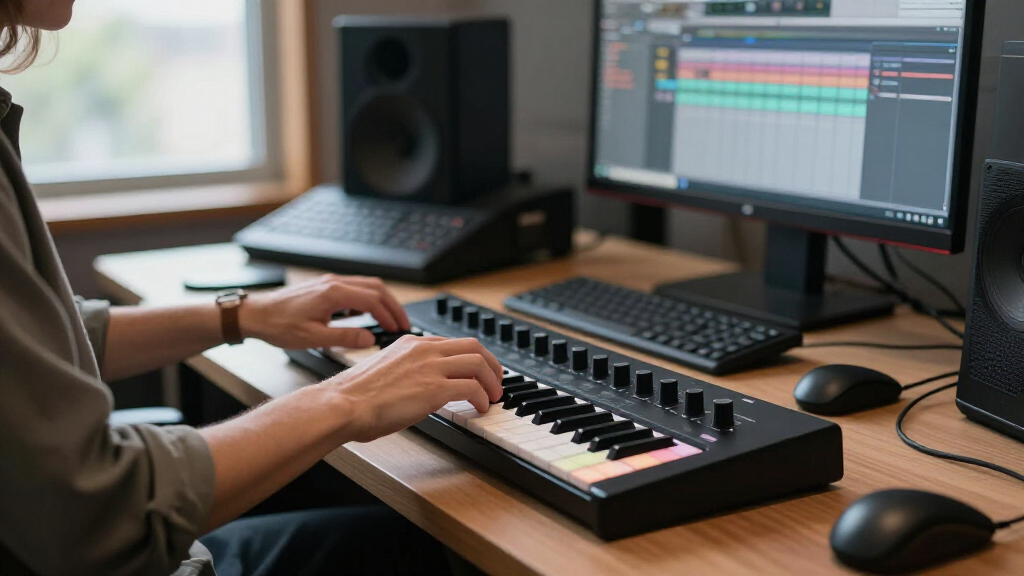
Choosing the right music production MIDI controller can significantly impact your workflow and creativity. The Akai MPK Mini MK3 stands out as the best overall for its versatility and compact design, making it suitable for both studio and mobile setups. For those seeking budget-friendly options, the M-AUDIO Keystation Mini 32 MK3 offers reliable performance without breaking the bank. If premium features are your priority, the Akai MPK Mini Plus provides expanded keys and advanced controls, though it comes at a higher price point. The main tradeoffs involve balancing features like key count, build quality, and price. Keep reading for a detailed breakdown of these options and which might suit your specific needs best.

Get audio and creator gear delivered free with Prime
- Fast, free delivery on millions of items
- Prime Video, Amazon Music and more included
- Member-only deals all year
Complete the kit


Key Takeaways
- The top models balance size, key count, and feature set to suit different production styles.
- Compact controllers are ideal for portability but often sacrifice key range and tactile feel.
- Premium options tend to include more controls and better build quality, justifying higher prices.
- Budget controllers excel in simplicity and affordability but may lack advanced features.
- Design and compatibility with your DAW are critical factors that influence ease of use and integration.
| Akai Professional MPK Mini MK3 25-Key USB MIDI Keyboard Controller |  | Best Overall for Versatile, Portable Production | Keys: 25 velocity-sensitive mini keys | Pads: 8 backlit MPC-style pads | Knobs: 8 assignable 360-degree knobs | VIEW LATEST PRICE | See Our Full Breakdown |
| Arturia MiniLab 3 Universal MIDI Controller, White |  | Best for Seamless Workflow and Multi-Device Integration | Keys: 25 | Pads: 8 multi-color pads | Faders: 4 | VIEW LATEST PRICE | See Our Full Breakdown |
| Akai Professional MPK Mini Play MK3 25-Key USB MIDI Keyboard Controller |  | Best for Standalone and Portable Performance | Keys: 25 velocity-sensitive mini keys | Pads: 8 backlit MPC pads | Built-In Sounds: Over 100 drum and instrument sounds | VIEW LATEST PRICE | See Our Full Breakdown |
| Akai Professional LPK25 25-Key USB MIDI Keyboard Controller |  | Best for Basic MIDI Control and Live Play on the Go | Keys: 25 velocity-sensitive keys | Connectivity: USB | Features: Arpeggiator, programmable presets | VIEW LATEST PRICE | See Our Full Breakdown |
| PreSonus ATOM Production & Performance MIDI Pad Controller with Software |  | Best for Expressive Pad Control and Studio Integration | Pads: 16 velocity- and pressure-sensitive RGB pads | Buttons: 20 assignable | Encoders: 4 | VIEW LATEST PRICE | See Our Full Breakdown |
| Akai Professional MPK Mini Plus 37-Key USB MIDI Keyboard Controller |  | Best Versatile Connectivity and Sequencing | Keys: 37 velocity-sensitive mini keys (3 octaves) | Pads: 8 RGB MPC pads | Knobs: 8 assignable endless rotary knobs | VIEW LATEST PRICE | See Our Full Breakdown |
| M-AUDIO Keystation Mini 32 MK3 USB MIDI Controller |  | Best for Portability and Simplicity | Number of Keys: 32 | Key Type: Velocity-sensitive | Connectivity: USB | VIEW LATEST PRICE | See Our Full Breakdown |
| Akai Professional APC Mini MK2 USB MIDI Pad Controller |  | Best for Ableton Live Performance and Clip Launching | Number of Pads: 64 RGB pads | Faders: 9 (8 assignable + 1 master) | Modes: Drum and Note modes | VIEW LATEST PRICE | See Our Full Breakdown |
| Donner USB-C MIDI Keyboard Controller, 25-Key Portable Mini MIDI Keyboard with 8 Drum Pads, OLED Display, 16 Smart Scales, Arpeggio, Replay, 4 DAW Software, and 40 Teaching Courses |  | Best for Beginners and Portable Creativity | Number of Keys: 25 | Drum Pads: 8 | Display: OLED | VIEW LATEST PRICE | See Our Full Breakdown |
| Akai Professional APC Key 25 MK2 25-Key USB MIDI Keyboard Controller |  | Best for Ableton Live Seamless Integration | Number of Pads: 40 RGB pads | Knobs: 8 | Connectivity: USB | VIEW LATEST PRICE | See Our Full Breakdown |
| music production MIDI controller | Connectivity | Keys | Pads |
|---|---|---|---|
| Akai Professional MPK Mini MK3 | USB | 25 velocity-sensitive mini keys | 8 backlit MPC-style pads |
| Arturia MiniLab 3 Universal MI | — | 25 | 8 multi-color pads |
| Akai Professional MPK Mini Pla | — | 25 velocity-sensitive mini keys | 8 backlit MPC pads |
| Akai Professional LPK25 25-Key | USB | 25 velocity-sensitive keys | — |
| PreSonus ATOM Production & Per | — | — | 16 velocity- and pressure-sensitive RGB pads |
| Akai Professional MPK Mini Plu | USB, MIDI I/O, CV/Gate I/O | 37 velocity-sensitive mini keys (3 octaves) | 8 RGB MPC pads |
| M-AUDIO Keystation Mini 32 MK3 | USB | — | — |
| Akai Professional APC Mini MK2 | USB | — | — |
| Donner USB-C MIDI Keyboard Con | — | — | — |
| Akai Professional APC Key 25 M | USB | — | — |
More Details on Our Top Picks
Akai Professional MPK Mini MK3 25-Key USB MIDI Keyboard Controller
The Akai MPK Mini MK3 stands out for its balanced combination of portability and comprehensive control features, making it the best choice for producers who need a compact but versatile MIDI controller. Compared with the Arturia MiniLab 3, it offers more hands-on control with an integrated arpeggiator and a larger sound library, but its mini keys may feel cramped for those used to full-sized keyboards. The inclusion of MPC-style pads and a four-way joystick enhances expressive play, ideal for producers working on the move or in small setups. While the extensive software bundle and sound content add value, the limited 25-key range may hinder complex performances or intricate compositions. Its reliance on USB power keeps setup simple, but advanced customization requires downloading extra software. Best suited for home studio owners, beatmakers, and mobile producers who value feature depth in a compact form.
Pros:- Compact, portable design ideal for on-the-go use
- Velocity-sensitive keys and MPC-style pads provide expressive control
- Includes extensive sound library and software bundle
Cons:- Mini keys may feel cramped for some players
- Limited 25-key range restricts performance scope
Best for: Home studio owners, beatmakers, and mobile producers needing a versatile, portable controller
Not ideal for: Keyboardists or composers requiring full-size keys for complex arrangements, as the mini keys may feel restrictive
- Keys:25 velocity-sensitive mini keys
- Pads:8 backlit MPC-style pads
- Knobs:8 assignable 360-degree knobs
- Control:4-way pitch and modulation joystick
- Connectivity:USB
- Power:USB-powered
Our verdict“This controller is perfect for mobile producers and home musicians who need a feature-rich, space-saving MIDI solution.”
Arturia MiniLab 3 Universal MIDI Controller, White
The Arturia MiniLab 3 excels in providing a sleek, responsive control surface with a focus on workflow efficiency. Compared to the Akai MPK Mini MK3, it offers four faders and 8 multi-color pads, catering well to producers who want tactile mixing control alongside melody and beat creation. Its compact size and included comprehensive software package make it ideal for users who prioritize quick setup and integration into different DAWs. However, with only 25 keys, it still faces the same limitation as other small controllers for elaborate performances. Its all-white aesthetic adds a stylish touch, but it may require external power or a dedicated USB port, which could be a constraint on some setups. While it’s less feature-heavy than larger controllers, its ease of use makes it a strong pick for beginners and mobile producers. Best suited for producers who value portability, aesthetics, and a straightforward workflow.
Pros:- Compact and portable with a sleek design
- Includes a comprehensive software suite for immediate use
- Responsive velocity-sensitive keys and versatile controls
Cons:- Limited number of keys for complex compositions
- Requires external power source or USB connection
Best for: Beginner producers and mobile musicians seeking an easy-to-integrate, stylish MIDI controller
Not ideal for: Advanced performers or composers needing extensive key ranges for complex arrangements, due to its limited keys
- Keys:25
- Pads:8 multi-color pads
- Faders:4
- Color:White
Our verdict“This controller is best for beginners and mobile producers who want a stylish, straightforward MIDI interface.”
Akai Professional MPK Mini Play MK3 25-Key USB MIDI Keyboard Controller
The Akai MPK Mini Play MK3 combines portability with standalone functionality, making it a unique choice for producers who need a mobile setup that doesn’t rely solely on a computer. Unlike the PreSonus ATOM, which is primarily a pad controller, this device offers built-in sounds, a display, and battery power, allowing for on-the-go beat-making without a laptop. Its 25 velocity-sensitive keys and MPC pads support expressive playing, but the mini keys may not suit all users, especially those accustomed to full-sized instruments. The inclusion of over 100 sounds and two months of Splice access adds value for producers seeking a self-contained device. However, battery operation and integrated sounds mean it’s less suitable for producers who primarily work within DAWs, and the small keys could limit performance complexity. Ideal for beatmakers, live performers, and producers needing a portable, all-in-one device.
Pros:- Works as both standalone instrument and MIDI controller
- Includes over 100 sounds for immediate music creation
- Battery-powered option supports mobile use
Cons:- Batteries are not included, adding extra cost
- Mini keys may feel restrictive for some players
Best for: Beatmakers and live performers who want a portable, standalone MIDI controller with built-in sounds
Not ideal for: Producers seeking a dedicated DAW controller or requiring full-size keys for intricate playing, as the mini keys may feel cramped
- Keys:25 velocity-sensitive mini keys
- Pads:8 backlit MPC pads
- Built-In Sounds:Over 100 drum and instrument sounds
- Display:OLED
- Power:Batteries or USB
Our verdict“This device is perfect for mobile producers and performers who want an all-in-one, battery-powered solution.”
Akai Professional LPK25 25-Key USB MIDI Keyboard Controller
The Akai LPK25 serves as a straightforward, no-frills MIDI keyboard ideal for those who need a simple controller for songwriting or live performances. Compared with the Akai MPK Mini MK3, it offers fewer controls but emphasizes ease of use with a lightweight, portable design. Its velocity-sensitive keys make it suitable for expressive playing, and the inclusion of an arpeggiator and programmable presets enhances basic creative workflows. The absence of built-in sounds or extensive control features limits its use to controlling external software, making it less appealing for producers seeking integrated software bundles. Its simplicity makes it more accessible for beginners but less adaptable for complex or performance-heavy setups. Best suited for musicians who want a lightweight, reliable MIDI keyboard for quick control and live play.
Pros:- Lightweight and highly portable
- Velocity-sensitive keys for expressive playing
- Built-in arpeggiator and presets for creative flexibility
Cons:- No built-in sounds or advanced controls
- Limited to 25 keys, restricting complex performances
Best for: Beginners and live performers needing a simple, portable MIDI keyboard for controlling software
Not ideal for: Producers requiring extensive control features or built-in sounds, as it lacks additional controls beyond basic keys
- Keys:25 velocity-sensitive keys
- Connectivity:USB
- Features:Arpeggiator, programmable presets
Our verdict“This controller is ideal for musicians seeking an easy-to-use, portable MIDI keyboard for basic control tasks.”
PreSonus ATOM Production & Performance MIDI Pad Controller with Software
The PreSonus ATOM is designed for producers seeking a highly expressive pad-based controller with extensive software support. Its 16 velocity- and pressure-sensitive RGB pads stand out for dynamic performance, especially when compared to the Akai MPK Mini MK3, which focuses more on keys and knobs. The large number of assignable buttons and encoders allows for detailed control over mixing and production tasks, making it suitable for both studio work and live performance. Its deep software integration with Studio One and compatibility with most DAWs provide a significant advantage, although the complex setup might challenge beginners. The device’s USB-only connectivity limits flexibility in some scenarios, but it remains a strong choice for producers who prioritize pad expressiveness and software control. Best suited for beatmakers, live performers, and studio producers needing expressive control over their music.
Pros:- Highly expressive velocity- and pressure-sensitive pads
- Includes professional software and plug-ins
- Extensive control with assignable buttons and encoders
Cons:- Requires familiarity with music production software
- Complex setup may deter beginners
Best for: Producers and performers who want a highly expressive, pad-focused MIDI controller with professional software integration
Not ideal for: Beginners or users preferring simple, plug-and-play setups, due to the complexity of features and setup
- Pads:16 velocity- and pressure-sensitive RGB pads
- Buttons:20 assignable
- Encoders:4
- Included Software:Studio One Artist, Ableton Live Lite, more
Our verdict“This pad controller is ideal for experienced producers and performers who need detailed expressive control and software integration.”
Akai Professional MPK Mini Plus 37-Key USB MIDI Keyboard Controller
The Akai MPK Mini Plus stands out for its comprehensive connectivity options, including MIDI and CV/Gate I/O, making it ideal for controlling modular synths alongside DAWs. Its built-in 64-step sequencer allows for computer-free composition, a feature that surpasses many compact controllers like the M-AUDIO Keystation Mini 32, which lacks sequencing capabilities. However, its mini keys may frustrate players used to full-sized keys, and the sequencer’s 8-note limit can restrict complex arrangements. Compared to the APC Mini MK2, which excels in clip launching for live sets, the MPK Plus offers more in-depth control for studio-based production. This pick makes the most sense for producers who want a versatile, all-in-one MIDI controller that balances sequencing, modulations, and modular gear control, even if it sacrifices some playing comfort.
Pros:- Versatile connectivity with MIDI and CV/Gate I/O for modular gear control
- Built-in 64-step sequencer enables standalone composition
- Includes MPC Beats and Komplete 15 bundle for immediate creative start
- NKS integration for seamless control of Native Instruments presets
Cons:- Mini keys may feel cramped for extended playing sessions
- Limited to 8 notes per sequencer track restricts complex arrangements
Best for: Musicians and producers seeking a versatile controller with sequencing and modular gear integration
Not ideal for: Players who prefer full-size keys or need a simple MIDI controller for basic tasks
- Keys:37 velocity-sensitive mini keys (3 octaves)
- Pads:8 RGB MPC pads
- Knobs:8 assignable endless rotary knobs
- Sequencer:64-step, 2 tracks (drums + melody/chords, up to 8 notes each)
- Connectivity:USB, MIDI I/O, CV/Gate I/O
- Power:USB-powered
Our verdict“Best suited for producers who want a feature-rich, flexible MIDI controller with sequencing and modular control capabilities.”
M-AUDIO Keystation Mini 32 MK3 USB MIDI Controller
The M-AUDIO Keystation Mini 32 MK3 excels in portability, offering 32 velocity-sensitive keys in a compact form that’s perfect for musicians on the move. It compares favorably with the Donner DMK 25 Pro for portability but falls short on features like smart scales and arpeggio, which the Donner offers in a more advanced package. Its simple design, including octave controls and pitch/mod wheels, makes it accessible for beginners, but the limited 32 keys constrain complex or layered compositions. Unlike the Akai APC Mini MK2, which is heavily optimized for Ableton Live and live clip launching, the Keystation focuses on straightforward MIDI control. This controller is ideal for users needing basic on-the-go MIDI input and quick software setup, but it’s less suited for detailed studio work or intricate arrangements.
Pros:- Ultra-portable design fits easily into bags for mobile setups
- Velocity-sensitive keys enable expressive playing
- Includes MPC Beats and educational content for immediate use
- Simple controls with octave, pitch, and modulation buttons
Cons:- Limited to 32 keys, restricting complex compositions
- No built-in sounds or audio output, requiring a computer for sound generation
Best for: Mobile musicians and beginners who need a compact MIDI keyboard for basic production
Not ideal for: Advanced producers requiring extensive control or more keys for complex arrangements
- Number of Keys:32
- Key Type:Velocity-sensitive
- Connectivity:USB
- Compatibility:Windows and Mac
- Included Software:MPC Beats
- Additional Features:Octave buttons, pitch bend, modulation, volume knob
Our verdict“Best for beginners or mobile musicians seeking a straightforward, portable MIDI controller for quick setup and basic control.”
Akai Professional APC Mini MK2 USB MIDI Pad Controller
The Akai APC Mini MK2 is tailored for Ableton Live users, featuring 64 RGB pads that provide clear visual feedback for launching clips and controlling scenes. Its 9 faders and multiple modes offer flexible mixing and performance options, making it ideal for live electronic acts. Compared with the Donner DMK 25 Pro, which emphasizes keyboard control and scale modes, the APC Mini MK2 is optimized for clip-based workflows, especially in live settings. Its limitations include a lack of a display or deep control features outside of Ableton, and it doesn’t work as smoothly with other DAWs. This controller is perfect for performers who want quick, visual clip management within Ableton Live, but it’s less suitable for studio producers who need more comprehensive control or software independence.
Pros:- Large RGB pad matrix offers excellent visual feedback for clips
- Multiple modes for versatile live performance control
- Plug-and-play USB connection simplifies setup
- Includes Ableton Live Lite and virtual instruments
Cons:- Limited to Ableton Live, reducing versatility with other DAWs
- No built-in display or advanced editing features
Best for: Ableton Live performers and live electronic musicians needing efficient clip launching
Not ideal for: Producers who work with multiple DAWs or need detailed editing controls outside Ableton
- Number of Pads:64 RGB pads
- Faders:9 (8 assignable + 1 master)
- Modes:Drum and Note modes
- Connectivity:USB
- Included Software:Ableton Live Lite, Hybrid 3, Mini Grand, Velvet
Our verdict“Ideal for Ableton Live users seeking an intuitive, visual clip control device for live performance and production.”
Donner USB-C MIDI Keyboard Controller, 25-Key Portable Mini MIDI Keyboard with 8 Drum Pads, OLED Display, 16 Smart Scales, Arpeggio, Replay, 4 DAW Software, and 40 Teaching Courses
The Donner DMK 25 Pro combines portability with advanced features like smart scales, arpeggio, and a bright OLED display, making it appealing for beginners and experienced users alike. Its 25 keys and 8 drum pads support versatile music creation, while the included 4 DAW software and 40 courses facilitate learning and quick start. Compared with the Akai APC Key 25 MK2, which is more performance-focused, the Donner emphasizes creative tools and education, though its limited key range can restrict complex melodies. Its dependency on a computer or device for sound output means it’s not a standalone instrument, but this is typical for MIDI controllers. This device suits musicians who want a compact, feature-rich controller with educational support for both practice and production.
Pros:- Portable and lightweight, ideal for mobile setups
- Includes smart scales, arpeggio, and OLED display for creative flexibility
- Supports multiple DAWs and devices, broad compatibility
- 40 teaching courses enhance learning for new users
Cons:- Requires connection to a computer or mobile device to produce sound
- Limited to 25 keys, which may restrict advanced melodic playing
Best for: Beginners and mobile musicians eager to learn with integrated tools and portable design
Not ideal for: Advanced producers needing extensive control or a full-range keyboard for complex compositions
- Number of Keys:25
- Drum Pads:8
- Display:OLED
- Smart Scales:16
- Included Software:4 DAW software
- Teaching Courses:40
Our verdict“Great for beginners and mobile creators seeking a versatile, educational MIDI controller with creative features.”
Akai Professional APC Key 25 MK2 25-Key USB MIDI Keyboard Controller
The Akai APC Key 25 MK2 offers a compact, full integration with Ableton Live, featuring 40 RGB pads and 8 knobs that facilitate clip launching, scene control, and parameter tweaking. Its bright visual feedback helps streamline workflows during live sets or studio sessions. Compared to the MPK Mini Plus, which provides more keys and sequencing, the APC Key 25 MK2 is more tailored toward Ableton users who prioritize quick, intuitive control over clips and scenes within the software. Its limited two-octave range may restrict melodic complexity, and without standalone sounds, it relies entirely on a computer. If your focus is on Ableton Live performance and live clip management, this controller offers unmatched simplicity and visual clarity, but it’s less suited to those needing broad control or more keys for melodic work.
Pros:- Bright RGB pads provide clear visual feedback for clips
- Compact size ideal for live performance and tight studio spaces
- Includes Ableton Live Lite and virtual instruments
- Full Ableton integration with dedicated clip and scene controls
Cons:- Limited to Ableton Live, reducing multi-DAW compatibility
- No display or advanced editing features outside clip control
Best for: Ableton Live performers and producers focused on clip launching and live scene control
Not ideal for: Producers needing extensive control outside Ableton or a full-range keyboard for complex melodies
- Number of Pads:40 RGB pads
- Knobs:8
- Connectivity:USB
- Includes:Ableton Live Lite, virtual instruments
Our verdict“Perfect for Ableton Live users who want efficient, visual clip control in live and studio settings.”
How We Picked
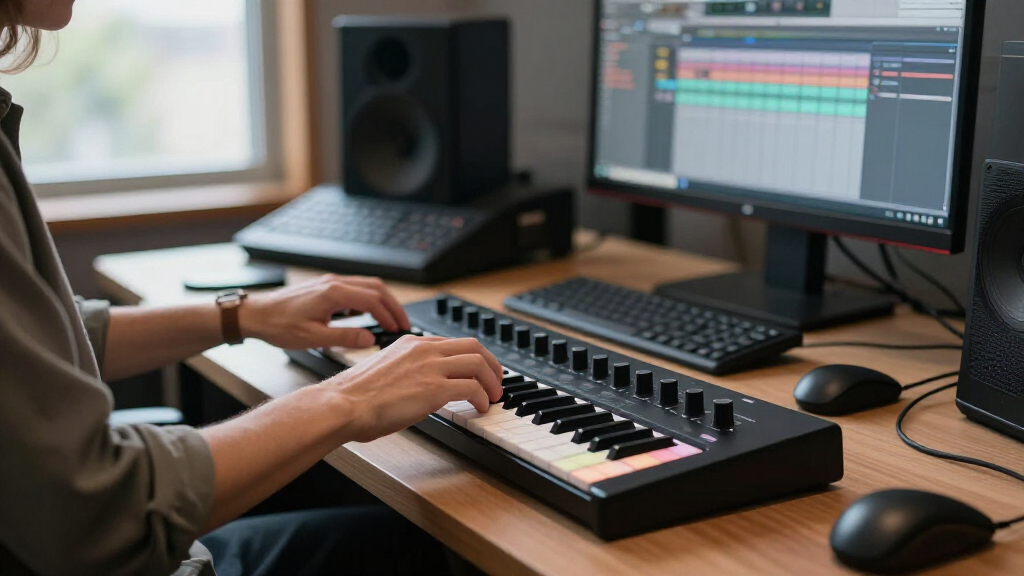
These MIDI controllers were evaluated based on performance, build quality, usability, feature set, and value for money. We prioritized models that cater to a range of user needs—from beginners to professionals—by assessing their control options, portability, and software compatibility. Our ranking reflects a balance between affordability and advanced features, ensuring that each pick offers a clear advantage for its target user. Devices with robust build quality and intuitive interfaces were rated higher, while those with limited controls or questionable durability were ranked lower. This approach ensures that each product serves a specific purpose without overstating its capabilities.| music production MIDI controller | Connectivity |
|---|---|
| Akai Professional MPK Mini MK3 | USB |
| Arturia MiniLab 3 Universal MI | — |
| Akai Professional MPK Mini Pla | — |
| Akai Professional LPK25 25-Key | USB |
| PreSonus ATOM Production & Per | — |
| Akai Professional MPK Mini Plu | USB, MIDI I/O, CV/Gate I/O |
| M-AUDIO Keystation Mini 32 MK3 | USB |
| Akai Professional APC Mini MK2 | USB |
| Donner USB-C MIDI Keyboard Con | — |
| Akai Professional APC Key 25 M | USB |
Factors to Consider When Choosing Music Production MIDI Controllers
When selecting a music production MIDI controller, understanding your specific needs and workflow is essential. Consider how many keys you need—whether a compact 25-key model suffices or a full-sized 49 or 61-key controller is necessary for your style. Compatibility with your DAW and software is also critical; some controllers come with integration features or dedicated mappings. Build quality and tactile feel influence long-term satisfaction, especially if you plan to use the controller extensively. Additionally, decide whether you want extra controls like pads, knobs, or faders to enhance your production versatility. Balancing these factors will help you find a controller that fits your budget and workflow, avoiding common pitfalls like overpaying for features you won’t use or buying too little for your production demands.Size and Key Count
Choosing the right size and key count depends on your workspace and playing style. Compact controllers like the Akai MPK Mini MK3 excel for portability and quick setups but may limit expressive playing. Larger controllers with more keys offer greater range and comfort but can be cumbersome in small spaces. Think about whether you’ll primarily produce at a desk or need something portable for live gigs or mobile setups. Remember, more keys often mean a higher price, so prioritize your core needs to avoid unnecessary expense.Compatibility and Software Integration
Not all MIDI controllers work seamlessly with every DAW or music software. Some include dedicated mappings, preset templates, or integration features that simplify workflow. Check if the controller supports your preferred DAW and whether it offers class-compliant operation or requires drivers. Compatibility issues can lead to frustration, especially if you plan to switch between multiple platforms or software. A controller with broad compatibility ensures smoother operation and saves time troubleshooting.Control Features and Expandability
Beyond keys, many controllers include pads, knobs, faders, and transport controls that expand your creative options. Consider whether you need dedicated drum pads for beat making or assignable knobs for real-time parameter control. More controls often mean a richer production experience, but they also increase complexity and cost. Decide which features are essential for your workflow and avoid paying extra for controls you won’t use regularly.Build Quality and Tactile Feel
Durability and the feel of keys or pads influence your long-term satisfaction. Cheap plastic keys might feel unresponsive or flimsy, leading to fatigue or frustration. Conversely, high-quality controllers use better materials and responsive keys, providing a more natural playing experience. If you plan to use your controller intensively, investing in a sturdy, well-built model is worth the extra cost. Don’t overlook build quality—it’s a key factor in reliability and overall enjoyment.Price and Value
Budget controllers are appealing for beginners or casual users but often lack advanced features or durability. Mid-range models strike a balance, offering more controls and better build without a hefty price tag. Premium controllers cater to professionals needing extensive control and premium build quality, often with software bundles and expandability. Evaluate your production needs and budget carefully—spending more on a controller that matches your workflow can save money and frustration in the long run.Frequently Asked Questions
Can I use a MIDI controller without any software?
While some MIDI controllers are class-compliant and can work as basic input devices without additional software, most require DAW or plugin support to fully utilize their features. Basic MIDI messages like note on/off can often be sent without software, but controlling parameters, pads, or additional controls will need compatible software or drivers. It’s important to verify whether the controller is plug-and-play or if it needs specific software to unlock its full potential. For seamless operation, pairing your MIDI controller with the right DAW and software setup is recommended.Is a larger keyboard always better for music production?
Not necessarily. Larger keyboards with more keys provide a greater range and can be more comfortable for live playing or composing pieces that require extensive range. However, they also take up more space and may be less portable. Smaller controllers are typically more affordable, lightweight, and easier to fit into tight spaces, making them ideal for mobile setups or limited desks. Your choice should depend on your playing style, available space, and whether you prioritize portability over key range.Should I prioritize keys or pads on my MIDI controller?
This depends largely on your production style. If you’re a keyboardist or focus on melodic and harmonic elements, keys are essential. Conversely, if beat making, sample triggering, or finger drumming are your priorities, pads become more valuable. Many controllers blend both, offering a compromise. Consider your workflow and the types of sounds you generate most often; this will guide you toward a controller with the right balance of keys and pads.Are premium MIDI controllers worth the extra cost?
Premium controllers often feature higher build quality, more controls, extended key ranges, and better integration with software, which can enhance your workflow and durability. If you’re a professional or spend many hours producing, investing in a higher-end model can improve your comfort and efficiency. However, if you’re just starting out or produce casually, a mid-range or budget option may be sufficient. Weigh these benefits against your budget and production demands to decide whether the investment makes sense for your situation.What should I consider if I want a portable MIDI controller?
Portability requires a compact size, lightweight design, and reliable connectivity. Look for controllers with a USB-C or USB 3.0 connection for faster data transfer and fewer connection issues. Battery-powered options are rare but ideal for mobile use; most rely on USB power. Ensure the controller is sturdy enough to withstand transport and offers essential controls without overloading on features. Choosing a lightweight, durable model helps you move between home, studio, and live environments with ease.Conclusion
For those starting out or needing a versatile, portable controller, the Akai MPK Mini MK3 offers a compelling mix of features and affordability. If budget constraints are tight, the M-AUDIO Keystation Mini 32 MK3 provides reliable basic functionality at a lower cost. Professionals or advanced producers seeking extensive control and durability should consider the Akai MPK Mini Plus or other high-end models, which justify their premium price with expanded features. Casual hobbyists or those with limited space will benefit from compact options, while studio-focused users might prioritize controllers with more keys and controls. Ultimately, your choice should align with your production style, workflow, and budget—making the right controller a key component in your musical journey.
Halloween Picks
halloween
As an affiliate, we earn on qualifying purchases.