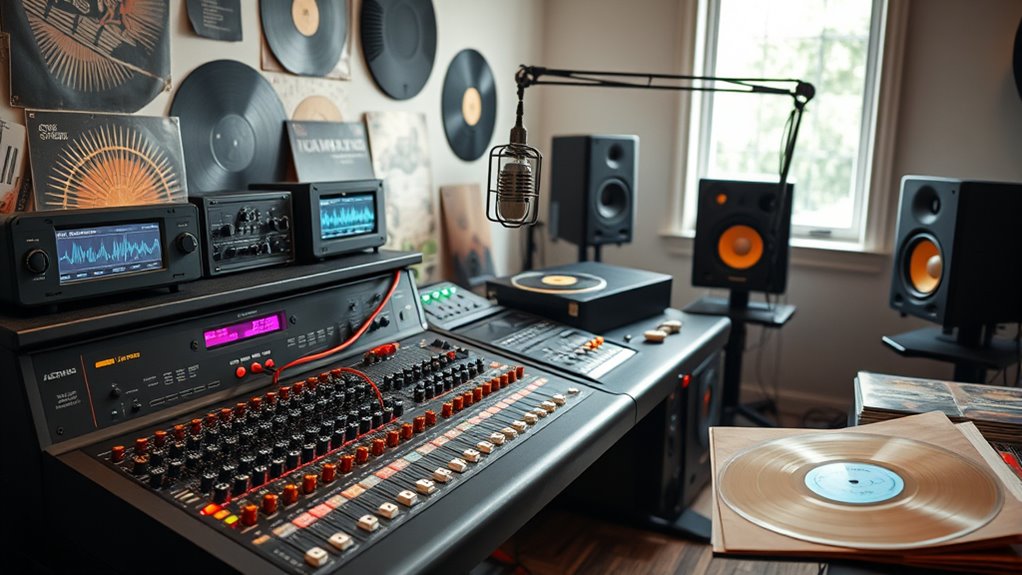

A hybrid setup lets you blend analog warmth and character with the precision and flexibility of digital gear. You can route signals carefully to maximize clarity, minimize noise, and create seamless workflows between different devices. Using audio interfaces, patch bays, and synchronization tools helps integrate synths, compressors, and digital software smoothly. This approach enhances your sound and allows for fine-tuning your workflow. If you want to discover how to optimize your hybrid system, keep exploring the essentials.
Key Takeaways
- Carefully plan signal routing to optimize the flow between analog and digital components, ensuring clarity and minimizing noise.
- Use audio interfaces with multiple inputs and outputs to facilitate seamless integration of analog gear with digital systems.
- Record analog outputs directly into DAWs to preserve warmth and character while enabling digital editing and effects.
- Synchronize digital devices with analog gear via MIDI or sync protocols to maintain timing and phase coherence.
- Leverage virtual routing within DAWs for flexible signal management, combining the strengths of both analog and digital setups.
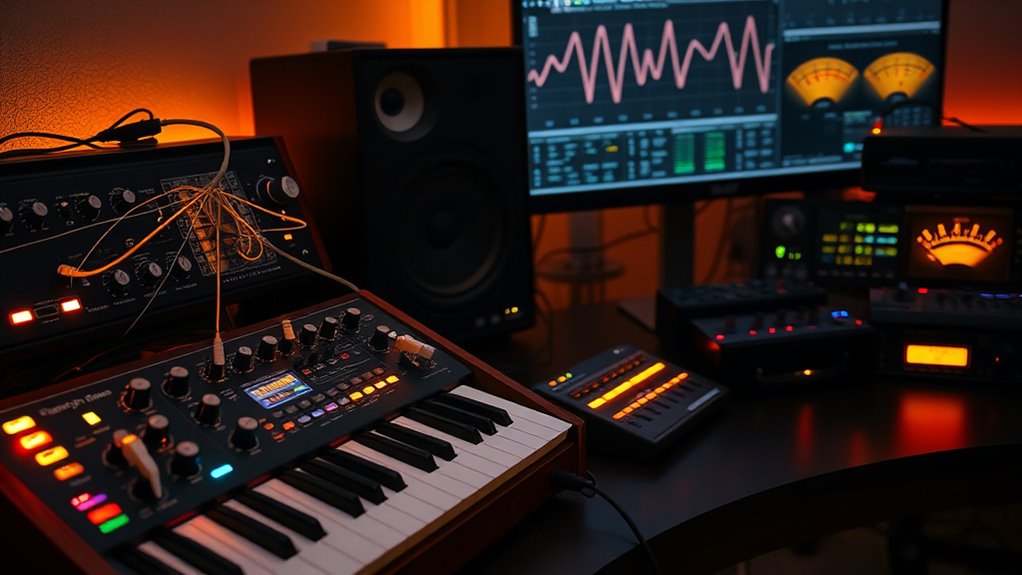
Hybrid setups are becoming increasingly popular because they offer the flexibility of combining different technologies or configurations to optimize performance and efficiency. When you blend analog and digital gear, you gain the ability to fine-tune your sound and workflow while maintaining the warmth and character of traditional equipment. One of the key advantages is how you manage signal routing. By carefully planning how signals flow between your analog and digital components, you can maximize clarity, minimize noise, and create seamless transitions. Proper signal routing ensures that your audio passes through the right channels and effects without degradation, allowing you to leverage the strengths of each gear type.
Gear integration is at the heart of a successful hybrid setup. You want your analog gear—such as compressors, EQs, or vintage synths—to work harmoniously with your digital devices like DAWs, plugins, and MIDI controllers. This integration requires thoughtful connection choices, whether through audio interfaces, patch bays, or direct connections. When you connect your gear properly, you avoid signal loss and latency issues, making your workflow smoother and more reliable. For example, using an audio interface with multiple inputs and outputs enables you to route signals from analog sources into your digital environment effortlessly, then back out for processing or mixing.
The real magic of hybrid setups lies in how you combine these technologies. You might use analog gear for its unique sonic characteristics, then process the sound further within your digital environment. Or you could record analog outputs directly into your DAW, preserving warmth while still taking advantage of digital editing and effects. Signal routing becomes a vital factor here, as it determines how efficiently and cleanly your signals move between different pieces of equipment. You might employ patch bays or virtual routing within your digital audio workstation to control exactly where each signal goes, giving you maximum flexibility.
Gear integration also means considering synchronization. Ensuring your digital devices stay in time with analog gear—using MIDI clock or sync protocols—prevents phase issues or timing discrepancies. This synchronization allows you to enjoy the best of both worlds without sacrificing timing or quality. Additionally, integrating hardware controllers with your digital setup can streamline your workflow, giving you hands-on control over parameters across both platforms. Understanding the importance of contrast ratio and how it impacts your sound can help you make more informed decisions when selecting equipment, ensuring your setup delivers the clarity and depth you desire.
Ultimately, a hybrid setup lets you craft a sound that’s rich, detailed, and dynamic. By mastering signal routing and gear integration, you create a cohesive environment where analog warmth complements digital precision. It’s about leveraging the strengths of each technology to produce a unique and professional sound, all while maintaining flexibility and control throughout your creative process.
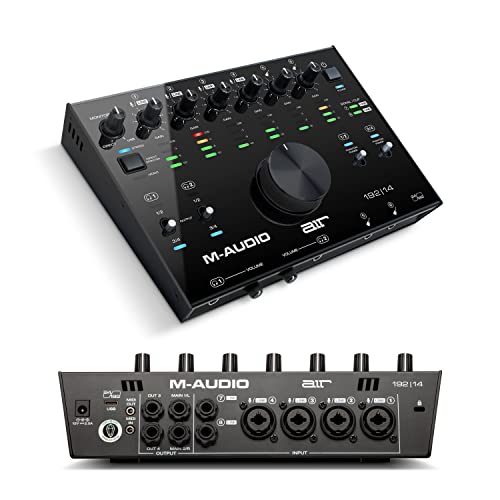
M-AUDIO AIR 192×14 USB-C Audio Interface for Studio Recording with 8 In and 4 Out, MIDI Connectivity, and Software from MPC Beats and Ableton Live Lite
Capture every detail – premium component selection and 24-bit/192kHz resolution for professional recording and monitoring to your Mac/…
As an affiliate, we earn on qualifying purchases.
As an affiliate, we earn on qualifying purchases.
Frequently Asked Questions
How Do I Integrate Vintage Analog Gear With Modern Plugins?
You can integrate vintage analog gear with modern plugins by using vintage integration techniques like re-amping or sending signals through your analog gear before capturing with your DAW. Guarantee plugin compatibility by choosing digital tools that emulate or complement your analog gear’s character. Use audio interfaces with high-quality AD/DA conversion to preserve sound quality, and consider software that models vintage equipment to blend the warmth and character seamlessly into your digital workflow.
What Are the Best Practices for Maintaining Hybrid Setups?
You should regularly check your signal routing to make clean, noise-free connections between analog and digital gear. Keep your vintage gear calibrated properly to maintain its tonal integrity, and do the same with digital plugins to avoid inconsistencies. Organize your setup with clear cable management, and document your routing and calibration settings. This keeps your hybrid system reliable, sound consistent, and easy to troubleshoot when needed.
Can I Automate Analog Gear Within a Digital Workflow?
Yes, you can automate analog gear within a digital workflow by using synth integration and MIDI control. Connect your analog synth to your computer with a MIDI interface, then assign MIDI CC messages to parameters you want to automate. This way, you can control and automate your analog gear’s functions directly from your digital audio workstation, making your hybrid setup more seamless and flexible.
How Do I Troubleshoot Signal Issues in Hybrid Configurations?
You troubleshoot signal issues in hybrid setups by first checking your signal path for loose connections or faulty cables. Make certain impedance matching between your analog and digital gear to prevent signal loss or distortion. Use a signal tester or meter to identify where the signal drops or degrades. Adjust impedance matching components if needed, and verify each connection step-by-step. This approach helps you pinpoint and resolve issues quickly.
What Are Cost-Effective Options for Hybrid Studio Setups?
Imagine your studio as a vibrant mosaic; you can create it with budget-friendly options and DIY solutions. To keep costs low, repurpose old gear, build your own cables, or use software plugins that mimic analog warmth. Look for second-hand gear and open-source tools. These affordable strategies let you blend analog and digital seamlessly, giving your setup professional sound without breaking the bank, all while fueling your creative vision.

Samson S-Patch Plus 48-Point Audio Patch Bay with 1/4-Inch Phone Connections
Smooth Mechanism: The Samson S-Patch Plus 48-Point Audio Patch Bay with 1/4-Inch Phone Connections has a fully balanced…
As an affiliate, we earn on qualifying purchases.
As an affiliate, we earn on qualifying purchases.
Conclusion
By blending analog warmth with digital precision, you create a sonic tapestry that’s richer and more versatile. Think of your hybrid setup as a musical garden, where each element blooms with its own character, yet all work together harmoniously. Embracing both worlds allows you to craft unique sounds and adapt effortlessly to any project. So, don’t be afraid to experiment—your perfect soundscape is waiting to be accessed, just like a treasure buried beneath a layered landscape.

Walrus Audio Canvas MIDI Clock
Tempo Out – Connect to any pedal or device that accepts external tap inputs or analog time controls…
As an affiliate, we earn on qualifying purchases.
As an affiliate, we earn on qualifying purchases.

DriverGenius AudioXfer Series | USB Audio Capture Card Device | Convert Analog Cassette Audio to Digital MP3 with 3.5mm/RCA Inputs | Compatible with PC, Mac & Linux (AV202-B, 1-Pack)
AUDIO CAPTURE CARD DEVICE: Farewell to the old cassette, make the memory alive and become forever. With 3.5mm…
As an affiliate, we earn on qualifying purchases.
As an affiliate, we earn on qualifying purchases.