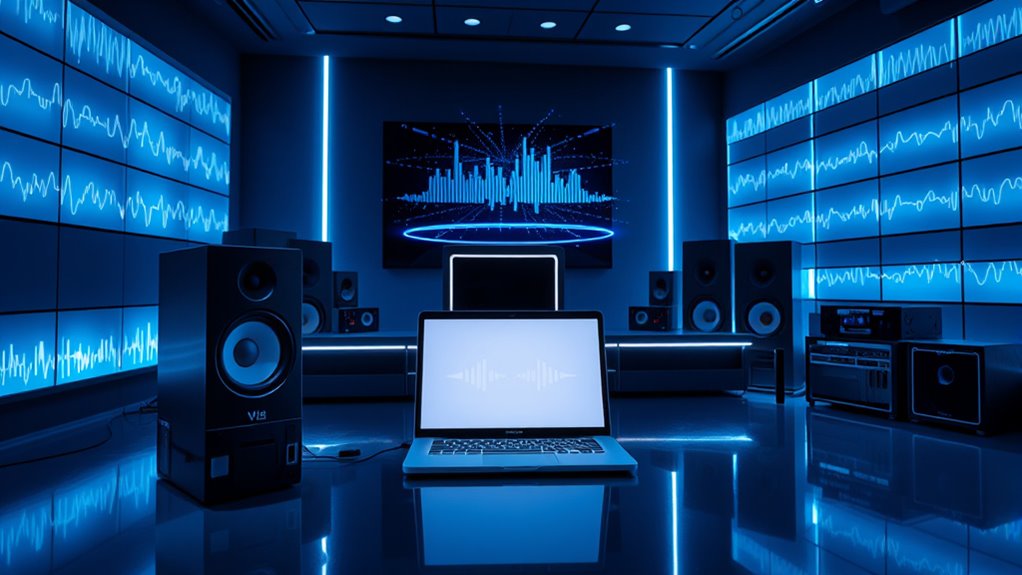

AI-powered sound design uses deep learning models to generate and enhance audio samples with remarkable realism and flexibility. You can create new sounds that are difficult or impossible with traditional methods, allowing for rapid experimentation and unique textures. These tools also enable real-time modulation, letting you shape pitch, effects, and dynamics on the fly. Exploring further reveals how integrating AI can transform your creative workflow and expand sonic possibilities.
Key Takeaways
- Neural synthesis enables realistic, complex sound generation and the creation of unique audio textures beyond traditional sampling methods.
- AI-powered tools facilitate rapid sample generation and enhancement, expanding creative possibilities in sound design workflows.
- Real-time modulation of AI-generated sounds allows dynamic adjustments like pitch, effects, and filters during production or live performance.
- Integration of neural synthesis with real-time controls supports iterative experimentation and seamless blending of AI and human creativity.
- User-friendly AI sound design platforms democratize access, empowering creators to produce sophisticated audio content easily.
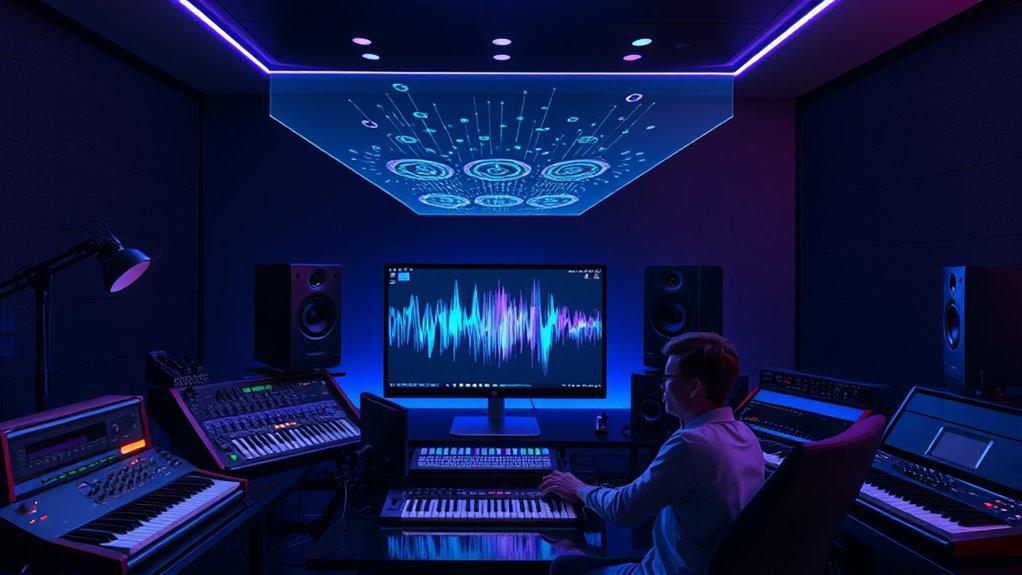
Artificial intelligence is transforming sound design by enabling creators to generate, manipulate, and refine audio with unprecedented efficiency. One of the most exciting advancements in this field is neural synthesis, which allows you to produce highly realistic and complex sounds by leveraging deep learning models. Instead of relying solely on traditional sampling or manual editing, neural synthesis creates new audio textures by learning patterns from vast datasets. This technique enables you to craft entirely new sounds that would be difficult or impossible to generate through conventional methods. With neural synthesis, your creative possibilities expand dramatically, giving you access to a rich palette of audio that can be tailored to fit any project.
AI-driven neural synthesis unlocks limitless, realistic sounds, transforming creative sound design with unparalleled efficiency and innovation.
Real-time modulation is another breakthrough that empowers you to interact with sounds dynamically. This technology allows you to modify parameters like pitch, filter, volume, and effects on the fly, all in real time. Whether you’re performing live or working within a digital audio workstation, real-time modulation makes it easier to experiment and shape sounds intuitively. Paired with AI-driven tools, it enhances your ability to create evolving soundscapes, adaptive effects, and intricate textures without interruption. The seamless integration of real-time modulation with neural synthesis means you can generate sounds that are not only complex but also highly responsive to your input, giving your work a more organic, expressive quality.
Together, neural synthesis and real-time modulation revolutionize how you approach sound design. Instead of static, pre-recorded samples, you can now generate sounds on demand and tweak them instantaneously. This synergy allows for rapid iteration, fostering experimentation and innovation. You might start with a neural network-generated sound and then manipulate it live, creating a fluid blending of AI-generated content and human artistry. Such capabilities are especially valuable in film scoring, game design, and live performances, where responsiveness and uniqueness matter.
Moreover, these tools often come with user-friendly interfaces that enable you to harness their power without needing extensive technical expertise. This democratization of advanced sound design techniques means you can focus more on your creative vision rather than technical limitations. As AI continues to evolve, expect even more sophisticated neural synthesis models and real-time modulation features that will push the boundaries of what’s possible in sound design. By embracing these innovations, you position yourself at the forefront of audio creativity, unveil new dimensions of sonic expression and efficiency. Understanding neural synthesis can help you better grasp how these cutting-edge technologies reshape the landscape of sound design.
![WavePad Audio Editing Software - Professional Audio and Music Editor for Anyone [Download]](https://m.media-amazon.com/images/I/B1fcLEGCs6S._SL500_.png)
WavePad Audio Editing Software – Professional Audio and Music Editor for Anyone [Download]
Full-featured professional audio and music editor that lets you record and edit music, voice and other audio recordings
As an affiliate, we earn on qualifying purchases.
As an affiliate, we earn on qualifying purchases.
Frequently Asked Questions
Can Ai-Generated Sounds Replace Human Sound Designers Entirely?
AI-generated sounds won’t fully replace human sound designers because creative collaboration and artistic authenticity matter. While AI can produce impressive samples and enhance your work, it lacks the emotional nuance and personal touch only you bring to the process. Your intuition and artistic vision guide the sound design, ensuring authenticity. So, use AI as a tool to complement your creativity, rather than a replacement for your unique artistic insight.
What Ethical Considerations Arise From Ai-Generated Audio Content?
Think of AI-generated audio as a double-edged sword, like a paintbrush that can create beautiful art or infringe on an artist’s work. You must consider authenticity concerns, ensuring sounds feel genuine and not deceptive. Also, respect intellectual property rights, avoiding the misuse of copyrighted material. Ethical use requires transparency and proper attribution, so you protect creators’ rights while embracing innovation in sound design.
How Do AI Tools Handle Copyright Issues With Sample Generation?
AI tools handle copyright concerns by implementing licensing challenges and filtering systems to avoid infringing samples. They analyze existing works to prevent copying or unauthorized use, but you should still review generated content for potential copyright issues. Keep in mind that licensing challenges can arise if the AI’s training data includes copyrighted material, so always verify the source and ensure proper rights are in place before using AI-generated samples commercially.
Are There Limitations to Ai’s Ability to Mimic Complex Acoustic Environments?
You might think AI can perfectly mimic complex acoustic environments, but it struggles with acoustic complexity and environmental realism. Ironically, no matter how advanced, AI often falls short capturing the subtle nuances and unpredictable variations of real-world sounds. So, while it can generate impressive samples, it still can’t fully replicate the richness and depth of authentic acoustic environments, leaving some emotional and sensory gaps unfilled.
How Accessible Are AI Sound Design Tools for Beginners?
AI sound design tools are quite accessible for beginners, thanks to their user-friendly interfaces and straightforward workflows. You’ll find many options that are affordable, making it easier to start experimenting without a big investment. These tools often include tutorials and presets, helping you learn quickly and create professional-sounding samples. So, if you’re new to sound design, AI tools can be a great, cost-effective way to develop your skills.

Audio Signal Generator ECUTEE Low Frequency Signal Generator 10Hz-1MHz Audio Adjustable Signal Generator TAG-101 110V
Our low frequency signal generator uses reliable circuitry to ensure high stability and accuracy. Sine and square waveforms…
As an affiliate, we earn on qualifying purchases.
As an affiliate, we earn on qualifying purchases.
Conclusion
So, after all this talk about AI transforming sound design, it’s funny how we’re now relying on algorithms to create the very human element of music. You’d think that by automating samples, we’d lose some artistry, but instead, it seems we’re just handing over creativity to machines. Ironically, the more we depend on AI, the more it feels like we’re rediscovering the magic of human ingenuity—just with a digital twist.

Portable Vocal Remover, AI Intelligent Real-Time Voice Elimination for Karaoke Machines,Bluetooth-Enabled Receiver Compatible with Any 3.5mm Speaker
AI Real-Time Vocal Remover: This AI Vocal remover adopts a millisecond-level AI chip and is equipped with intelligent…
As an affiliate, we earn on qualifying purchases.
As an affiliate, we earn on qualifying purchases.
AI-powered music sample enhancer
As an affiliate, we earn on qualifying purchases.
As an affiliate, we earn on qualifying purchases.