
In AI-assisted music, you count as the author when you actively shape the work through deliberate choices like composition, arrangement, and editing. Merely pressing buttons or selecting AI suggestions doesn’t establish your creative control. Your personal taste, artistic decisions, and emotional input matter most. The more you influence the final piece with your unique style and vision, the stronger your claim to authorship. Keep exploring to understand how you can maintain your artistic voice in AI-driven music.

Get audio and creator gear delivered free with Prime
- Fast, free delivery on millions of items
- Prime Video, Amazon Music and more included
- Member-only deals all year
Key Takeaways
- Active creative control through composition, arrangement, and editing affirms human authorship.
- Personal artistic choices and stylistic nuances distinguish human contributions from AI output.
- Curating and shaping AI suggestions reflect originality and reinforce human involvement.
- Merely selecting AI-generated options without deliberate shaping does not establish authorship.
- Clear expression of emotional depth and artistic vision signifies authentic human creative input.
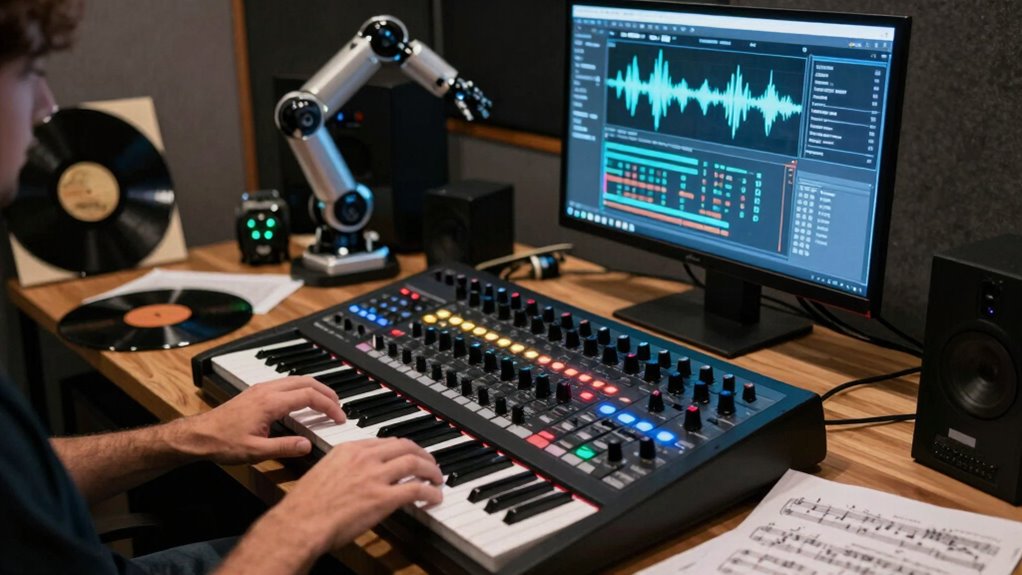
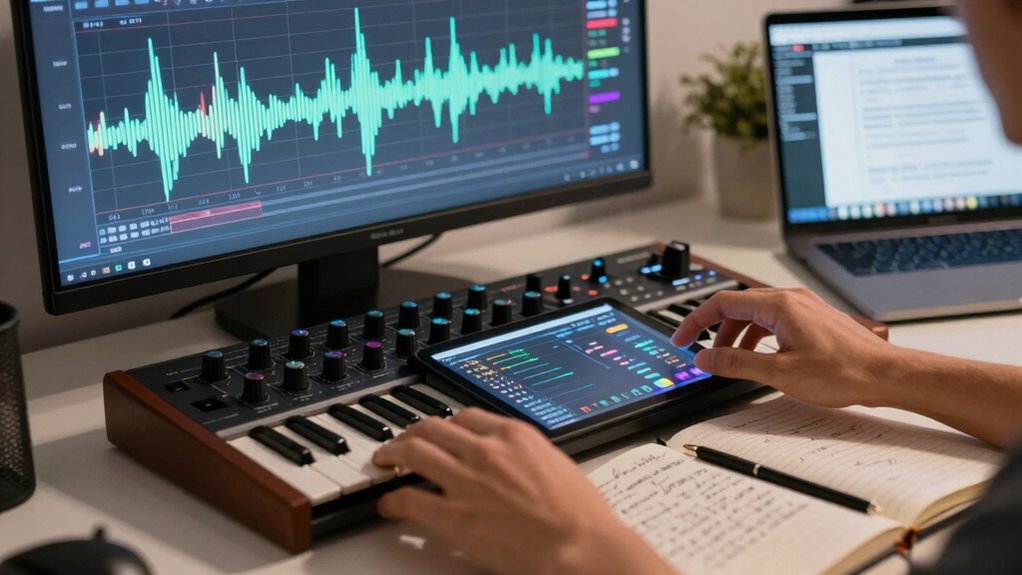
Have you ever wondered what truly makes music human-made in an age of AI assistance? As technology advances and AI tools become more integrated into the creative process, the question of authorship becomes increasingly complex. At the heart of this debate is the idea of creative control—who truly directs the artistic vision when algorithms generate parts of a composition? If you’re using AI to suggest melodies or harmonies, you might feel you’re still in charge, but the extent of your influence determines whether your work is genuinely human-authored. To be considered the creator, you need to exercise enough creative control to shape the final outcome actively. Merely selecting from AI-generated options doesn’t automatically grant you full authorship unless you steer the process with intentionality and decision-making.
Originality criteria also play an essential role in defining human authorship. When AI produces music based on vast datasets and learned patterns, it blurs the line between human innovation and machine output. If your role involves curating, editing, or combining AI suggestions into a cohesive piece, you’re adding a layer of originality that reflects personal artistic sensibility. However, if the AI’s output is largely unaltered, some might argue that the work’s originality is compromised, and your role becomes more of an editor than a creator. The key is whether your involvement introduces new ideas, emotional depth, or stylistic choices that aren’t merely derivative of existing data. If you’re applying your unique taste and judgment, you meet the originality criteria that help differentiate your work from purely machine-generated outputs.
Determining what counts as human authorship involves examining both how much control you exert and whether your contributions imbue the music with personal, creative qualities. It’s not just about pressing buttons or selecting options but about actively shaping the music in a way that reflects your artistic identity. When you make deliberate decisions—be it in the composition, arrangement, or final editing—you reinforce your role as the author. Ultimately, the line between human and machine becomes clearer when your personal vision, creative choices, and artistic voice are evident in the finished piece. As AI-generated content becomes more sophisticated, understanding content formats and asserting your creative control are essential to maintaining your role as the true creator. In this new era of AI-assisted music, understanding and asserting your creative control and originality criteria helps ensure your human authorship remains intact.
As an affiliate, we earn on qualifying purchases.
Frequently Asked Questions
How Do Copyright Laws Apply to Ai-Generated Music?
Copyright laws are still catching up with AI-generated music, leading to legal ambiguities. Since AI tools can produce content without human input, determining authorship becomes tricky. You might wonder if the creator’s input grants copyright or if the work is in the public domain. Typically, for legal protection, the work must demonstrate artistic originality by a human. As laws evolve, staying informed helps you navigate rights and ownership in AI-assisted music.
Can AI Be Considered a Co-Author in Music Creation?
AI can’t be considered a co-author in music creation because it lacks the capacity for creative collaboration and artistic originality. When you use AI, you’re the one guiding the process, making decisions, and shaping the work. The AI acts as a tool, not a partner. As a result, authorship remains with you, as the human creator, since the essence of artistic originality stems from your input and creative vision.
What Ethical Concerns Arise From Ai-Assisted Music Authorship?
Like Icarus’ flight, AI-assisted music raises questions about creative authenticity and artistic originality. You might worry that relying on AI diminishes genuine human expression, risking a loss of emotional depth and personal voice. Ethical concerns also include authorship rights, transparency, and potential cultural homogenization. Ensuring AI enhances rather than replaces human creativity helps preserve the integrity of music and maintains respect for artists’ unique visions.
How Do Different Cultures View AI Involvement in Music?
Different cultures perceive AI involvement in music through varied lenses. Some view it as a breakthrough, blending tradition with innovation, enhancing artistic authenticity. Others see it as a threat to cultural purity, questioning whether AI-generated music truly reflects human creativity. You might find that in certain societies, AI’s role in music sparks excitement and openness, while in others, it raises concerns about preserving cultural integrity and the essence of human artistry.
Will AI Replace Human Musicians Entirely in the Future?
Will AI replace human musicians entirely? No, because AI can’t replicate the soul of creative collaboration or capture true artistic authenticity. AI tools will evolve into partners that enhance your music, not replace your unique voice. Think of AI as a brush in your hand—expanding your creative horizon, rather than overshadowing your artistry. Your human touch remains irreplaceable in shaping genuine, emotionally resonant music.
music editing and arrangement tools
As an affiliate, we earn on qualifying purchases.
As an affiliate, we earn on qualifying purchases.
Conclusion
So, when it comes to AI-assisted music, your role as a human creator isn’t just a drop in the ocean—you’re the entire universe! Without your choices, emotions, and vision, the AI’s notes are just digital echoes. Your contribution isn’t just a part of the music; it’s the heartbeat that makes it alive. In this wild, tech-driven symphony, your human touch is the secret sauce that turns code into a masterpiece!
digital audio workstation for creative control
As an affiliate, we earn on qualifying purchases.
As an affiliate, we earn on qualifying purchases.
music production tools for artists
As an affiliate, we earn on qualifying purchases.
As an affiliate, we earn on qualifying purchases.
Halloween Picks
halloween
As an affiliate, we earn on qualifying purchases.