📊 Full opportunity report: Licensing And Approvals Hub For Voice Actors' AI Clones on IdeaNavigator AI — validation score, market gap, and execution plan.

Get audio and creator gear delivered free with Prime
- Fast, free delivery on millions of items
- Prime Video, Amazon Music and more included
- Member-only deals all year
TL;DR
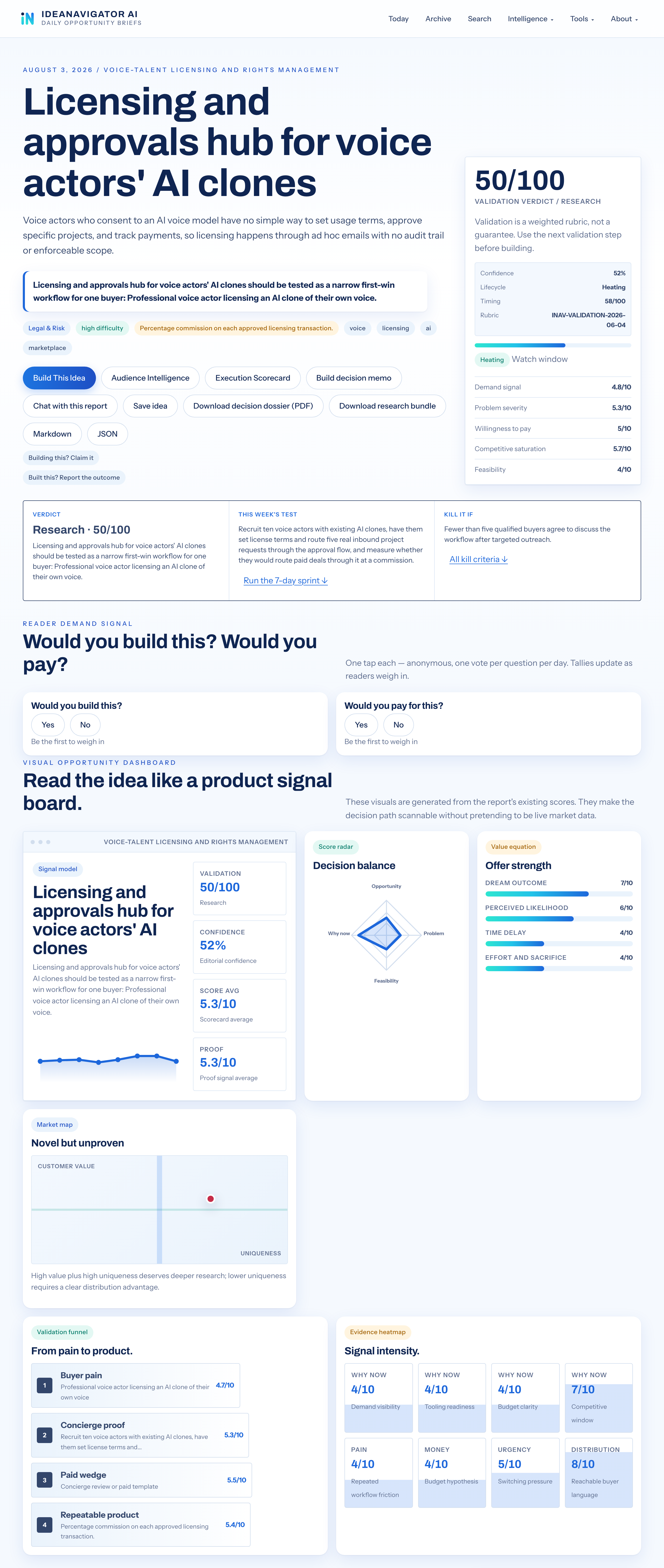
IdeaNavigator AI has outlined a proposed licensing and approvals hub for professional voice actors who license AI clones of their own voices. The suggested MVP would let actors set usage limits and rates, review project requests, and log approved deals; the idea is still at the validation stage, with no launch or market results reported.
IdeaNavigator AI has proposed testing a licensing and approvals hub for professional voice actors who authorize AI clones of their voices, aiming to replace informal project-by-project arrangements with defined terms, approvals and payment records. The proposal describes an MVP concept, not a launched service, and sets out a test with ten actors and real project requests to gauge whether they would use it for paid deals.
According to IdeaNavigator AI’s proposal, the service would let a voice actor create a listing for an AI version of their voice. The actor could specify permitted uses, prohibited categories and a rate for each project. Buyers would submit projects for the actor to approve or reject through a simple workflow. Approved uses would be recorded with their payment terms, creating a record of what was authorized.
IdeaNavigator AI says the concept targets a gap between consenting to an AI voice model and settling how that voice can be used in later projects. The proposal describes actors handling terms and approvals through ad hoc email exchanges, which it says can make permissions, payments and license boundaries harder to track. It provides no evidence about how common that practice is or whether existing services already address some of those needs.
The proposal suggests a commission on each approved licensing transaction as the revenue model. Its proposed demand test would recruit ten voice actors who already have AI clones, ask them to set license terms, then route five real inbound project requests through the approval process. IdeaNavigator AI identifies willingness to use the system for paid deals while accepting a commission as a key measure. It reports no participants, transaction volume, pricing or test findings.
Putting Voice Permissions on Record
In IdeaNavigator AI’s framing, the proposed workflow addresses a practical gap between agreeing to create or license a synthetic voice and controlling its use in individual projects. A project-level approval process could make scope and consent easier to document, while a record of payment terms could help both actor and buyer refer back to what was agreed. The proposal does not establish whether those records would be legally enforceable or resolve disputes.
For buyers, IdeaNavigator AI says a structured approval step could clarify whether a particular use has been authorized before production or release. The proposal points to increased attention from unions and legal professionals to questions of permission, usage limits and compensation, but provides no specific statements or other evidence for that characterization. The idea would not set industry-wide rules; it is presented as a possible transaction tool for parties negotiating individual licenses.
The commercial test is also important. A commission-based platform needs enough actors and buyers to conduct transactions, and participants must see value in using it rather than continuing with direct agreements. IdeaNavigator AI’s proposed pilot is intended to test that willingness, but its small planned sample would not by itself establish broad market demand.
Popular right now

Ninja CREAMi 7-in-1 Ice Cream Maker, NC299AMZ

Bose QuietComfort True Wireless Noise-Cancelling Earbuds, Black

Bose QuietComfort Wireless Noise Cancelling Headphones, Sandstone
As an affiliate, we earn on qualifying purchases.
From Consent to Project Approval
IdeaNavigator AI describes a narrow use case: professional voice actors licensing AI clones of their own voices. The proposal is not for a general marketplace for synthetic media, a voice-generation product, or a system that automatically grants rights. The actor would define terms and retain a decision point for each submitted project.
IdeaNavigator AI gives commercial viability of voice cloning and union and legal attention to consent, scope and compensation as reasons to explore the concept. The proposal names no specific union statements, legal decisions or dates, so those points are the company’s stated rationale, not evidence that a particular new rule has taken effect.
The proposed first step is operational rather than a broad rollout: test whether actors with existing AI clones will configure terms and process genuine requests through the service. IdeaNavigator AI says this would help distinguish general interest in the concept from willingness to use a platform when a paid opportunity arrives.
Demand and Legal Scope Remain Open
IdeaNavigator AI’s proposal describes no product launch, company build, or completed pilot. It does not identify who would operate the proposed hub, how buyers would be recruited, what commission rate might apply, or how the service would verify a buyer’s identity and intended use. It also does not say how an actor could respond if a project’s use changed after approval.
The proposal identifies an audit trail and enforceable scope as needs, but does not explain whether platform records would have legal force, what contract terms would govern transactions, or how disputes and unauthorized uses would be handled. It offers no evidence that actors who already have AI clones would accept platform fees or that buyers would adopt an approval process. These are questions for the proposed test, not confirmed outcomes.
A Ten-Actor Pilot Is Proposed
IdeaNavigator AI’s stated next step is to recruit ten voice actors with existing AI clones, have each set licensing terms, and route five real inbound project requests through the approval flow. The proposed test would examine whether actors can use the workflow to review projects and whether they would direct paid licensing through it despite a commission.
IdeaNavigator AI has provided no schedule, recruitment status or results. If the test proceeds, its findings could show whether the approval process fits actual licensing requests and what changes might be needed before a larger trial. Until then, the hub remains a proposed product concept rather than an available service.
Source: IdeaNavigator AI proposal
Key Questions
Is the AI voice licensing hub available now?
No launch is reported. IdeaNavigator AI describes the hub as a proposed MVP and validation test, not a service currently available to actors or buyers.
What would voice actors be able to control?
Under IdeaNavigator AI’s proposal, actors could list allowed uses, banned categories and a per-project rate, then approve or reject requests for specific projects. Approved uses would be logged with payment terms.
How would the proposed service make money?
IdeaNavigator AI suggests a commission on each approved licensing transaction. The proposal gives no commission percentage or fee schedule.
How would the idea be tested?
IdeaNavigator AI proposes involving ten actors with existing AI clones who would set terms and route five real inbound project requests through the approval workflow. The plan would measure whether they would use it for paid deals at a commission; no results are available.
Would platform approval records be legally enforceable?
That has not been established. IdeaNavigator AI’s proposal calls for logging approved uses and payment terms but does not specify contract design, legal status or how disputes would be resolved.
Source: IdeaNavigator AI