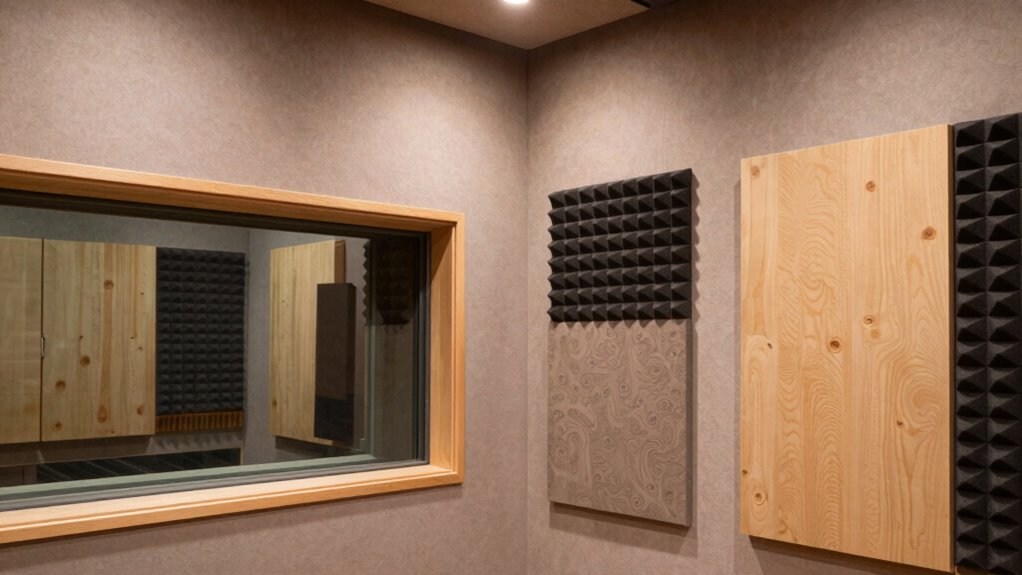

Acoustic treatment improves sound quality inside a room by absorbing or diffusing sound waves, reducing echoes, and enhancing clarity. Soundproofing, on the other hand, blocks sound from entering or leaving a space with dense materials that add mass and prevent noise transmission. Understanding the difference helps you choose the right approach for your needs. If you want to learn how to effectively balance both strategies, there’s more to uncover that can help you optimize your space.

Get audio and creator gear delivered free — and shop member deals
- Fast, free delivery on millions of items
- Access to Prime Big Deal Days deals on October 6–7
- Prime Video, Amazon Music and more included
Key Takeaways
- Acoustic treatment improves sound clarity within a room, reducing echoes and reverb, while soundproofing prevents external noise from entering or leaving.
- Materials for treatment focus on absorption and diffusion; soundproofing relies on dense, mass-loaded barriers.
- Proper placement of acoustic panels enhances internal sound quality; soundproofing requires sealing gaps and adding mass to block sound transmission.
- Larger rooms typically need more acoustic treatment due to increased reverb, whereas soundproofing aims to contain or block external noise regardless of size.
- Achieving optimal sound environment often involves a combination of both strategies, tailored to specific room characteristics and goals.

When it comes to improving the sound quality in a space, understanding the difference between acoustic treatment and soundproofing is essential. These two strategies target different issues, and knowing how to apply them effectively depends on your specific needs. Acoustic treatment focuses on enhancing sound clarity and reducing echoes within a room, while soundproofing aims to block sound from entering or leaving the space. To decide which approach suits you best, consider your room dimensions and material choices carefully.
Your room dimensions play a crucial role in how sound behaves inside the space. Larger rooms tend to produce more echo and reverb, making acoustic treatment necessary to absorb or diffuse sound waves. Conversely, smaller rooms might need less treatment but still benefit from strategic placement of sound-absorbing materials. If you have an irregularly shaped room, you might need to be more precise with your material choices to prevent sound reflections from bouncing around unevenly. The key is to analyze how sound interacts with your space and select treatments that fit its size and shape. For example, thicker panels or bass traps work well in larger rooms with low-frequency issues, whereas smaller rooms might require thinner absorption panels to manage mid and high frequencies. Additionally, the power output of electric dirt bikes, which can reach up to 20 horsepower, demonstrates how significant motor strength can be, similar to how the right acoustic materials can significantly impact sound quality in a space. Properly understanding the room acoustics can help you choose the most effective treatments for your specific environment. Recognizing how sound waves reflect and absorb within your space can lead to more targeted and efficient treatment choices.
Material choices are just as important as room dimensions when it comes to achieving the sound environment you want. Acoustic treatment materials include foam panels, diffusers, and bass traps, all designed to improve sound clarity and reduce reflections. These materials are often lightweight and easy to install, making them a practical choice for customizing your space. Using appropriate placement of these materials can maximize their effectiveness and ensure a balanced sound environment. On the other hand, soundproofing involves dense, mass-loaded materials like drywall, mass loaded vinyl, or specialized barrier paints that block sound transmission through walls, floors, and ceilings. The goal here is to add mass and damping to prevent sound leaks, especially if you’re trying to isolate a room for recording or practice. Incorporating soundproofing techniques effectively can help you achieve a quieter environment, whether for work or relaxation.
Ultimately, your choice depends on your primary goal. If you’re looking to improve how sound behaves inside a room—making music, podcasting, or watching movies—you’ll focus on acoustic treatment and material choices tailored to your room’s dimensions. If your goal is to prevent noise from escaping or entering, then soundproofing with dense, sound-blocking materials is the way to go. Both strategies require understanding your space’s unique characteristics, and selecting the right materials based on those factors ensures you create an environment optimized for your needs.
As an affiliate, we earn on qualifying purchases.
Frequently Asked Questions
Can Acoustic Treatment Improve Sound Quality Without Soundproofing?
Yes, acoustic treatment can improve your sound quality without soundproofing. It reduces room resonance and enhances frequency absorption, making your space sound clearer and more balanced. By adding panels or diffusers, you control reflections and minimize echoes, resulting in better sound clarity. While it doesn’t block outside noise, acoustic treatment focuses on optimizing your room’s interior acoustics, giving you a significant upgrade in sound quality without the need for soundproofing.
How Much Does Professional Acoustic Treatment Typically Cost?
Think of professional acoustic treatment as investing in a finely tailored suit—costs vary based on material options and room size. Typically, you’ll spend between $1,000 and $10,000, with cost comparisons showing higher-end materials like bass traps and diffusers being pricier. While that might seem steep, the investment transforms your space into a sonic sanctuary, ensuring your sound quality shines without breaking the bank.
Is DIY Acoustic Treatment as Effective as Professional Installation?
DIY acoustic treatment can be effective, but its success depends on your material durability and installation complexity. If you choose quality materials and carefully follow instructions, you’ll see significant improvements in sound quality. However, if your DIY setup isn’t durable or installation is too complex, it may not perform as well as professional installation. Professionals guarantee precise placement and durable materials, leading to more consistent, long-lasting acoustic benefits.
How Do I Choose Between Soundproofing and Acoustic Treatment?
You should choose between soundproofing and acoustic treatment based on your needs, as 70% of room sound issues stem from poor acoustics rather than external noise. If you’re prioritizing room aesthetics and want simple installation, acoustic treatment is ideal. However, if blocking external noise is key, soundproofing is more effective. Consider installation complexity and your goals to make the best choice for your space.
Can Acoustic Treatment Reduce Noise Transmission to Adjacent Rooms?
Acoustic treatment primarily improves sound quality within your room, but it doesn’t substantially reduce noise transmission to adjacent rooms. For effective noise insulation, you need structural barriers like added drywall, insulation, or specialized soundproofing materials. Acoustic treatments can help control echoes and improve clarity inside, but if your goal is to block noise from leaving the room, focus on soundproofing techniques that enhance structural barriers to prevent sound leaks.
As an affiliate, we earn on qualifying purchases.
Conclusion
Ultimately, understanding the subtle differences between acoustic treatment and soundproofing helps you create the perfect space for your needs. While each approach has its own strengths, finding a balance that suits your environment might mean embracing a bit of compromise. Sometimes, it’s about making your space more inviting rather than completely silent. By thoughtfully considering your priorities, you can craft a room that feels just right—peaceful enough for you, without losing the vibrant energy of life outside.
As an affiliate, we earn on qualifying purchases.
sound diffusers for acoustic treatment
As an affiliate, we earn on qualifying purchases.
As an affiliate, we earn on qualifying purchases.
Fall Picks
fall essentials
As an affiliate, we earn on qualifying purchases.