To master immersive mixing for Dolby Atmos and spatial audio, focus on precise object placement and dynamic movement within the three-dimensional sound field. Use spatial audio tools to position sounds overhead, behind, and around your listener, creating depth and realism. Adjust elevation, distance, and movement paths to enhance immersion. Critical listening and iterative tweaks are key to achieving a natural, convincing environment. Keep exploring techniques to elevate your mix even further.
Key Takeaways
- Utilize 3D object placement to position sounds throughout the entire sound field, including overhead and behind the listener.
- Employ real-time spatial audio tools to animate sound objects, adjusting elevation, distance, and movement paths dynamically.
- Build depth and width by layering sounds across different spatial zones, avoiding muddiness and enhancing clarity.
- Apply principles of sound localization to accurately position cues, guiding listener focus and creating realistic immersive scenes.
- Strategically develop dynamic soundscapes that evoke a sense of presence and emotional engagement within Dolby Atmos environments.
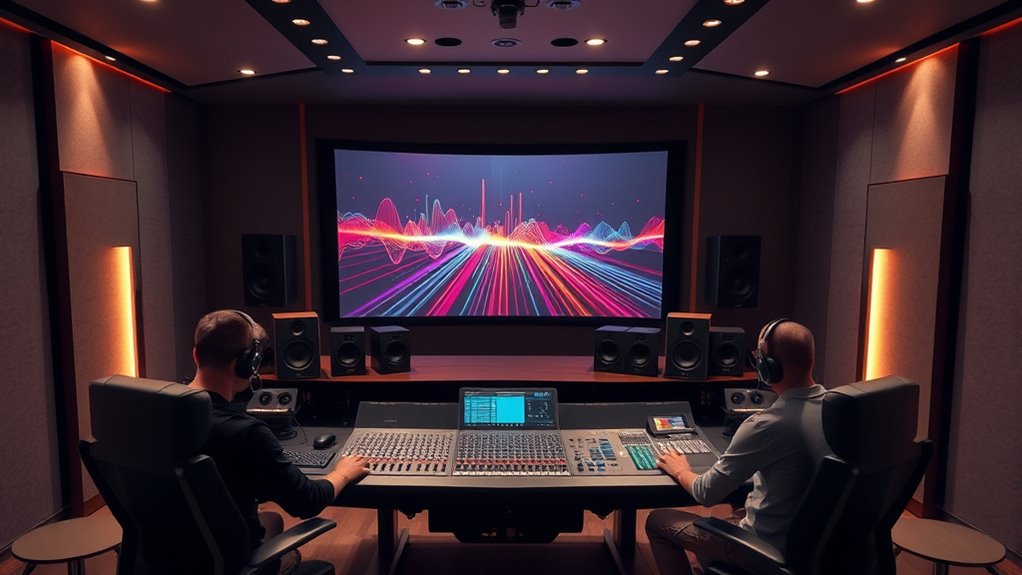
Have you ever wondered how audio engineers create a truly immersive listening experience? It all comes down to mastering techniques like object placement and sound staging. When working with Dolby Atmos and spatial audio, your goal is to craft a three-dimensional soundscape that surrounds the listener from all angles. To do this effectively, you need to understand how to position individual sound objects within a virtual space, ensuring each element feels natural and precise. Object placement involves assigning specific audio cues to locations in space, whether that’s overhead, to the side, or behind the listener. This meticulous positioning allows sounds to move seamlessly across the sound field, mimicking real-world acoustics and making the experience more engaging.
Object placement crafts a three-dimensional soundscape, positioning audio cues naturally around the listener for true immersion.
Sound staging, on the other hand, refers to how well you can create a sense of depth and width within your mix. It’s about layering sounds in a way that they occupy distinct spaces, avoiding muddiness and enhancing clarity. Proper sound staging helps the listener identify the distance and direction of different sounds, which is vital in immersive experiences like movies, gaming, or music. When you combine object placement with effective sound staging, you’re fundamentally building a rich, multi-dimensional environment. For example, you might position a helicopter overhead and slightly behind the listener, while background music is spread across the front and sides, creating a convincing scene that feels alive and real.
To achieve this, you need to think in three dimensions, not just left and right. Spatial audio tools allow you to place and animate objects in real-time, giving you control over how sounds move and evolve. You can adjust parameters like elevation, distance, and movement path, which enhances the natural feel of your mix. The key is to listen critically, constantly adjusting object positions to maintain balance and realism. Remember, the goal isn’t just to fill the space but to guide the listener’s focus and emotion through strategic placement. Additionally, understanding sound localization principles can vastly improve the accuracy of your spatial placement.
Ultimately, mastering object placement and sound staging in immersive mixing means you’re creating an experience where sounds aren’t just heard—they’re felt. Your audience should feel as if they’re inside the scene, with sounds coming from specific locations and moving naturally around them. This level of detail makes the difference between a good mix and a truly immersive one. With practice, you’ll develop a keen sense of spatial awareness that allows you to craft dynamic, engaging soundscapes that captivate and transport your audience into another world.

Xbox Wireless Gaming Headset | Carbon Black | Over Ear Headphones | Spatial Audio with Dolby Atmos | Console, PC, and Cloud Devices
IMMERSE YOURSELF IN THE GAME — Game loud and clear with the XBOX Wireless Headset, featuring enhanced auto-mute…
As an affiliate, we earn on qualifying purchases.
As an affiliate, we earn on qualifying purchases.
Frequently Asked Questions
How Do I Choose the Right Monitoring Setup for Immersive Mixing?
To choose the right monitoring setup for immersive mixing, focus on proper monitoring calibration and speaker placement. Guarantee your speakers are calibrated correctly for accurate sound reproduction, matching your room’s acoustics. Place your speakers at ear level and equidistant from your listening position, forming a balanced sound field. This setup helps you make precise adjustments, ensuring your immersive mixes translate well across different playback systems.
What Are Common Pitfalls When Mixing for Dolby Atmos?
Did you know that over 60% of immersive mixes struggle with common pitfalls? When mixing for Dolby Atmos, you often overuse panning, which can distract listeners, or you might have inconsistent level balancing, causing some sounds to overpower others. To avoid these issues, make certain your panning is purposeful and levels are carefully balanced, creating a cohesive and immersive experience that enhances the listener’s engagement without overwhelming or confusing them.
How Does Room Acoustics Affect Spatial Audio Accuracy?
Room acoustics greatly impact spatial audio accuracy because reflections can cause sound to bounce unpredictably, blurring spatial cues. Proper speaker placement minimizes harmful reflections and ensures precise sound localization. You should position speakers away from reflective surfaces and treat your room with acoustic panels to reduce reflections. By controlling room acoustics, you create a clearer, more accurate spatial experience, making immersive audio feel more natural and convincing.
Are There Specific Plugins Optimized for Immersive Mixing?
Yes, there are specific plugins optimized for immersive mixing. You should explore immersive plugins like Dolby Atmos Renderer, and spatial plugins such as Dear Reality’s dearVR, or Facebook 360 Spatial Workstation. These tools help you position sounds accurately in 3D space, enhancing the immersive experience. By integrating these plugins into your workflow, you’ll achieve more precise spatial audio and a richer, more engaging mix.
How Can I Ensure Compatibility Across Different Playback Systems?
You might worry about playback inconsistencies, but you can guarantee compatibility by maintaining formatting consistency and adhering to loudness normalization standards. Test your mix on various systems, including headphones, soundbars, and theater setups. Use calibration tools to match levels and avoid clipping. Keep your metadata updated, and always follow industry guidelines. This way, your immersive audio sounds great everywhere, regardless of the playback system, providing a seamless experience.

Game Audio Mixing
As an affiliate, we earn on qualifying purchases.
As an affiliate, we earn on qualifying purchases.
Conclusion
By mastering immersive mixing techniques, you become the architect of sonic worlds, weaving sounds into a vibrant tapestry that surrounds your audience. Think of Dolby Atmos and spatial audio as your palette, allowing you to paint with depth and dimension. As you hone these skills, you’ll craft experiences that pull listeners into a swirling vortex of sound, where every whisper and crescendo dances in perfect harmony, transforming mere audio into a mesmerizing voyage through an infinite sonic universe.

3D Printing and Maker Lab for Kids: Create Amazing Projects with CAD Design and STEAM Ideas (Volume 22)
As an affiliate, we earn on qualifying purchases.
As an affiliate, we earn on qualifying purchases.

Immersive RGB Gaming Computer Speakers for Desktop PC with 3 Sound Modes, USB Powered Monitor Speakers with Enhanced Bass, Aux-in & Headphone Port for PC, Laptop, Mac, PS5(Black)
【Premium Audio with 3 Customizable Sound Modes】 Engineered with dual-layer neodymium magnets and mica fiber diaphragms, our computer…
As an affiliate, we earn on qualifying purchases.
As an affiliate, we earn on qualifying purchases.