
To effectively incorporate your Eurorack into your DAW setup, organize your patch bay with clear labels and color-coded cables for quick access. Use high-quality, well-filtered power supplies to keep noise low and guarantee reliable operation. Integrate the modular system with your DAW via audio interfaces or CV-to-MIDI modules to facilitate seamless signal flow. Proper cable management and system organization boost workflow and troubleshooting speed. Keep exploring these setup techniques to open your studio’s full creative potential.
Key Takeaways
- Use a well-organized patch bay with clear labeling to streamline Eurorack integration into your DAW setup.
- Incorporate high-quality, filtered power supplies to ensure stable, noise-free operation of modular gear.
- Employ consistent cable management and color coding to facilitate quick patching and troubleshooting during workflow.
- Utilize CV and MIDI interfaces to connect Eurorack modules seamlessly with your DAW for MIDI control and automation.
- Regularly review and optimize your patch and power configurations to maintain signal integrity and maximize creative flexibility.
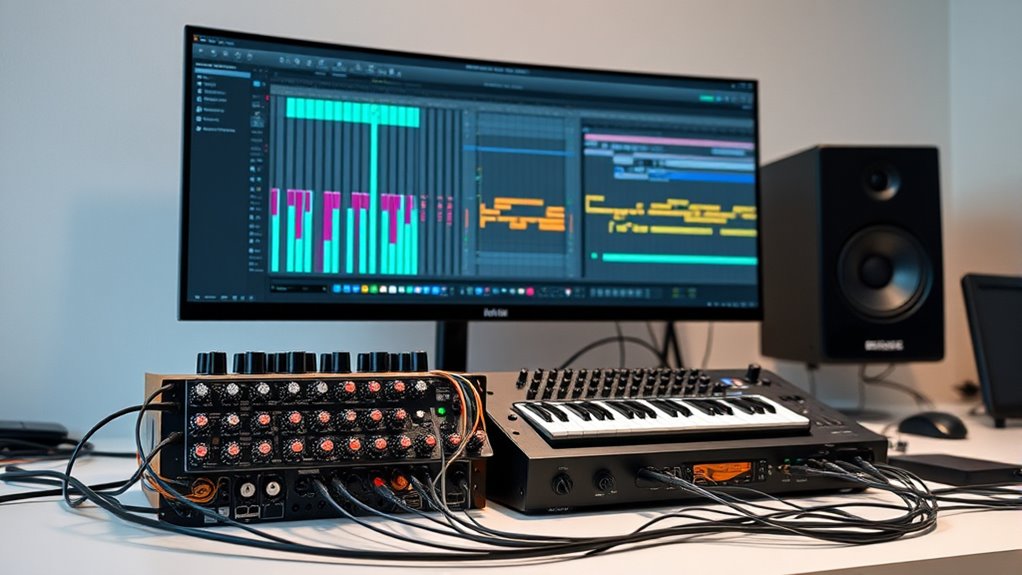
Modular gear has revolutionized the way you approach studio setup and sound design, offering unparalleled flexibility and customization. When integrating Eurorack modules into your digital audio workstation (DAW), organizing your patch bay becomes essential. A well-structured patch bay helps you keep track of complex signal paths and prevents accidental cable swaps that could disrupt your workflow. You should consider labeling each connection clearly and grouping related modules together. This not only speeds up your patching process but also minimizes confusion during live sessions or intricate sound design tasks. Using color-coded cables or dedicated patch points can further streamline your setup, making it easier to recall specific patches later. Proper organization guarantees you spend less time troubleshooting and more time creating. Additionally, regularly reviewing your system layout can help identify potential bottlenecks or inefficiencies in your setup. Power supply considerations are equally critical. Eurorack modules draw varying amounts of power, and your system’s stability depends on providing a clean, reliable source. You’ll want to invest in a high-quality power supply capable of handling your current load with some headroom to accommodate future expansions. Ensure that your power distribution is well-filtered to minimize noise and prevent interference from affecting your audio quality. It’s wise to check each module’s power requirements beforehand and allocate power accordingly, avoiding overloading specific rails. Using power supplies with multiple, isolated channels can greatly reduce ground loop issues and humming sounds. Proper power management also prolongs the lifespan of your modules and preserves signal integrity. When setting up your studio, don’t overlook the importance of cable management in relation to your power supply. Keep power cables separate from audio and patch cables to prevent unwanted noise coupling. Routing cables neatly not only improves aesthetics but also makes troubleshooting easier if issues arise. Modular gear‘s flexibility means you can change configurations often, so designing a scalable power and patch organization from the start prevents headaches down the line. Remember that a stable, clean power source paired with an intuitive patch bay layout creates a more reliable and inspiring environment for your creative process. By paying careful attention to these aspects, you’ll open the full potential of your Eurorack modules and seamlessly integrate them into your DAW workflow, elevating your sound design and production capabilities to new heights.
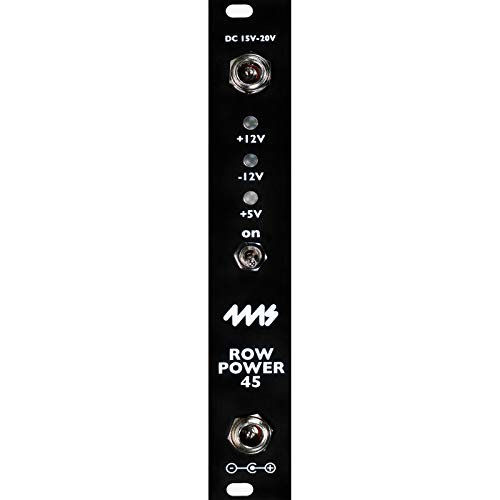
4MS Row Power 45 Power Solution for Eurorack Systems – Black
- Daisy-Chaining Power Jacks: Connect multiple units easily
- Independent Power Switch: Cuts power without disrupting chain
- High Power Output: Supports three rows of modules
As an affiliate, we earn on qualifying purchases.
As an affiliate, we earn on qualifying purchases.
Frequently Asked Questions
How Do I Choose the Right Eurorack Modules for My Genre?
To choose the right Eurorack modules for your genre, focus on creating genre-specific sounds that fit your style. Consider modules that offer the textures, filters, or modulation options unique to your music. Also, verify module compatibility with your existing setup to guarantee smooth integration. Experiment with different modules to find those that inspire your creativity and help you achieve the sound you’re after.
What Are the Best Power Solutions for a Eurorack Setup?
Think of your Eurorack as a thriving city, needing reliable roads and traffic signals. Your best power solutions are like a solid power distribution system paired with precise voltage regulation, ensuring all modules get clean, stable energy. Use a dedicated power supply with sufficient current capacity, and consider power modules with built-in protections. This keeps your setup running smoothly, preventing crashes and noise, so your musical city stays vibrant and healthy.
Can Eurorack Modules Be Used With Software Synthesizers?
Yes, you can use Eurorack modules with software synthesizers through CV compatibility and MIDI integration. Many modules offer CV outputs that can control virtual instruments in your DAW. Additionally, MIDI-to-CV interfaces let you sync your hardware with software synths, enabling seamless integration. This setup allows you to combine the tactile control of Eurorack with the versatility of software, expanding your creative possibilities.
How Do I Troubleshoot Signal Issues Between Hardware and DAWS?
Pinpoint potential problems quickly by checking your connections first. You’ll want to troubleshoot audio interface issues by ensuring cables are secure and drivers are updated. For MIDI signal issues, verify proper routing and settings within your DAW. Double-check your hardware’s input/output configurations, reset devices if needed, and test with different cables. Staying systematic helps you solve signal snags swiftly, ensuring your hardware and DAW harmonize perfectly for seamless sound.
What Are Cost-Effective Ways to Expand My Modular System?
You can expand your modular system affordably by building DIY cases, which saves money and lets you customize your setup. Look for used modules on online marketplaces—they’re often in good condition and much cheaper than new ones. Mixing new and used gear helps you grow your system without breaking the bank. Keep an eye out for sales and bundle deals to get more modules and case options at lower prices.
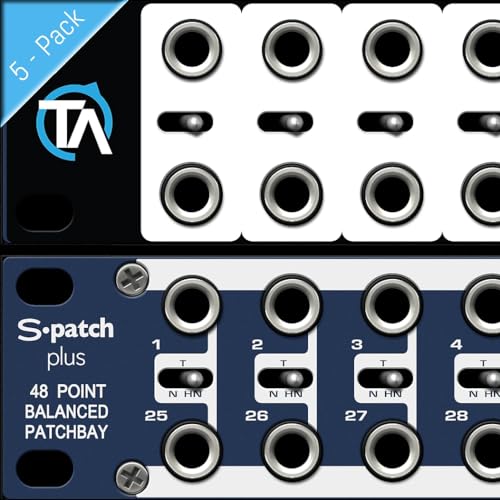
Trace Audio Write-Your-Own Patchbay Label Compatible with Samson S-Patch Plus Patchbays (5-Pack)
- Easy to Apply: Peel and stick to patchbay
- Write On: Use fine tip marker for labeling
- Erasable: Remove markings with alcohol and cloth
As an affiliate, we earn on qualifying purchases.
As an affiliate, we earn on qualifying purchases.
Conclusion
By weaving modular gear into your DAW setup, you open a portal to endless sonic adventures. Think of your studio as a garden, where Eurorack modules are vibrant flowers blooming with unique sounds. With each patch, you’re planting seeds of creativity that grow into lush, intricate landscapes. Embrace this fusion, and let your music flow like a river—dynamic, unpredictable, and alive with possibility. The journey into modular mastery is your next great musical voyage.

Behringer CM1A High-Resolution 16-Bit MIDI to CV Converter Module for Eurorack
- MIDI to CV Conversion: Converts MIDI signals to control voltages
- High-Resolution DAC: 16-Bit Texas Instruments DAC for accuracy
- Versatile Control: Supports MIDI keyboard, sequencer, or DAW
As an affiliate, we earn on qualifying purchases.
As an affiliate, we earn on qualifying purchases.
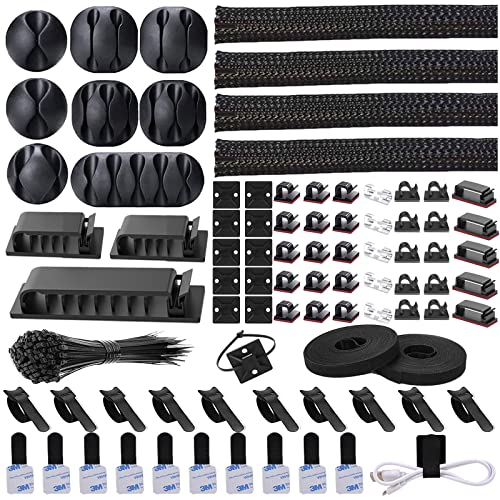
N NOROCME 192 PCS Cable Management Kit 4 Wire Organizer Sleeve
- Complete Cable Management Kit: Includes sleeves, ties, clips, and mounts
- Various Cable Clips: 6 types, eco-friendly, strong, multi-surface use
- Durable Materials: Sturdy, long-lasting components for clutter-free organization
As an affiliate, we earn on qualifying purchases.
As an affiliate, we earn on qualifying purchases.