
Effective sound design in VR and AR makes your experience more immersive and believable. You’ll want to use spatial audio to position sounds accurately in 3D space, helping users navigate and interact naturally. By matching sounds with visual cues and considering environmental effects, you’ll create a realistic world that responds to head movements. paying attention to details like volume and reverberation enhances authenticity, drawing users deeper into your virtual space. Keep exploring to discover how sound elevates digital worlds.
Key Takeaways
- Use spatial audio to accurately position sounds in 3D space, enhancing immersion and realism.
- Incorporate environmental effects like reverb and echoes to create authentic auditory experiences.
- Ensure sound cues naturally align with visual elements to guide user navigation and interaction effectively.
- Balance sound source volume and distance to reflect real-world perception, making sounds feel close or distant appropriately.
- Design sounds that respond dynamically to user movements, maintaining spatial consistency and presence.
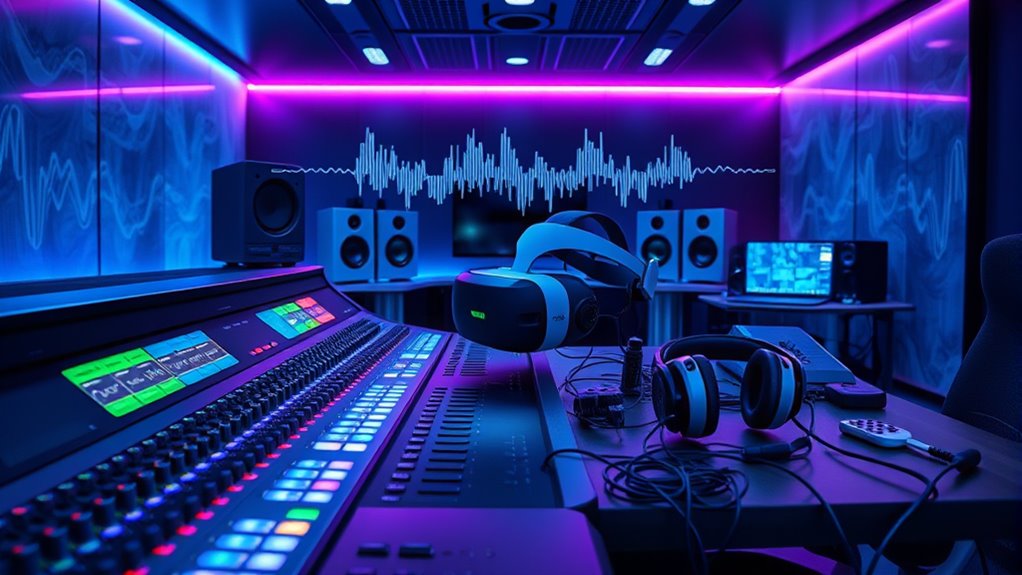
Sound design plays a crucial role in creating immersive and believable VR and AR experiences, as it helps users feel truly present within digital environments. When you step into a virtual world, your sense of spatial awareness hinges heavily on how sound is crafted and delivered. Spatial audio isn’t just background noise; it’s a powerful tool that positions sounds accurately in three-dimensional space, making your interactions feel natural and intuitive. For example, if you turn your head, the sounds around you should shift accordingly, providing a seamless sense of depth and direction. This technology enhances immersive environments by aligning audio cues with visual elements, so you’re not just watching a scene—you’re living it.
In VR and AR, sound isn’t an afterthought; it’s a core component that shapes perception and interaction. When you hear footsteps approaching from your left, you instinctively turn your head, preparing for what’s next. Properly designed spatial audio guides your attention and informs your actions without the need for visual prompts. This creates a more intuitive experience, where sounds act as environmental cues—be it the distant hum of machinery, the rustling of leaves, or a character’s voice echoing from a specific direction. The precise placement of these sounds heightens the realism and helps you navigate complex virtual worlds confidently.
Designing effective sound for immersive environments requires attention to detail and understanding of how humans perceive sound in three dimensions. You need to contemplate how sound interacts with space, materials, and distance. For instance, a sound source close to you should be loud and clear, while distant sounds should be muffled and faint. Incorporating environmental effects—like reverb or echoes—further enhances authenticity, making the experience more convincing. When you’re immersed in a virtual forest, for example, the way sounds bounce off trees and echo in the distance adds layers of realism that draw you deeper into the environment. Understanding sound perception is essential for creating truly convincing audio experiences.
Ultimately, the goal of sound design in VR and AR is to blur the line between digital and physical worlds. By leveraging spatial audio and creating rich, responsive environments, you can feel genuinely present in a virtual space. When done well, sound becomes an invisible guide, enriching your experience and making virtual interactions as natural and engaging as real life. It’s this attention to auditory detail that transforms a good VR or AR experience into a truly memorable one.
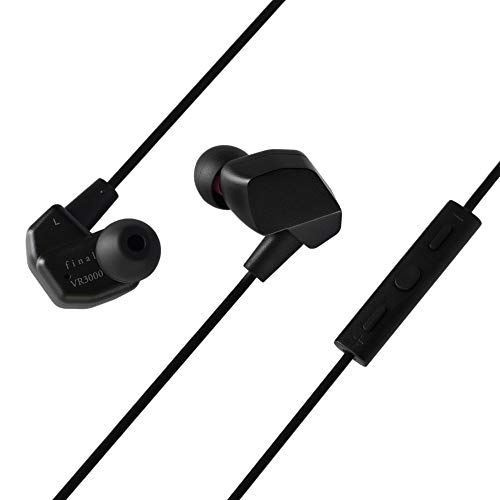
Final VR3000 Gaming Earphones for Immersive Spacious Experience – Open World Adventure, Virtual Reality & Spatial Environments – in-Line Microphone and Controls – Black
SPATIAL GAMING SOUND: VR3000 gaming earphones provide an immersive and open sound experience – ideal for exploring large…
As an affiliate, we earn on qualifying purchases.
As an affiliate, we earn on qualifying purchases.
Frequently Asked Questions
How Does Spatial Audio Enhance Immersion in VR and AR?
Spatial audio enhances immersion in VR and AR by providing accurate spatial cues through binaural audio, making sounds feel like they’re coming from specific directions and distances around you. This realism helps you perceive your environment more naturally, heightening your sense of presence. When you experience sounds that respond dynamically to your head movements, it reinforces the illusion of being inside the virtual or augmented world, making your experience more engaging and believable.
What Tools Are Best for Creating 3D Sound Environments?
Imagine crafting a vivid sonic landscape; the best tools for this are binaural techniques and soundfield microphones. Binaural recording captures your environment’s nuances like an audio camera, while soundfield microphones create immersive 3D soundscapes that surround your listeners. These tools allow you to sculpt realistic, enveloping sound environments, making your virtual worlds feel alive. Immerse yourself in these technologies to bring your spatial audio to new heights and captivate your audience.
How Can Sound Design Influence User Emotions in Vr/Ar?
You can influence user emotions in VR and AR by crafting emotional resonance through strategic sound design. Use auditory cues like subtle ambient sounds or dynamic shifts to evoke feelings such as calmness, excitement, or tension. By aligning sounds with visual cues and environment changes, you deepen immersion and foster emotional connections, making experiences more memorable and impactful. Thoughtful sound design guides users’ emotional responses naturally and effectively.
What Are Common Challenges in Vr/Ar Sound Synchronization?
You face common challenges in VR/AR sound synchronization, like latency issues and hardware limitations. Latency can cause audio to lag behind visuals, breaking immersion. Hardware constraints, such as processing power and headphones, can restrict how precisely sounds are synchronized. To overcome these, optimize your audio pipeline, use low-latency audio interfaces, and test across different devices. Prioritizing these fixes guarantees a seamless, immersive experience for users.
How Does User Movement Affect Sound Perception in Immersive Experiences?
When you move in an immersive experience, your perception of sound changes based on your position and orientation. Haptic feedback enhances this by providing physical cues that complement auditory cues, making the environment feel more real. Your movement influences how sound sources are perceived, so accurate spatial audio and dynamic sound adaptation are essential for maintaining immersion and ensuring you experience realistic, synchronized sound from all directions.

Corsair HS65 Surround Multiplatform Wired Gaming Headset – Dolby Atmos – SonarWorks SoundID – iCUE Compatible – PC, Mac, PS5, PS4, Xbox, Nintendo Switch, Mobile – Carbon
Hours of Comfortable Gaming: Leatherette memory foam ear cups with soft fabric, a mesh grill ear cup design,…
As an affiliate, we earn on qualifying purchases.
As an affiliate, we earn on qualifying purchases.
Conclusion
By mastering immersive sound design, you can truly bring VR and AR experiences to life. Imagine guiding users through a haunted house, where footsteps, whispering voices, and eerie sounds react dynamically to their movements. This creates a sense of realism and emotional connection. When you carefully craft these soundscapes, you’re not just enhancing the experience—you’re transporting users to a whole new world, making every moment unforgettable and deeply engaging.

Bionik Mantis Attachable VR Headphones: Compatible with PlayStation VR, Adjustable Design, Connects Directly to PSVR, Hi-Fi Sound, Sleek Design, Easy Installation
Compatible with PlayStation VR – Designed to match the look and feel of PSVR headset
As an affiliate, we earn on qualifying purchases.
As an affiliate, we earn on qualifying purchases.

Walrus Audio Fundamental Series Ambient Reverb
The Ambient Reverb comes in a black finish with blue and off-white ink.
As an affiliate, we earn on qualifying purchases.
As an affiliate, we earn on qualifying purchases.