
Immersive sound and spatial audio create realistic 3D soundscapes that surround you with multi-dimensional environments. Using techniques like binaural recording and holographic audio, these methods mimic natural hearing cues, making sounds seem to come from specific directions and distances. This deep sense of presence enhances emotional and sensory engagement, making you feel more connected to the scene. Keep exploring to learn how these advanced audio techniques transform your auditory experiences.
Listen free for 30 days with Audible
Thousands of audiobooks and originals — cancel anytime.
As an affiliate, we earn on qualifying purchases.
Key Takeaways
- Combining binaural and holographic audio techniques creates realistic, multi-dimensional sound environments that enhance immersion.
- Accurate spatial positioning uses auditory cues to simulate depth, distance, and directional sound for a convincing 3D experience.
- Binaural recordings mimic natural ear perception, allowing precise localization of sounds when listened through headphones.
- Dynamic holographic audio responds to head movements, maintaining consistent sound source positions in virtual spaces.
- Building immersive soundscapes increases emotional engagement and makes users feel present within the environment.
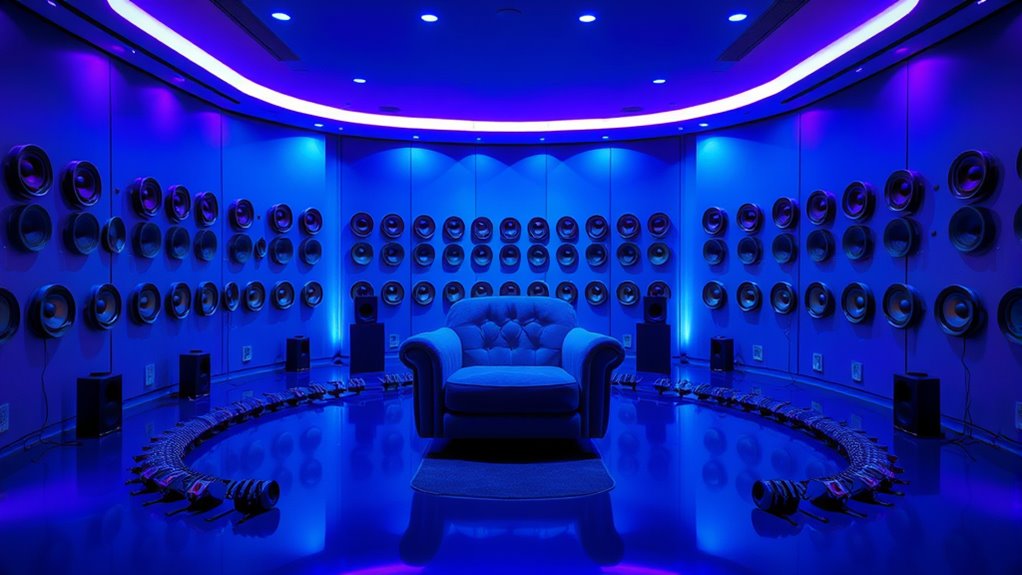
Have you ever wondered what it would be like to immerse yourself in a sound environment that surrounds you from every direction? 3D soundscapes make this possible by creating a rich, multi-dimensional auditory experience that tricks your brain into feeling as if you’re right there in the scene. This immersive quality is achieved through advanced audio techniques like binaural techniques and holographic audio, which work together to craft lifelike sound environments. Binaural techniques, in particular, mimic the way our ears naturally perceive sound. When you listen through headphones, binaural recordings use two microphones placed at ear distance, capturing subtle cues like time differences and sound intensity differences. These cues allow your brain to localize sounds accurately, creating a convincing three-dimensional space. When you wear headphones, binaural audio can make sounds seem to come from specific directions—above, below, behind, or in front of you—enhancing the sense of presence and realism. Additionally, precise spatial positioning is essential for achieving these effects, leveraging accurate spatial cues to enhance immersion.
Holographic audio takes this a step further by constructing soundscapes that seem to exist in a three-dimensional space, not just on a flat plane. It employs sophisticated algorithms and spatial processing to produce a virtual sound environment that responds dynamically to your head movements, adding a layer of realism often missing from traditional stereo or surround sound. When you turn your head, holographic audio adjusts in real-time, maintaining the illusion that sounds are coming from fixed points in space. This creates an experience that’s remarkably similar to how you perceive sound in the real world, making it ideal for applications like virtual reality, gaming, and immersive storytelling.
Both binaural techniques and holographic audio rely heavily on precise spatial positioning and sound design. The goal is to trick your brain into perceiving depth, distance, and directionality, transforming a simple audio track into an engaging environment. Whether you’re exploring a serene forest or steering through a bustling city street, these technologies help you feel more connected to the scene. As you listen, your brain synthesizes the auditory cues to produce a vivid, three-dimensional perception of your surroundings. This immersive quality intensifies emotional engagement, making experiences more memorable and authentic. By combining binaural techniques with holographic audio, creators can craft soundscapes that are not only realistic but also deeply immersive, inviting you to step inside the sound and feel truly surrounded by it.
binaural headphones for immersive sound
As an affiliate, we earn on qualifying purchases.
As an affiliate, we earn on qualifying purchases.
Frequently Asked Questions
How Does Spatial Audio Enhance Virtual Reality Experiences?
Spatial audio enhances your virtual reality experience by creating a realistic sense of space around you. Using binaural recording, it captures sound as your ears perceive it, making it feel authentic. Head tracking technology adjusts the audio as you move, maintaining accurate sound positioning. This immersive approach makes you feel truly part of the environment, heightening immersion and engagement in the virtual world.
What Are the Main Challenges in Creating Realistic 3D Soundscapes?
Creating realistic 3D soundscapes faces challenges like technological limitations and listener perception. You might think advanced hardware guarantees perfect sound, but technical constraints can hinder accuracy. Additionally, individual perception varies, making it hard to achieve a universal experience. You need precise spatial algorithms and high-quality data to mimic real-world acoustics, but these demands often clash with hardware capabilities and subjective hearing differences, complicating the process of building authentic 3D sound environments.
How Does Immersive Sound Impact Listener Emotion and Engagement?
Immersive sound deeply impacts your emotions and engagement by creating emotional resonance and pulling you into the experience. When you feel fully immersed, your brain responds more strongly to the sounds, enhancing feelings like excitement, fear, or calm. This heightened listener immersion makes the experience more memorable and meaningful, allowing you to connect on a visceral level. Ultimately, immersive sound transforms passive listening into an emotionally powerful journey.
What Equipment Is Necessary for Producing High-Quality Spatial Audio?
To produce high-quality spatial audio, you need specialized equipment like binaural microphones for capturing 3D soundscapes and headphones with proper calibration. Headphone calibration guarantees accurate sound positioning, making the experience immersive. Binaural microphones replicate human hearing, providing realistic spatial cues. Using these tools, you can create detailed, lifelike audio environments that fully engage your listeners. Proper setup and calibration are essential for achieving professional, high-quality spatial audio recordings.
Can 3D Soundscapes Be Personalized for Individual Listeners?
Imagine your soundscape as a tailored suit, perfectly fitting your unique ears. Yes, 3D soundscapes can be personalized using advanced techniques like listener profiling and customization algorithms. These personalization techniques analyze your preferences, hearing profile, and environment, shaping the audio to respond to your movements and mood. This creates a deeply immersive experience, making every note feel like it’s crafted just for you, transforming sound into a personal symphony.
As an affiliate, we earn on qualifying purchases.
Conclusion
As you step into the world of immersive sound and spatial audio, you’re opening a doorway to a universe where every sound is a brushstroke on a 3D canvas. With these technologies, you’re not just hearing; you’re truly experiencing a symphony of space and depth. Think of it as weaving an intricate tapestry of sound around you, transforming ordinary listening into a mesmerizing journey. Embrace this evolution, and let your senses explore the endless horizons of soundscapes.
spatial audio virtual reality headset
As an affiliate, we earn on qualifying purchases.
As an affiliate, we earn on qualifying purchases.
As an affiliate, we earn on qualifying purchases.
Fall yard work Picks
leaf blowers
As an affiliate, we earn on qualifying purchases.