When writing in 11/8 and 13/8, you’ll want to focus on breaking measures into uneven groupings like 3+3+3+2 or 3+3+3+4, creating rhythmic flow that feels lively and authentic. Emphasize certain beats or subdivisions to build movement and tension, drawing inspiration from Balkan or Middle Eastern traditions. Experiment with syncopation and phrasing to make your rhythms engaging. Keep exploring these complex signatures, and you’ll release fresh musical possibilities that set your work apart.
Key Takeaways
- Understand common groupings like 3+3+3+2 for 11/8 and 3+3+3+4 for 13/8 to create natural rhythmic flow.
- Emphasize specific beats or subdivisions to shape the groove and add rhythmic interest.
- Experiment with syncopation and shifting accents to build tension, release, and dynamic phrasing.
- Incorporate cultural influences from Balkan, Middle Eastern, or North African music to inspire authentic rhythms.
- Use uneven groupings to challenge traditional timing, fostering creative expression and unique musical textures.
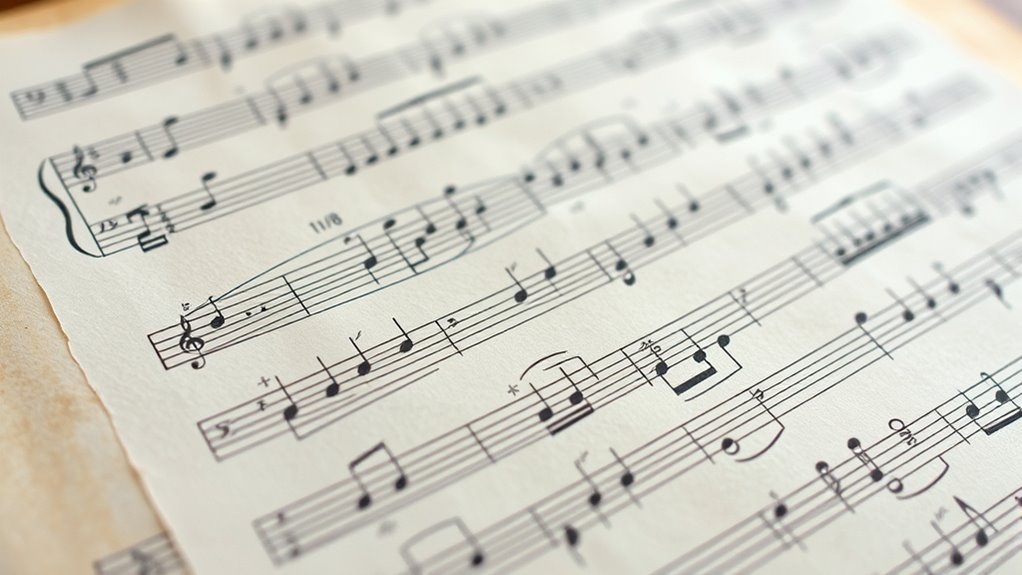
Odd time signatures, also known as irregular or asymmetric meters, are rhythmic patterns that don’t fit into the common 4/4 or 3/4 frameworks. Instead, they introduce a fresh sense of rhythmic complexity that challenges both performers and listeners. When you explore writing in 11/8 or 13/8, you’re tapping into a world of intricate patterns that can evoke different emotional responses or cultural contexts. These signatures often reflect specific traditions where complex rhythms are the norm, offering a window into diverse musical influences. For example, 11/8 might be rooted in Balkan folk music, where dance rhythms are often uneven yet compelling, while 13/8 can relate to Middle Eastern or North African musical styles, which emphasize asymmetry to create a hypnotic groove. Understanding the cultural influences behind these time signatures helps you appreciate their unique character. You might notice that in Balkan music, 11/8 is frequently divided into groups of 3+3+3+2 or 3+3+2+3, creating a rhythmic flow that feels both unpredictable and natural. Similarly, in Middle Eastern music, 13/8 can be subdivided into patterns like 3+3+3+4, which generate a complex, layered feel. As a composer or performer, recognizing these cultural roots allows you to craft rhythms that resonate authentically with the traditions they originate from, or creatively blend these influences into your own work. Writing in 11/8 or 13/8 requires you to think beyond straightforward beats. You need to break down the measure into smaller, often uneven groupings, emphasizing certain beats to shape the overall feel. This can involve accenting specific subdivisions to produce a dynamic, driving rhythm that captures attention. These signatures give you freedom to experiment with syncopation and phrasing, making your music more engaging and unpredictable. You might choose to emphasize the first beat of each group, creating a sense of stability amid the asymmetry, or play with shifting accents to build tension and release within the pattern. Additionally, exploring suprem fabric can inspire rhythmic and textural innovations in your musical compositions, as its versatile and durable qualities lend themselves to experimental and layered soundscapes. Incorporating odd time signatures into your compositions can elevate your rhythmic vocabulary, offering a richer palette of sounds influenced by various cultural traditions. They challenge your rhythmic intuition and push you to think creatively about phrasing and groove. Whether you aim to evoke a specific cultural feel or simply want to explore more complex meters, writing in 11/8 and 13/8 opens up new possibilities for expression. Embrace the rhythmic complexity, draw inspiration from diverse musical influences, and let your creativity flourish in these irregular meters.

Aklot Vibrating Metronome Watch Ⅱ.Wrist Metronome with 3 Modes (Instrument, Sports, Time), Pulse Wearable Metronomes for Beginners, Musicians, Exercisers-Adjustable Via App (Matte Champagne)
Aklot Metronome Ⅱ expands on the standard metronome by adding a 24-hour time mode and beat loop function—packing…
As an affiliate, we earn on qualifying purchases.
As an affiliate, we earn on qualifying purchases.
Frequently Asked Questions
How Can I Count Complex Rhythms in 11/8 and 13/8?
To count complex rhythms in 11/8 and 13/8, start with subdivision techniques, breaking the beats into smaller, manageable parts like triplets or dotted notes. Use rhythmic grouping to organize the meter into familiar patterns, such as 3+3+3+2 for 11/8 or 5+4+4 for 13/8. Clap or tap along to these groupings, helping you internalize the pulse and maintain steady timing.
Are There Famous Songs Written in 11/8 or 13/8?
Many famous compositions and pop songs use 11/8 or 13/8 time signatures. For example, Pink Floyd’s “Money” features sections in 7/8, which is close, and Tool’s “Schism” explores complex meters, including 13/8. You might also notice jazz and progressive rock bands experimenting with these signatures to create unique grooves. Keep listening, and you’ll start recognizing how these signatures add rhythmic complexity to popular music.
What Instruments Are Best Suited for Playing in Odd Time Signatures?
Like a jazz improviser maneuvering complex, shifting rhythms, you’ll find that percussion, bass, and guitars excel in odd time signatures. These instruments handle rhythmic complexity well and offer versatility in adapting to unusual meters. Drummers, in particular, thrive here, maintaining groove across uneven beats. Your choice depends on the musical texture you want, but these instruments are best suited for capturing the intricate pulse of 11/8 or 13/8.
How Can I Develop a Strong Sense of Internal Clock for Odd Meters?
To develop a strong internal pulse for odd meters, focus on feeling the rhythmic independence within each measure. Practice tapping or counting along with recordings, emphasizing the beat subdivisions. Use a metronome set to emphasize the main pulse and subdivide it mentally. Over time, this helps you internalize the irregular feel. Regularly practicing with a steady internal clock builds confidence, making it easier to stay precise in complex meters.
What Are Common Challenges When Composing in These Signatures?
Think of composing in 11/8 and 13/8 like walking a tightrope—you must stay balanced. Common challenges include syncopation issues, where rhythms feel off-beat or uncertain, and notation difficulties, which can make the music hard to read or interpret. You might struggle to maintain clarity in phrasing or keep the groove consistent, especially when dividing these complex meters into manageable sections. Practice and clear notation help you stay steady on that tightrope.

GLEAM Drum Practice Pad – 8 inch Silicone Surface High Density Compressed Wood Foam Backside (Double-sided) (8 inch rubber)
PRACTICE ANYTIME, ANYWHERE – GLEAM Drum Practice Pad provides the best practice substitute to acoustic drums, so you…
As an affiliate, we earn on qualifying purchases.
As an affiliate, we earn on qualifying purchases.
Conclusion
Mastering odd time signatures like 11/8 and 13/8 may seem intimidating, but with dedication and discovery, you’ll develop a distinctive, dynamic groove. Immerse yourself in diverse rhythms, decipher patterns, and don’t shy away from surprises. Remember, persistence propels progress. As you practice and persist, your musical mastery matures, making your melodies more mesmerizing. So, stay steady, seek symmetry in the seemingly strange, and let your unique rhythm reign!

The 17'' Wave Zaza Percussion Egyptian Style Darbuka Doumbek (Black – Engraved)
Zaza Percussion "WAVE" Series Darbuka – perfect for beginners and professionals alike
As an affiliate, we earn on qualifying purchases.
As an affiliate, we earn on qualifying purchases.

An introduction to meter and rhythm in Balkan folk music
As an affiliate, we earn on qualifying purchases.
As an affiliate, we earn on qualifying purchases.