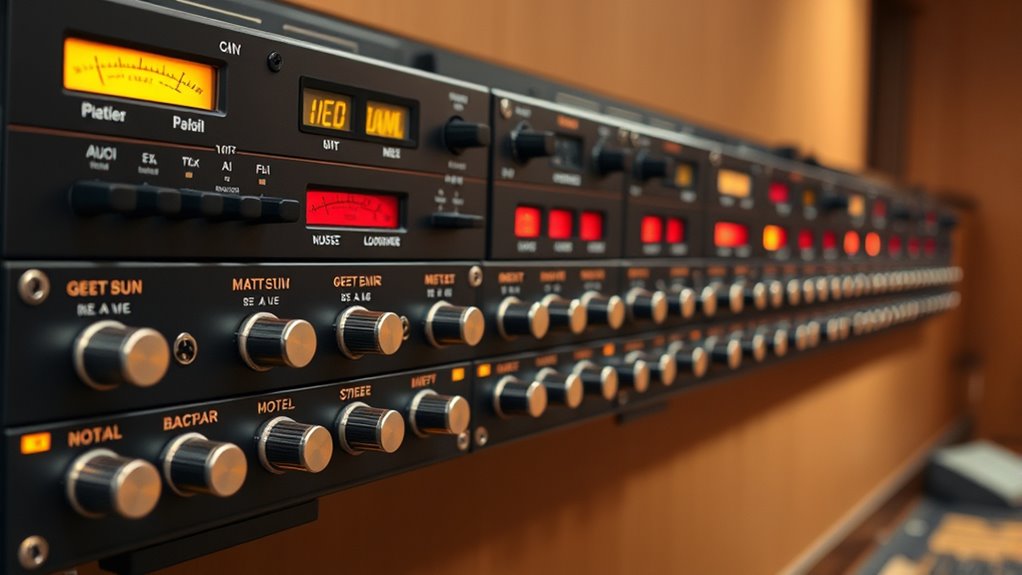

Choosing the right stereo bus compressor rack involves balancing sound quality, features, and budget. The API 2500+ stands out for its transparent, punchy tone suitable for professional mixes. The Heritage Successor offers authentic vintage vibe with modern flexibility, though it comes at a premium and requires space. Meanwhile, the Behringer 369 delivers versatile compression in a compact, budget-friendly package, ideal for small studios or beginners. Each has tradeoffs: high-end models offer nuanced control and tonal richness at a cost and size, while Behringer prioritizes affordability and simplicity. Here’s a detailed look at what makes each unique and who they’ll serve best.

Get audio and creator gear delivered free — and shop member deals
- Fast, free delivery on millions of items
- Access to Prime Big Deal Days deals on October 6–7
- Prime Video, Amazon Music and more included
Complete the kit


Key Takeaways
- The API 2500+ excels in transparent, musical compression suitable for professional mix buses.
- Heritage Successor provides authentic vintage British tone with advanced features but is larger and more costly.
- Behringer 369 offers flexible controls in a compact, affordable form, ideal for smaller setups or newcomers.
- Tradeoffs include complexity and price for high-end models versus simplicity and limited features on budget options.
- Your choice depends on your studio size, budget, experience level, and tonal preference.
| API 2500+ Stereo Bus Compressor |  | Best Overall for Professional Mixing | Application: Stereo bus compression | Controls: Attack, release, ratio, threshold | Design: Feed-forward detection circuit | VIEW ON AMAZON | See Our Full Breakdown |
| Successor Stereo Bus Compressor |  | Best for Vintage British Tone with Modern Flexibility | Audio Output Effects: Compression | Controls: Stepped, sidechain filter options | Type: Analog | VIEW ON AMAZON | See Our Full Breakdown |
| Behringer 369 2-Channel Rackmount Stereo Compressor |  | Best Budget-Friendly for Small Studios | Number of Channels: 2 | Rack Units: 2U | Transformers: Custom Midas | VIEW ON AMAZON | See Our Full Breakdown |
| stereo bus compressors rack | Controls | Transformers |
|---|---|---|
| API 2500+ Stereo Bus Compresso | Attack, release, ratio, threshold | — |
| Successor Stereo Bus Compresso | Stepped, sidechain filter options | Carnhill |
| Behringer 369 2-Channel Rackmo | — | Custom Midas |
More Details on Our Top Picks
API 2500+ Stereo Bus Compressor
The API 2500+ stands out for its ability to deliver transparent, punchy compression with a classic API circuitry tone. Its versatile controls — including attack, release, ratio, and threshold — enable precise dynamic shaping, making it a favorite in professional studios. Compared with the Heritage Successor, it offers a more transparent, less colored sound, which is ideal for those who want their mix to breathe naturally. However, this complexity can be overwhelming for beginners, and its studio-grade build comes with a higher price tag. Still, if you need a reliable, high-quality compressor that handles a variety of mix scenarios, this pick is hard to beat.
Pros:- Delivers smooth, transparent compression ideal for mix buses
- Features classic API circuitry for a punchy, musical tone
- Versatile controls for precise dynamic shaping
- Built to professional studio standards
Cons:- May be complex for beginners to operate
- Designed primarily for professional use, possibly overkill for casual users
Best for: Professional engineers and serious hobbyists seeking transparent, musical bus compression.
Not ideal for: Beginners or users on a tight budget who prefer simplicity over precision.
- Application:Stereo bus compression
- Controls:Attack, release, ratio, threshold
- Design:Feed-forward detection circuit
- Build:Professional rack-mount standards
Our verdict“A studio-grade compressor that excels in transparency and musicality, best suited for experienced users.”
Successor Stereo Bus Compressor
The Successor Stereo Bus Compressor offers a compelling blend of vintage British diode-bridge character with modern features like stepped controls and sidechain filtering. Its true stereo operation and Carnhill transformers contribute to a warm, musical sound that appeals to those seeking authentic coloration. Compared to the API 2500+, it adds more tonal coloration, making it perfect for adding vibe to a mix. However, its size and weight can pose installation challenges, and its control scheme may be intimidating for beginners. Still, for users craving that classic British tone with modern versatility, this unit delivers on both fronts.
Pros:- Authentic vintage British diode-bridge sound
- True stereo operation with matched gain cells
- Flexible attack and release times for creative control
- High-quality Carnhill transformers and Class A circuitry
Cons:- Very heavy and large, requiring dedicated space
- Potentially complex controls for new users
- High cost for premium features
Best for: Mix engineers wanting vintage warmth and character in their bus compression.
Not ideal for: Beginners or those needing a compact, straightforward compressor.
- Audio Output Effects:Compression
- Controls:Stepped, sidechain filter options
- Type:Analog
- Style:Classic
- Transformers:Carnhill
Our verdict“Ideal for those seeking a vintage tone with modern control and high-quality build, provided space and budget are available.”
Behringer 369 2-Channel Rackmount Stereo Compressor
The Behringer 369 offers a surprisingly flexible stereo compression solution in just 2U of rack space. Its dual-mono operation allows for independent control of each channel, yet it functions well as a stereo compressor overall. The inclusion of custom Midas transformers elevates its sound quality beyond typical budget gear, and the variable attack and multiple ratios provide ample control. Compared to the high-end units, it might lack some tonal nuance and advanced features like sidechain filtering, but it compensates with affordability and ease of use. It makes an excellent choice for smaller studios or those just starting out, though it’s limited in some professional features.
Pros:- Compact 2U rackmount design
- High-quality Midas transformers for rich sound
- Flexible control with variable attack and five ratios
Cons:- Limited to stereo operation, no multichannel capability
- Requires rack space in small setups
- Lacks digital connectivity options
Best for: Small studios, beginners, or anyone needing a compact, versatile stereo compressor at a reasonable price.
Not ideal for: Users seeking maximum tonal coloration or advanced control options in a single unit.
- Number of Channels:2
- Rack Units:2U
- Transformers:Custom Midas
- Remote Control Port:15-pin
- Compression Ratios:5
Our verdict“A practical, affordable compressor that packs versatility and quality into a small footprint, perfect for budget-conscious studios.”

How We Picked
Our selection process focused on key factors like sound quality, build quality, versatility, and value for money. We compared technical features such as controls, I/O options, and sonic characteristics. Each product was evaluated for its suitability in typical stereo bus applications, considering user experience, professional standards, and overall flexibility. We aimed to include options that span from high-end studio-grade gear to budget-friendly alternatives, ensuring a balanced perspective for different user needs.
| stereo bus compressors rack | Controls | Transformers |
|---|---|---|
| API 2500+ Stereo Bus Compresso | Attack, release, ratio, threshold | — |
| Successor Stereo Bus Compresso | Stepped, sidechain filter options | Carnhill |
| Behringer 369 2-Channel Rackmo | — | Custom Midas |
Factors to Consider When Choosing Stereo Bus Compressors Rack
Selecting a stereo bus compressor rack depends on your studio size, budget, and the tonal character you desire. High-end options like the API 2500+ and Heritage Successor excel in transparency and vintage warmth, respectively, but come with larger footprints and higher prices. Budget-friendly models like the Behringer 369 focus on versatility and compactness, making them ideal for smaller setups or those just starting out. When choosing, consider whether you need transparent control, vintage coloration, or a balance of both, along with how much space and investment you’re willing to dedicate.Sound Quality and Tonal Character
High-end compressors like the API 2500+ are prized for their clean, transparent sound that preserves the mix’s natural dynamics. The Heritage Successor adds a warm, vintage British vibe, ideal for adding character. Budget models like the Behringer 369 deliver solid, musical compression but might lack the tonal nuance of pricier units. Your choice should reflect whether your priority is transparency, color, or a mix of both.
Controls and Features
More advanced units offer comprehensive control over attack, release, ratio, and sidechain filtering, allowing for nuanced dynamic shaping. Simpler models may rely on fixed or stepped controls, which are easier for beginners but less flexible for seasoned engineers. Determine your comfort level with complex controls versus straightforward operation before buying.
Size, Space, and Connectivity
High-end units tend to be larger and heavier, requiring dedicated space and careful installation. Budget options are often more compact and lightweight, ideal for small racks or portable setups. Connectivity options vary; professionals often need multiple I/O, while casual users might prioritize basic XLR connections and remote control features. Match your space and connectivity needs with the unit’s form factor.
Price and Value
Expect to pay a premium for studio-grade, vintage, or highly flexible units. The API 2500+ and Heritage Successor are investments in quality and tonal versatility, suited for serious studios. The Behringer 369 offers a balanced mix of features and affordability, making it appealing for budget-conscious users or small setups. Weigh your budget against your desired features to find the best value.
Frequently Asked Questions
What is the main difference between transparent and colored compression?
Transparent compression aims to control dynamics without significantly altering the tonal character of the audio, often used in professional mixing for a natural sound. Colored compression, on the other hand, adds harmonic richness or vintage vibe, which can be desirable for adding character or mojo to a track. Your choice depends on whether you want the compressor to be invisible or to add a specific tonal coloration.
Are high-end compressors worth the investment for small home studios?
High-end compressors like the API 2500+ and Heritage Successor can provide superior sound quality, durability, and tonal flexibility, making them worthwhile if your budget allows and your project demands professional-grade gear. However, for casual or hobbyist use, more affordable options like the Behringer 369 often deliver excellent results at a fraction of the cost, especially if space and features are limited.
How important are controls like sidechain filtering and attack/release times?
These controls are vital for fine-tuning how the compressor responds to your audio, enabling precise dynamic shaping. Sidechain filtering can help prevent pumping on bass-heavy mixes, while adjustable attack and release allow you to craft the transient response. If you’re working on complex mixes, these features are highly beneficial; for simple tasks, basic controls may suffice.
Can I use a stereo bus compressor for mastering?
While some stereo bus compressors are suitable for mastering, most of the gear in this roundup is optimized for mix bus use rather than final mastering. For mastering, you might prefer units with more transparent, subtle compression and additional features like metering and detailed control. These products are better suited for mixing and bus processing within a broader mastering chain.
What should I consider when choosing between rack size and space?
Rack size and space are practical considerations that depend on your studio setup. Larger units like the Heritage Successor require dedicated space and weight capacity, which might not be feasible in small or portable setups. Smaller units like the Behringer 369 can fit into compact racks easily but may lack certain features or tonal options found in larger, more expensive gear. Always measure your available space before selecting a unit to ensure proper fit and ventilation.
Conclusion
If you run a professional studio and need the highest fidelity with authentic tonal control, the API 2500+ is the best fit. For those seeking vintage warmth and character with a larger budget, the Heritage Successor offers unmatched tonal coloration. Smaller studios, beginners, or those working with limited space will appreciate the Behringer 369 for its affordability, flexibility, and compact design. Your choice should align with your studio’s size, your experience level, and your tonal goals.
Evergreen bestsellers Picks
bestsellers
As an affiliate, we earn on qualifying purchases.