Many believe that higher bit depths like 24-bit automatically mean better sound quality, but that’s not always true. While 24-bit captures more dynamic range and reduces noise, it doesn’t improve clarity or realism if your equipment and environment can’t support it fully. For most projects, 16-bit is sufficient, especially for casual listening. To understand when and why higher bit depths matter—and when they don’t—you’ll find the details worth exploring.
Key Takeaways
- Higher bit depth increases dynamic range but often offers negligible audible improvements in typical listening environments.
- 24-bit recordings create larger files without necessarily enhancing perceived sound clarity.
- Actual sound quality depends on recording techniques and playback equipment, not just bit depth.
- Human hearing limits mean differences between 16-bit and 24-bit are often inaudible.
- Overemphasizing bit depth can distract from focusing on overall sound quality and recording environment.

PIYONE Audio Interface, 2X2 24-bit/192kHz Interface for High-Fidelity, Studio Quality PC/Mac/iOS Recording, XLR/TRS Combo Input, Monitor Mix/Loopback Function, One-Cable Setup(Alloy Red)
PIYONE Plug-and-Play USB C Audio Interface. Experience seamless connectivity with this class-compliant audio interface for Mac and PC….
As an affiliate, we earn on qualifying purchases.
As an affiliate, we earn on qualifying purchases.
Understanding Bit Depth and Its Impact on Audio Quality
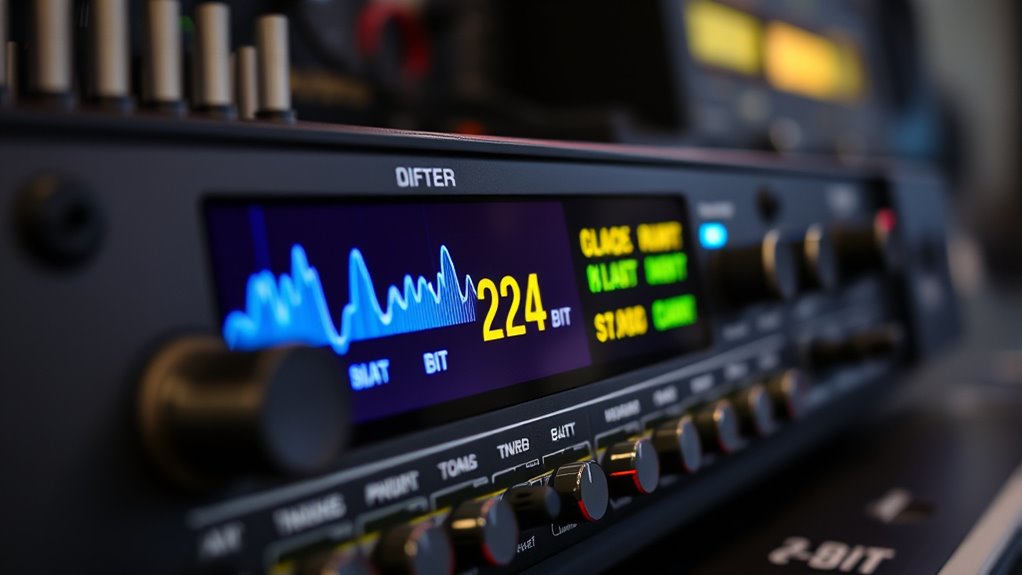
Understanding bit depth is essential because it directly affects the quality of your audio recordings. Bit depth determines how many individual levels your audio can capture for each sample. The higher the bit depth, the more accurately your recording reflects subtle nuances in sound. For example, 16-bit audio offers 65,536 levels, while 24-bit provides over 16 million levels. This means 24-bit can capture more detail, especially in quiet sounds or dynamic passages. However, simply increasing bit depth doesn’t always improve perceived sound quality. It also impacts file size and processing requirements. Knowing how bit depth influences your recordings helps you make informed decisions about recording settings, ensuring your audio maintains clarity without unnecessary data bloat. Additionally, understanding dog breed traits can be useful if you’re recording or producing content involving specific breeds to capture their unique sounds and characteristics accurately. Recognizing the limitations of high bit depth can help prevent unnecessary storage and processing burdens when lower bit depths suffice for your needs.

PQRQP Wireless Mini Microphone for iPhone/iPad/Android: 2 Pack Lavalier Microphone for Video Recording, High-Fidelity Audio iPhone Mic for Content Creators(Graphite Black)
Professional Clear Audio: PQRQP professional wireless microphone with a design delivers high-quality, noise-reduced audio. Utilizing stable 2.4GHz transmission,…
As an affiliate, we earn on qualifying purchases.
As an affiliate, we earn on qualifying purchases.
The Myth of Superior Sound With Higher Bit Depths
Many believe that higher bit depths automatically mean better sound quality, but that’s not always true. Increasing bit depth doesn’t guarantee clearer audio, especially beyond a certain point where gains become minimal. In real listening situations, practical differences are often negligible compared to the technical improvements suggested by specs. Moreover, AI security vulnerabilities highlight that technical perfection doesn’t necessarily translate to safe or trustworthy systems. Additionally, factors like audio processing and playback equipment have a more significant impact on perceived sound quality than bit depth alone. Recognizing the individual variability in listener preferences is also crucial, as what sounds better to one person may not to another. Understanding the personal development principles behind technology choices can help manage expectations and improve overall satisfaction.
Higher Bit Depth Doesn’t Guarantee Clarity
While increasing bit depth can capture more detailed audio data, it doesn’t automatically mean you’ll hear clearer sound. Higher bit depths reduce quantization noise and improve accuracy, but they don’t enhance the inherent clarity of your audio. Clarity depends on factors like recording quality, microphone placement, and playback equipment. If your source material is flawed or compressed, a higher bit depth won’t fix those issues. Additionally, the human ear has limits; beyond a certain point, increased bit depth offers no perceptible improvement. Simply put, more bits don’t translate into better sound quality unless the original recording and playback systems support that level of detail. Bit depth limitations can prevent the perceived benefits of higher resolution audio. Don’t assume that bumping up bit depth alone will make your audio clearer—other elements matter just as much.
Diminishing Returns in Dynamic Range
Increasing bit depth does expand the theoretical dynamic range of your audio, but beyond a certain point, you won’t notice any real difference in sound quality. Human ears have limitations, and most listening environments don’t require the extra headroom that higher bit depths provide. For example, the difference between 16-bit and 24-bit audio is significant in theory, but in practice, the quietest sounds often fall below your hearing threshold or are masked by background noise. Pushing beyond 24-bit doesn’t translate into audible improvements. Instead, it adds complexity and file size without meaningful benefit. Ultimately, your listening experience remains unchanged because your ears can’t perceive the subtle enhancements that higher bit depths theoretically offer.
Practical Listening vs. Technical Specs
Although higher bit depths offer impressive technical specifications, they don’t necessarily translate into better sound quality during everyday listening. In real-world scenarios, your ears are less likely to notice the subtle differences that higher bit depths provide. Instead, focus on how you experience music, not just the numbers. Imagine:
- Hearing a rich, full tone during a quiet passage that feels natural and immersive
- Noticing that a well-recorded song sounds clear and detailed without needing ultra-high resolution
- Feeling the warmth and emotion of a performance without getting distracted by technical specs
- Remembering that appliance lab tests often measure technical features that don’t always align with actual listening experiences.
These aspects matter more than the bit depth on paper. The goal is to enjoy music as it was intended, not to chase impossible perfection through technical specifications alone.
![WavePad Audio Editing Software - Professional Audio and Music Editor for Anyone [Download]](https://m.media-amazon.com/images/I/B1fcLEGCs6S._SL500_.png)
WavePad Audio Editing Software – Professional Audio and Music Editor for Anyone [Download]
Full-featured professional audio and music editor that lets you record and edit music, voice and other audio recordings
As an affiliate, we earn on qualifying purchases.
As an affiliate, we earn on qualifying purchases.
When 16-Bit Is More Than Enough for Your Projects
For many projects, 16-bit depth provides all the detail and dynamic range you need. If you’re working on casual recordings, podcasts, or projects where ultimate fidelity isn’t critical, 16-bit is more than sufficient. It offers 65,536 discrete amplitude levels, which capture the nuances of most sound sources without excessive file sizes or processing demands. For typical music production, voiceovers, and streaming content, 16-bit audio maintains quality while keeping things manageable. Additionally, many consumer devices and platforms default to 16-bit audio, ensuring compatibility and ease of use. Unless you’re working in specialized fields like professional mastering or archival preservation, sticking with 16-bit saves time, storage, and complexity without sacrificing the listening experience for most audiences. Furthermore, bit depth impacts how accurately audio signals are represented, and for most applications, 16-bit provides a practical balance between quality and efficiency.

ehaon Portable Sound Card Microphone, 6 Professional Sound Modes, Noise Reduction & Sidechain, USB/Bluetooth Mic for PC/iPhone, Live Streaming, Gaming, Karaoke for Podcasters, Streamers, Gamers
6 Professional Sound Modes & Smart Audio Effects: Instantly switch between 6 preset modes for podcasting, gaming, karaoke,…
As an affiliate, we earn on qualifying purchases.
As an affiliate, we earn on qualifying purchases.
The Role of Bit Depth in Dynamic Range and Noise Floor

Bit depth directly influences both the dynamic range and the noise floor of your audio recordings. Higher bit depths allow you to capture a broader span between the loudest and softest sounds, giving your recordings more clarity and detail. They also lower the noise floor, reducing unwanted background hiss. Imagine:
- A vast mountain range, where peaks represent loud sounds and valleys, soft whispers
- A quiet room filled with subtle details that don’t get drowned out
- A clear signal, free of static and background noise, even at low volumes
With greater bit depth, you gain more headroom for dynamics and cleaner sound quality. However, beyond a certain point, increasing bit depth offers diminishing returns—especially if your recording environment isn’t perfectly controlled.
How Bit Depth Interacts With Sample Rate and Overall Sound
Your choice of bit depth and sample rate directly affects your audio’s dynamic range and noise floor. Increasing sample rate can improve sound fidelity but doesn’t extend the dynamic range set by bit depth. Understanding how these factors work together helps you optimize your recordings for the best overall sound quality.
Dynamic Range Limitations
While bit depth considerably influences the dynamic range of a digital audio signal, it doesn’t operate in isolation; instead, it interacts with sample rate and overall sound quality. You might think higher bit depth automatically means better sound, but limitations still exist. These include:
- Maximum amplitude levels that can be captured, which restricts how loud a sound can be without distortion.
- Fading details at very high or very low volumes, where the subtle nuances might get lost.
- Practical dynamic range constrained by hardware, environment, and recording techniques, meaning more bits won’t necessarily translate to clearer sound.
- Additionally, audio fidelity is affected by factors beyond bit depth, such as recording environment and playback systems, highlighting that higher bit depth alone doesn’t guarantee superior sound quality.
Sampling and Noise Floor
The relationship between sampling rate, bit depth, and overall sound quality is complex, with each factor influencing how accurately audio signals are captured and reproduced. When you increase the sample rate, you capture a broader range of frequencies, which can improve clarity. However, if your bit depth is too low, the noise floor rises, introducing unwanted hiss and reducing dynamic detail. Higher bit depths lower the noise floor, allowing for more subtle sound nuances, but only if the sampling rate is sufficient to accurately record the entire frequency spectrum. Basically, a high sample rate alone doesn’t guarantee better sound quality. It’s a balance: adequate sampling rate combined with an appropriate bit depth minimizes noise and preserves audio fidelity, ensuring your recordings sound natural and detailed.
Choosing the Right Bit Depth for Different Recording Scenarios
Choosing the right bit depth depends on the specific recording scenario and the desired balance between quality and file size. For live performances, lower bit depths like 16-bit may suffice, reducing file size while maintaining clarity. In contrast, studio recordings benefit from higher bit depths, such as 24-bit, capturing more detail and dynamic range. Consider these factors:
- Recording quiet passages where extra headroom prevents clipping
- Capturing instruments with wide dynamic ranges, like drums or vocals
- Archiving projects that may require extensive editing and processing
Frequently Asked Questions
How Does Bit Depth Affect File Size and Storage Requirements?
When you choose a higher bit depth, your audio files get larger because more data is stored per sample. This means increased storage requirements and bigger file sizes. Conversely, lower bit depths reduce file size but may sacrifice audio quality. You should balance your needs, considering whether you prioritize sound fidelity or storage efficiency, because selecting the right bit depth impacts both your audio quality and the space needed for your files.
Can Lower Bit Depths Still Produce Professional-Quality Recordings?
You can still produce professional-quality recordings with lower bit depths, especially if your goal is to capture clear, accurate sound without the need for extensive dynamic range. While higher bit depths like 24-bit offer more detail and flexibility during editing, 16-bit recordings are often sufficient for most projects, such as podcasts or demos. Focus on proper recording techniques and good equipment to guarantee your sound quality remains high.
What Are Common Misconceptions About 24-Bit Audio?
You might think 24-bit audio is the ultimate magic bullet for perfect sound, but that’s a myth. Many believe it guarantees better quality, yet it often just means more data and storage hassle. In reality, misconceptions like “more bits always mean better sound” overlook practical needs. You should choose bit depth based on your project, not hype—because sometimes, less really is more in the world of audio.
How Do Hardware Limitations Influence Optimal Bit Depth Choices?
Hardware limitations play a vital role in choosing the right bit depth for your audio. If your equipment can’t process higher bit depths accurately, you’d be better off sticking with a lower one to avoid noise and distortion. You might think that more bits always mean better sound, but if your hardware struggles, the extra detail won’t improve your audio quality. Always match your bit depth to your hardware’s capabilities for ideal results.
Is Higher Bit Depth Necessary for All Types of Audio Editing?
Did you know that most professional audio recordings are made at 24-bit, yet many casual projects are fine at 16-bit? You don’t always need higher bit depth for editing; it depends on your goals. If you’re working on simple projects or final mixes, 16-bit often suffices. Higher bit depths provide more headroom during editing, but for basic tasks, they might be unnecessary and just consume more storage.
Conclusion
Remember, higher bit depths don’t always mean better sound. In fact, 16-bit recordings offer a dynamic range of 96dB, which is sufficient for most projects, and only rarely benefits from 24-bit’s 144dB range. Overestimating the need for higher bit depths can lead to unnecessary file sizes and processing. So, choose wisely based on your recording scenario, and don’t fall for the myth that more always equals better.